When traveling through familiar places in our past, we often encounter landmarks, buildings, spaces, people, or things that remind us of certain events or times in our lives.
My mother and I one day traveled down roads and through neighborhoods we had not visited together since I was a kid. As we drove, we pointed out buildings over here and over there that held special memories. We laughed as we remembered, asking each, “Do you remember when…?” when pointing to other spaces.
It was literally our chance to drive down memory lane. Although it took us longer to reach our intended destination, the joy we experienced in traveling through these memories made it more than worthwhile.
In life, I often come upon places, things, persons, or even situations that will spark a memory in my heart, a memory of deliverance. Whatever it is that initiated that spark, the thought of “I remember when…” comes, and I cannot help but stop and thank God for the way He brought me through or stood by my side during that situation.
In the Bible, places were named and marked for various things, including those deliverance moments. In Joshua 4, stones were gathered from the midst of the Jordan by some of the men of Israel, one from each tribe, after the people crossed over on dry ground. The purpose was, “That this may be a sign among you, that when your children ask their fathers in time to come, saying, What mean ye by these stones? Then ye shall answer them, That the waters of Jordan were cut off before the ark of the covenant of the Lord; when it passed over Jordan, the waters of Jordan were cut off: and these stones shall be for a memorial unto the children of Israel for ever,” (4:6, 7).
Those stones were gathered to remember a moment of God’s deliverance on behalf of His people.
As we encounter things, people, or moments that jar a memory of God’s moving deliverance on our behalf, take a moment to thank God for where He brought you from and what He brought you through, and use that memory to reassure your heart in the faithfulness of our God today. He who has traveled with you in those moments is with you now in these moments of today.
Father God, thank You for all the times of deliverance You have provided in my life. Thank You for all the moments I can reflect and see where Your hand and power have stepped in for my cause and worked on my behalf. There are multiple times when You have kept me from seen and unseen dangers. Thank You for all of those deliverances time and time again. Thank You for Your keeping power, strength, mercy, grace, and help at work for me. Your faithfulness has been so real and I just want to bless Your holy name for continuing to travel with me through this life. In the name of our Lord Jesus Christ, I pray, AMEN.
Text Free Photo by Quang Nguyen Vinh on Pexels.com
“And seeth two angels in white sitting, the one at the head, and the other at the feet, where the body of Jesus had lain.” John 20:12
The morning after the high Sabbath had come. Certain women, of whom Mary Magdelene was one, approached the tomb of their beloved Savior, intent on properly honoring Him with the spices they brought for His body.
Upon arrival at the tomb, the object of their desire for coming was not there. The body of Jesus, whom they wanted to pay homage to, was gone.
They felt the earthquake, they saw the angel that sat upon the stone that had been rolled from the door of the tomb, and they heard his words: “And the angel answered and said unto the women, Fear not ye: for I know that ye seek Jesus, which was crucified. He is not here: for he is risen, as he said. Come, see the place where the Lord lay,” (Matthew 28:5, 6).
The women were entrusted to share the news with Jesus’ disciples, but one had come back.
Mary, whose encounter with Jesus freed her life of demonic oppression (Mark 16:9), needed to take a deeper look into the tomb, and what she saw may have reminded her of God’s presence and work among His people: “But Mary stood without at the sepulchre weeping: and as she wept, she stooped down, and looked into the sepulchre, And seeth two angels in white sitting, the one at the head, and the other at the feet, where the body of Jesus had lain,” (John 20:11, 12).
Not being a high priest, or any priest for that matter, and never seeing it for herself, but hearing stories of what it may have been like, I wonder if she pondered this question in her heart, “Is this what the mercy seat was like?”
The Mercy Seat in the Old Testament
The book of Exodus describes the meticulous instructions and care to follow on the building of everything regarding the Tabernacle as prescribed by God, including the mercy seat: “And thou shalt make a mercy seat of pure gold: two cubits and a half shall be the length thereof, and a cubit and a half the breadth thereof. And thou shalt make two cherubims of gold, of beaten work shalt thou make them, in the two ends of the mercy seat. And make one cherub on the one end, and the other cherub on the other end: even of the mercy seat shall ye make the cherubims on the two ends thereof,” (Exodus 25:17-19).
This is the sacred place of which God said, “And there I will meet with thee, and I will commune with thee from above the mercy seat, from between the two cherubims which are upon the ark of the testimony…” (Exodus 25:22).
This is the place of atonement, where the high priest would enter with the blood of animals once a year for the sins of the people.
The Mercy Seat in the New Testament
But when Jesus died on the cross, that protocol had been done away with. The old covenant had been replaced by the new: “Jesus, when he had cried again with a loud voice, yielded up the ghost. And, behold, the veil of the temple was rent in twain from the top to the bottom…” (Matthew 27:50, 51).
The way that only one man could enter once a year (Hebrews 9:6) had now been opened for all who would believe: “But Christ being come an high priest of good things to come, by a greater and more perfect tabernacle, not made with hands, that is to say, not of this building; Neither by the blood of goats and calves, but by his own blood he entered in once into the holy place, having obtained eternal redemption for us,” (Hebrews 9:11, 12).
Whether or not what she saw reminded her of that ancient ark, what she saw was the sure sign that the price had been paid once and for all. Not only for her sins but for the sins of the world (John 3:16) if they would only believe: “For Christ is not entered into the holy places made with hands, which are the figures of the true; but into heaven itself, now to appear in the presence of God for us… but now once in the end of the world hath he appeared to put away sin by the sacrifice of himself,” (Hebrews 9:24, 26b).
What Jesus’ Fulfillment Means to Us
Mercy, by definition, is God not giving us what we deserve. We deserved the penalties. We deserved the price that was extracted through His holy sacrifice. When He laid down His life, He did so for us, not Himself.
Now, all hindrances are removed. All excuses, as they say, are nailed to the cross. Believers far and near have no reason, like Mary, to draw near in complete faith: “Having therefore, brethren, boldness to enter into the holiest by the blood of Jesus, By a new and living way, which he hath consecrated for us, through the veil, that is to say, his flesh; And having an high priest over the house of God; Let us draw near with a true heart in full assurance of faith, having our hearts sprinkled from an evil conscience, and our bodies washed with pure water. Let us hold fast the profession of our faith without wavering; (for he is faithful that promised;),” (Hebrews 10:19-23).
Paul, in his second letter to the Corinthian church, called God, “The Father of mercies” (2 Corinthians 1:3), and rightly so. Just a glimpse into any of our lives would reveal how much His love and long-suffering nature have held, blessed, kept, provided, and more, despite our undeserving state.
And still today, mercy is available as we are invited not to draw near to the tomb, but to the throne: “Let us therefore come boldly unto the throne of grace, that we may obtain mercy, and find grace to help in time of need,” (Hebrews 4:16).
Once the way was not as easily accessible, but now we are beckoned to come. And not just come, but “come boldly.” Jesus paid the price for our mercy. The “new and living way” has been opened.
While the old mercy seat is gone, Jesus Christ has more than satisfied the atoning cost of the new covenant, establishing now, that through Him, is where we find the grace and mercy we need.
Friend, come boldly to Jesus Christ if you need mercy.
“And his mercy is on them that fear him from generation to generation.” Luke 1:50
“But ye are a chosen generation, a royal priesthood, an holy nation, a peculiar people; that ye should shew forth the praises of him who hath called you out of darkness into his marvellous light; Which in time past were not a people, but are now the people of God: which had not obtained mercy, but now have obtained mercy.” 1 Peter 2:9-10
For miracles to take place, you don’t need much. With God, the smallest nothing can be of the greatest significance.
Great news indeed, for those who are dwarfed by the circumstances of life or who come in undersized, underrated, or undervalued.
But with God, the undervalued and overlooked nothing has the potential to become so much more.
A mother in 2 Kings 4 found this out for herself. After her husband died, the family was left in a state of financial ruin that would be detrimental unless a solution was found for their money woes.
Creditors were threatening to rob this woman of all she had left, her two sons, to help satisfy the debt she could not pay.
With widowhood already her new normal, and now she was looking at the possibility of losing her children, she ran to the prophet Elisha with her desperate plea for help.
I don’t know what she expected or exactly what type of help she was hoping to get, but when she poured her heartful request before him, I’m sure the answer she received was one she was not expecting.
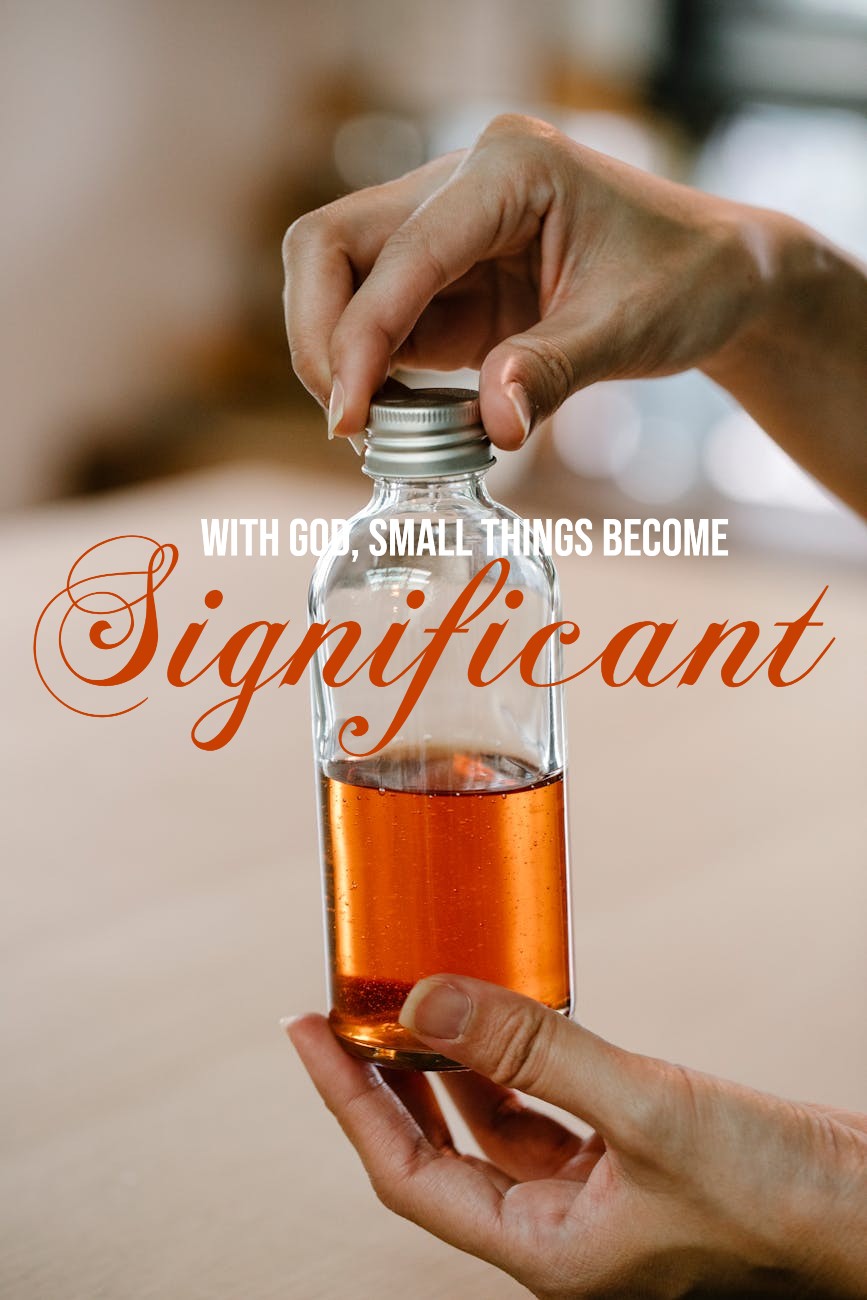
After questioning her about what was available in her house, he found out the woman had only a lowly pot of oil.
Not much indeed, according to how the natural eye sees it, but when we invite our Heavenly Father’s hand to help our most desperate cases, miracles can happen even with the smallest of starts.
That’s why Jesus taught His disciples about “mustard seed” faith (Matthew 17:20). When they went out to do the work that He sent them to do, even if He was not physically with them, their job was still to keep their composure of belief, which He stated, only needed the smallest, true measure of faith to work.
The biggest acts, with the biggest voices, and the biggest things can’t help but grab our attention. But it’s the underrated lowly pot of oil, it is the unimpressive and least flashy thing that God can use to bring about the greatest change (after all, He did use a little Baby born in a small manger in obscurity to change the trajectory of eternity for those who would believe – but that’s for another time).
The widow who came before Elisha left her house that morning not knowing that what she viewed as nothing and unimportant would be the greatest thing she had on her shelf for a breakthrough.
Elisha’s instructions were for her to borrow as many empty vessels as possible, take them home, shut the door, and watch God work.
The Bible tells us, “Now faith is the substance of things hoped for, the evidence of things not seen” (Hebrews 11:1). When she received the instructions on how to handle her seemingly insignificant source, what her eyes could not see, she moved forward in faith to fulfill. Which by the way, was the truly greatest thing she had on her spiritual shelf to work with.
As a result, every vessel she borrowed brought her one step closer to her breakthrough. Every time she poured her pot of oil, another filled, giving her more than enough in the end to satisfy all the debts against her and live comfortably off the rest.
Friends, I have written quite a few articles emphasizing the little things (I will link those below). And it is because I want you to believe in what God has placed in you and around you.
It may not impress people, but when we move forward in faith and believe God can do the impossible, He can.
While it seems the loud, boastful, and most flamboyant gets all the attention, faith that is true, even in its smallest measure, gets God’s attention the most (Hebrews 11:6).







 Word For Life Says...