As I was praying this morning, I was walking back and forth, as I sometimes do, and my eyes settled on a special plate and saucer set mounted on my shelf. It is from the Liberty Blue collection. I acquired these pieces years ago at Goodwill because I loved their aesthetic. Not knowing their value, I only picked up these few pieces and left the others there. And yes, I’m still kicking myself over it today.
I have a fondness for things of the past. If you were to describe the aesthetic of my home, I would call it “cozy vintage.” I love to incorporate things of bygone years into the design of my house. And while my whole home doesn’t emanate this style, there are many pieces that do. They remind me of simpler times. Their beauty, for me, is in the feelings they evoke of a bygone era.
Sadly, all our days of remembering are not filled with such fondness. When we look through our history, there may be experiences and events we wish we could change. Things that we would desire the outcome to be different.
Unfortunately, we cannot undo history. But what we can do is lean into the faithfulness of God and remember how He brought us through.
The Book of Lamentations was written by the prophet Jeremiah. In it, he expresses his grief and sadness over the now fallen Jerusalem. The people had turned a deaf ear to the warnings of God sent through the mouth of the prophet, and now tragedy has taken hold of the land. Destruction, hurt, and pain are mixed in the rubble of the ruins from the invasion of the enemy. Their future as a nation looks dismal at best.
But then there comes a shift in Jeremiah’s thinking. Something beautiful began to rise in his heart that could not be extinguished by the disaster that surrounded him. And that beautiful uprising is called hope. This prompted him to pen the familiar words of Lamentations 3:21: “This I recall to my mind, therefore have I hope.”
Jeremiah could have continued to wallow in sorrow with the belief that their case was beyond help, without hope. Instead, he chose to lean upon the faithfulness of God, Who always gives us a reason to hope. Rather than letting the feelings of dismay and despair overwhelm him and execute their language into his life – in the middle of this rehearsal of the negative, he chose to rewrite the narrative of how he would personally view this story. He chose to interject a praise of the positive, which was the faithfulness of God (Lam. 3:22, 23).
And we can do the same. While there may be hard parts of the story, there is a wonderful part: God Himself. The daily news may be littered with hopelessness, but our story declares that because of God, we still have hope.
“This I recall to my mind, therefore I have hope!” Like Jeremiah, we can have a made-up mind to focus on all that God had previously done, remembering how He had moved in times past. Recalling the positives of His faithfulness will help us to store an arsenal of truth for the days ahead.
Have you ever noticed how much we depend on signs? They tell us which way to go on highways. They give us directions on streets. They advertise products and services on billboards. And they tell us the names and purposes of buildings.
Signs are also indicators announcing the changes of seasons. They can be a signal to personality traits of another person to determine whether they are for or against us. And they can be used in some instances to determine the onset of some illness.
Signs were also referred to heavily in the Bible. Jesus used signs or miracles that pointed to the very real fact that He was the Christ, the Son of God: “And many other signs truly did Jesus in the presence of his disciples, which are not written in this book: But these are written, that ye might believe that Jesus is the Christ, the Son of God; and that believing ye might have life through his name” (John 20:30, 31; see also Acts 2:22).
The disciples/apostles also performed many signs: “And by the hands of the apostles were many signs and wonders wrought among the people…” (Acts 5:12; see also 2 Corinthians 12:12). These signs demonstrated to the people the truth of Christ and His Word (Mark 16:20; see also Acts 2:43; 14:3).
While the association with signs was used in a positive sense many times, the Bible gives us warnings about relying just on signs.
As Moses was preparing the Israelites to enter their promises land, he gave them this warning:
“If there arise among you a prophet, or a dreamer of dreams, and giveth thee a sign or a wonder,
And the sign or the wonder come to pass, whereof he spake unto thee, saying, Let us go after other gods, which thou hast not known, and let us serve them;
Thou shalt not hearken unto the words of that prophet, or that dreamer of dreams: for the Lord your God proveth you, to know whether ye love the Lord your God with all your heart and with all your soul.
Ye shall walk after the Lord your God, and fear him, and keep his commandments, and obey his voice, and ye shall serve him, and cleave unto him.”
Deuteronomy 13:1-4
Jesus also warned, “For there shall arise false Christs, and false prophets, and shall shew great signs and wonders; insomuch that, if it were possible, they shall deceive the very elect” (Matthew 24:24; see also 2 Thessalonians 2:9).
So, how can we know if it is a sign?
The way we can tell if something is from God is to refer to the Word of God, verifying the truth in its proper context. Not manipulating the Word or taking it out of context to sign off on a wrong desire.
This is what Moses taught the children of Israel. Going back to Deuteronomy, he told them, as noted above, “Ye shall walk after the Lord your God, and fear him, and keep his commandments, and obey his voice, and ye shall serve him, and cleave unto him” (v. 4). In that, we see, if there is a sign or wonder that doesn’t align with God’s Word, God’s commandments, then it is not of God.
God will NEVER contradict His own Word (Numbers 23:19; Hebrews 6:18). This truth alone is our solid basis on whether something is right or wrong.
Moses warned that if the sign or wonder that was performed is drawing hearts away from God and His truth, then it is not of God: “And the sign or the wonder come to pass, whereof he spake unto thee, saying, Let us go after other gods… Thou shalt not hearken unto the words of that prophet” (Vv. 2-3a).
We must stand solidly on the truth of the Word. If a sign, wonder, teaching, etc. contradicts the Word, then it contradicts everything God stands for.
Everyone must be determined to follow the truth of God in their own heart and not just by what they see with their eyes. Moses told the Israelites, “The Lord your God proveth you, to know whether ye love the Lord your God with all your heart and with all your soul” (v. 3; compare Deuteronomy 10:12, 13; Joshua 32:5; emphasis added). This is what Jesus tells us is the “first and great commandment” (Matthew 22:37, 38).
Therefore, to find out if it is a sign, we must ask, is this drawing us away from God, out of His will, or is it drawing me closer? Because if we love Him, if our hearts are for Him, we don’t have to rely on signs. We rely on pleasing God in whom our heart is connected.
“And above all things have fervent charity among yourselves: for charity shall cover the multitude of sins.” 1 Peter 4:8
Love, in earnest, can be a balm to a heart broken by the bruises this life sometimes leaves. Earnest love simply gives; it does not demand perfection or dwell on faults but looks to the heart within each person. It is concerned with the person on the inside, without basing rash actions and feelings on outward stumbles from grace.
Do you know one who can use this covering love in their life? Has a life been touched by error and negativity? Could they use the heart of another speaking to them, “I’m still here for you.”
God’s steadfast love rescues, restores, and covers us. As such, we, who were once recipients, are now dispensers and have the power, through love, to lift another from their struggles.
Real love works through patience and is very kind toward others (1 Corinthians 13:4). It does not keep records of every wrong committed (1 Corinthians 13:5). Instead, it releases offences over and over again (Matthew 18:22) and just continues to love.
Have you ever been denied this kind of love from the Father? The answer is no. Time and again, we have sought His perfect love to forgive our many wrongs, and by His grace and mercy, He did (Psalm 103:12; Hebrews 10:17).
Now, we are to be glad vessels ready to pour out to others the same love we have received, for “He that covereth a transgression seeketh love; but he that repeateth a matter separateth very friends” (Proverbs 17:9).
Is there a heart waiting to be on the receiving end of this type of love today? Let go of everything else and love like Jesus loves. You may help heal the brokenness of another.
“Let thine eyes look right on, and let thine eyelids look straight before thee. Ponder the path of thy feet, and let all thy ways be established. Turn not to the right hand nor to the left: remove thy foot from evil.” Proverbs 4:25-27
Some of the moments I most enjoy as a grandparent are when I have the chance to take my grandchildren to the local playground. Here, their adventurous side emerges as they attempt to accomplish new feats such as climbing higher, swinging with more experience, or sliding faster than the day before.
More than once during this time, I will hear, “Grandma, can you help me?” Especially when it comes to the balance beam. Although it is low to the ground, the challenges of walking with one foot in front of the other on that narrow implement can make the bravest little hearts nervous about falling. Taking their hand in mine, I steady them until they are confident to do it on their own.
For these little ones, and us big ones, focusing is an integral part of our walk. And it will determine if we end up with the desired results we had hoped for when we first started out.
Proverbs 4:25-27 (above) offers us wise words to help keep our course correct and walking faithfully before the Father on the “narrow” path we are called to (Matthew 7:14).
Advancing along this path of life, first we are instructed to “Let thine eyes look right on, and let thine eyelids look straight before thee” (v. 25). Where the eyes lead, the heart will soon follow. What has your attention has your life. Whatever you fixate upon holds your reins and steers your steps in its direction. Just ask Eve, Achan, and David (just to name a few) whose eyes steered them away from God’s perfect purpose for their lives and into sin. So, Proverbs tells us to keep our focus straight.
A wayward focus leads to a wayward heart. A stern warning given by Solomon a few verses prior, accentuating the importance of keeping the instruction of what is right “in the midst of thine heart” (Proverbs 4:21).
Secondly, we are told, “Ponder the path of thy feet, and let all thy ways be established” (v. 26). Whatever flows through the eyes and lands in the heart, it begins to direct the heart’s choices or one’s thinking. So, not only are we to be direct in our focus, but we are to be equally intentional with our thought life.
Walking with our physical bodies is something many do instinctively, naturally, not giving the whole of one’s thoughts to the hows of it all. They just get up and do it. But when it comes to our spiritual life, we cannot just follow every urge or natural human instinct. We, who seek to walk supernaturally, must have our steps guided by godly, spiritual thinking.
We want “established” steps that are firm and sure. As such, we cannot adopt every idea into our thoughts. But we must carefully strain out the negative, the natural, the ungodly – and “ponder” the right ways (comp. Philippians 4:8).
Lastly, Proverbs 4:27 promotes rigidity. A refusal, at one’s core, to be moved: “Turn not to the right hand nor to the left: remove thy foot from evil.” There is no room for compromise. On the balance beam and in life, it is your core strength that will keep you steady. A slight shift here or there can alter your center of gravity, leading to a fall.
Jesus, in one verse, gave us an easy way to remember these three points together, making sure we are moving in the right direction, the right way, by teaching us, “Thou shalt love the Lord thy God with all thy heart, and with all thy soul, and with all thy mind” (Matthew 22:37). This one verse keeps our eyes, our thinking, and our heart focused on our core strength who is our Heavenly Father. When we have Him as our primary center, our feet will stay on the steady path.
Often we are given to praying as the psalmist did when he said, “Order my steps in thy word…” (Psalm 119:133), and that’s good. But that does not negate our personal responsibility. Before each action taken in Proverbs 4:25-27, there was a command of responsibility for the individual: “Let,” “Ponder,” and “Turnnot.” These are personal, conscious efforts that each person is to take to ensure they are walking and moving in the right direction.
Personal accountability for our spiritual walk can not be delegated to another. We must choose with heart, mind, and soul to walk faithfully and live in a way that is pleasing to God.
Many times when we discuss the land of Egypt within the confines of the Bible, our minds automatically track back to the time when the children of Israel were in bondage there. We see them under the weight of the taskmasters, dealing with oppressive circumstances that are beyond their control. They stand by and watch as some are beaten, others are killed; lack and degrading situations run rampant throughout their time there. Fear, hatred, and jealousy by others drove them to the place where they are residing; a place where tough days seem like they will never come to an end.
Oftentimes, when people find themselves in a hard spot of life, or when they find themselves coming up short and just not happy with the way things are turning out at this particular time, they refer to that circumstance as their place of “Egypt.” This is where heartbreak and troubling times lie. This is the place where it seems everything is fighting against them, and no matter what one does, it just doesn’t appear that they will ever come out on top. People may not have taskmasters’ whips to deal with, but other things just lash and lash out at them, making it hard to get back up again.
As hard as this may be to believe, I assure you your Egypt will not last forever. I’m sure the children of Israel had doubts about this. After all, their time there lasted about four hundred years. Yet, even before this family of seventy ventured into the land and grew to the astronomical numbers we see in Exodus, God knew all about their time there before they were even there.
In Genesis 15:13 God told Abram, “Know of a surety that thy seed shall be a stranger in a land that is not theirs, and shall serve them; and they shall afflict them four hundred years.” Outside of that prophecy God also said, “And also that nation, whom they shall serve, will I judge: and afterward shall they come out with great substance,” (Genesis 15:14). In this we see, there was a promise before they even set one foot in Egypt; before they even encountered a problem, God already had a blessing lined up for when they came out.
Today, we fight against so many unknowns. We deal with all the this’s and that’s of life that simply weigh one down. One might not find themselves in a literal state of captivity, but something just sits on them heavy, becoming an almost unbearable burden, and they just don’t know what to do. With a feeling of exasperation, some just give up, content to go through the motions of life, without grabbing hold of the feeling of hope because of the fear of being let down again, just to drift back into that state of uncertainty once more.
But, I am here to tell you today, continue hoping and never give up. Your “Egypt” is not lost on God. God knows what you are facing. He knows every disappointment you are dealing with. He knows every struggle you are battling. He knows everything that you are fighting through, and that’s fighting against you.
It may be hard to see the proverbial silver lining in a dark cloud at times or the light at the end of the tunnel, but we have something better. We have a promise! God told Abram that when his people came out, they would be coming out better than when they went in. God was going to judge those who did them wrong, and God was going to bless them greatly.
Another promise Abram received was in a few verses before those noted above. God told him, “Look now toward heaven, and tell the stars, if thou be able to number them: and he said unto him, So shall thy seed be,” (Genesis 15:5). Not only were they going to be blessed, but they were going to come out increased in the people they were. To go from one individual to the millions they would come out to be, they were going to grow not only in number but in experience through their troubling times. They would have to learn to endure some stuff to be the people who would eventually be fit to take on the Promised Land.
While it may at times seem like the hard times are breaking you, they may actually be making you. So remember, before there was Egypt, there was a promise. And, I don’t know about you, but I will take a promise of God over a so-called silver lining any day. The promises of God are sure. Through our relationship with Jesus Christ, we are told, “For all the promises of God in him are yea, and in him Amen, unto the glory of God by us,” (2 Corinthians 1:20).
In other words, no matter what you are facing today, Jesus has you covered. No matter the obstacles or hard places that make you feel like you are in Egypt and you just want to give up, God has an unfailing promise of His love, grace, mercy, peace, and deliverance through even the most difficult circumstances.
Today, I am reposting encouragement. May you walk in the fullness of God’s unlimited blessings, because almost everybody wants to see a mighty move of God in their life. But often, some things get in God’s way; obstacles that act as barriers to blessings. There are two very specific items I want to deal with in this article that the Bible clearly shows us to be things that limit God’s power to work in an individual’s or a people’s life.
But, before I move any further in this article, I want to clarify a few things: 1) Just because one may be in the waiting process, it doesn’t mean these items that are going to be discussed apply to that individual or their situation. Sometimes, for His own wise reasons, God just has us waiting for His right time to move. And, 2) The two items that are going to be listed here are not the only things that form themselves as a blockade to one’s blessings. A truly seeking heart will prayerfully peel back the layers of self for a close-up examination of the inner man to see if there is anything else that may be getting in the way.
As I was reading my Bible, I came across Psalm 78:41, which states, “Yea, they turned back and tempted God, and limited the Holy One of Israel.” This psalm recites Israel’s history, and it highlights several of their rebellious moments. Particularly, God’s deliverance of them from Egypt, and their provocation of Him in the wilderness, through sin. The verse above brings out those same disobedient actions as limiting God. Their sin made a mark or drew a line, prohibiting them from the fullness of God and what He had to offer. Rather, they ended up provoking Him to anger.
Disobedience is one thing that will definitely limit God’s ability to work in you, through you, and for you. Disobedience evicted Adam and Eve from the Garden of Eden (Genesis 3:1-11) when God’s blessing was for them to live in paradise. Disobedience turned Lot’s wife into a pillar of salt (Genesis 19:17, 26) when God’s blessings wanted to deliver them from that city of sin. Disobedience caused Jonah to end up in the belly of a fish (Jonah 1:3, 15-17) when God’s blessing was for him to be a great witness to a great city. And, there are oodles of more cases noted in the Bible. Disobedience will always forfeit God’s best in one’s life.
As I was pondering this verse in the Psalm about limiting God, I was reminded of a time when Jesus wasn’t able to do great works in Nazareth, His hometown. Matthew 13:58 tells us, “And he did not many mighty works there because of their unbelief.” He was limited by their unbelief.
Now, we all know by now Jesus’ ability to do absolutely anything. One thing He won’t do is infringe, encroach upon, or overstep one’s belief. Mankind is a creature made with free will. It is His hope and desire that one would fully believe who He is and all that He says He can do. But it is a choice that every individual must make, by faith, for himself or herself.
The Bible tells us in no uncertain terms that, “Without faith it is impossible to please him:” (or, to agree with Him), “for he that cometh to God must believe that he is, and that he is a rewarder of them that diligently seek him,” (Hebrews 11:6).
God is the God of all possibilities, but a lack of faith and belief will hinder those possibilities. Unbelief caused the first group that attempted to enter the Promised Land to be made to turn back (Hebrews 3:19). God’s best wasn’t for them to wander in the wilderness for forty years. His blessing was for them to go in and possess it at that time. Their own unbelief refused the blessing for them. Going back to Psalm 78 in the recitation of their history, there are other noted instances where the unbelief of the people came to the forefront (Psalm 78:22, 32).
In the New Testament, if it had not been for Jesus on the boat with His disciples, they may have perished in the storm. Jesus had already done miracles and even taught many powerful parables, but when the storm blew, they freaked out and asked Jesus, “Master, carest thou not that we perish?” (Mark 4:38). But after Jesus stilled the storm He asked them this one question: “How is it that ye have no faith?” (Mark 4:40). Faith matters.
Back to Jesus’ experience in Nazareth, in parallel verses found in Mark, the Bible tells us, “He marvelled because of their unbelief” (Mark 6:6).
God, throughout the Bible, wants the best for His people. God would rather add blessings to our account rather than subtract them. If God blesses and takes care of the birds of the air and the grass in the field (Matthew 6:25-29), “shall he not much more clothe you, O ye of little faith,” (Matthew 6:30).
But He says in Matthew, “Seek ye first the kingdom of God, and his righteousness; and all these things shall be added unto you,” (Matthew 6:33; emphasis added). Go after a life of obedience and faith! Reject those hindrances to the blessings. The things that stand in one’s way and limit God’s moving in their life have to be put down so that He can raise His people higher.
We hear a lot of inspirational messages dealing with the subject of “No Limits.” And, that’s wonderful! But, in order to have a life of no limits, one needs to make sure God isn’t being limited in their life through disobedience and unbelief.
One is not a lonely number. Nor is it weak. One shows its beauty in its strength because it stands firm when others may be wavering. One holds on in faith to God, Who is their surety of hope. When others cannot work it in their hearts to see beyond the now into something better to come, one sees more by faith.
One makes a difference. Although God would love to use the multitudes for His glory, He only needs one who will open everything up to Him and simply believe.
Think of Noah in the days of old. The whole world had gone mad and corrupt, but there stood this one who found “grace in the eyes of the LORD” (Gen. 6:8). By faith, he “moved with fear, prepared an ark to the saving of his house…” (Heb. 11:7).
And what of Rahab? Although she was a harlot, when she heard about God and all He had done for His people, she took steps of faith that not only saved the messengers but also her house and relatives (see James 2:25; Joshua 6:17, 25, 23).
So, if you sometimes feel like you are the only one – the only one concerned, the only one willing to take steps – then you are in great company with others whose single decision to believe led them to follow God with feet stepping out in faith.
Your impact matters. When you feel like you’re standing alone, stand even taller knowing that what you do will never be forgotten in the eyes of the Father. He sees you.
You may be just an individual. But you are an individual meant for change. Because you refuse to give up, even when it seems you are walking alone, other lives may draw closer to the Lord. Both Noah’s and Rahab’s families experienced a tremendous deliverance because one person in that family chose to stand in faith.
There is power in one! You make a personal impact! You are an individual with influence! Stand, and be that one!
Be further encouraged by visiting the selections below:
Determination and decisions not only impact this day but also become a foreteller of what all your tomorrows will be. Are you ready? Refuse the what-ifs of life and be resolved to go where God is leading.
Her name may call her a bee, but she was lionhearted, sure, confident, and decisive, and she literally rose to the occasion when her people needed her the most. She was a spiritual champion who wielded her faith unflinchingly. Her name was Deborah.
In many ways, encounters mean everything to one’s progression forward. People judge others on first encounters. We often hear the importance of making a good and lasting first impression. It will determine if one should go deeper in the relationship or not. Opposite that, there are experiences with encounters that can go sourly wrong if not handled correctly. Think of a surprise meeting with a wild animal such as a bear.
Moses learned early on in his encounter with God that God cannot be approached in a haphazard fashion (Exodus 3:2-5). One must be very serious when coming into the presence of God. The standard has to be raised from the normal, and the steps which one treads to approach Him must be done with reverence because He is God.
Approximately two months after God’s final blow of the last of the 10 plagues, the death of all the firstborn in Egypt, and Israel’s departure from that land, the people have traveled and arrived in the wilderness of Sinai (Exodus 19:1) and are now camped at the base of Mount Sinai (Exodus 19:2).
Moses was then called up the mountain to come before God (Exodus 19:3). From that place, God began to speak words of promise and instruction for Moses to relay in the hearing of the people. God wanted them to remember their deliverance and how He brought them out of that land of oppression (Exodus 19:4). Afterward, God laid out stipulations for being in a covenant relationship with Him. Unlike the Abrahamic Covenant which was unconditional, the Mosaic Covenant had guidelines, rules, and rituals for the people to follow: “If ye obey my voice indeed, and keep my covenant,” God spoke, “then ye shall be a peculiar treasure unto me above all people,” (Exodus 19:5).
Moses then called the elders of the people together and relayed all of this to them and their status as a “holy nation” (Exodus 19:6-7). After, the people agreed to do what God commanded (Exodus 19:8).
But now that they have met with Moses and received these terms, it’s time for them to prepare their hearts, minds, bodies, and souls to meet with God. Moses was relaying all this pertinent information as God’s mouthpiece to them, but God wanted a one-on-one audience with His chosen people, His peculiar treasure.
As far as the purpose for that audience, God made it very clear: “Lo, I come unto thee in a thick cloud, that the people may hear when I speak with thee, and believe thee forever,” (Exodus 19:9). God wanted them to hear and experience His power up close and personal. He wanted them to hear and bear witness for themselves, as He spoke with Moses, so that they might believe and listen to Moses as His chosen leader, who receives His words and instructions and passes them on to the people. Although the covenant is for all His people, it was given to Moses; thus, it is referred to as the Mosaic Covenant.
For this “meeting” to take off properly, what the people do beforehand is of great importance. They had to consecrate themselves before approaching God. Filth had to be washed off, clothes had to be changed, and the people had to be sanctified (Exodus 19:10, 14), or “set apart.” Boundaries had to be set (Exodus 19:12-13). His sacredness was going to pervade that mountain, and the people needed to respect His presence. During that time, even intimate relations with their spouses were prohibited to be considered ceremonially clean (Exodus 19:15).
Friends, if we are to go deeper, if we are to be a people who will draw near to His presence, then we must, ourselves also, prepare for the approach as they did in the days of the ancients. Not with ceremony, but with sincerity. Not with rituals, but with a heart seeking an intimate relationship with the Father as the driving force. There is no greater place to be, nor any greater experience to experience than whole and beautiful, sweet fellowship with our God.
But when we start discussing rules, compliance, and the like, it tends to put people off. As we are born with the nature of free-will beings, sometimes it bucks against the very thing that is most helpful for us to have a better life. That is discipline, order, and obedience to the One who knows the healthiest guidelines for our lives to be directed by.
Any child of God should hunger to be nearer to Him than the day before. Therefore, daily, we need to monitor and adjust our approach if need be. We need hearts and minds prepared for the encounter.
How do we do that?
We must ready ourselves.
For anything important we want to do or any event we want to attend, we work hard to make sure we are properly prepared. Oh, how much more the effort should we put forth in readying to meet our God!
The people of old had to wash off any dirt and be sanctified. Is there anything that needs to be removed from your life that would be an impediment to the approach? Hebrews 12:1 says, “Lay aside every weight, and the sin which doth so easily beset us, and let us run with patience the race that is set before us.” Everything that wants to hold us back; everything that stands as an obstacle to our spiritual success; everything that works against our salvation, preventing us from a proper approach.
The people of old set boundaries and had to remain where the borders allowed and not enter where they prohibited. Previously, I shared, “God’s Word is filled with instructions, commandments, statutes – lines, if you will, not to confine us, but to give us a life far greater. Jesus taught, “Enter ye in at the strait gate: for wide is the gate, and broad is the way, that leadeth to destruction, and many there be which go in thereat: Because strait is the gate, and narrow is the way, which leadeth unto life, and few there be that find it” (Matthew 7:13-14).” (We Need the Lines/WordforLifeSays)
His holy Word shows us the guidelines for the approach. It reveals to us not only the importance and how of drawing near to our Heavenly Father, but also life principles and directions that will help us to keep the pathway of relationship clear of obstacles and hindrances: “Great peace have those who love Your law, and nothing causes them to stumble,” (Psalm 119:165).
We are promised “In thy presence is fulness of joy; at thy right hand there are pleasures for evermore” (Psalm 16:11). In that, we should not want anything to come between us and the moment of that great, holy experience. So, like the ancients, what we do beforehand will determine how close we can draw near.
The Bible encourages us to “Examine yourselves…” (2 Corinthians 13:5); prepare for our day of approach both now for relationship, and for eternity, where we will finally hear those blessed words: “Well done, good and faithful servant; thou hast been faithful over a few things, I will make thee ruler over many things: enter thou into the joy of thy lord” (Matthew 25:23). For it is then and there, we will experience the Holy Encounter like never before.
God’s desire has always been to have an up-close and personal relationship with each one of us. May we let nothing hinder our coming closer. Are you ready?
“Let us draw near with a true heart in full assurance of faith, having our hearts sprinkled from an evil conscience, and our bodies washed with pure water.” Hebrews 10:22
“Beloved think it not strange concerning the fiery trial which is to try you, as though some strange thing happened unto you,” 1 Peter 4:12
“Confirming the souls of the disciples and exhorting them to continue in the faith, and that we may through much tribulation enter into the kingdom of God,” Acts 14:22
One of the best things about being an avid reader is the happy ending that appears at the end of almost every book I read. When you first dive into a new book, you begin to get familiar with the characters and their life. Each turn of the page takes us along on their journey, revealing to us their joys and sadness, hardships and pain. By the time we reach those last few pages, everything has worked itself out. There’s almost always a reason for celebration and the typical “aww” moment, especially if you’re into romance novels.
That’s the great thing about books. They allow your imagination to soar, taking you into worlds you may not otherwise get a chance to explore. Your mind’s eye becomes connected to the writer’s vision for the book, and soon a vivid story begins to unfold before you. Though there are no pictures, illustrations begin to form, revealing all that is written therein. Television has its place – oh, but to read a book!
Whether it’s a movie, a television program, or a book, the stories we hear and see transport us, giving us a reprieve from reality. But when the last page is read or the screen goes blank, it’s back to reality. And reality isn’t always as picturesque as the stories we left behind. Sometimes love does not find its way. Sometimes the bad guy does get away. Sometimes the hero doesn’t make it home. Sometimes the disease doesn’t heal. Sometimes the child does not find their way home. Sometimes the friend does not stick closer than a brother, and so on.
Sometimes life is just not fun! I think more so than ever that we have not heard enough about the reality of life. Instead, we are raising up a generation of rose-colored glasses wearers. Even from the pulpit of most American churches, the messages of peace, prosperity, and wealth have taken over the reality of life. Jesus Christ Himself clearly stated that in the world you will have tribulation (John 16:33). Peace and blessings will come. Promises will be fulfilled, but our physical being is living in the world right now, and while we are here, we have to face the reality that everything, every day, is not going to be easy.
This philosophy breeds a culture of disillusionment. Romanticizing life leaves one totally off guard and taken aback when troubling times come. A hard life is a hard life, no matter which way you look at it, and when one is not ready in the least for it, the residual effects can be devastating. “We may through much tribulation enter the kingdom of God.” It is going to be hard sometimes.
“Beloved, think it not strange concerning the fiery trial which is to try you, as though some strange thing happened unto you,” 1 Peter 4:12. In other words, the test is going to be hard sometimes. Tests are not passed with a fly-by-night attitude. Tests are passed when people are prepared for them. But the wearer of the rose-colored glasses will have a harder time because the tests seem like a “strange thing” that has happened to them.
Listen, prepared or not, some things in life will just come out of the blue and whip your world around, causing you to say, “What the what?” It’s inevitable. The idea behind not romanticizing life is to expect the unexpected. We don’t want to lose out on those promises God has for us because we have the false illusion that nothing will ever happen to us.
The promises are coming, that’s a given. In John 16:33, after Jesus warned, “In the world ye shall have tribulation,” He also gave us cause to celebrate. He said, “But be of good cheer, I have overcome the world.” And after Peter wrote of the “strange thing,” he exhorted his readers with verses 13-14a. He said, “But rejoice, inasmuch as ye are partakers of Christ’s sufferings; that, when his glory shall be revealed, ye may be glad also with exceeding joy. If ye be reproached for the name of Christ, happy are ye; for the spirit of glory and of God resteth upon you . . .”
Oh yes, thank God for the promises. Every word that speaks of them is true. But don’t be surprised when we have to go through some stuff today before we reach those promises.
If you have ever spent time in a garden, you know to get the most out of what you are planting, you must first spend time cultivating the soil. This involves preparing the soil to support the life of the seed or the plant. It is about nourishing and amending the soil. This ensures it will have all the healthful benefits needed to reach full maturity and fruitfulness.
Many want fruitfulness. However, the way we have been pursuing it has left many less than satisfied. They feel deflated, worn out, and frazzled because of all it takes to reach it in this world of demands.
Our modern culture allows us to do many things. This increase in perceived productivity has been helpful in some areas while taking its toll on others.
The physical, emotional, and mental burnout that people have come to equate with success has created dissatisfaction. This has awakened a not-so-silent call for a better way to live. There must be more than this constantly rushing about.
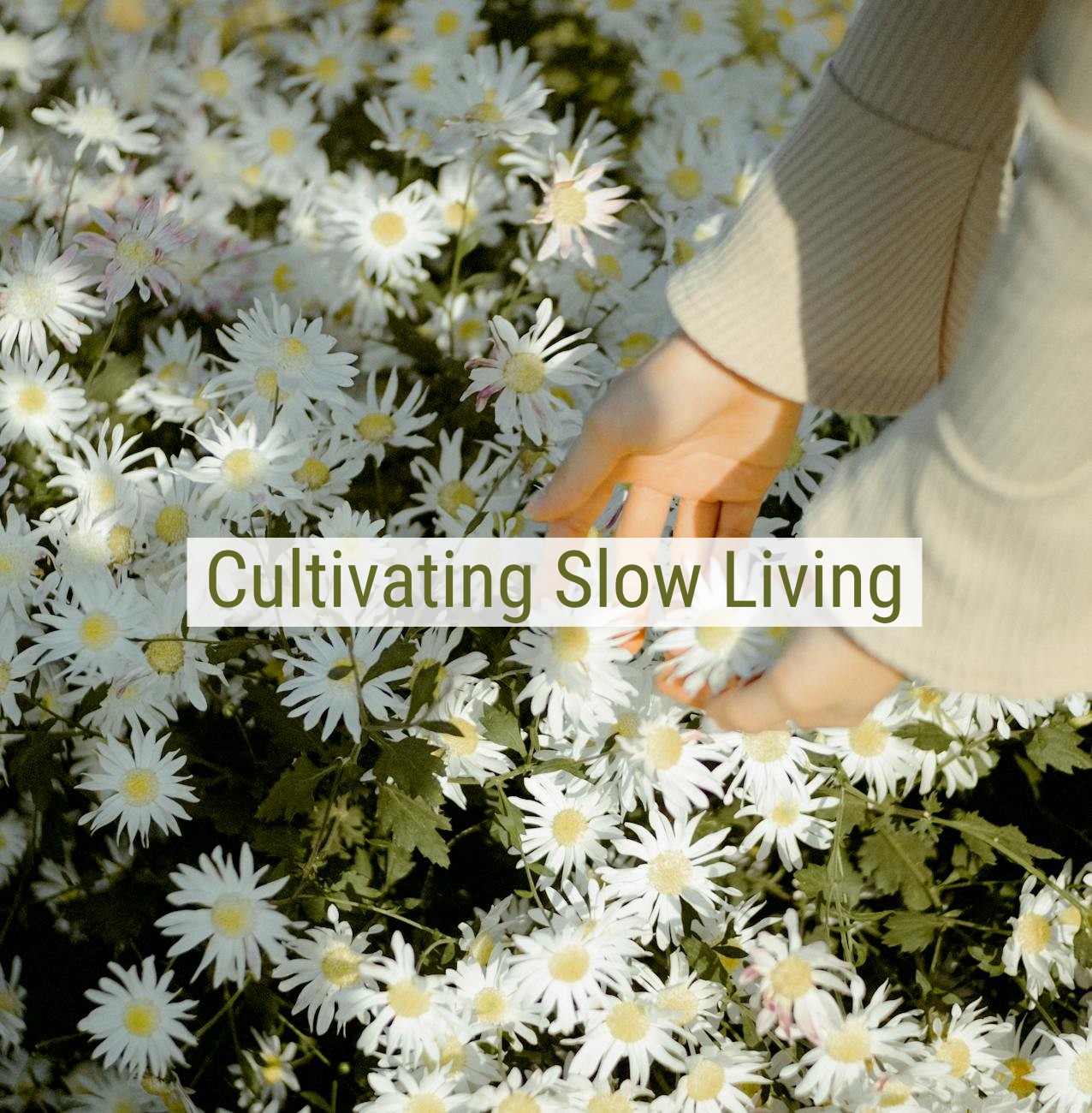
Many have become aware of the unhealthy way our over-rushed and overworked culture has pushed us forward and the term “slow living” has regained our attention. Dealing with constant busyness and hurried lifestyles has caused some to take a step back. In this, they reflect and reevaluate what is really a priority for them to have a wholesome, balanced, and healthy life. And what many are finding out is that there is a real need to put space on the calendar or the everyday routine of life to let go, and get slow.
Slow, misunderstood, and used wrongly, can be viewed as laziness. But slow can be beautiful because you are deciding to be purposeful with your life. Moving forward at a hundred miles an hour is not your goal, rather you account that people and life, in general, are made for so much more than mere zooming by without the time for deep connections. So, you take the time to love, nourish, be intentional, and simply live and enjoy all the ways God has blessed you.
You are cultivating, on purpose, the ground of your life to support more than agendas and achievements. The abundance you are desiring cannot be confined to such trivial things. The greatest example is in our relationship with Christ.
Jesus promised us an abundant life (John 10:10). That abundance is not about forcing or focusing on things we can gain in this world or material wealth. The richest thing one can invest in to be more intentional with the life they have been given is more of Him. That cannot happen if we are always distracted by constantly doing and never taking the time to sit and be where He is (Luke 10:40-42).
He says, “Be still, and know that I am God…” (Psalm 46:10).
Cultivating slow living is not about shirking responsibilities or approaching life with a lackadaisical attitude. This is about valuing everything I have been given, especially the people in my life, and I want to care for each and honor each in a way that lets them know I esteem them, I am here for them, and I love them. I want to use this life in a way that pleases God by stewarding well what He has given me and not have my focus continually on climbing some invisible ladder of success.
Think about what pursuit has you running about at a hurried pace today? The Bible tells us, “He that followeth after righteousness and mercy findeth life, righteousness, and honour” (Proverbs 21:21).
It is so easy to get caught up in what has been dubbed “the rat race,” but our daily living is made for more. These days, people, and moments are gifts to us by our Heavenly Father and we are encouraged about how we spend our time with each (Ephesians 5:15, 16).
“To every thing there is a season, and a time to every purpose under the heaven” Ecclesiastes 3:1
Changing what we pursue and how we pursue it will make our lives a lot less stressful. Take time today to slow down, prioritize, and recenter on what matters most. There is so much more to life, and we don’t want to miss it.
So, how do we make this change?
Prioritize – Look where you are now and what you want your tomorrow to look like. To achieve your desired outcome, what can you let go of or shave down some so that you don’t always feel at your wit’s end. I can attest to the fact that often we take on more than we are capable of in any given season. Laying something aside right now doesn’t mean it’s not important; it just means it doesn’t fit in with the season of life I’m in right now. So we prioritize, bringing out the best without being overburdened with things that can wait.
Recenter – Once you have strained out the main priorities for your right-now season, you can recenter and mark your path forward. When using a GPS, sometimes I look at the overview screen of the trip to see the highways and streets we must travel ahead of us. But when I need to get back to dealing with where I am currently on my journey, I need to hit the recenter button. While it’s okay to think about the future (the Bible encourages this often), we must also pay attention to where we are in our present moment. What needs our immediate attention right now? How much strength, time, and commitment can I put into this right now? These are important questions to ask. We often get hurried and over-stressed because we want to deal with all the right-now stuff the along with the what-ifs of the future stacked on top of it. Most of the daily things we deal with can be broken down into more manageable tasks and delegated to other times. It doesn’t have to be all or nothing (an attitude that overworks us).
Go slow – take a deep breath and move forward at a manageable pace. There have been times I have prayed and asked God to help me steward this day or for the best way to handle the tasks in front of me. He, who is the “Ancient of Days” (Daniel 7:9), has the wisdom and strength your day needs. Trust Him with your schedule. We are given gifts to be productive, but remember, God, who is the Author of those gifts, is also the Author of rest (Genesis 2:2,3). Not just with the Sabbath, but throughout Scripture, His call to rest is a call to trust in what He is doing in your life during this season. We become filled with ideas and inspirations and want to put the pedal to the metal and give it our all. And that’s fine. But if you are feeling burned out and extremely overwhelmed, you have to question is this what God has for me in this season, or is it me rushing ahead? And if we feel it is the Lord’s leading, perhaps we need to revisit steps 1 and 2 to be sure we have shaved unnecessary things away for now.
Don’t be disheartened. Schedules often need to be revisited to see if everything we have going on right now is for our optimal good. Recently, I have personally had to revisit how I approach certain tasks, and it is helping me see that although I love my routines, some routines or expectations may not work for certain periods of life. We must be willing to move and adjust when feeling led or if we feel like this particular thing isn’t working for now, and trust God with the outcome.
We want to cultivate a life where we are productive under God’s grace without completely feeling exhausted and stressed as if we are being buried under the burden of each day’s demands. Sometimes, slowing down will help us to do just that. Enjoy this life God has given.

























 Word For Life Says...