
Sunday School Lesson – “Jesus Blesses the Children” Mark 10:13-16

VERSE DISCOVERY: Mark 10:13-16 (KJV, Public Domain)

There is a familiar scene that plays out in many families between dad, mom, and the little ones.  It is the one where the father, playing with his children, tosses them into the air and catches them on a band of giggles coming from the child while the mother stands on the sidelines holding her breath.

The father with a sure grip and a steady hand has no qualms playing this innocent game.  The child, often young, just thinks it is absolutely hilarious to go for this free ride.  The child never worries about being caught.  The child never worries about being hurt.  The child only sees daddy.  Daddy loves me, daddy cares for me, I trust daddy and daddy will never let me fall.  Therefore, I will enjoy playing with daddy.

From the time that children are born, they have an innate capacity to trust.  They are literally at the whim of their caretakers and can do nothing for themselves.  Their dependency is constantly on others to feed, care for, and love them in their most vulnerable state.  In their innocence, they do not judge by anything outwardly but, only by the love they receive inwardly.

Children are a gift from the Lord (Psalm 127:3).  Children are our future.  These little ones will be the next carriers of God’s Word.  They will be the conduits through which generations after them will find their way to the Lord and His salvation.  At the same time, children can teach us so many things and one of the things they teach us is how to have faith.

Faith gets over-complicated in the adult way of thinking while children just simply receive, remain dependent, trust, and believe.  And that is all God asks from all His children, no matter what their age is.

 Parents Desire

Mark 10:13 “And they brought young children to him, that he should touch them: and his disciples rebuked those that brought them.”

Teachings on the kingdom of God and examples of what true faith looks like were never far from Jesus’ vocabulary.  He took many times and opportunities to open the understanding of all who would listen and heed what God looks for in a true follower of His.

In this lesson, He gives us an undeniable example of both as parents in the crowd “brought young children to him.”  The desires of the parents in question are to have Jesus “touch” their children thereby blessing them. This was not an uncommon practice in this ancient culture.

The truth is parents always want what is best for their children.  If they find a good thing, naturally they would want their children exposed to it as much as possible.  Many modern-day parents spend an enormous amount of money each year to give their children the best clothes, education, housing… the best start in life, if and as they are each able to do.

The parents in today’s lesson saw Jesus teaching and healing and showing compassion to many people, many times over.  He was (and still is) the best thing they could give to their children.  Why would they not want their child exposed to Him?  Why would they not seek a “touch” from Jesus for their little ones if they could?

A child’s faith often starts with their parents (or guardian), and in the home.  It’s where God gave the command of responsibility to Moses for the parents to “teach them diligently unto thy children, and shalt talk of them when thou sittest in thine house…” (Deuteronomy 6:7; see also Deut. 11:19).  There are many variables that go into raising a child.  Parents really must take into consideration and calculate what their children are exposed to on a daily basis and whether or not it is beneficial to their physical and spiritual wellbeing.  The guidelines given to Moses to pass down through the generations was to ensure that the most impressionable of society receive the proper exposure to the things of God; to what would benefit their children the most.  This would also ensure the longevity of the faith amongst the community as a whole.

Those in today’s lesson wanted to expose their children to Jesus.  They wanted Him to touch their little ones with a blessing.  They brought their children near to where Jesus was, giving them the opportunity to hear of His teaching and wisdom on life and the kingdom of God.  The Bible encourages us to, “Train up a child in the way he should go: and when he is old, he will not depart from it,” (Proverbs 22:6).  This stands as a strong lesson that if we want our children to be exposed to Jesus, then we, as parents, must take that responsibility and not depend on others to do it for us.  When it comes to our children’s faith there can be no complacent parenting.

“And his disciples rebuked those that brought them.”  The disciples didn’t have the same vision for the children as the parents did.  The Bible does not exactly state why their rebuke was so strong (although many speculate).  But they did prohibit the parents from bringing the children nearer to where Jesus was and made no attempts to hide their displeasure at the intrusion.

Did they think the children were unworthy of the Master’s time and consideration?  Maybe they believed Jesus was just too busy and important to deal with the likes of these.  Who knows?  Perhaps it would have been prudent for them to ask Jesus first instead of thinking to act on His behalf.  The fact of the matter is they stood in between Jesus and the children.  Something Jesus highly disapproved of.

Everyone MATTERs TO JESUS

Mark 10:14 “But when Jesus saw it, he was much displeased, and said unto them, Suffer the little children to come unto me, and forbid them not: for of such is the kingdom of God.”

Jesus intervened.  Jesus has never turned away a desiring soul.  He has never told a mom or dad no who sought physical or spiritual healing for their child.  And He was not going to turn down or turn away those who desired a special spiritual blessing or touch for their children now.

One of the most precious things I love about our Lord is His ability to see value in everybody.  Those whom society thinks are the lesser, non-important, are magnificent in the eyes of our God.  The Bible teaches us, “But even the very hairs of your head are all numbered. Fear not therefore: ye are of more value than many sparrows,” (Luke 12:7).

To Him, it does not matter where you live, what your social status in life is, or anything else like that.  It does not matter if you are aged with wisdom or new and in the innocence of your years.  He that knows the days then, the days now, and the days to come and sees beyond all of that, straight down to the very soul He loves.  With that, He invites or allows (“suffer” as this lesson puts it) them to come unto Him.

Previously I wrote in another lesson, “The feet of faith walk forward believing God is, “and that he is a rewarder of them that diligently seek him,” (Hebrews 11:6).  Faith in its highest form removes all worldly shackles and just rests in the truth that if it is His will, there is nothing that can hinder God from performing a miracle in one’s life.  Ethnicity, background, and prestige all fall away in the eyes of our Savior whose only view is that of an opened heart filled with belief,” (Word for Life Says/The Centurion’s Great Faith).  All are welcomed before Him: man, woman, and child.  Many are quick to write off young people, but our youths’ matter to Jesus, too!  Everyone matters to Him!

“Forbid them not,” Jesus commanded.  Do not prevent people, no matter who they are, from drawing nearer to Christ.  The constraints that society then and now may put on some people are not recognized by God.

Youths especially come packed with potential.  For example, Samuel was dedicated to God as an incredibly young child (1 Sam. 1:21-28) and became a righteous judge of God’s people.  Josiah, became king at the tender age of 8 (2 Chr. 34:1), and “in the eighth year of his reign, while he was yet young, he began to seek after the God of David his father: and in the twelfth year he began to purge Judah and Jerusalem from the high places, and the groves, and the carved images, and the molten images,” (2 Chr. 34:3) and eventually went on to make great reformations for God’s people in turning them back to true worship (2 Chr. 34-35) which all started while he was still young.  Timothy learned from his grandmother and mother about true faith and helped the apostle Paul during his missionary journeys and in the establishing of new churches (2 Tim. 1:5).  And, let us not forget our Lord Jesus Christ who was found at the age of 12 in the temple with the “doctors”, amazing all who saw Him and heard “his understanding and answers,” (Luke 2:41-52).   It is far better that potential is tapped in young people for the glory of God than for the things of this world.

I am sure the disciples thought they were doing their best in providing protection and care for their Master.  Yet, Jesus has always had an open-door policy when it comes to people.  People matter to our Savior, even the littlest people – the kiddos.  Jesus always had a heart that burned for drawing people near and exposing to them the kingdom of God.  He loves people.  He loves children.  And He loves you, too!

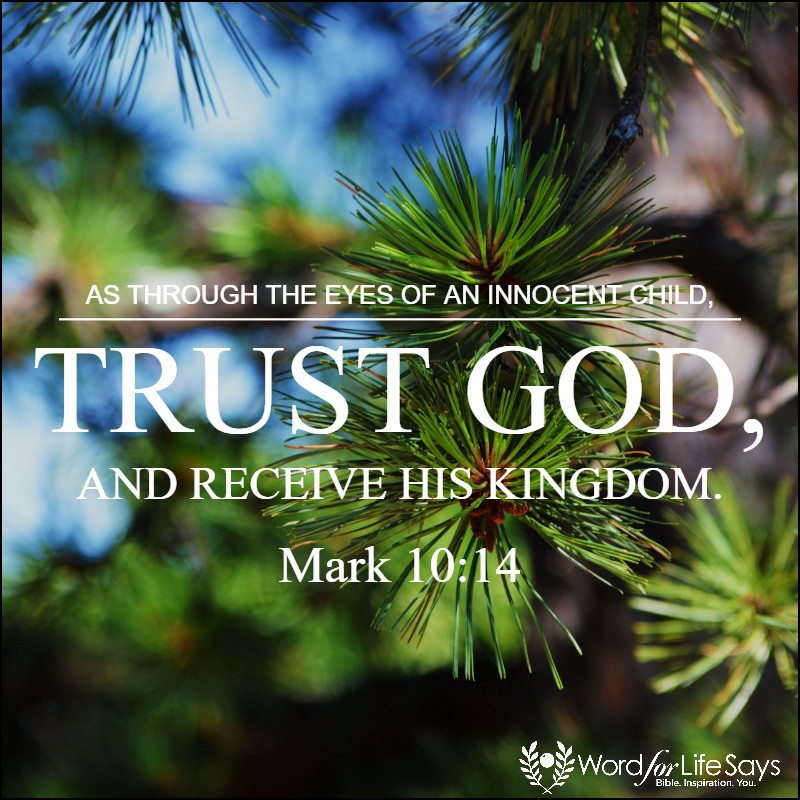
“For of such is the kingdom of God.”  God’s kingdom is made of those who trust Him with total abandon and are dependent without inhibitions; that have faith and just believe as through the eyes of an innocent child.  Too many adults are hindered in their faith due to life experiences.  But children just accept and believe and love and trust.  They are prime examples of how His sheep come to the Shepherd and humbly follow His lead.

Faith as a Child

Mark 10:15 “Verily I say unto you, Whosoever shall not receive the kingdom of God as a little child, he shall not enter therein.”

Continuing His line of teaching on the kingdom of God, Jesus reiterates the one who wishes to enter in must “receive” it “as a little child.”  Those who choose not, forfeit their right to “enter therein.”

Why? Because the same characteristics that made that celebrated faith like a child acceptable in heaven are not found in those who refuse to receive it.  In fact, the exact opposite is usually what is present.  Instead of trusting, one may see self-sufficiency, and instead of a heart surrendered in faith, one may see it being lifted in pride.  Of course, one does not have to go far in realizing these are things God opposes.  They are not found in His children, the accessors of that heavenly kingdom, therefore to them who refuse to receive it as a child, access is denied.

The promise of heaven awaits any and all who will humble themselves as these children do and put on those same traits.  Walking in a lifestyle that opposes the fruit of the Spirit which is often found in these little ones is to oppose the working of the Spirit in that life.  Flesh wins and carnality overtakes that individual prohibiting them an opened door into the heavenly realm.

Do not be like the children of Israel.  God led them through the wilderness, and they fell short of the promise that lay ahead of them.  Losing out on the spiritual blessings of entering heaven would be far worse with more significant eternal consequences than that of an earthly Promised Land.  Therefore, it is prudent that one takes on this faith, which He describes as being like a child in their trust and willingness to receive, that they may enter in.

Blessed by Jesus

Mark 10:16 “And he took them up in his arms, put his hands upon them, and blessed them.”

After His lesson on the benefits of having the same faith as these little ones that were brought before Him, Jesus granted the parent’s request and “blessed them.” 

Look at Jesus’ actions closely. He did not just speak a word over them as He could have.  He did not send one of the disciples to relay the blessings.  No.  He got personally involved with each child there in showing them the compassion of the Savior.  He lifted “them up in his arms, put his hands upon them, and blessed them.”  I get the impression that He possibly took the time to lay hands on each child individually as any good father or spiritual leader would and speak a word of encouragement over each one of them (just my thoughts).

Remember our introduction: “The child never worries about being caught.  The child never worries about being hurt.  The child only sees daddy.  Daddy loves me, daddy cares for me, I trust daddy and daddy will never let me fall.  Therefore, I will enjoy playing with daddy.”  Jesus is calling for all of us to turn to Him with that same kind of innocent and trusting faith found in children.  Your heavenly Daddy loves you!  Turn to Him.

PDF Full Printable Sunday School Lesson Pack (With easy to read instructions following the P.E.A.R.L. format on how to conduct each lesson with areas for adding personal notes): Sunday School Lesson – Jesus Blesses the Children

Suggested Activities:

Lesson Opener:  If you tried to put a picture to the word faith, what would that picture look like? What would it show? (As you present the questions in the following paragraph to open the lesson, have pictures ready that depict the scenes being spoken of.)

Would we see one authoritatively speaking with power to the multitudes (show picture)?  Would we see miracles and signs being performed (show picture)?  Or would you see the face of an innocent child (show picture)?

When Jesus taught about what those who enter the kingdom of God and what they would be compared to, in this lesson, He likened them to the picture of an innocent child.

While all the others are very real signs of things being done by those who profess and walk in the faith – what it all boils down to is if one wants to enter His heavenly kingdom, they must, in faith, receive it as a child.

Adult Journal Page: Adult Journal Page – Jesus Blesses the Children

Kid’s Journal Page: Kid’s Journal Page – Jesus Blesses the Children

Blank Journal Pages: These pages, one designed for adults and one for children, can be used to bring out, remember, or write a particular part of the lesson you wish for you and/or your class to focus on.  Click>>Blank Adult and Kid’s Journal Pages to access the journal pages.

Paper Bag Puppet Craft:  Younger students can also put together a paper bag puppet depicting themselves and, on the back, attach the phrase from the printable available on site which states, “Jesus Thinks I’m Special, Too!”  Click here for the printable PDF.

 

Draw the Scene: Jesus Blesses the Children Draw the Scene

Memory Verse: Jesus Blesses the Children Memory Verse

Word Search: Jesus Blesses the Children Word Search  Answers: Jesus Blesses the Children Word Search Answers

Crossword: Jesus Blesses the Children Crossword  Answers: Jesus Blesses the Children Crossword Answers

Word Scramble: Jesus Blesses the Children Word Scramble  Answers: Jesus Blesses the Children Word Scramble Answers

Copyright © Word For Life Says.com (Sharing any posts or lessons can only be done through the share buttons provided on this site from the original posts, lessons, and articles only. You can reblog from the original posts only using the reblog button provided, or share using the share buttons provided from these social media platforms: Facebook, Twitter, or Pinterest, etc., and they must be shared from the original posts only. All other repostings are prohibited. Posts and other items of interest found on this site MAY NOT BE COPIED AND PASTED, downloaded, uploaded, etc to another website or entity not listed (physical or electronic).  See COPYRIGHT PAGE for more details.

Sunday School Lesson – “Doers of the Word” James 1:19-27

VERSE DISCOVERY: James 1:19-27 (KJV, Public Domain)

The word “do” is a word of action.  It begs for the spirit of complacency to be put off and done away with.

“Do” wants you to go after it, not just to observe it, but to put it to work.  To allow it to become a part of you.  To allow it to be represented in you.

“Do” wants to see things accomplished.  “Do” wants to act when others only want to hear and speculate.  And, when it comes to the Word of God, nothing less than “do” is acceptable. Because “do” puts into practice what it reads and hears.  Those who are doers are not satisfied with anything less than God’s active Word being active in their own life.

James, in his book, really talks a lot about Christian living.  His book opens our understanding of what it really means to live out God’s Word in our lives through deliberate action and not just complacent listening. 

Do – Be Mindful of Others

 James 1:19-20 “Wherefore, my beloved brethren, let every man be swift to hear, slow to speak, slow to wrath: For the wrath of man worketh not the righteousness of God.”

Being mindful of others affect how we respond and communicate with individuals on a personal level.  It is the works and the Word of God we want to be manifested in our lives and not our own selfish ambitions, anger, or agendas.

In these verses and the ones following, James lays out guidelines and precepts for human communication and purposeful thoughtfulness in our response to others.  By using the words “every man” he implies that these are good guidelines for any and everyone to follow when dealing with one another.

First, “be swift to hear.”  I must admit in the age where texting and social media is the prevalent form of communication, really learning to sit down and hear someone out is a passing characteristic trait.  This being “swift to hear” is not for one who is running to hear gossip about others.  Rather, it is the ability to stay oneself in a conversation where another can unload a burden, where another can trust you to be their confidant in the time of trouble, or where you can invest in hearing the whole of the matter, digesting it completely before offering your two cents on the subject at hand.

Thusly, we are commanded to “be slow to speak.”  If you have ever been in one of those conversations where the other person is always jumping in and cutting you off, you know how it can be a real put-off.  Proverbs 21:23 reminds us, “Whoso keepeth his mouth and his tongue keepeth his soul from troubles.”  Many of the misunderstandings that occur between people are because the right words were not spoken at the right time, rather the wrong words were spoken at the wrong time (see James 3 for more on this tongue of trouble).

Then, this verse admonishes us to be “slow to wrath.”  Proverbs 14:29 tells us, “He that is slow to wrath is of great understanding: but he that is hasty of spirit exalteth folly.”  The one with a quick temper shows his/her lack of self-control.  Oh, how easy it is to let loose and lash out.  But what great strength is shown in the one who does not.

One part of the fruit of the Spirit is “temperance” (Gal. 5:23), which means self-control.  In other words, the passions of the flesh that provoke one to rise in anger are not to have the final rule or say.  We, as Christians, are to allow the working of the Spirit to have free course as opposed to that of the fleshly desire.  That is why Paul said, “I keep my body, and bring it into subjection…” (1 Cor. 9:27a).  He, as well as we, are running this Christian race and often that requires putting the things we feel under the obedience of Christ who Himself was our living example (see Is. 53:7).

“For the wrath of man worketh not the righteousness of God.”  “Man” operates with fleshly inclinations.  What that means is man is not infinitely wise and all-knowing as our heavenly Father is who said, “For my thoughts are not your thoughts, neither are your ways my ways, saith the LORD,” (Is. 55:8).  Man, judges according to his finite knowledge and abilities, especially in times of anger where his judgment could be clouded and impaired by raging emotions.

This often causes man to lash out on his own without first prayerfully considering the consequences and recourses of his actions, thereby not producing the “righteousness of God.”  That is why the Apostle Paul admonishes us, “Be ye angry and sin not: let not the sun go down upon your wrath,” (Eph. 4:26).  Proverbs 16:32 tells us, “He that is slow to anger is better than the mighty; and he that ruleth his spirit than he that taketh a city.”  He who can control his emotions in this manner through inner strength is stronger than the one who can conquer a city with his outer strength.

James 1:21 “Wherefore lay apart all filthiness and superfluity of naughtiness, and receive with meekness the engrafted word, which is able to save your souls.”

“Lay apart.”  Take it off!  These things are not only destructive to oneself, but they are also destructive to others when unleashed.  These things can hold an individual back from being all that God has called them to be.  Hindrances that get in the way of one fulfilling God’s Word in their lives.  James said to lay it apart – take it off because it is not profitable to “save your souls.”

Rather, “receive with meekness the engrafted word.”  “Receive” means to bring into oneself.  This is what we want to lay ownership to and put on: “the engrafted word.”  The Word is an essential component in the spiritually mature life.  It upholds us (Ps. 119:116).  Through the Word, faith is increased (Rom. 10:17).  The Word is our weapon to fight with (Eph. 6:17).  The Word lights the pathway for us (Ps. 119:105).  The Christian cannot live without the Word.  God freely gives it to us “for doctrine, for reproof, for correction, for instruction in righteousness,” (2 Tim. 3:16), that when we “receive” it with “meekness” we will know how to operate like Him and not according to our fleshly wrath and ways.

Do – Put Actions Behind What You Hear

James 1:22 “But be ye doers of the word, and not hearers only, deceiving your own selves.”

“But be ye doers of the word.”  A “doer” is a person marked by activity and action.  It is a person who is not complacent (refer back to the introduction), content with just sitting on the sidelines.  This person believes in getting in there, rolling their sleeves up, and working the Word to its fullest capacity.

God’s Word is not an aquarium.  In an aquarium, we view the fish from the outside.  We do not go in and interact with them.  We just watch them swimming along and think about how beautiful and peaceful they are.  God’s Word is beautiful and peaceful, but it is also meant to be lived out; it is meant to be interacted with, and it is meant to be active in the life of every believer.  One is not just to be an observer or a “hearer” but a “doer.” 

They that only hear are “deceiving your own selves.”  Many pack churches out on Sunday’s to fulfill their “weekly obligation” of attending church without having a personal relationship with the Word; without contemplating and applying its truths to their own lives.  This may make one appear spiritually rich on the outside, but on the inside, they have cheated themselves out of its rich rewards.  This is deceptive to self.

James 1:23-25 “For if any be a hearer of the word, and not a doer, he is like unto a man beholding his natural face in a glass: For he beholdeth himself, and goeth his way, and straightway forgetteth what manner of man he was. But whoso looketh into the perfect law of liberty, and continueth therein, he being not a forgetful hearer, but a doer of the work, this man shall be blessed in his deed.”

There, in the morning rush to get out of the door, a dash to the mirror to make sure every hair is in place and the face is in order.  Walking away, another dash to the mirror to verify once again that everything looked okay.  Again, in the car, adjust the mirror once again to reaffirm what one looks like, and so on; readjusting and running back to the mirror so that outwardly things may appear right.

One who does not have an active relationship with the Word does not have it as a constant measuring stick to live by.  Think of a leveling tool that is used in construction to make sure everything lines up evenly and according to plan.  Without that level, walls could end up slanted and out of place causing the entire structure to be unstable.  Just taking a quick glance or eyeing it will not give a good representation.  You need the tool to be sure.

The Word is that tool that keeps us in line so that we will not “forget what manner of man he was.”  He who is a “doer” of the Word has an active relationship with the Word and keeps coming back to it to align his or herself aright.  This is the one who looks intently and intentionally into the Word, here referred to as “the perfect law of liberty” and sees it for the truth marker that it is.

“This man shall be blessed in his deed.”  Luke 11:28 says, “Blessed are they that hear the word of God, and keep it;” a promise that is spoken over and over again in the Bible (see also Deut. 4:40; John 13:17 and Rom. 2:13).  God’s blessings are poured out on the “doers,” not just the “hearers.”  The “doer” is the one who despite his/her feelings does the will of the Father (see Jesus’ parable in Mt. 21:28-31).  Jesus was a “doer!”  In agony, He declared, “Nevertheless not my will, but thine, be done,” (Lk. 22:42).

Do – Match Your Actions with Your Profession of Faith

James 1:26-27 “If any man among you seem to be religious, and bridleth not his tongue, but deceiveth his own heart, this man’s religion is vain. Pure religion and undefiled before God and the Father is this, To visit the fatherless and widows in their affliction, and to keep himself unspotted from the world.”

Here is a reiteration of where the lesson began with instructions on being swift to hear and slow to speak.  One can seem holy and pious on the outside but if that little inside member known as the “tongue” is not brought under control, “this man’s religion is vain.” 

If the Word is not active in his life causing him to operate in love and concern for his fellow brethren, rather seeks to tear others down, his religion is not fruitful.  It is not producing the things that will draw men to Christ, instead, it is repelling.  The Word is meant to go beyond just believing it.  It is meant to be put into operation and lived.

James, in essence, was saying, if you really want to know if the Word is at work in one’s life, watch what they do.  “Pure religion and undefiled” fulfill the command of God in their lives.  “Pure religion” is not seen in just talk, but in fruitful actions.  It shows in their care of others like: “to visit the fatherless and widows in their affliction.”  It goes beyond just being a hearer and displays actual evidence of being a doer.  It is also shown in how they line themselves up to the Word “to keep himself unspotted from the world.”  The proof is in the pudding, so to speak.  A “doer” shows what they believe, whereas a “hearer” is only a complacent bystander.

There are enough hearers, observers, and viewers of the faith.  God needs some action heroes that will allow the Word to work in their lives.  God needs more “doers!”

PDF Printable Sunday School Lesson Pack (With easy to read instructions following the P.E.A.R.L. format on how to conduct each lesson with areas for adding personal notes): Sunday School Lesson – Doers of the Word

Suggested Activities:

Lesson Opener: On a board, write the words Hearer on one side, and Doer on the other. Draw a line down the middle of the two.  Ask students to give you ideas on what can be used to describe each word.

Under the two columns in all caps write the word OBEY as big as your board will let you.  To obey is to hear instructions and then follow through.  Explain what it would be like to just hear without doing.  That is not obeying.  Ultimately, God is looking for our faith to be worked out in our lives through obedience and that means we have to not only listen to what He says, but we have to put into action what God says.

Lesson Lead-In: One option for a lesson lead-in is to talk about or show a fun online cute video about animal training. Talk about the ups and downs of training and the rewards when training is successful.

Our lesson tells us, “He being not a forgetful hearer, but a doer of the work, this man shall be blessed in his deed,” (James 1:25).  There is always a reward in doing what God asks us to, and not just hearing about it.  When we are Doers of the Word, we are living a life that is pleasing to God.  We put a smile on God’s face when we obey.

Adult Journal Page: Adult Journal Page – Doers of the Word

Kid’s Journal Page: Kid’s Journal Page – Doers of the Word

Draw the Scene: Doers of the Word Draw the Scene

Mini-Puzzle Activity: After students have drawn their picture using the Draw the Scene sheet (above), they can cut the square portion of the sheet and cut it into several pieces to use as a mini-puzzle.  If you choose this option for an activity, as always it is best to print out the page using cardstock or glue the regular paper to construction paper for stability.

Paper Bag Puppets: Younger students can design paper bag puppets featuring themselves.  After completion, have them attach the “I Will Be a Doer of God’s Word” Button to the back of their puppets.

Declaration Buttons: Using the buttons link and picture from above, students can make their own buttons to wear, declaring to be Doers of God’s Word (print out on cardstock or glue to construction paper for stability).  Color, decorate, and tape or glue a safety pin to the back.  Bonus: using the same materials, punch a hole in the top and string through with yarn to design a necklace. 

Aquarium Activities: From the statement pulled from the lesson saying, “God’s Word is not an aquarium just to be looked at.  We are called to be doers of the Word,” you can find any fish, aquarium, or similar crafts and activities to incorporate into this lesson.  Or, make a construction paper fishbowl with this lesson quote in it.  An easy activity sheet is provided below to be used as-is or you cut the fishbowl out as a template for a craft.

Doers of the Word Activity Sheet


Fishbowl Toss Review Game: Buy a cheap fishbowl or make one out of virtually anything and some little balls or toy fish.  Armed with a list of questions, if a student can answer the question correctly (also use True or False and Fill in the Blank questions), then they get a point for their team and a chance to shoot the ball or fish into the fishbowl.  If the ball or fish goes into the bowl, then they get another point for their team.  This review game can be as simple or as challenging as you want and can easily be adapted for many ages and levels of learning.   

Word Search: Doers of the Word Word Search  Answers: Doers of the Word Word Search Answers

Crossword: Doers of the Word Crossword  Answers: Doers of the Word Crossword Answers

Word Scramble: Doers of the Word Word Scramble  Answers: Doers of the Word Word Scramble Answers

Copyright © Word For Life Says.com (Sharing any posts or lessons can only be done through the share buttons provided on this site from the original posts, lessons, and articles only. You can reblog from the original posts only using the reblog button provided, or share using the share buttons provided from these social media platforms: Facebook, Twitter, or Pinterest, etc., and they must be shared from the original posts only. All other repostings are prohibited. Posts and other items of interest found on this site MAY NOT BE COPIED AND PASTED, downloaded, uploaded, etc to another website or entity not listed (physical or electronic).  See COPYRIGHT PAGE for more details.
 

Sunday School Lesson – “Made Righteous in Christ” Romans 3:21-31

VERSE DISCOVERY: Romans 3:21-31 (KJV, Public Domain)

Since “all have sinned, and come short of the glory of God,” (Romans 3:23; discussed further in this lesson), then how can one ever be truly justified by a holy and righteous God?

The answer is a simple one although it is not always simply accepted: Jesus Christ.  Through His sacrificial atoning of our sins, He changed our former status into one who now becomes righteous in the eyes of our righteous God, Paul explains in this lesson.

The Righteousness of God

Romans 3:21-22 “But now the righteousness of God without the law is manifested, being witnessed by the law and the prophets; Even the righteousness of God which is by faith of Jesus Christ unto all and upon all them that believe: for there is no difference:”

Although the Apostle Paul did not plant the Church in Rome as he had in other cities, he still took a fatherly-leadership role in helping this church to thrive to be all that God calls them to be.

He prayed for them and desired to visit them (1:1-15), but in the meantime, he wrote this letter to encourage and instruct them on the matter of salvation, God’s righteousness, and how we as sinners, can be made righteous in the eyes of God.

After establishing his fearless zeal in wanting to preach the gospel to them, for in it, he knows, “the righteousness of God” is revealed (1:15-17), which is really the main focus of this letter, Paul continues on discussing what all this means.

God’s righteousness can be described as everything just and right and holy.  God is right, there is no other way to put it.  What He does is right.  Always.  His ways are higher than ours and they are above reproach (Isaiah 55:8-9).  Opposite that is the “ungodliness and unrighteousness of men” (Romans 1:18).

Since the Fall in the garden, mankind has been corrupted by sin.  Since that day, when the age of innocence has passed off the scene, mankind has been subjected to the “wrath of God” (1:18), “Because that, when they knew God, they glorified him not as God” (1:21).  They, mankind, are accused of changing the glory of God (1:23) and the truth of God (1:25) to follow after sinful ways.  Although creation itself testifies to the power of God (1:20), Paul sums up the ungodly truth of sinful man by saying, “Who knowing the judgment of God, that they which commit such things are worthy of death, not only do the same, but have pleasure in them that do them.” (Romans 1:32).

God’s judgment is against ALL SIN and He will render to “every man according to his deeds,” (2:6).  It doesn’t matter who they are, Jew or Gentile.  It doesn’t matter if they have been raised in the Law or not (2:11-15).  Anything that one can boast in outside of faith in Jesus Christ will profit nothing in that coming day (more on this later).

The law cannot justify one before God.  The law, and it’s following the adherence thereof, cannot earn one true salvation.  The law’s purpose was to bring about “the knowledge of sin,” (3:20), but it could never erase sin for good and make people righteous before God.

Then Paul introduces a “but now” moment that begins to explain how the “righteousness of God” is “manifested.”  This “but now” introduces the wonderful realization that mankind is not left to drift in the world of sin without help; without an anchor to steady and save them.  There is a way for them to receive “the righteousness of God” and it is “by faith of Jesus Christ unto all and upon all them that believe.”

In Christ, lies that hope to be justified before the Father, accomplishing something the law never could do.  “For what the law could not do, in that it was weak through the flesh, God sending his own Son in the likeness of sinful flesh, and for sin, condemned sin in the flesh: That the righteousness of the law might be fulfilled in us, who walk not after the flesh, but after the Spirit,” (Romans 8:3-4).

In the work of the cross of Christ, salvation is available for them that believe.  Jesus Christ is the only answer to heal mankind from their dreaded sinfulness and to make them right before a holy and just God, “upon all them that believe.”

It doesn’t matter who they are, where they’re from, or what they’ve done: “there is not difference.”  Any and all who turn to Jesus Christ by faith can be saved.  The answer to all our sins’ woes is fulfilled in what Christ accomplished on the cross (compare Romans 10:12).

All Have Sinned and Need to be Justified

Romans 3:23-26 “For all have sinned, and come short of the glory of God; Being justified freely by his grace through the redemption that is in Christ Jesus: Whom God hath set forth to be a propitiation through faith in his blood, to declare his righteousness for the remission of sins that are past, through the forbearance of God; To declare, I say, at this time his righteousness: that he might be just, and the justifier of him which believeth in Jesus.”

Just as there is no difference in who can receive the righteousness of God by faith in Christ, there is no difference in who can be categorized as a sinner in need of this grace, in need of redemption, “For all have sinned, and come short of the glory of God.”  Everyone who ever was and ever will be needs to be saved by the redemptive blood of Christ.  No one measures up to God’s standard on their own.  We all need Jesus!

It is through Him, where one can be “justified freely by his grace.”  The word “justifies” signals the “being made right before God” part, while “grace” speaks of the undeserving mercy we receive in that.  Our guilt had us bound, but Jesus set us free through “redemption,” by redeeming us.  He paid the cost.  He “gave himself a ransom for all, to be testified in due time,” (1 Timothy 2:6).  So that our eternity could be secured before the Father, He “freely” satisfied the demand against mankind’s sin.

Jesus became our eternal sacrifice that atoned for our sins once and for all: “Whom God hath set forth to be a propitiation through faith in his blood.”  The Bible declares and attests to this truth in other areas, saying, “Herein is love, not that we loved God, but that he loved us, and sent his Son to be the propitiation for our sins,” (1 John 4:10).  The word “propitiation” in both of these verses speak of Christ’s complete, atoning sacrifice.  “His blood” was shed that we might be made free (compare Hebrews 10:4).  Christ died for our sins.  Our justification is not a human invention.  God “set forth” Christ and the plan of salvation through Christ.

“To declare his righteousness for the remission of sins that are past.”  Not only today are our past sins taken care of, but the yesterday and the yesteryear sins of sinners are taken care of for all who believe, both before the cross and after the cross (compare Ephesians 1:7; Hebrews 9:15)!  Hallelujah!  The “past,” and those in the past, have been covered by the cross, also!  The cross, and what Jesus did on the cross, is enough to satisfy and uphold the demands of God’s “righteousness” against the sin and sinners of today, yesterday, and forevermore.  Nothing else is needed.  It has already been proven that nothing else will do (read Hebrews 9:12-14).

“Through the forbearance of God.”  God’s own “righteousness” (above), which is the very “habitation of His throne” (Psalm 97:2), is shown in His willingness and longsuffering to withhold final actions upon mankind’s sin as a whole before the time of the cross.  At the time of His death, all sin, past, present, and future, were placed upon our Savior as He hung on that cross.  It’s what one does with the revelation of the cross for their own life that makes the difference.  This is what one will be judged by.

God has always been fair in His actions toward humanity, sinful though they may be.  He gives everyone time and space to repent: “The Lord is not slack concerning his promise, as some men count slackness; but is longsuffering to us-ward, not willing that any should perish, but that all should come to repentance,” (2 Peter 3:9).  But, as we know, all will not come to repentance.  The time of ignorance is over and there is an appointed day for the judgment for all, past, present, and future (Acts 17:30-31).

But, for the one that “believeth in Jesus,” God justifies.  Because of what Christ did, and because of our belief and acceptance of what Christ did as our Savior, God credits that to our account as righteousness.  God declares them/us right and justified!  Mankind, any person in human history outside of Jesus Christ, is far from perfect and right in the eyes of God.  But, when one believes in Jesus, for all He accomplished on the cross and accepts that sacrifice for their life; when God looks at that person, He no longer sees them and their wrongs.  He sees Jesus and His right, and He is the one that declares them now to be righteous.

By Faith, Jesus is Enough

Romans 3:27-31 “Where is boasting then? It is excluded. By what law? of works? Nay: but by the law of faith.  Therefore we conclude that a man is justified by faith without the deeds of the law.  Is he the God of the Jews only? is he not also of the Gentiles? Yes, of the Gentiles also: Seeing it is one God, which shall justify the circumcision by faith, and uncircumcision through faith.  Do we then make void the law through faith? God forbid: yea, we establish the law.”

Because everything is based solely on what Christ has done, and because it is only God who is able to aptly justify one, what right does anyone have for “boasting”?  They don’t!  That’s the plain and simple truth. No one can make themselves righteous.  No “law” could declare one righteous.  Nor, could any “works” (compare Ephesians 2:9).  Salvation is not something that can be earned.  It is something we are blessed with through “faith.”

Instead of being a source of contention, this should be a relief, for salvation does not depend on what a person can do perfectly, it only depends on what Christ has already done perfectly.  Only the self-righteous would find some kind of joy in trying to pat themselves on the back for a job well-done in trying to get to heaven for all eternity on their own accord or by their own works.  But self-righteousness won’t get you or me there.  Only those who are found Christ-righteous will enter in.

Therefore, “boasting” is kicked to the curb.  “Boasting” is a symbol of pride.  “Boasting” glorifies self and what self can accomplish on its own.  But salvation, I repeat, is NOT something that people can accomplish on their own.  Everyone needs forgiveness and reconciliation through Jesus Christ!  “No flesh shall glory in his presence,” (1 Corinthians 1:29).  National heritage, religious pride, or any other reason one may exalt themselves believing them worthy of this great gift by what they have done or do – all of that is made null and void before the perfect sacrifice of Christ.  For it is ONLY “by grace are ye saved through faith; and that not of yourselves: it is the gift of God,” (Ephesians 2:8).

True salvation requires true “faith” in the right source, and we are not it, nor were the receivers of this letter in the Roman church.  What self can do is not it.  The gospel tells the story and the way of that right source who is Christ our Lord.  He is it!  Any other way outside of Christ is “excluded.” 

“Therefore we conclude that a man is justified by faith without the deeds of the law,” Paul said.  The reality of this truth permeates Paul’s letter to the Roman Christians.  Prior to reaching the text of study in this lesson, in verse 20 of this same chapter, Paul writes, “Therefore by the deeds of the law there shall no flesh be justified in his sight…”  Later in Romans, he will write, “Therefore being justified by faith, we have peace with God through our Lord Jesus Christ,” (Romans 5:1).  Here, he is declaring exactly what Christ’s sacrifice on the cross accomplished for the sin-sick soul.  He justified us and made us right with the Father (Romans 5:1).  None of this was based on our own efforts or human goodness.  Our new position in Christ was and is solely based on the sacrificial love of Christ that propelled Him through any hurt and pain He was personally feeling to think outside of Himself and see a world of humanity drowning in an ocean of wayward disobedience and rebellion leading them to a lost path of which there is no return unless their souls be saved!

Because of what He did, we now have “access by faith into this grace” and we have a reason to “rejoice in hope of the glory of God,” (Romans 5:2).  With His blood, He bought the key that would give us an open door to our heavenly Father.  And, with everything we face, our end reward is hope (Romans 5:3-5).

He, Jesus, did it all for us and our job is to whole-heartedly accept it, accept His work, accept His sacrifice “by faith.”  Those words, “by faith”, “through faith”, “the law of faith”, and other references to faith appears no less than thirty-seven times in the book of Romans alone.  The “law”, and the works of the law couldn’t do it (compare Acts 13:38-39).  “For therein is the righteousness of God revealed from faith to faith: as it written, The just shall live by faith,” (Romans 1:17).  It’s a faith thing!

And, this is God’s plan for all.  It’s not just for the “Jews” or for the “Gentiles.”  There is only “one God” with one plan of salvation for all to accept: faith in what Jesus Christ has already done.

Does this make the law “void”?  Absolutely not!  Through Christ, God fulfilled the law.  The law was “established”.  Before His death, Jesus plainly stated, “Think not that I am come to destroy the law, or the prophets: I am not come to destroy, but to fulfil,” (Matthew 5:17).  In Him, the requirements of the law were fully and completely satisfied.  Therefore, God is just when He makes one righteous through Christ because, in Christ, all the law is fulfilled.  By faith, Jesus is enough!

PDF Printable Sunday School Lesson Pack (With easy to read instructions following the P.E.A.R.L. format on how to conduct each lesson with areas for adding personal notes): Sunday School Lesson – Made Righteous in Christ

Suggested Activities:

Adult Journal Page: Adult Journal Page – Redeemed

Kid’s Journal Page: Kid’s Journal Page – Jesus Saves

Blank Journal Pages: Blank Adult and Kid’s Journal Pages

Draw the Scene: Made Righteous in Christ Draw the Scene

Word Search: Made Righteous in Christ Word Search Answers: Made Righteous in Christ Word Search Answers

Crossword: Made Righteous in Christ Crossword Answers: Made Righteous in Christ Crossword Answers

Word Scramble: Made Righteous in Christ Word Scramble Answers: Made Righteous in Christ Word Scramble Answers

Copyright © Word For Life Says.com (Sharing any posts or lessons can only be done through the share buttons provided on this site from the original posts, lessons, and articles only. You can reblog from the original posts only using the reblog button provided, or share using the share buttons provided from these social media platforms: Facebook, Twitter, or Pinterest, etc., and they must be shared from the original posts only. All other repostings are prohibited. Posts and other items of interest found on this site MAY NOT BE COPIED AND PASTED, downloaded, uploaded, etc to another website or entity not listed (physical or electronic).  See COPYRIGHT PAGE for more details.
 

Sunday School Lesson Series: “Getting to Know God Better”

When we enter into a new relationship it takes time to begin to understand and know the other individual.  This knowledge does not come instantly.  It comes with patience and perseverance; it comes by spending time with someone to get to know them personally.  It’s how we figure out all those special things that make them, them.

Getting to know God better, I believe, operates in much the same way.  The more time we spend with Him and the more time we take to understand Him and those special things that make Him, Him, the greater our love and appreciation for Him grows.  That growth is important because our understanding of who God truly is has eternal implications.  Jesus Himself spoke and said, “And this is life eternal, that they might know thee the only true God, and Jesus Christ, whom thou hast sent,” (John 17:3; emphasis mine).

Can I tell you a secret?  God wants us to know Him.  He spoke in Jeremiah, saying, “Thus saith the Lord, Let not the wise man glory in his wisdom, neither let the mighty man glory in his might, let not the rich man glory in his riches: But let him that glorieth glory in this, that he understandeth and knoweth me, that I am the Lord which exercise lovingkindness, judgment, and righteousness, in the earth: for in these things I delight, saith the Lord,” (Jeremiah 9:23-24; emphasis mine).

The greatest thing we could ever have is a solid relationship with God.  Fortifying that comes by taking the time to get to know Him better, which is the gist of this new lesson series.  Each lesson focuses on some of those things that make up the beautiful character of our wonderful God.  In the end, my prayer is that your faith in Him and your relationship with Him would be strengthened all the more.  We have this promise in the Bible: “Draw nigh to God, and he will draw nigh to you…” (James 4:8).  I pray that the words written in these lessons would help you to do just that, get closer to God.

To access the lessons, simply click on the links below.  They can be studied individually or grouped together as a series.

The power of God is over all! The power of God is responsible for all things created! The power of God cannot be matched and Job declares, even during the roughest patch of his life, that God’s sovereignty over all remains.

When we truly grasp the understanding of the love of God for us, then can we learn to love others better.

“The Lord is not slack concerning his promise, as some men count slackness; but is longsuffering to usward, not willing that any should perish, but that all should come to repentance,” (2 Peter 3:9). God’s longsuffering is God’s patience at work in the best possible way.  Believe today and turn to the Lord for salvation.

Holiness is still right! Isaiah saw a vision of God’s holiness in heaven, unmatched by anything we can know down here or imagine. Peter lets us know, the only way we will get to experience heaven, is to live holy while down here on earth. We must be holy because God is holy!

I am expecting to add more lessons to this series in the future so please stay tuned for updates.  For now, I’m off to work on other projects and series.  Many blessings to you all!

Sunday School Lesson – “God Called Abram” Genesis 12:1-9

VERSE DISCOVERY: Genesis 12:1-9 (KJV, Public Domain)

What once was
Will not always be,
When we follow the way
The Lord leads.

Abandoning the comforts
And safety we know,
Attaching oneself
To the One who speaks, “Go.”

Stepping out
In this journey of trust.
By faith, we follow,
Leaving the past in the dust.

One foot, one step,
We walk our way through.
Arriving in His promise
Where every word comes true.
©WordForLifeSays.com

Every journey in life starts with a first step.  That step, and the ones that come after it is the way to arrive at the destination that was hoped for.

For most people, when making such a drastic change in life, they have properly prepared for it well in advance.  But, when you’re like Abram, there is no such thing.  The call was made, what will he do with it?  Will he make excuses as to why this is not the right time to uproot his family?  Will he reason himself out of what lay ahead because he just doesn’t have enough details to make a thoughtful and well-informed decision?  Or will he go against the norms of rational, and put one foot in front of the other and walk where God says walk?

At this point, we all know that’s exactly what he did.  Let’s examine the story of his call a little closer that we might find the encouragement to move when God asks us to move with nothing but faith as our guide.

God Called

Genesis 12:1-3 “Now the Lord had said unto Abram, Get thee out of thy country, and from thy kindred, and from thy father’s house, unto a land that I will shew thee: And I will make of thee a great nation, and I will bless thee, and make thy name great; and thou shalt be a blessing: And I will bless them that bless thee, and curse him that curseth thee: and in thee shall all families of the earth be blessed.”

In order for there to be a complete blessing, there must be complete obedience.  Our God is not a half-way God.  He does all things well, and when He pursues individuals and welcomes them into His plans, He expects the same follow-through mentality He possesses.  Often, this requires a great deal of faith.

And this, we will find out, is exactly what Abram did and why he is honored by God in the way that he was.  At the command of God, he was willing to leave everything behind that attached him to his old life that he may be more attached to his relationship with God.  Generally, this action is similar to what every Christian is called to do when God delivers them from what they used to do or be.

Back to Abram.  While living life in the land of Ur, minding his business and going about what we assume was his daily routines or normal course of living, Abram’s life was interrupted by God.  This interruption would cause him to nix any plans he had for himself.  This interruption would let him know that he was no longer the most important person in his life, and neither was his family.  This interruption would speak of things the eyes have not yet seen but ask to walk that way anyhow.  This interruption would change the life of Abram forever, but more importantly, it would help usher in the greatest change the world has ever seen.

In the place he was currently in, God said to leave it.  Everything familiar, leave it.  Everything you are comfortable with, leave it.  Every person you have become attached to, leave them.  The life they lived and the place where he was, was not conducive to what God had in store for this man.

Many times, we read stories like this and we think, “Oh, that’s all he had to do.”  It’s more to it than that because whether you admit it or not, as humans, we like the familiar.  We like the things that we are used to.  We like the circle of people who we have come to know their little idiosyncrasies, and they have come to know ours.  We like our positions in that circle of people, so leaving everything behind, especially in the most permanent way Abram was called to leave, takes faith.

God commanded him, “Get thee out of thy country.”  Detach yourself, Abram, from everything that’s not a part of my plan for you.  In that country, idol worshipping prevailed.  In that country, people were not in a relationship with the one true God.  That place would not foster the environment that would grow Abram to be the man that He has designed him to be, nor would it be the right environment for the promises and the people that God has in store for Abram’s future to reproduce and grow.

Some comfortable places are traps.  Some of the familiar things that we have a hard time letting go of are keeping us from where God wants to take us.  Abram had to choose, follow God or stay put and risk losing everything even though he didn’t know anything about where God was taking him.

Abram’s separation was to be a complete severance from “thy kindred, and from thy father’s house.”  Walk away from everything and everyone, with only those that belong just to you in tow.  Turn your back on that auntie who used to pinch your cheeks in the sweetest fashion every time she saw you.  Your cousin, who was more like your best friend, you must leave behind.  All familial holds had to be let go of.

He must go “unto a land that I will shew thee.”  God knew where He was taking Abram, but Abram didn’t.  One must wonder, what was it about this call that would inspire Abram to make such a sudden, life-altering choice.  We don’t know exactly how God appeared to him or how the call was made, but for Abram, a man raised in idol worship, he was more than willing to do what God asked him to do, and follow His leading, sight unseen.  That’s the true definition of faith (Hebrews 11:1).

Ur, he knew.  Haran, he knew.  Where God was taking him, he knew nothing about it.  What would the land be like?  Will it be enough to support us?  Will it be enough to support our herds and the people I have with me?  So many questions must have gone through his mind, yet if there were reservations, they were never allowed to manifest and become a hindrance of following through with where God called him to go.  Rather, his faith was manifested in his obedience to go, in spite of it all.

God not only told him He had a land for him, but God also had promises attached to his act of faith in stepping out.  God was going to “bless” Abram.  That word “bless” meant there were going to be some good things that would come his way.  Things that would be unattainable if he chose to stay where he was.

“I will make of thee a great nation” was one of the blessings attached to his step of faith.  The man who didn’t even have one heir at the time was promised a whole nation.  Considering his age at the time (75), could Abram even fathom this sort of increase on the horizon?  God was going to take Abram’s nothing (from an heir point of view) and “make” it more than he could ever realize.  God was going to create an entire “nation” from this one man of faith (see Genesis 17:4).  God had a definitive plan in mind for this man and when he stepped out in faith, God would accomplish His purposes for him and his future family.

“I will bless thee” was the next portion of the promises for Abram.  In general, God was going to honor Abram with His blessings which could really cover every area of his life (compare Genesis 24:1).  God’s favor would be evident upon Abram.  God would be in a covenant relationship with Abram, and eventually, his people, and the state of their blessedness in Him will show (compare Genesis 24:35).

“And make thy name great” is designed around the reputation Abram (who would eventually become Abraham) would be known for.  To this day, his name, attached to his steps of faith, is known and honored.  He didn’t leave for fame, but fame would follow his faith story.

“And thou shalt be a blessing.”  All that Abram would be and become was not just for himself or his family.  As God has blessed him, he would also bless others.  Abram would “be” a blessing.

“And I will bless them that bless thee.”  When favor was shown to this special man and this special family, God would take special note of it.  One cannot bless the people of God and God not be pleased with it.  When we treat others right, especially those in covenant relationship with God, God notices and rewards.

At the same time, if one mistreats these same ones, then God would turn their “curse” back on their own heads to bear.  When God is in a covenant relationship with His people, God protects them.

Lastly, God promised, “In thee shall all families of the earth be blessed.”  This was a promise that has been reiterated several times in Scripture (see Genesis 18:18; 22:18, and more).  In the New Testament, the Apostle Paul noted in Galatians, “That the blessing of Abraham might come on the Gentiles through Jesus Christ; that we might receive the promise of the Spirit through faith,” (3:14).  As Abraham received his promise through faith, so too do those who believe in Christ, be they, Jew or Gentile.  When God stated, “all families”, that’s exactly what He meant.  He left the door open for any believing heart to have access to what Christ has to offer.  And Christ would come through the line of Abraham and his family, extending the blessings of God to whoever will receive Him.   

Abram Responded

Genesis 12:4-5 “So Abram departed, as the Lord had spoken unto him; and Lot went with him: and Abram was seventy and five years old when he departed out of Haran.  And Abram took Sarai his wife, and Lot his brother’s son, and all their substance that they had gathered, and the souls that they had gotten in Haran; and they went forth to go into the land of Canaan; and into the land of Canaan they came.” 

Abram responded to the call of God in a positive fashion.  He obeyed.  When he “departed, as the Lord had spoken unto him,” it means he obeyed what the Lord instructed him.  Abram’s faith, as well as our own, is tied to obedience.  Obedience says, I don’t know everything, and he didn’t, but I trust God enough to step into the unknown and do what He has asked me to do.

Abram is seventy-five years old at this point in his life.  How difficult would it have been to leave everything when one is probably well-planted and settled where he is?  Yet, leave is what he did because this is what the “Lord had spoken unto him.”  He moved his life and his family under the direction of God.

Many years later, one of Israel’s future leaders will make a bold declaration for him and his house in obeying what God wills for their life.  Joshua stood and spoke with his faith, and said, “As for me and my house, we will serve the LORD,” (Joshua 24:15).  Whether it’s addressing the issue of properly serving God as opposed to those who went after what is false, or as in Abram’s story of faith that has him trekking on an unknown journey because it is what God commands for his life, both scenarios are journeys of obedience, both require faith, and both had the whole family that belonged to them involved.

When Abram departed, he didn’t go it alone.  He had responsibilities to those who belong to him to include them in on what God was doing in his life now and in the future.  They had to follow him as he followed God.  Therefore, Abram “took Sarai his wife, and Lot his brother’s son, and all their substance that they had gathered, and the souls that they had gotten in Haran” with him and they would witness firsthand what faith in following God looked like through their obedient leader.

“They went forth to go into the land of Canaan.”  “They”, all those journeying with Abram followed Abram and “they” all “went forth to go into the land of Canaan.”  They may have not understood but they followed Abram.  They all left Haran.

“And into the land of Canaan they came.”  As Abram would soon find out, this place they were entering was going to be the same place God said He would show him.  This place was going to be a pivotal place throughout their history for so many wonderful things of faith.  This place was going to belong to him and his people.  Others may live there now, but it would be their Promised Land.    

 Abram’s Journey and Worship

Genesis 12:6-9 “And Abram passed through the land unto the place of Sichem, unto the plain of Moreh. And the Canaanite was then in the land.  And the Lord appeared unto Abram, and said, Unto thy seed will I give this land: and there builded he an altar unto the Lord, who appeared unto him.  And he removed from thence unto a mountain on the east of Bethel, and pitched his tent, having Bethel on the west, and Hai on the east: and there he builded an altar unto the Lord, and called upon the name of the Lord.  And Abram journeyed, going on still toward the south.”

If you have ever journeyed on a long trip, you know the sheer joy of arriving.  Arriving means your destination has been reached.  Arriving means whatever travail occurred during the trip can be put into the back of your mind because you are here now and that’s all that matters.

Abram’s journey started on nothing but pure faith in what God promised, and now he is in that very place of promise.  How awesome!

Coming into the land, Abram “passed through the land unto the place of Sichem, unto the plain of Moreh.”  He was walking through his promise.  Every step he took, every piece of land he crossed in that place was already his.  This land, though inhabited by “the Canaanite” at that time, his descendants will rightfully claim as their own because he stepped out in faith.

Verifying all of this, “the LORD appeared unto Abram, and said, Unto thy seed will I give this land.”  “This land” was promised by God.  “This land”, the very parcel of ground where he stood, and all the borders of the region God would lay out for him was his and his “seed.”  God gave it to them.  God promised it to Abram (see also Genesis 15:18-21).  He may be a “stranger” in this place right now, but God was giving it to him for an “everlasting possession” (Genesis 17:8).

Many, many other verses in the Bible verify this land of promise by God belongs to Abram and his descendants.  God spoke to Isaac, his future son, when a famine hit the area, saying, “Sojourn in this land, and I will be with thee, and will bless thee; for unto thee, and unto thy seed, I will give all these countries, and I will perform the oath which I sware unto Abraham thy father,” (Genesis 26:3).  And unto Jacob, He said, “I am the LORD God of Abraham thy father, and the God of Isaac: the land whereon thou liest, to thee will I give it, and to thy seed,” (Genesis 28:13).  With many more references throughout God’s holy Word, Abram has the assurance that he is in the place God had for him.  His step of faith led him into what was previously unknown territory into the remarkable position of standing in that very place of promise.

The leaving was worth it.  The journey was worth it.  The stepping out into the unknown was worth it.  God did exactly what He said He would do, and as he looked around the land, and the mountains, and the plains and seeing all the places of “Moreh”, “Bethel”, and “Hai” in his journey, he could see nothing but the fulfillment of everything he hoped for in God.  It was no longer just a dream, but the expectations of that dream had been rewarded to him for his faith.  Physically, and literally, he could see all God had in store for him.

And so, he worshipped.  Worship should always be a part of one’s journey with God, and worship should also be prevalent when we get to where God was leading us (before, during, and after – at all times, Psalm 34:1).  Abram built “an altar unto the LORD, who appeared to him.” 

Abram, through his faith, through his obedience to go, and through his worship, centered his life on the “LORD.”  Herein is a great example to live by.  Knowing and recognizing who it is that has authored not only our lives, but everything in between, and giving Him the proper glory that is due to His name.

Abram “called upon the name of the LORD” and blessed and honored publicly the same God who so blessed and honored him.  He stepped out in faith, and in that same faith, he is declaring his devotion to God alone.

One man out of all the men of the earth.  Taken out of one nation to begin a new nation.  Out of this, one family will increase and grow until centuries later it gives birth to one Savior who will save all mankind from their sins when they turn to Him in faith.

All this started, by faith.  That faith led to obedience, which then led to the fulfillment of everything God promised.

As he continued “toward the south” one can imagine him taking in more and more of the land in utter amazement.  What an awe-inspiring feeling that must have come over him as he took it all in.

One step.  One journey.  One very happy result in the end.

Everybody is not called to take the same journey as Abram did, but when God calls, we are all to respond the same way: in faith and obedience.

PDF Printable Sunday School Lesson Pack (With easy to read instructions following the P.E.A.R.L. format on how to conduct each lesson with areas for adding personal notes): Sunday School Lesson – God Called Abram

Suggested Activities:

Adult Journal Page: Adult Journal Page – God Called Abram

Kid’s Journal Page: Kid’s Journal Page – God Called Abram

Word Search: God Called Abram Word Search  Answers: God Called Abram Word Search Answers

Crossword: God Called Abram Crossword  Answers: God Called Abram Crossword Answers

Word Scramble: God Called Abram Word Scramble  Answers: God Called Abram Word Scramble Answers

Draw the Scene: God Called Abram Draw the Scene

Memory Verse: God Called Abram Memory Verse

For fun game ideas, go to MinistryArk.com

For great activity ideas, hop on over to SundaySchoolzone.com

For a wonderful activity and printables, click on InMyWorld.com