
Sunday School Lesson – “In the Beginning | The Creation Story” Genesis 1:1-27

VERSE DISCOVERY: Genesis 1:1-27 (KJV, Public Domain)

Taking in the world view as a whole, we will see that all that is before us has a starting point. Every person we see began at the time of conception. Every leader had a first step that led to their position. Every nation had the birth of its people coming together as unified persons. Every plant started with a seed. And every building with a first brick being laid.

Creation has its origin as well. And it does not start with a cosmic bang. The wisdom, intelligence, plan, and sovereignty of God, thought through, designed, and put together all of the creation story.

How it All Started

Genesis 1:1, 2 “In the beginning God created the heaven and the earth. And the earth was without form, and void; and darkness was upon the face of the deep. And the Spirit of God moved upon the face of the waters.”

“In the beginning” is not only the lesson/series title but also the biblical designation of when everything that follows these words actually occurred.

From the start, we are told about the start, and how it all began with “God.” (visit “God the Main Character” and “This Was God’s Doing | God is the Creator of All” found on site for further reading)

God, Himself, has no origin, as Isaiah verifies. Still, He is responsible for the origination of all: “Hast thou not known? hast thou not heard, that the everlasting God, the Lord, the Creator of the ends of the earth, fainteth not, neither is weary? there is no searching of his understanding” (40:28).

From His eternal nature and wisdom, all the creation story below starts with God for He “created the heaven and the earth” (see also Job 26:7). All the history of all the beginnings has its foundations laid by our Heavenly Father: “And, Thou, Lord, in the beginning hast laid the foundation of the earth; and the heavens are the works of thine hands” (Hebrews 1:10; see also Deuteronomy 10:14).

The whole scope of every part of creation is attributed to God alone (Genesis 2:4; Psalms 102:25; Isaiah 44:24; Revelation 14:7). Everything our eyes can see and not see, is in existence because the breath of God spoke it here; because He fashioned it: “By the word of the Lord were the heavens made; and all the host of them by the breath of his mouth” (Psalm 33:6), and by faith, it is to be believed: “Through faith we understand that the worlds were framed by the word of God, so that things which are seen were not made of things which do appear” (Hebrews 11:3).

Nothing was anything before God created it: “Where wast thou when I laid the foundations of the earth?” He asked Job, “declare, if thou hast understanding” (38:4). “Who hath laid the measures thereof, if thou knowest? or who hath stretched the line upon it?  Whereupon are the foundations thereof fastened? or who laid the corner stone thereof;” (Job 38:5,6; I suggest reading Job 38 entirely).

Even the “earth” itself was “without form, and void; and darkness was upon the face of the deep” (see also Jeremiah 4:23). “He hath made the earth by his power, he hath established the world by his wisdom, and hath stretched out the heaven by his understanding” (Jeremiah 51:15).

After the complete declaration of verse 1, accrediting God alone as Creator of all, the complexities and intricacies of all that it entails begin to come to life, starting with the state of the earth itself.

Originally called into creation, there was nothing there. But out of this nothingness, something beautiful would form from the formless. That without content and composure would be permeated with the purpose of God’s design.

As of yet, it lay empty in its state without the specifics of creation, but God was getting ready to change it into something more: “And the Spirit of God moved upon the face of the waters.”

Psalm 104:30 says, “Thou sendest forth thy spirit, they are created: and thou renewest the face of the earth.” God as One, shows every part of Himself (Father, Son, and Spirit) being present at the time of creation (see also John 1:1-3).

The same “Spirit,” with a capital S, found throughout the Bible as the promised Comforter (John 14:6), the “Spirit of truth” (John 14:7), the One who filled believing men and women, and in Paul’s prayer for strength in the inner man (Ephesians 3:16), is the same Spirit at work at creation in the beginning.

Day #1

Genesis 1:3-5 “And God said, Let there be light: and there was light. And God saw the light, that it was good: and God divided the light from the darkness. And God called the light Day, and the darkness he called Night. And the evening and the morning were the first day.”

“And God said.” Each day of the six days of creation began with these three words. By God’s design and by His word, the voice of God broke through the nothingness, took authority over the creation story, and spoke His divine will for each day.

And for day one, the command was, “Let there be light.” One of my favorite games to play as a child was focused on light: “Spotlight Tag.” It was played at night when it became dark enough outside. It was a game somewhat like hide-and-seek except the finding and tagging was done with flashlights. When the children hid, they could only be found when the person that was “it” shone a light on them, saying, “Spotlight on ________ (whoever it was).”

Light is pivotal when one wants to illuminate something.

On day one, light was created and entered the world. Although not noted by a specific source as the flashlight was at this point, it still came with the purpose of adding illumination and delineation from the present darkness where none existed before.

And the light was considered “good” by God. Now there was a defining separation. Light and darkness could not cohabitate, rather they are given their own special designations with God calling the light “Day” and the darkness He called “Night.”

 Day #2

Genesis 1:6-8 “And God said, Let there be a firmament in the midst of the waters, and let it divide the waters from the waters. And God made the firmament, and divided the waters which were under the firmament from the waters which were above the firmament: and it was so. And God called the firmament Heaven. And the evening and the morning were the second day.”

On day two the heavens were created, referred to as “firmament,” or as we know it, the sky. In verse two, we see there was no distinction between the waters that were upon the earth, no space between the waters that were above or below (v. 7), The firmament provided this space of separation. It set boundaries and these boundaries were called “Heaven” (v.8). There is now a visible sky with clouds floating upon the waves of the atmosphere. The Bible tells us, “The heavens declare the glory of God; and the firmament sheweth his handywork” (Psalm 19:1).

Day #3

Genesis 1:9-13 “And God said, Let the waters under the heaven be gathered together unto one place, and let the dry land appear: and it was so. And God called the dry land Earth; and the gathering together of the waters called he Seas: and God saw that it was good. And God said, Let the earth bring forth grass, the herb yielding seed, and the fruit tree yielding fruit after his kind, whose seed is in itself, upon the earth: and it was so. And the earth brought forth grass, and herb yielding seed after his kind, and the tree yielding fruit, whose seed was in itself, after his kind: and God saw that it was good. And the evening and the morning were the third day.”

Day three was particularly active in that we see more form come to that which was formless. We see God’s design begin to come alive more vividly as the putting together of different aspects of creation takes on more definition and purpose.

Now the waters under the heavens are called to move into more defined spaces, gathering into “Seas.” And out of these Seas, “dry land” was called forth and recognized as “Earth.”

Although we refer to the whole planet as Earth, in the beginning, it was the designation of the ground beneath the feet.

If you find yourself in the privileged position to stand on the shore of any massive body of water where the land and seas meet, take a moment while looking out at the vastness of it all and appreciate the fact that this is here because the voice of God commanded it to be (see also Psalm 95:3-5).

“And so it was” reminds us that whatever God speaks must happen and obey as He commands.

Then, the earth was called to bring “forth grass, the herb yielding seed, and the fruit tree yielding fruit after his kind, whose seed is in itself, upon the earth.”

Every imaginable and unimaginable plant, tree, herb, and seed was called into existence. The apple you eat today was originally called to inhabit the earth by the voice of God.

When they were called into existence, all types, be they perennials, annuals, weeds, fruit, or what have you, they came forth and followed the marching orders of God and took up residence and established roots of fruitfulness upon the once barren dry land.

Every conceivable produce has ancestor heritage in one form or another that goes back to the time of the beginning, and many reappear through Scripture attached with significant meaning.

Day #4

Genesis 1:14-19 “And God said, Let there be lights in the firmament of the heaven to divide the day from the night; and let them be for signs, and for seasons, and for days, and years: And let them be for lights in the firmament of the heaven to give light upon the earth: and it was so. And God made two great lights; the greater light to rule the day, and the lesser light to rule the night: he made the stars also. And God set them in the firmament of the heaven to give light upon the earth, And to rule over the day and over the night, and to divide the light from the darkness: and God saw that it was good. And the evening and the morning were the fourth day.”

On day one light was called, here specific “lights” (with an s) are created “in the firmament of the heaven to divide the day from the night.”

The day will come when there will be no longer a need for these specific lights (Rev. 22:5; Is. 60:19), but while they are here, they help us manage the telling of times and seasons (Psalm 104:19).

They not only illuminate the sky in their given tasks, but they give us points of reference in our grand scale of living.

The “two great lights” we refer to as the sun and moon are given the charge to rule over the day and night (compare Psalm 74:16). Worshipping these objects of creation has been a downfall of humanity since the beginning. While we don’t do that, we can be appreciative of these huge visible reminders of God’s handiwork throughout history from the start of it all.

When you feel the warmth of the sun on your face or you view the moon rising in the star-lit sky, you can thank God for what He has done then, and what He can and will do now, and in the times to come.

“He made the stars also.” Scientists may attribute the stars in the sky to an extremely complex process of gas and dust, but in the beginning, we are assured that the significance of their presence high above is because God made them also regardless of their makeup, and He knows each one individually: “He telleth the number of the stars; he calleth them all by their names” (Psalm 147:4).

Using the simple process of His authoritative speech and power over all creation, in the same way He called everything else forth, is the same way the stars arrived in the skies above.

“God set them in the firmament.” God specifically placed them in the right place to perform their jobs perfectly. Careful planning indeed.

In our homes, we place ornaments and knick-knacks in precisely the best location for style and aesthetics, but the carefulness of God’s placement of these lights was for neither style nor aesthetics, they were divinely purposed (compare Jeremiah 31:35).

In Psalm 104:2 we see the psalmist attributing to God as the one “who stretchest out the heavens like a curtain.” Can a man even fathom to catch one star that falls from the sky, let alone stretch out the heavens with galaxy upon galaxy and universe upon universe?  God can.  As a matter of fact, in His wisdom in the beginning all He had to do was speak a word and creation obeyed and came into existence.  All in the sky that looks to be stretched out as a cosmic curtain twinkling above our heads is because God is the one who made it to be so.

Side Note: With such carefulness and attention to detail in the creation of this world, do not think that your life is any less purposed or carefully planned by God’s divine plan as well: “When I consider thy heavens, the work of thy fingers, the moon and the stars, which thou hast ordained; What is man, that thou art mindful of him? and the son of man, that thou visitest him?” (Psalm 8:3,4). I’m so glad He is mindful of us.

Day #5

Genesis 1:20-23 “And God said, Let the waters bring forth abundantly the moving creature that hath life, and fowl that may fly above the earth in the open firmament of heaven. And God created great whales, and every living creature that moveth, which the waters brought forth abundantly, after their kind, and every winged fowl after his kind: and God saw that it was good. And God blessed them, saying, Be fruitful, and multiply, and fill the waters in the seas, and let fowl multiply in the earth. And the evening and the morning were the fifth day.”

Life appears. Living and moving creatures come forth. The existence of sea life begins to swim and move in the waters. Imagine them taking their places, setting up habitats among the reefs, and going about their business as if they had always been.

Psalm 104:25-26 tells us, “So is this great and wide sea, wherein are things creeping innumerable, both small and great beasts.  There go the ships: there is that leviathan, whom thou hast made to play therein.” “Innumerable” creatures come to life by God’s design.

For every creature dwelling there we know nothing about, God knows the makeup of their design from the inside out. He knows their identity. He knows the places they swim and hide. What seems impossible to explore and uncover all the intricacies of all life that may dwell in the deepest of the waters, God already understands their mysteries and purpose.

On this same day, birds take to the sky. Wings spread and life begins to soar. Dipping and diving below the clouds, they test their created abilities to new heights and just fly. Amazing! (Check out this poem I wrote about a bird and be encouraged by God’s design.)

Oh, the beauty that must have been in the Heavenly Father’s sight as He witnessed all this new life take off and begin to inhabit the places He created.

“It was good.” You know that space in your house that you finally got decluttered and organized, and now you don’t have to cringe when walking by it anymore? In fact, you go out of your way to look at the transformed space it has become, and you think to yourself, how wonderful and good it is.

My friend, God’s good is so much more.

“God blessed them.” God did something He had not done with the previous days of creation. He commanded a blessing over life: “Be fruitful, and multiply, and fill the waters in the seas, and let fowl multiply in the earth.” Life is of utmost importance to God and protecting life that it continues was in the grand scale of His perfect plan.

Day #6

Genesis 1:24-27 “And God said, Let the earth bring forth the living creature after his kind, cattle, and creeping thing, and beast of the earth after his kind: and it was so. And God made the beast of the earth after his kind, and cattle after their kind, and every thing that creepeth upon the earth after his kind: and God saw that it was good. And God said, Let us make man in our image, after our likeness: and let them have dominion over the fish of the sea, and over the fowl of the air, and over the cattle, and over all the earth, and over every creeping thing that creepeth upon the earth. So God created man in his own image, in the image of God created he him; male and female created he them.”

“The living creature.” As the sea life and birds populated the waters and sky, so too did these come forth to inhabit and populate the earth.

Notice there is no discrepancy in the creation story. No parts are left unfinished or wanting. All are in His mind, and all come to fruition in His story.

“And it was so.” The course of the creation story continued to follow the protocol it was given. Every being formed, gained breath, and became everything God designed them to be. As they entered the realm of creatures that are now living, they entered fulfilling divine purpose: “I have made the earth, the man and the beast that are upon the ground, by my great power and by my outstretched arm…” (Jeremiah 27:5).

“After their kind.” Today, through years of studies by many professionals, we recognize the specific genetic makeup of the various beings that dwell on this earth. Interestingly, and encouraging for the believer, is that we recognize the hand of God in authoring these specific genetic makeups.

Every living creature had the built-in ability to reproduce after its own kind, or its own genetic makeup. From the beginning, it has always been so.

Therefore, there are no needed discussions for evolutionary this and that. What it is, is what it produces. Outside of the interference of man, what it is, is what it will keep producing.

“And God said, Let us make man in our image, after our likeness.” Evolutionary experts will try to take you through billions of years of history to explain the origin of life, civilization, and this world, which they have never known or seen. But “theory” tells them they are right.

Yet, there is a God who has always been and always will be who recorded our earth’s history for us, letting us know that we are a beautiful part of His holy plan.

Here’s the thing, both require some sort of leap of faith. But the walk of faith we have seen played out in the historical, written record of the Bible, along with other non-biblical texts that support its work, in addition to great archeological discoveries doing the same, tells us, beyond a shadow of a doubt, that their theories are wrong, and our God is right: “Have we not all one father? hath not one God created us?…” (Malachi 2:10).

Therefore, in the beginning, this is how it all went down according to the authority of God’s written record, the Holy Bible, which says, “Thy hands have made me and fashioned me…” (Psalm 119:73; emphasis added).

And I assure you, my friend, on that same authority, “God created man in his own image, in the image of God created he him; male and female created he them.”

I have only touched on the creation of man here because I have an entire lesson dedicated to that subject, along with the seventh day of rest in part two of the “In the Beginning” Series.

“For the invisible things of him from the creation of the world are clearly seen, being understood by the things that are made, even his eternal power and Godhead; so that they are without excuse” Romans 1:20

PDF Printable Sunday School Lesson Pack (With easy to read instructions following the P.E.A.R.L. format on how to conduct each lesson with areas for adding personal notes): Sunday School Lesson – In the Beginning – Part 1 The Creation Story

Suggested Activities:

Lesson Prep Opening Idea: “In the beginning…” As our lesson will state, everything has a beginning except for God who is from “everlasting to everlasting” (Psalm 90:2). Therefore, in the beginning of the world and the universe as we know it today, God was already there, orchestrating events and the particulars of the creation story.

Every day of creation began with “And God said.” To demonstrate this as an opening object lesson, set up a row of dominoes in whatever configuration you would like. The first domino is the “beginning” domino, and when it falls over, at its moving, all the other parts of the configuration will move and fall as well.

During the days of the creation story, whenever God, in the beginning, spoke, that part of creation came to pass and fell into its proper place (topple the first domino and watch the effect take place).

Journaling: Tonight, if the skies are clear (or on the next clear night), take a few minutes to stargaze and/or take out your cell phone and photograph the wonders above that you see.  Allow yourself a few minutes to reflect on the greatness of God based on what you have observed.  Jot down what you see or feel on this Blank Journal Page and let the awe of God wash over you as you reacquaint yourself with the majesty of His power and wisdom in the creation story.

Or as Day #3 in the lesson suggests, if you find yourself in the privileged position of standing on the shore of any massive body of water where the land and seas meet, take a moment while looking out into the vastness of it all and appreciate the fact that this is here because the voice of God commanded it to be, and record your thoughts and inspiration (this can be done with any or all days or points of the creation story).

Further Journaling Options:

Adult Journal Page: Adult Journal Page – The Creation Story

Kids Journal Page: Kids Journal Page – The Creation Story

Earth Mobile Craft: Using a hanger, wooden rod, or stick, students can attach the earth printable to remind them of God’s power displayed in the creation story. Color and cut the printable and duplicate the smaller circles until you have seven (one for each day). In the smaller circles, draw pictures or write words describing what occurred during that particular day in the beginning. Note: While we may have to hang a paper earth on something to keep it up, God hangs the real earth on nothing but His power to keep it up (Job 26:7). PDF: The Creation Story Earth Mobile Craft

 

Apple Stamp Picture: Regarding day 3 of the creation story, I wrote in the lesson, “The apple you eat today was originally called to inhabit the earth by the voice of God.” As a reminder that everything was called by God, make an apple stamp picture. Cut apples in half, dip in paint, and allow students to make and decorate apple stamp pictures. Attach or write Genesis 1:11 “And God said, Let the earth bring forth grass, the herb yielding seed, and the fruit tree yielding fruit after his kind, whose seed is in itself, upon the earth: and it was so.”

(Something similar can be done with day 4 using star stickers on a page for decorating with the corresponding verse from Genesis 1:16 “He made the stars also.”) As a side note, any day of creation can be pinpointed and punctuated with corresponding pictures and verses.

Memory Verse Game: Using an inflatable globe (or ball as a substitute), teach students the memory verse by having them rehearse the verse every time the ball lands in their hands. Put the ball into play in whatever form you like (ex. Toss it in the air and whoever catches it repeats the memory verse. That one, in turn, can toss it into the air or to another student, then they too must repeat the verse, and so on.)

Another version of this is to play music. As the globe or ball is passed around the circle of students, when the music stops, whoever has the globe or ball is to say the memory verse. What a fun way to remember God created all.

Word Search: The Creation Story Word Search  Answers: The Creation Story Word Search Answers

Crossword: The Creation Story Crossword  Answers: The Creation Story Crossword Answers

Word Scramble: The Creation Story Word Scramble  Answers: The Creation Story Word Scramble Answers

Memory Verse: The Creation Story Memory Verse

How Many Words: The Creation Story How Many Words

Text Free Top Image by WikiImages from Pixabay

Sunday School Lesson – “No Respect of Persons” James 2:1-13

VERSE DISCOVERY: James 2:1-13 (KJV, Public Domain)

We all remember those playground days when the team captains stood in the front of the group declaring in order the people that were worthy to be on their team.  One by one they would call out the names, from the greatest to the least that would help them win the game.  Sometimes this decision was not made on ability so much as favoritism.  Some in the crowd dared not look up, afraid of the desperation showing in their eyes of not being called last again.

This playground mentality humiliated some for the benefit of others, something James would not let Christians get away with in the church. 

In light of one verse that says, “But we are all as an unclean thing, and all our righteousnesses are as filthy rags” (Is. 64:6a), how would we feel if God looked at our sin-stained status and judged us unworthy to receive His favor?  Let’s get into this lesson so that we may learn to appreciate all that God has done for us and that we might learn to express kindness toward one another by not yielding to the unfair preference of some while willfully neglecting others.

Favoritism is Not Allowed

James 2:1 “My brethren, have not the faith of our Lord Jesus Christ, the Lord of glory, with respect of persons.”

“Have not the faith of our Lord Jesus Christ . . . with respect of persons.”  Let us view our “faith” in light of what it really is.  We were no good before Christ or had any goodness of our own to speak of or rely on.  We have no righteousness of our own, Philippians 3:9.  Our world before our faith in Christ is described as “dead in trespasses and sin,” (Eph. 2:1).  We were not fit for a heavenly home.

But, “He was delivered for our offences, and was raised again for our justification,” (Rom. 4:25).  Christ is He “Who his own self bare our sins in his own body on a tree, that we, being dead to sins, should live unto righteousness: by whose stripes ye were healed,” (1 Pet. 2:24).  Knowing what He did for us and where He brought us from, we are commanded not to use our faith as an occasion to have “respect of persons.”  One is not to use their time of assembling together to belittle some and exalt others through outward-appearing preferences of whom we count worthy or not.

James 2:2-4 “For if there come unto your assembly a man with a gold ring, in goodly apparel, and there come in also a poor man in vile raiment; And ye have respect to him that weareth the gay clothing, and say unto him, Sit thou here in a good place; and say to the poor, Stand thou there, or sit here under my footstool: Are ye not then partial in yourselves, and are become judges of evil thoughts?”

The word “partial” speaks of prejudice.  Prejudices come in all shapes and forms.  Regardless of how it comes, it seeks to pass judgment on another based on what one sees or perceives on the outside without knowing the person, their inside story, or their situation.

In this lesson, “partial” or the prejudices spoken against revolve around the unfavorable preference for those who are rich over those who are poor.

“Goodly apparel” versus “vile raiment.”  These were the precursors James is addressing by which men “become judges of evil thoughts.”  Outward appearances became the criteria by which one determines where one is worthy to be seated.  If this is the case, then those to whom James is writing can themselves be classified as one who shows that in their way of thinking they are “then partial in yourselves.”  A wrong spirit of dividing and categorizing people based on a superficial standard dwells in them.

It is so easy, by human standards, to fall into the trap of viewing with the eyes and judging one’s status.  This is called “stereotyping,” when one thinks they know you by how you appear on the outside and places you in a certain category and determines for themselves, based on nothing else, that is where you belong.

Even the prophet Samuel fell into this dangerous mindset in searching for the next king of Israel.  Judging by the mighty men before him, one of these, all appearing to fit the outer criteria, had to be the one.  God rebuked such notions and told him, “Look not on his countenance, or on the height of his stature; because I have refused him: for the LORD seeth not as man seeth; for man looketh on the outward appearance, but the LORD looketh on the heart,” (1 Sam. 16:7).

With such a profound biblical example of exactly what James is teaching, let us take heed to this warning found in Leviticus 19:15 which says, “Ye shall do no unrighteousness in judgment: thou shalt not respect the person of the poor, no honour the person of the mighty: but in righteousness shalt thou judge thy neighbor.”  Our fair and just God wants us to mimic His holy character and treat others fairly without personal preferences.

Our faith is founded in Christ, who Himself said, “Judge not according to the appearance, but judge righteous judgment,” (Jn. 7:24).  Place seating, such as was the case that James is confronting, according to “goodly apparel” versus “vile raiment” is judging “according to appearance.”  It is sizing up people according to what they can afford to buy or do for another.

This is unjust thinking.  God wants equal opportunity Christians for God Himself shows no partiality, Romans 2:11.  His Son, the Lord Jesus Christ, came and died so that the whole world, not just some specific groups whom others count worthy, might be saved, John 3:16.  When one goes against His basis of salvation and is biased in showing partiality according to what is seen on the outside of a man, they “become judges of evil thoughts.” 

Fulfill the Royal Law

James 2:5 “Hearken, my beloved brethren, Hath not God chosen the poor of this world rich in faith, and heirs of the kingdom which he hath promised to them that love him?”

“Hath not God chosen the poor of this world rich in faith, and heirs of the kingdom?”  Jesus once taught, “The life is more than meat, and the body is more than raiment” (Luke 12:23).  Yet, these temporary things are what people strive for the most to achieve.  One can have all the treasures in the world and “is not rich toward God,” (Luke 12:21).  These persons shall never inherit His “kingdom” in that coming day.

Those whose boast is in their material wealth, those whose pride rests in all they have acquired, are lacking the most important thing to enter that kingdom: a “love” relationship with “Him.”  Revelation 3:17 shows how the accumulation of things will never satisfy that holy requirement: “Because thou sayest, I am rich, and increased with goods, and have need of nothing; and knowest not that thou art wretched, and miserable, and poor, and blind, and naked.”

In other words, according to the world’s system of judging success, these individuals thought they had what it takes to enter that “kingdom.”  Yet, they were really the ones who lacked the most.  Jesus’ instructions were, “I counsel thee to buy of me gold tried in the fire, that thou mayest be rich…” (Rev. 3:18).  Jesus is and has been proven to be the only way to enter that “kingdom” and He wants people to depend on a “love” relationship with Him, not material possessions.

Matthew 5:3 also tells us, “Blessed are the poor in spirit: for theirs is the kingdom of heaven.”  Those who recognize their depravity are prone to be more dependent on the grace of another, be it in the natural or spiritual.  The natural poor have nothing great to boast of, no apparent accumulation of goods and accolades to give just cause to receive favor.  The same is true for the spiritually poor.  These are usually the ones marked as being “rich in faith” because they depend on what God can do and has done for them, and not their own selves or riches.

James 2:6-7 “But ye have despised the poor.  Do not rich men oppress you, and draw you before the judgment seats?  Do not they blaspheme that worthy name by the which ye are called?”

James drew his readers in to really examine their unjust actions.  Their inequality of treatment toward the “poor” was wrong and they did their fellow man a great disservice by despising them.  This treatment of being “despised” for their lack goes beyond just making them feel rejected; rather, through their preference for the rich they are showing hatred toward the “poor.” 

To James, this made no sense because it is the rich who are always at enmity with them.  He questions them, “Do not the rich oppress you, and draw you before the judgment seats? Do not they blaspheme that worthy name by the which ye are called?”  This, to him, was all backward thinking.

Those in power and authority often act with great contempt toward the common man and sometimes toward God also, thinking their status in life affords them special privileges above others.  They would “oppress” their fellow man and take them to court, using their wealth to gain favor not normally available to the poor.

If you will allow me to paraphrase, James said, “Not in here.  Not in the church.”  This is a place for all humanity to humbly submit in worship before the Lord and no partiality is allowed, no respect of persons.  When they come into this building, the only thing that matters is what the inner man possesses and professes, and not their outward possessions.

James 2:8-9 “If ye fulfill the royal law according to the scripture, Thou shalt love they neighbour as thyself, ye do well: But if ye have respect to persons, ye commit sin, and are convinced of the law as transgressors.”

“If ye fulfill the royal law according to scripture.”  One day, a lawyer thinking to trip Jesus up on His words, asked, “Master, which is the great commandment in the law?” (Mt. 22:36).  Jesus took no time in answering him and immediately said, “Thou shalt love the Lord thy God with all thy heart, and with all thy soul, and with all thy mind.  This is the first and great commandment,” (Mt. 22:37-38).

But Jesus did not stop there.  This was a prime teaching opportunity to let them know how they treat people matters.  Therefore, He went on to say, “And the second is like unto it, Thou shalt love thy neighbor as thy self” (Mt. 22:39), words James also reminds them of.

Treat people as you would want to be treated.  The Bible tells us “God is love” (1 John 4:8), therefore, those that belong to Him should operate in love also.  Love is an energy that supplies the deepest crevices of man, filling a longing that has been present since conception. Everybody wants to be loved, no matter their status in life, and the church should be a supply source of His great love.

“But if ye have respect to persons, ye commit sin.”  In Matthew 22, when Jesus listed these two greatest commandments He also stated, “On these two commandments hang all the law and the prophets,” (vs. 40).  How we treat people really does matter.  Showing “respect” to one who seems more affluently endowed could cause unfair actions toward those who are not, thereby committing sin.

Think about it.  One of the greatest commandments spoken by our Lord was focused on how we treat others.  To go against that grain of the love that He lived and died for is to go against Him.  When one chooses to side with the rich (or any unjust group), they choose to partake in the characteristic of oppression that exudes from that individual.

James 2:10-11 “For whosoever shall keep the whole law, and yet offend in one point, he is guilty of all.  For he that said, Do not commit adultery, said also, Do not kill.  Now if thou commit no adultery, yet if thou kill, thou art become a transgressor of the law.”

Sin is sin!  If one treats his fellow man wrong in any of the ways the Word of God lists, he is just as guilty as if he had committed any other sin.  Therefore, he is teaching Christians to avoid it.  Don’t do it.  Do not behave in or mimic these practices.  It is not just an unpleasant way of acting – it is a sin!

One can cross every supposed “T” and dot every “I” of the law, but if “they offend in one point, he is guilty of all.”  “All unrighteousness is sin,” exclaims 1 John 5:17.  If it goes against God’s commands, it is sin no matter how small or large we may view it.  “For thou art not a God that hath pleasure in wickedness: neither shall evil dwell with thee,” the psalmist said in Psalm 5:4.  God hates all sin, Psalm 11:5.

Mercy Receives Mercy

James 2:12-13 “So speak ye, and so do, as they that shall be judged by the law of liberty.  For he shall have judgment without mercy, that hath shewed no mercy; and mercy rejoiceth against judgment.”

One day judgment is coming and how we treat others will be compensated, for good or bad.  If no “mercy” was shown toward one’s fellow man then don’t expect “mercy,” James taught.  In other words, he was teaching them the same way they judged whether one was worthy to sit here or there is the same way they will be judged.  “For with what judgment ye judge, ye shall be judged: and with what measure ye mete, it shall be measured to you again,” (Mt. 7:2).  All decisions have repercussions.  Measure for measure, payday is coming.  There are eternal rewards or judgments for how we treat one another.

PDF Printable Sunday School Lesson Pack (With easy to read instructions following the P.E.A.R.L. format on how to conduct each lesson with areas for adding personal notes): Sunday School Lesson – No Respect of Persons

Suggested Activities:

Blank Journal Pages: These pages, one designed for adults and one for children, can be used to bring out, remember, or write a particular part of the lesson you wish for you and/or your class to focus on.  Click>> Blank Adult and Kid’s Journal Pages to access the journal pages.

Unity Craft: Use my Outlines People Template to trace a Unity Chain of people. Print the template onto cardstock and cut it out.  Use the template as a tracing pattern on any paper you choose to make your chain of people as long as you want it to be.  Then, cut it out and decorate to represent many people from all walks of life.  Or, you can use them as shown in the Better Together Craft below.  Just decorate your people however you wish.

Better Together Craft:  Although this was originally used for an Adam and Eve lesson for husbands and wives, I think it can be used here as well, because uniting people together will demonstrate that we are better together (similar to the chain craft above, but with words).  Decorate as you wish.  Using the Better Together Craft pdf template, create this craft following the directions as a reminder of God’s great design.

Try Me on for Size Shoe Game: This is an interesting game I created. Pile everyone’s shoes in a pile in the middle of the room.  Take a blindfolded volunteer to rummage through the shoes and try to put on the first shoe they pick up.  While still blindfolded ask does it fit?  Is it too big or too small?  What can you tell about this person who wears this shoe, and so on?  Literally, they are putting themselves in another’s shoes.  Teach them this is how James wants us to relate to others.  We are to go beyond what we think we see and consider individuals a little more closely.  Then, give another student a chance to go.  When the new volunteer is blindfolded, mix the shoes up, and start again.

Word Search: No Respect of Persons Word Search  Answers: No Respect of Persons Word Search Answers

Crossword: No Respect of Persons Crossword  Answers: No Respect of Persons Crossword Answers

Word Scramble: No Respect of Persons Word Scramble  Answers: No Respect of Persons Word Scramble Answers

Draw the Scene: No Respect of Persons Draw the Scene

Memory Verse: No Respect of Persons Memory Verse


Sunday School Lesson – “Pursuing the Good Fight of Faith” 1 Timothy 6:11-21

Pursuing the Good Fight of Faith title pic-001

VERSE DISCOVERY: 1 Timothy 6:11-21 (KJV, Public Domain)

In case you didn’t know, we are in a competition like no other.  The world, as God originally designed it, was good.  But through the course of time, as evil entered the world, this place that we call our physical home has become a contentious place.  It has become a battleground where a spiritual war is being waged every day and the target of the main attacks is our faith.

If you have ever heard someone use phrases of exasperation over the struggles they are facing, you get the sense that what they are involved in at that moment or what they are dealing with is extremely hard.  The way they are trying to go or the thing they are trying to accomplish at that time is not easy; rather, it comes with the press of extra effort to get done what they need to get done to make it through.

No truer is this than in the adherence of and the push to maintain our Christian faith.  In a world bent on opposing us with its lack of values and moral character, and with spiritual enemies all around, we are in a fight to keep firm in what we believe.

But keep firm we must.  We are called to be proactive in protecting and walking in our faith.  We must be diligent in our obedience to God as we hold on to our confession and confidence in the One who “…hath delivered us from the power of darkness, and hath translated us into the Kingdom of His dear Son,” (Colossians 1:13). 

What God has given us through Jesus Christ is too good to let go of now and the reward up ahead is greater than one can imagine (1 Corinthians 2:9) and it is eternal.  We must strive to not let the flow of this world influence us or make us waver in our faith.

This lesson is a bold message for us to hold on to what we believe.  To pursue after and fight the good fight of faith, and never let it go.  Pursuing the good fight of faith requires something from us.  In this lesson, I will cover six specific topics of personal accountability for the one who is pressing forth and pursuing the good fight of faith.

 1. Our Inward Commitment

1 Timothy 6:11 “But thou, O man of God, flee these things; and follow after righteousness, godliness, faith, love, patience, meekness.”

In the verses leading up to the lesson text, Paul, in his letter to Timothy, encourages him in his role as pastor of the church of Ephesus.  In this role of leadership, Timothy would be responsible for how things are ordered or conducted in the church.  As one to whom others would look up to, spiritual discipline would be of the highest order because it not only testifies of the leader before the congregation, but it teaches the congregation how to act before the world.  All with the end purpose of drawing more people to believe in Jesus Christ through their living testimonies.

In chapter 6 particularly, some of the issues Paul points out for teaching edification revolves around the idea of contentment, erroneous teaching and beliefs, and the warning of the love of money and how it has already caused some to “err from the faith, and pierced themselves through with many sorrows” (1 Timothy 6:10).  For these, Paul wants Timothy to be on guard from these practices while pursuing and protecting his faith.

“But thou, O man of God.”  Let us pause here for a moment and pay attention to that word “but.”  In contrast to what Paul has already described as the wrong way some are following, the word “but” serves as a sifting agent for the one whose identity is tied up in God.  In baking, sifting is used to separate, and as a “man of God,” Timothy particularly had to make sure his actions were separated from the things that would dim his testimony before the world instead of edifying the God he served.  In other words, he was saying, “Timothy, you are different, and I want you to act differently, talk differently and walk differently in the pursuit of your faith.  Don’t do what they are doing but let your testimony before God and the world be of truer stuff.”  For that to happen, Paul lays out some specifics for Timothy, and those in Christ, to follow.

“Flee these things.”  Disassociate yourself from the wrongdoings of others.  The word “flee” gives great urgency to get away from there.  High tail it out of there like never before!  Do not give opportunity for the seed of evil that comes from hanging around that stuff to have a chance to plant in you.  In other words, “RUN!”

The effects of hanging around these sinful behaviors or pondering them in one’s heart, if continually being exposed to it, can ravage the faith of a believer.  If you touch fire, you are going to get burned.  The best way to avoid getting burned is to not expose yourself to the fire in the first place. Many don’t realize it, but in pursuing the good fight of faith, it means one needs to take themselves away from things that can cripple their walk with the Lord.

While Timothy is to turn away from those things that can be damaging to one’s faith, Paul counterbalances his teachings for the things Timothy should be seeking because what one is turning to is just as important as what one is turning away from.

Timothy and every Christian’s life will be characterized by what they “follow after”; by the things they pursue.  Rather than going after the things others are going after like money and materialistic things that those in the world are looking for, Paul teaches Timothy and us what are the better things to seek in our lives.

With that, he makes this list of things to pursue: “righteousness, godliness, faith, love, patience, meekness,” all designed to govern our relationship with God and with each other.  They not only show the inner commitment we are to have toward God in the right things we pursue, keeping His ways as a priority in all that we do in our lives, to believe in them and adhere to them through it all, but they also show us how to respond to circumstances and people through the production of the fruit of the Spirit (see Galatians 5:22-23).

2. Our Upward Focus

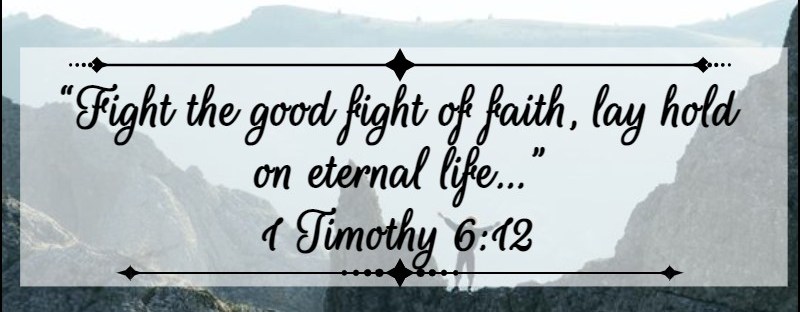
1 Timothy 6:12 “Fight the good fight of faith, lay hold on eternal life, whereunto thou art also called, and hast professed a good profession before many witnesses.”

So, Paul teaches, “Fight the good fight of faith.”  Fighting the good fight of faith is not about putting your dukes up.  It is all about putting your faith up.  It is more about taking a stand than taking a punch.  It’s ordering one’s life and steps according to the will of God for our lives (Psalms 119:133).  It is running the race of this Christian life and competing in this spiritual contest, pushing toward the finish line with every ounce of effort one possesses because there is a wonderful goal up ahead.

While we are pushing forth in the defense and protection and adherence to what we believe, we are doing so with the intent of laying hold of a prize.  Our prize is the “eternal life” we are living in hopes of.  At the end of any contest, at the end of the struggle, there is something wonderful we are looking forward to.  Our stand through all we are facing here is in light of the victory we are promised to gain in the end: “eternal life.”

Heaven belongs to the believers.  Life eternal is the ultimate prize for the one who refuses to give in or give up; to the one who does not get entangled by the things of this world others are chasing after (compare 2 Timothy 2:4).  That’s why Jesus once taught, “Labour not for the meat which perisheth, but for the meat which endureth unto everlasting life…” (John 6:27).  We have something better than money; we have something better than the materialistic things and social status’ down here to lay hold of.

Our purpose in being “called” and of having this “profession” of faith, is to pursue the things of God.  To be God-focused and heaven-focused, not world-focused and getting caught up in the things we presently see.  It is pushing past every contention here while keeping an upward focus for our future.

3. Our Outward Responsibility

1 Timothy 6:13 “I give thee charge in the sight of God, who quickeneth all things, and before Christ Jesus, who before Pontius Pilate witnessed a good confession;”

Our testimony before others matters and it is our responsibility to represent our Lord well. Therefore, in the strongest terms, Paul tells Timothy, “I give thee charge in the sight of God.”  If you have ever attended a graduation ceremony you may hear the word “charge” being used during the occasion when the higher-ups of the learning institution instruct the graduating class on how to apply their newfound knowledge with responsibility.  This is a word that Paul has chosen to use several times in his letter to Timothy to invoke the seriousness of all he is relaying to him.

And, to punctuate his statement even more with its importance, he is delivering this message before the same All-Mighty, Sovereign, and Supreme God of all the universe that breathes life into every being (“quickeneth”) and “Christ Jesus” who stood blameless with His “good confession” before “Pontius Pilate”, never wavering in what He spoke or knew was the truth.  Our Lord never raised the white flag of surrender, not even through the most difficult thing He would ever face.  Timothy, and all Christians alike, are to follow the example of our Lord with that same fierceness of our “good confession”. 

1 Timothy 6:14 “That thou keep this commandment without spot, unrebukable, until the appearing of our Lord Jesus Christ:”

With that, Paul continues to encourage Timothy to “keep this commandment without spot, unrebukable.”  Continue forth in the press of your faith; continue to live a life above reproach and accusation.  When Jesus comes back at His “appearing” (second coming), He’s coming back for a church “not having spot, or wrinkle, or any such thing; but that it should be holy and without blemish,” (Ephesians 5:27).

Yes, that might not meld well with the current culture of the world, but in Christ, we are not living to please the culture of this world; rather, we are living for a higher life and that requires the discipline of maintaining and keeping the faith without fail against all adversaries, including the flesh.  We who are called by His name are called to live like Him.  “He that saith he abideth in him ought himself also so to walk, even as he walked,” (1 John 2:6, see also 1 Peter 1:13-25; Matthew 5:48).  Our faith is on display as an example of the Christ we follow.  What people see being performed outwardly in our lives will speak volumes more than any message we could ever preach verbally.

4. Our Spiritual Readiness

1 Timothy 6:15-16 “Which in his times he shall shew, who is the blessed and only Potentate, the King of kings, and Lord of lords;  Who only hath immortality, dwelling in the light which no man can approach unto; whom no man hath seen, nor can see: to whom be honour and power everlasting. Amen.”

For when He comes “in his times,” all will see Him as He truly is.  We do not know the day or the hour (Matthew 24:36), but Peter teaches us, “The day of the Lord will come as a thief in the night…” (2 Peter 3:10).

Once, I wrote:

“Preoccupation with this world has so many in its clutches and has lulled multitudes into a false sense of security.  How many of our waking hours are spent on the temporary trappings of now instead of the glory that awaits our future?  Our time on this earthly sojourn is not infinite.  Time will pass.  Days will turn to night and eventually, at our proper time, we will step into eternity or as the older folk used to say, when Jesus cracks the sky – it will all be over.

Will we be ready or caught unawares?” (I Come Quickly/Word for Life Says)

Paul wants Timothy, and every Christian, to be aware of not only the life they are living, but the times they are living in, and the time they are living for.  Be ready.

Know that is God the Father is the “only Potentate, the King of kings, and Lord of lords,” meaning He, as noted above in verse 13, is supremely Sovereign, with all authority over all (Revelation 19:6).  The Lord reigns, the Bible tells us (Psalms 93:1; 97:1; 99:1)!  He is “the Lord sitting upon a throne, high and lifted up, and his train filled the temple,” (Isaiah 66:1).  He is God alone!

Scripture shows us that the Lord Jesus Christ is also known and called by the same description/title (noted above) being attributed to Him (Revelation 17:14; 19:16), and the Bible also encourages us in His power and authority (compare Colossians 2:10) and that we can take heart because our faith is complete in Him!  We are told, “That at the name of Jesus every knee should bow, of things in heaven, and things on earth, and things under the earth; And every tongue shall confess that Jesus Christ is Lord, to the glory of God the Father,” (Phil. 2:10-11).  He will be acknowledged as King forever.  The everlasting King will rule forever, and all will “bow the knee” in honor and recognition of who He really is!

God “hath immortality” meaning death and everything that comes with it can never be imposed on Him or appropriated to Him as to others.  Not that He simply just cannot die, but the very fact that His immortality is who He is, He is explicitly incapable of doing what is against the very nature and make up of Himself.    “From everlasting to everlasting, thou art God,” (Psalm 90:2).  As God in the flesh (1 Timothy 3:16; see also John 1:14, 1 John 1:2), Jesus Christ is conqueror over death.  2 Timothy 1:10 tells us, “But is now made manifest by the appearing of our Saviour Jesus Christ, who hath abolished death, and hath brought life and immortality to light through the gospel.”  Life everlasting is found in Christ who lives forever (see Hebrews 7:24).  Hold on to your faith that you may live eternally with Him!

God is He who is that “light which no man can approach unto.”  The Bible reminds us of the story of Moses asking to see God’s face, His glory, just how impossible this was (read Exodus 33:18-20).  Christ is where God is in that glorious place and it is God’s glory that illuminates all of heaven (see Revelation 21:23).  It is a place too wonderful for man to obtain on his/her own; whom without Christ, we would not be admitted into the presence of God.  Keep pursuing and fighting the good fight of faith that you may be able to enter in to be with Him “whom be honour and power everlasting. Amen.”

5. Our Quest for the Greater Gain

1 Timothy 6:17-19 “Charge them that are rich in this world, that they be not highminded, nor trust in uncertain riches, but in the living God, who giveth us richly all things to enjoy;  That they do good, that they be rich in good works, ready to distribute, willing to communicate;  Laying up in store for themselves a good foundation against the time to come, that they may lay hold on eternal life.”

“Charge them that are rich in this world, that they be not high-minded, nor trust in uncertain riches.”  In light of all of this, teach people what is the greater gain, Timothy!  Wealth, notoriety, social status, and the things the world applauds are not what counts.  They are fleeting and will pass away.  “For riches are not for ever: and doth the crown endure to every generation?” (Proverbs 27:24).  Nothing we accumulate here will last forever.  Therefore, don’t put your trust in things but put your trust in the God “who giveth us richly all things to enjoy;” who gave you those things in the first place.

And, when He blesses, use those blessings, not just for yourself, but turn them into “good works” by sharing and positively impacting the lives of others.  Part of fighting the good fight of faith is using what we have to lift others and offer help and support when and where it is needed; not be self-focused, but others-focused.

This, in turn, benefits us spiritually as well in the long run.  For we are “laying up in store… a good foundation against the time to come.”  With “eternal life” ever-present in the mind of the believer, that one lives with not only their own life of faith in their hearts but with the concern of others there as well.  What we do in the here and now impacts our future to come.

6. Our Standing in the Truth

1 Timothy 6:20-21 “O Timothy, keep that which is committed to thy trust, avoiding profane and vain babblings, and oppositions of science falsely so called:  Which some professing have erred concerning the faith. Grace be with thee. Amen.”

Therefore, Timothy, “Keep that which is committed to thy trust.”  All that Paul is teaching Timothy, all that entails this life of faith, Timothy is to pursue it, fight for it, and guard against anything contaminating it such as “profane and vain babblings, and oppositions of science falsely so called.”  There was a lot of talk with a lot of false teaching that Timothy was to guard himself and guard the faith against.  Everything that sounds good is not good.  Timothy, hold on to the truth and fight to stand in it!

Even though some “professing have erred concerning the faith,” meaning having been drawn away into believing what is false, you Timothy, continue in the good fight of faith.

The world today is full of false teachings that may sound right, but if it does not match up with the Word of God in its entirety, it is false, and we would do good to stay away from it, too.

As Timothy is, so are we to be just as diligent in our press for our faith.  Our prize for a race well-run is set in the Heavenlies where it will neither tarnish nor fade with time but will last into all eternity.  May we pursue after and fight the good fight of faith that we too may gain that greater reward.

PDF Full Printable Sunday School Lesson Pack (With easy to read instructions following the P.E.A.R.L. format on how to conduct each lesson with areas for adding personal notes): Sunday School Lesson – Pursuing the Good Fight of Faith

Suggested Activities:

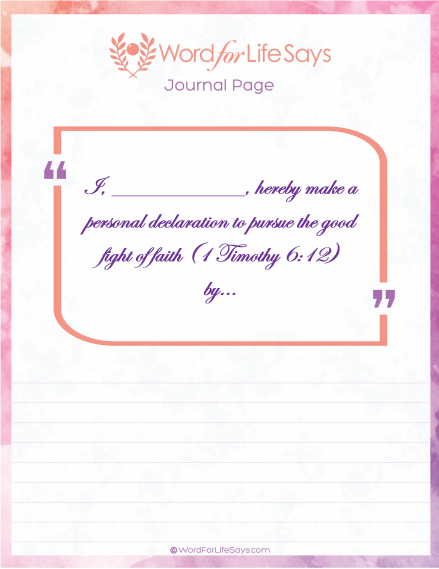
Adult Journal: Adult Journal Page – Pursuing the Good Fight of Faith

Adult Journal Page - Pursuing the Good Fight of Faith

Kid’s Journal: Kid’s Journal Page – Pursuing the Good Fight of Faith

Kid's Journal Page - Pursuing the Good Fight of Faith

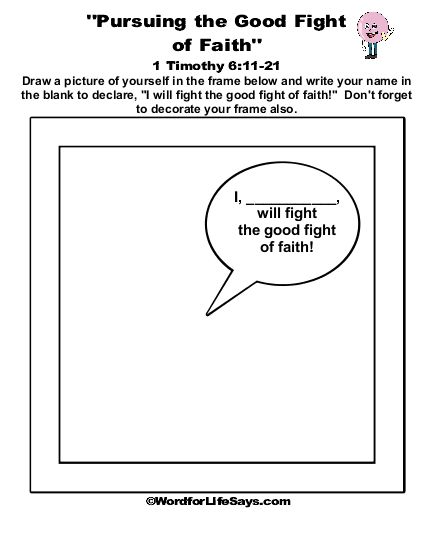
Draw the Scene: Pursuing the Good Fight of Faith Draw the Scene

Pursuing the Good Fight of Faith Draw the Scene-001

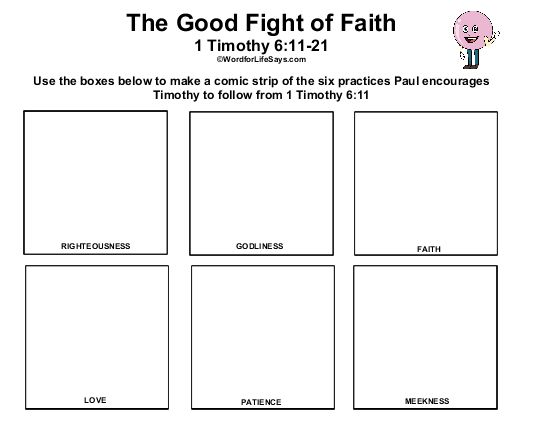
Craft: Collage Craft: In the lesson, Paul described six practices for Timothy and all Christians to follow in verse 11. Find pictures from old magazine, books, comics, etc. and make a collage of examples of each of these practices being used.  For an alternate activity, use The Good Fight of Faith Comic Strip activity page for students to draw these examples instead.

The Good Fight of Faith Comic Strip-001

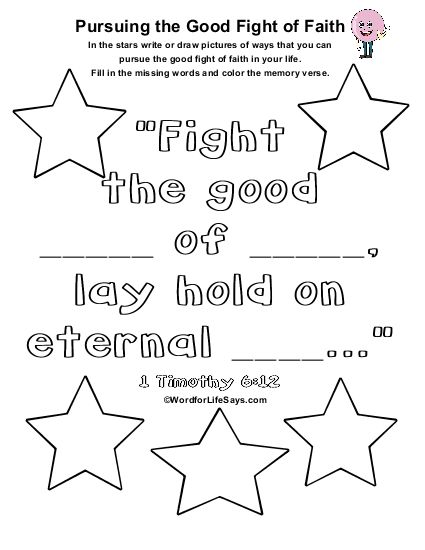
Memory Verse: Pursuing the Good Fight of Faith Memory Verse

Pursuing the Good Fight of Faith Memory Verse-001

How Many Words: The Good Fight of Faith How Many Words

The Good Fight of Faith How Many Words-001

Word Search: Pursuing the Good Fight of Faith Word Search Answers: Pursuing the Good Fight of Faith Word Search Answers

Crossword: Pursuing the Good Fight of Faith Crossword Answers: Pursuing the Good Fight of Faith Crossword Answers

Word Scramble: Pursuing the Good Fight of Faith Word Scramble Answers: Pursuing the Good Fight of Faith Word Scramble Answers

Copyright © Word For Life Says.com (Sharing any posts or lessons can only be done through the share buttons provided on this site from the original posts, lessons, and articles only. You can reblog from the original posts only using the reblog button provided, or share using the share buttons provided from these social media platforms: Facebook, Twitter, or Pinterest, etc., and they must be shared from the original posts only. All other repostings are prohibited. Posts and other items of interest found on this site MAY NOT BE COPIED AND PASTED, downloaded, uploaded, etc to another website or entity not listed (physical or electronic).  See COPYRIGHT PAGE for more details.

Sunday School Lesson – “Faith Without Works is Dead” James 2:14-26

VERSE DISCOVERY: James 2:14-26 (KJV, Public Domain)

Remember the days of “Show and Tell” at school?  It was an opportunity for one to not just talk about what they do or have, but to display visible evidence before their classmates of a possession or skill.

Jesus was a “Show and Tell” Savior.  He drew many crowds to Himself through the many miracles that He performed: feeding 5,000, healing the sick, raising the dead, and so on.  People would often marvel at what He could do.  He did more than just talk the talk or preach and lecture, He demonstrated the power of the Kingdom of God through Himself.

While you and I may not be multiplying a boy’s lunch to feed 5,000, we can through our actions and service toward one another, volunteer to feed some.  We may not be raising the dead or healing the sick (although, miracles really do still happen), we can volunteer to comfort and help those around us in need.  What this does is it shows that we are more than just talk; rather our faith is manifested in what we do.

James knew that people needed to see the church displaying tangible evidence of what they say they believe, especially when it comes down to how we treat one another.  Jesus, along with many others in the Bible, let their works speak for them.  And, how they worked showed what the real measure of their concern and faith was on the inside.

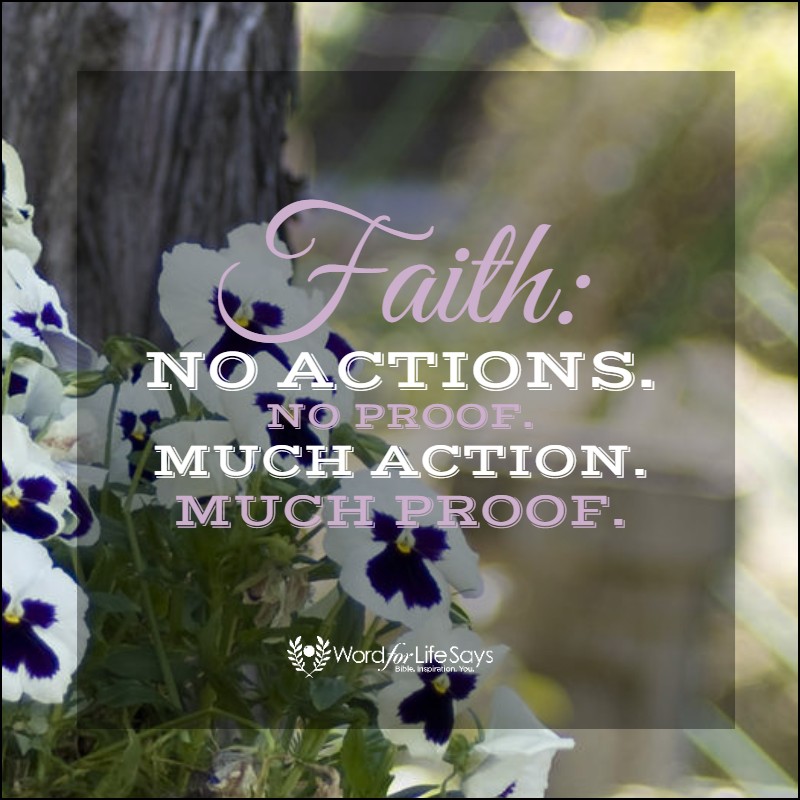
No Actions. No Proof.

 James 2:14 “What doth it profit, my brethren, though a man say he hath faith, and have not works? can faith save him?”

This section of verses picks up right where James left off his teaching against having respect of persons and dealing with how we treat people.

In my opinion, right at the beginning of this lesson, James seems to be questioning the validity of someone’s faith without works, without evidence.  He said, “What doth it profit?”  What does it profit you?  What does it profit for others around you?

For a man or woman to say they have faith or are in the faith without evidence to back it up is like saying one is a doctor without a degree to prove it.  When I go into a doctor’s office, I am one of those people who will read the accreditations on the wall.  This is proof that they can take care of me.  What I see before me is speaking up on behalf of the individual to whom I am submitting myself for care.  Those papers hanging on the walls are little, personal testimonies.

Faith that is worked out operates in the same manner.  Faith is not silent.  Faith is full of action.  Faith is alive.  Faith is shared through works to testify of its genuineness and sincerity.  Faith does more than move mountains.  If it is lived out in the lives of the men and women of God, it can help move hearts toward salvation!

When one is living a life of faith people should be able to look at their life, their actions, as signs of accreditation that we belong to God.  They should be able to tell by how we operate and carry ourselves through our display of service, that we live what we talk.

Where is the profit if there is no proof?  What can you and I show to a hurting world that we have their best interest in mind; that we genuinely care about them as a person?

James 2:15-16 “If a brother or sister be naked, and destitute of daily food, And one of you say unto them, Depart in peace, be ye warmed and filled; notwithstanding ye give them not those things which are needful to the body; what doth it profit?”

Is this one’s faith real or not?  Words without supplying to the physical, emotional, or spiritual comfort and support of another in distress are what these two verses speak of.  But, all too often, how many times have we heard or spoken of what should be done to help others without putting in some work to help society move toward that goal?

All that talking becomes useless speech.  Unless we move past the act of just talking and show that we care through the act of doing; unless we put some backbone and muscle behind our mouths, the world will never see the true love of Jesus Christ in action.

That is what it’s all about, isn’t it?  It is going beyond pulpits and church walls to work at meeting the needs of the communities that we are in, to put the love of Christ on display through our actions and not just our words.  Obviously, some people, churches, and communities can do more than others.  That is not what James is after here.  He just wants us to get up, move past complacency, and just do something.

James saw no positive effect for others in just words alone.  Speaking “peace” without lifting a finger to physically help satisfy the present need, to him it was not true faith.  True faith believes and then allows that belief to be put to work.  True faith has heavenly aspirations that work out to show good on earth.  So, he asked, “What doth it profit” without it?  What is each of us doing now that is benefiting his fellow man and the kingdom of heaven?

James 2:17-18 “Even so faith, if it hath not works, is dead, being alone.  Yea, a man may say, Thou hast faith, and I have works: shew me thy faith without thy works, and I will shew thee my faith by my works.”

What you profess and what you do together should match up to display a well-rounded Christian.  People cannot claim they are heaven bound and yet show no heavenly fruit in their lives.  Such claims to faith are “dead,” meaning there is nothing in it to prove it is alive and real.

Don’t you know, you can start today to make a difference?  You can start where you are and with what you have.  You do not need a personal invitation to love and serve others.  What are you waiting for?  Show the world that God is alive in you!  Put some action behind those words you speak!

One may say, “Thou hast faith, and I have works: shew me thy faith without thy works, and I will shew thee my faith by my works.”  Our faith, which comes through hearing the Word of God (Rom. 10:17) should compel us to actively participate in the things that are written of or spoken through that Word; it should get us involved in the things that God is concerned about.  The faith that shows that the Word is working in us is the faith that can do more.  Therefore, faith and works do not go against each other, rather, they support one another in proving that Christ is alive and active on the inside of the believer (compare with James 2:22 notes below).

When that happens, this, in turn, shines a light to the world reflecting Him.  Matthew 5:16 says, “Let your light so shine before men, that they may see your good works, and glorify your Father which is in heaven,” (emphasis mine).  This light shines by what it is doing; by “good works.”  This kind of faith can make a bigger impact in this world and draw more people to God.

James 2:19-20 “Thou believest that there is one God; thou doest well: the devils also believe, and tremble.  But wilt thou know, O vain man, that faith without works is dead?”

One’s claim to faith goes beyond just believing in the very real fact that there is a one and only true living God.  It is living out that belief in one’s daily life.  It’s working His works.  James opened our perspective this way by saying that’s good; that’s a start, that’s right, “thou doest well” to believe.  Everything in our faith walk begins with believing.  But, where does it go from there?    

He goes on to say, “The devils also believe, and tremble,” but they’re still “devils.”  They know there is a God.  They believe He exists, but they are not bowing their selves to working His works.  They are not obeying Him.  They are not working His will.  They are not in a relationship with God; rather, they work against everything God is, loves, and stands for.

But, what of those who claim they are in a relationship with God through faith?  Where is the fruit of their faith?

Faith without fruit is not an operational faith.  It is stale.  It’s stagnated.  It does no good.  Real faith must act out what it is experiencing on the inside.  Real, genuine faith will not just be content in a life of mediocrity – never accomplishing or making a difference for His kingdom.  Real faith wants to see better in and for people’s lives.  Real faith shows itself and overflows to those around him or her.

Therefore, if faith is meant to be alive and active and shown to the world through works, then “faith without works is dead.”  The one who claims they believe without any evidence to support that proclamation is “vain,” useless, hollow, in other words, no good.

Rather, when we come to that great and glorious day, Jesus wants to say, “Well done, good and faithful servant; thou hast been faithful over a few things, I will make thee ruler over many things: enter thou into the joy of thy lord,” (Matthew 25:23, emphasis mine).  Those who have put their faith into action and have “done” something with what He has given them can make a difference.  God can use people like this in the world.  But He cannot do that unless you work what He has given you.

If it is not working – it’s “dead.”  It’s lifeless with no functioning activities.  It is useless!

Much Action. Much Proof.

James 2:21-24 “Was not Abraham our father justified by works, when he had offered Isaac his son upon the altar?  Seest thou how faith wrought with his works, and by works was faith made perfect?  And the scripture was fulfilled which saith, Abraham believed God, and it was imputed unto him for righteousness: and he was called the Friend of God.  Ye see then how that by works a man is justified, and not by faith only.”

Genesis 15:6 declares of Abram, “And he believed in the LORD; and he counted it to him for righteousness.”  This was after God told him to count the stars and see if he could number them.  God then told him, “So shall thy seed be,” (Genesis 15:5).

At another point, Abraham was forced to send Hagar and Ishmael away, but God gave him this promise: “for in Isaac shall thy seed be called,” (Genesis 21:12).

Then there came the day when Abraham’s faith was tested to see if he still believed in the God of those promises that were spoken unto him; to see if the faith and righteousness that was attributed to him was true on the inside and not just an outward, surface claim to faith.  By taking action to obey God in going forth with the procedure to offer “Isaac his son upon the altar,” he manifested through his works the very realness of his faith.  His faith, in turn, became a testimony before the whole world.  Abraham’s story does not just talk about faith, it shows how his faith was worked out (compare Hebrews 11:17-19).

His actions demonstrated his heart.  “Seest thou how faith wrought with his works, and by works was faith made perfect.”  Pay attention to that word “with” (compare this to the notes above in James 2:18) which speaks to the accompanying factor of each coming alongside one another as agents together to show what he was really made of; to show his true belief in God alone, regardless of the way things outwardly appeared.  Jointly, they showed his true faith nature, and jointly, “by works was faith made perfect,” or complete.

“And the scripture was fulfilled which saith, Abraham believed God, and it was imputed unto him for righteousness.”  Referencing the above verse quote I noted earlier from Genesis 15:6, James saw a fulfilling of that verse through the actions of Abraham, through his obedience.  Abraham’s faith was real, and it was shown by what he did (compare Romans 4:3; Galatians 3:6).

“And he was called a friend of God.”  Abraham’s experiences with God drew his heart closer to God in obedience and in turn, he was considered a friend of God (compare 2 Chronicles 20:7; Isaiah 41:8), in such a way that God was even able to reveal to Abraham what His plans were for the destruction of Sodom (see Genesis 18:17-18).

Jesus once taught, “Ye are my friends, if ye do whatsoever I command you.  Henceforth I call you not servants; for the servant knoweth not what his lord doeth: but I have called you friends; for all things that I have heard of my Father I have made known unto you,” (John 15:14-15).  As His Father revealed to Abraham, His friend, of His plans, so too does Jesus reveal the will of God to those disciples, to those who obey Him, for they are His friends, too.

James put the two together as in a great summation: “Ye see then how that by works a man is justified, and not by faith only.”  James was calling his readers to put their faith on display.  To show they had a lively faith.  To show the world that you are not just all talk, but the love of Christ is in you and manifesting through you to touch a world in need.  Put Him on display that when eyes see you, they might see Him.

The Apostle Paul put it like this, “Be ye followers of me, even as I also am of Christ,” (1 Corinthians 11:1).  In the chapter before, he left off saying he was not seeking his own profit.  But in all that he did, he was seeking the “profit of many, that they might be saved,” (1 Corinthians 10:33).

While works cannot save us they show that we are saved, they are telling proof that we are “justified” and moving in the same direction as our Christ.  And, what we do, can, in fact, profit others (compare to Paul’s statement above from 1 Corinthians 10:33 regarding what he was doing was for the “profit of many” and James asking in the above verses (James 2:14-16), about what does it profit when the works are missing from the faith).

James 2:25 “Likewise also was not Rahab the harlot justified by works, when she had received the messengers, and had sent them out another way?”

Here is another example of WHAT YOU DO MATTERS!  I cannot overemphasize those words enough.  Rahab could have lost her life if she had been found helping the enemy of her people.  But she heard about all God had done in delivering His people against their enemies (Joshua 2:10) and it made the people of Jericho’s hearts melt (Joshua 2:11).  But Rahab believed for more. She said, “I know that the LORD hath given you the land, and that your terror is fallen upon us,” (Joshua 2:9). Not only did she express belief in all that God has done and was still doing, but she also went as far as to take these men in her home and personally sought for their care and safety.  That was a bold step for her.  Her faith was put into action.  To make a long story short, for those in her house, their lives were spared in the fall of Jericho because of her active, working faith which landed her in the hall of fame of faith (Hebrews 11:31).

James 2:26 “For as the body without the spirit is dead, so faith without works is dead also.”

The body is a physical shell, so to speak, that houses the spirit.  At the time of death, the spirit departs and goes back to God (Ecclesiastes 12:7) leaving behind the lifeless shell that remains.  When we attend funerals and view our dearly departed all we see is what is left, the outer man, the shell.  “So faith without works is dead also.”  Faith, without the outward workings of tangible evidence, is just as dead as a body without a spirit.  Life is not represented there.

Our actions testify to the faith that we say we have in us.  What we do or how we live out our faith matters.  Jesus taught, “Verily I say unto you, Inasmuch as ye have done it unto one of the least of these my brethren, ye have done it unto me,” (Matthew 25:40; read Matthew 25:31-46 for further explanation).

Let us remember, we are not saved by works: “For by grace are ye saved through faith; and that not of yourselves: it is a gift of God: Not of works, lest any man should boast,” (Ephesians 2:8-9).  Rather, works give proof to the faith living on the inside of you: “Even so faith, if it hath not works, is dead, being alone,” (James 2:17).

No action.  No proof.  Much action.  Much proof.

PDF Printable Sunday School Lesson Pack (With easy to read instructions following the P.E.A.R.L. format on how to conduct each lesson with areas for adding personal notes): Sunday School Lesson – Faith Without Works is Dead

Suggested Activities:

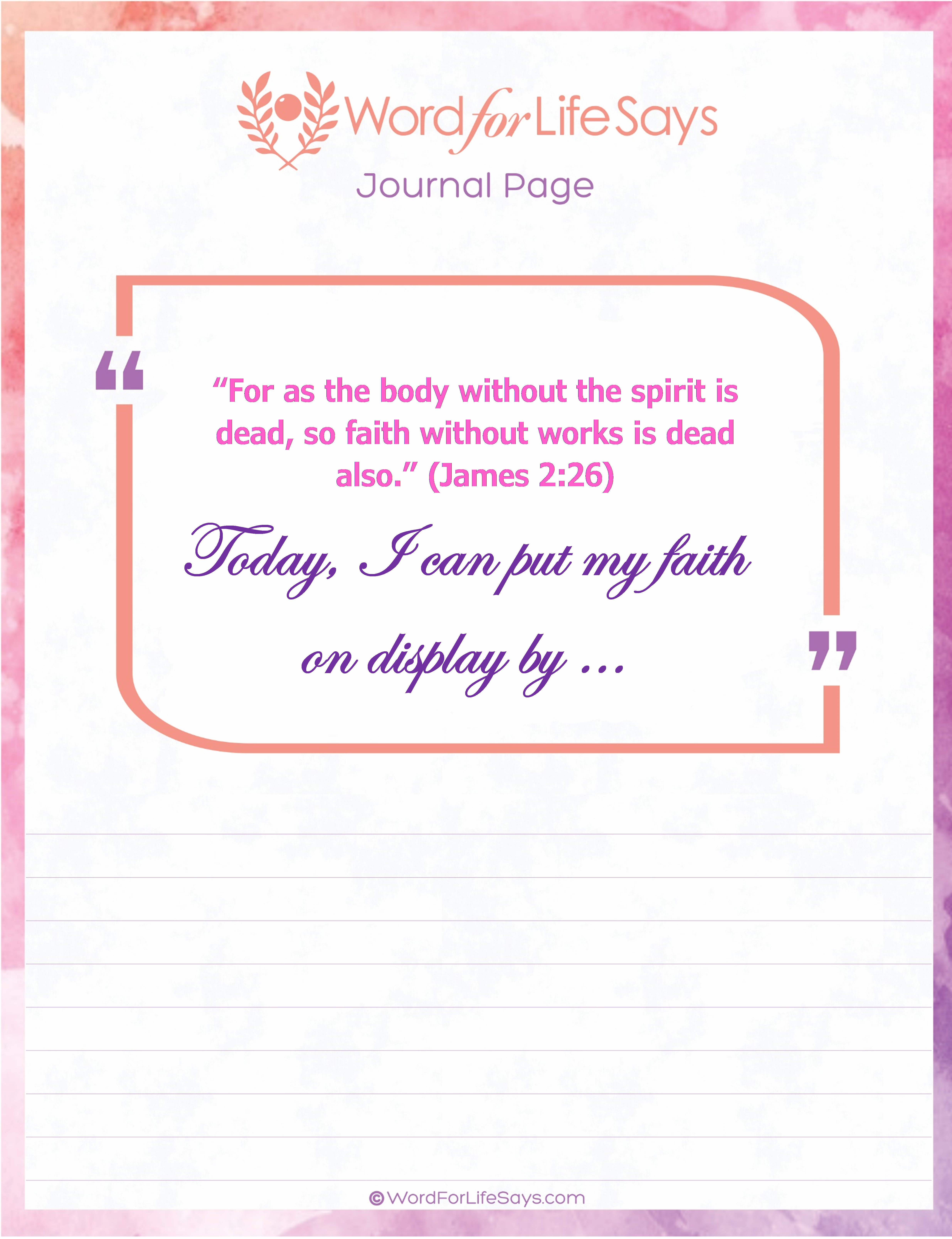
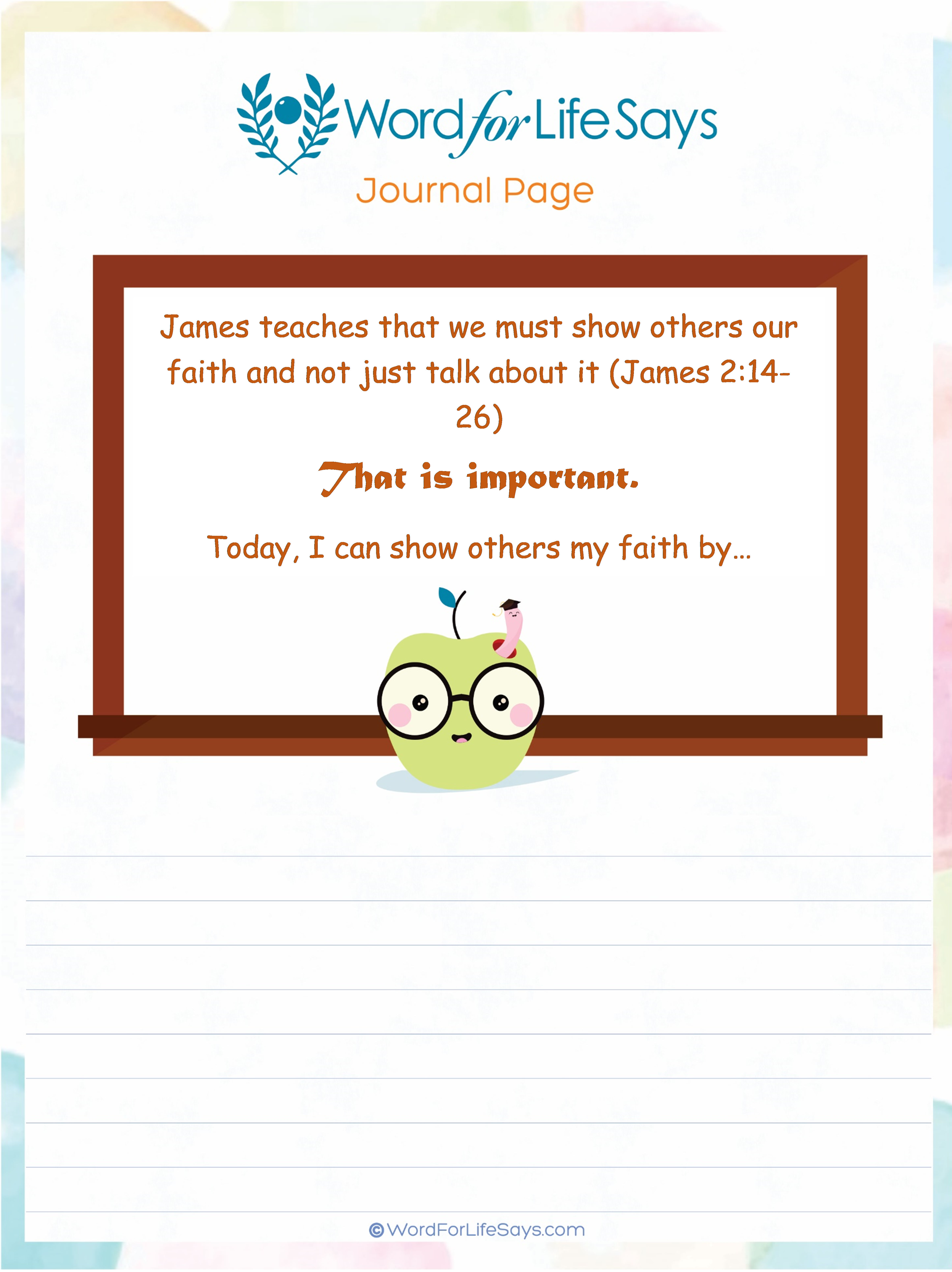
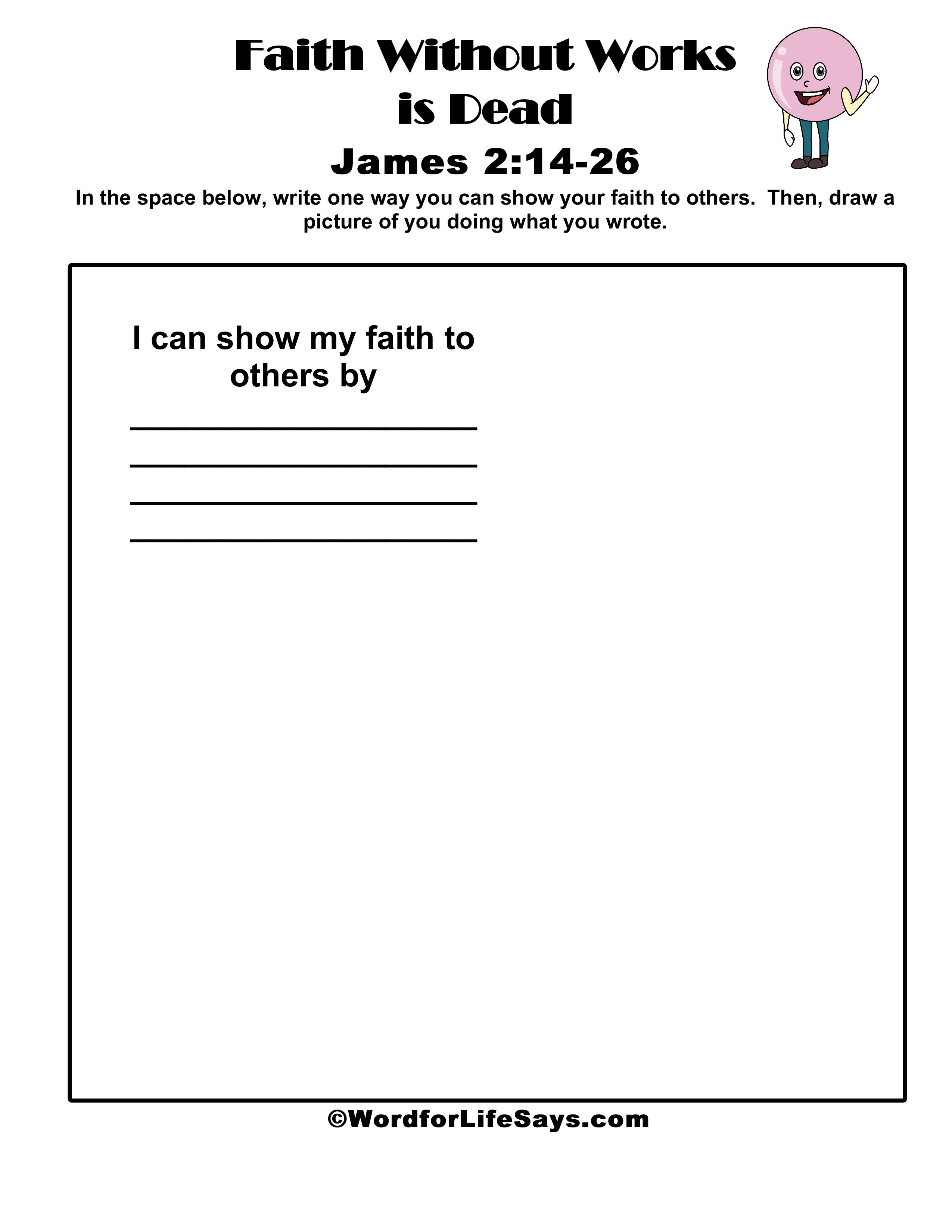
Adult Journal Page: Adult Journal Page – Faith Without Works is Dead

Kid’s Journal Page: Kid’s Journal Page – Faith Without Works is Dead

Blank Journal Pages: These pages, one designed for adults and one for children, can be used to bring out, remember, or write a particular part of the lesson you wish for you and/or your class to focus on.  Click>>Blank Adult and Kid’s Journal Pages to access the journal pages.

Draw the Scene: Faith Without Works is Dead Draw the Scene

In getting across the idea of “Faith Without Works is Dead” I used crafts incorporating the hands (as seen in previous lessons) since that’s what we use the most to show other’s love to and help them (see below). Enjoy!

LACE IT UP HANDPRINT:

One craft idea is to simply have students trace their handprint on cardstock or use this Handprint Craft Cutout printed on cardstock for this project because it’s sturdier, and then cut it out.   Using a hole punch, go around the outer edges of the picture of the hand (these will be for lacing).  Students can then decorate and lace with ribbon, colorful shoelaces, or yarn (note: if you use ribbon like I did, you may want to wrap the ends in tape to make a little aglet like on a shoelace to make it easier to navigate through the holes).  You or your students can even write a memory verse reference directly on your project. (Example pictured below)


HANDPRINT NECKLACE:

Continuing with our hand theme, students can make a Handprint Necklace (example pictured below – I used construction paper with tracing).  Students can trace their handprint onto construction paper or cardstock or use this Handprint Craft Cutout and cut out.  Punch one hole in the top.  Using ribbon or yarn and cut up straws, beads, or whatever you have laying around (even loop cereal).  Let them have fun and decorate it as they see fit. You or your students can even write a memory verse reference directly on your project.

Charades: To bring home the idea of “doing”, have students play a game of Charades.  But, for this game of charades, have ideas in the bucket that people can do to help others, make them feel loved, and show your faith (ex. Sweep the floor for someone, pick flowers to show love, wash the dishes to be helpful, visit the sick, welcome everyone, etc.)  Emphasize there are a lot of ways we can show our faith through our “doings”.  You can even have students come up with ideas to throw in the bucket and see if others can figure out what they wrote.

Card Match: Play any card matching game (or make your own using ideas from the lesson) to highlight the idea of how our actions should “match” the faith we say we have.  If you do not want to do a “Show and Tell” as a lesson opener (as listed in the PDF lesson packet), this activity would work well in its place as an object lesson.

Word Search: Faith Without Works is Dead Word Search  Answers: Faith Without Works is Dead Word Search Answers

Crossword: Faith Without Works is Dead Crossword  Answers: Faith Without Works is Dead Crossword Answers

Word Scramble: Faith Without Works is Dead Word Scramble  Answers: Faith Without Works is Dead Word Scramble Answers

Copyright © Word For Life Says.com (Sharing any posts or lessons can only be done through the share buttons provided on this site from the original posts, lessons, and articles only. You can reblog from the original posts only using the reblog button provided, or share using the share buttons provided from these social media platforms: Facebook, Twitter, or Pinterest, etc., and they must be shared from the original posts only. All other repostings are prohibited. Posts and other items of interest found on this site MAY NOT BE COPIED AND PASTED, downloaded, uploaded, etc to another website or entity not listed (physical or electronic).  See COPYRIGHT PAGE for more details.

Sunday School Lesson – “Made Righteous in Christ” Romans 3:21-31

VERSE DISCOVERY: Romans 3:21-31 (KJV, Public Domain)

Since “all have sinned, and come short of the glory of God,” (Romans 3:23; discussed further in this lesson), then how can one ever be truly justified by a holy and righteous God?

The answer is a simple one although it is not always simply accepted: Jesus Christ.  Through His sacrificial atoning of our sins, He changed our former status into one who now becomes righteous in the eyes of our righteous God, Paul explains in this lesson.

The Righteousness of God

Romans 3:21-22 “But now the righteousness of God without the law is manifested, being witnessed by the law and the prophets; Even the righteousness of God which is by faith of Jesus Christ unto all and upon all them that believe: for there is no difference:”

Although the Apostle Paul did not plant the Church in Rome as he had in other cities, he still took a fatherly-leadership role in helping this church to thrive to be all that God calls them to be.

He prayed for them and desired to visit them (1:1-15), but in the meantime, he wrote this letter to encourage and instruct them on the matter of salvation, God’s righteousness, and how we as sinners, can be made righteous in the eyes of God.

After establishing his fearless zeal in wanting to preach the gospel to them, for in it, he knows, “the righteousness of God” is revealed (1:15-17), which is really the main focus of this letter, Paul continues on discussing what all this means.

God’s righteousness can be described as everything just and right and holy.  God is right, there is no other way to put it.  What He does is right.  Always.  His ways are higher than ours and they are above reproach (Isaiah 55:8-9).  Opposite that is the “ungodliness and unrighteousness of men” (Romans 1:18).

Since the Fall in the garden, mankind has been corrupted by sin.  Since that day, when the age of innocence has passed off the scene, mankind has been subjected to the “wrath of God” (1:18), “Because that, when they knew God, they glorified him not as God” (1:21).  They, mankind, are accused of changing the glory of God (1:23) and the truth of God (1:25) to follow after sinful ways.  Although creation itself testifies to the power of God (1:20), Paul sums up the ungodly truth of sinful man by saying, “Who knowing the judgment of God, that they which commit such things are worthy of death, not only do the same, but have pleasure in them that do them.” (Romans 1:32).

God’s judgment is against ALL SIN and He will render to “every man according to his deeds,” (2:6).  It doesn’t matter who they are, Jew or Gentile.  It doesn’t matter if they have been raised in the Law or not (2:11-15).  Anything that one can boast in outside of faith in Jesus Christ will profit nothing in that coming day (more on this later).

The law cannot justify one before God.  The law, and it’s following the adherence thereof, cannot earn one true salvation.  The law’s purpose was to bring about “the knowledge of sin,” (3:20), but it could never erase sin for good and make people righteous before God.

Then Paul introduces a “but now” moment that begins to explain how the “righteousness of God” is “manifested.”  This “but now” introduces the wonderful realization that mankind is not left to drift in the world of sin without help; without an anchor to steady and save them.  There is a way for them to receive “the righteousness of God” and it is “by faith of Jesus Christ unto all and upon all them that believe.”

In Christ, lies that hope to be justified before the Father, accomplishing something the law never could do.  “For what the law could not do, in that it was weak through the flesh, God sending his own Son in the likeness of sinful flesh, and for sin, condemned sin in the flesh: That the righteousness of the law might be fulfilled in us, who walk not after the flesh, but after the Spirit,” (Romans 8:3-4).

In the work of the cross of Christ, salvation is available for them that believe.  Jesus Christ is the only answer to heal mankind from their dreaded sinfulness and to make them right before a holy and just God, “upon all them that believe.”

It doesn’t matter who they are, where they’re from, or what they’ve done: “there is not difference.”  Any and all who turn to Jesus Christ by faith can be saved.  The answer to all our sins’ woes is fulfilled in what Christ accomplished on the cross (compare Romans 10:12).

All Have Sinned and Need to be Justified

Romans 3:23-26 “For all have sinned, and come short of the glory of God; Being justified freely by his grace through the redemption that is in Christ Jesus: Whom God hath set forth to be a propitiation through faith in his blood, to declare his righteousness for the remission of sins that are past, through the forbearance of God; To declare, I say, at this time his righteousness: that he might be just, and the justifier of him which believeth in Jesus.”

Just as there is no difference in who can receive the righteousness of God by faith in Christ, there is no difference in who can be categorized as a sinner in need of this grace, in need of redemption, “For all have sinned, and come short of the glory of God.”  Everyone who ever was and ever will be needs to be saved by the redemptive blood of Christ.  No one measures up to God’s standard on their own.  We all need Jesus!

It is through Him, where one can be “justified freely by his grace.”  The word “justifies” signals the “being made right before God” part, while “grace” speaks of the undeserving mercy we receive in that.  Our guilt had us bound, but Jesus set us free through “redemption,” by redeeming us.  He paid the cost.  He “gave himself a ransom for all, to be testified in due time,” (1 Timothy 2:6).  So that our eternity could be secured before the Father, He “freely” satisfied the demand against mankind’s sin.

Jesus became our eternal sacrifice that atoned for our sins once and for all: “Whom God hath set forth to be a propitiation through faith in his blood.”  The Bible declares and attests to this truth in other areas, saying, “Herein is love, not that we loved God, but that he loved us, and sent his Son to be the propitiation for our sins,” (1 John 4:10).  The word “propitiation” in both of these verses speak of Christ’s complete, atoning sacrifice.  “His blood” was shed that we might be made free (compare Hebrews 10:4).  Christ died for our sins.  Our justification is not a human invention.  God “set forth” Christ and the plan of salvation through Christ.

“To declare his righteousness for the remission of sins that are past.”  Not only today are our past sins taken care of, but the yesterday and the yesteryear sins of sinners are taken care of for all who believe, both before the cross and after the cross (compare Ephesians 1:7; Hebrews 9:15)!  Hallelujah!  The “past,” and those in the past, have been covered by the cross, also!  The cross, and what Jesus did on the cross, is enough to satisfy and uphold the demands of God’s “righteousness” against the sin and sinners of today, yesterday, and forevermore.  Nothing else is needed.  It has already been proven that nothing else will do (read Hebrews 9:12-14).

“Through the forbearance of God.”  God’s own “righteousness” (above), which is the very “habitation of His throne” (Psalm 97:2), is shown in His willingness and longsuffering to withhold final actions upon mankind’s sin as a whole before the time of the cross.  At the time of His death, all sin, past, present, and future, were placed upon our Savior as He hung on that cross.  It’s what one does with the revelation of the cross for their own life that makes the difference.  This is what one will be judged by.

God has always been fair in His actions toward humanity, sinful though they may be.  He gives everyone time and space to repent: “The Lord is not slack concerning his promise, as some men count slackness; but is longsuffering to us-ward, not willing that any should perish, but that all should come to repentance,” (2 Peter 3:9).  But, as we know, all will not come to repentance.  The time of ignorance is over and there is an appointed day for the judgment for all, past, present, and future (Acts 17:30-31).

But, for the one that “believeth in Jesus,” God justifies.  Because of what Christ did, and because of our belief and acceptance of what Christ did as our Savior, God credits that to our account as righteousness.  God declares them/us right and justified!  Mankind, any person in human history outside of Jesus Christ, is far from perfect and right in the eyes of God.  But, when one believes in Jesus, for all He accomplished on the cross and accepts that sacrifice for their life; when God looks at that person, He no longer sees them and their wrongs.  He sees Jesus and His right, and He is the one that declares them now to be righteous.

By Faith, Jesus is Enough

Romans 3:27-31 “Where is boasting then? It is excluded. By what law? of works? Nay: but by the law of faith.  Therefore we conclude that a man is justified by faith without the deeds of the law.  Is he the God of the Jews only? is he not also of the Gentiles? Yes, of the Gentiles also: Seeing it is one God, which shall justify the circumcision by faith, and uncircumcision through faith.  Do we then make void the law through faith? God forbid: yea, we establish the law.”

Because everything is based solely on what Christ has done, and because it is only God who is able to aptly justify one, what right does anyone have for “boasting”?  They don’t!  That’s the plain and simple truth. No one can make themselves righteous.  No “law” could declare one righteous.  Nor, could any “works” (compare Ephesians 2:9).  Salvation is not something that can be earned.  It is something we are blessed with through “faith.”

Instead of being a source of contention, this should be a relief, for salvation does not depend on what a person can do perfectly, it only depends on what Christ has already done perfectly.  Only the self-righteous would find some kind of joy in trying to pat themselves on the back for a job well-done in trying to get to heaven for all eternity on their own accord or by their own works.  But self-righteousness won’t get you or me there.  Only those who are found Christ-righteous will enter in.

Therefore, “boasting” is kicked to the curb.  “Boasting” is a symbol of pride.  “Boasting” glorifies self and what self can accomplish on its own.  But salvation, I repeat, is NOT something that people can accomplish on their own.  Everyone needs forgiveness and reconciliation through Jesus Christ!  “No flesh shall glory in his presence,” (1 Corinthians 1:29).  National heritage, religious pride, or any other reason one may exalt themselves believing them worthy of this great gift by what they have done or do – all of that is made null and void before the perfect sacrifice of Christ.  For it is ONLY “by grace are ye saved through faith; and that not of yourselves: it is the gift of God,” (Ephesians 2:8).

True salvation requires true “faith” in the right source, and we are not it, nor were the receivers of this letter in the Roman church.  What self can do is not it.  The gospel tells the story and the way of that right source who is Christ our Lord.  He is it!  Any other way outside of Christ is “excluded.” 

“Therefore we conclude that a man is justified by faith without the deeds of the law,” Paul said.  The reality of this truth permeates Paul’s letter to the Roman Christians.  Prior to reaching the text of study in this lesson, in verse 20 of this same chapter, Paul writes, “Therefore by the deeds of the law there shall no flesh be justified in his sight…”  Later in Romans, he will write, “Therefore being justified by faith, we have peace with God through our Lord Jesus Christ,” (Romans 5:1).  Here, he is declaring exactly what Christ’s sacrifice on the cross accomplished for the sin-sick soul.  He justified us and made us right with the Father (Romans 5:1).  None of this was based on our own efforts or human goodness.  Our new position in Christ was and is solely based on the sacrificial love of Christ that propelled Him through any hurt and pain He was personally feeling to think outside of Himself and see a world of humanity drowning in an ocean of wayward disobedience and rebellion leading them to a lost path of which there is no return unless their souls be saved!

Because of what He did, we now have “access by faith into this grace” and we have a reason to “rejoice in hope of the glory of God,” (Romans 5:2).  With His blood, He bought the key that would give us an open door to our heavenly Father.  And, with everything we face, our end reward is hope (Romans 5:3-5).

He, Jesus, did it all for us and our job is to whole-heartedly accept it, accept His work, accept His sacrifice “by faith.”  Those words, “by faith”, “through faith”, “the law of faith”, and other references to faith appears no less than thirty-seven times in the book of Romans alone.  The “law”, and the works of the law couldn’t do it (compare Acts 13:38-39).  “For therein is the righteousness of God revealed from faith to faith: as it written, The just shall live by faith,” (Romans 1:17).  It’s a faith thing!

And, this is God’s plan for all.  It’s not just for the “Jews” or for the “Gentiles.”  There is only “one God” with one plan of salvation for all to accept: faith in what Jesus Christ has already done.

Does this make the law “void”?  Absolutely not!  Through Christ, God fulfilled the law.  The law was “established”.  Before His death, Jesus plainly stated, “Think not that I am come to destroy the law, or the prophets: I am not come to destroy, but to fulfil,” (Matthew 5:17).  In Him, the requirements of the law were fully and completely satisfied.  Therefore, God is just when He makes one righteous through Christ because, in Christ, all the law is fulfilled.  By faith, Jesus is enough!

PDF Printable Sunday School Lesson Pack (With easy to read instructions following the P.E.A.R.L. format on how to conduct each lesson with areas for adding personal notes): Sunday School Lesson – Made Righteous in Christ

Suggested Activities:

Adult Journal Page: Adult Journal Page – Redeemed

Kid’s Journal Page: Kid’s Journal Page – Jesus Saves

Blank Journal Pages: Blank Adult and Kid’s Journal Pages

Draw the Scene: Made Righteous in Christ Draw the Scene

Word Search: Made Righteous in Christ Word Search Answers: Made Righteous in Christ Word Search Answers

Crossword: Made Righteous in Christ Crossword Answers: Made Righteous in Christ Crossword Answers

Word Scramble: Made Righteous in Christ Word Scramble Answers: Made Righteous in Christ Word Scramble Answers

Copyright © Word For Life Says.com (Sharing any posts or lessons can only be done through the share buttons provided on this site from the original posts, lessons, and articles only. You can reblog from the original posts only using the reblog button provided, or share using the share buttons provided from these social media platforms: Facebook, Twitter, or Pinterest, etc., and they must be shared from the original posts only. All other repostings are prohibited. Posts and other items of interest found on this site MAY NOT BE COPIED AND PASTED, downloaded, uploaded, etc to another website or entity not listed (physical or electronic).  See COPYRIGHT PAGE for more details.


Sunday School Lesson – “The Patience of God” 2 Peter 3:9-15a

VERSE DISCOVERY: 2 Peter 3:9-15a (KJV, Public Domain)

Waiting for things and promises to come to pass can be extremely hard sometimes.  Especially if you have been hearing it for a while but have yet to see the fruition of it.  This is a matter that Peter addressed in this portion of his letter.  The gospel has been preached for some time by now.  Those that believed were hopefully waiting for the promises preached to come to pass.  They’ve heard the story of Jesus’ ascension and the urging to keep focused for His return.  Yet, the scoffers (unbelievers) were making it hard to hold onto their faith.  They ridiculed their beliefs and mocked their devotion.

Peter taught there’s a different end for us who are believers than for those who are unbelievers.  Those that believe should never let go of the promise that He is coming back again regardless of how long it seems to us.  Just look at this way, we are thanking God for His patience and longsuffering because it gives more people a chance to be saved.  I think that’s well worth the wait, don’t you?

Scoffers May Disbelieve

2 Peter 3:3 “Knowing this first, that there shall come in the last days scoffers, walking after their own lusts,”

“Knowing this first.”  Peter wrote in 1 Peter 4:12, “Think it not strange concerning the fiery trial which is to try you.”  Yet, it still amazes us when we go through hardship.  We are still taken aback at any signs of adversity.  Here, Peter said the “first” thing you should know is there are going to be “scoffers.”  There are going to be people who don’t believe what you believe and because they don’t, they will mock, ridicule, and make fun of you for what you believe in.

If you have ever watched a clown perform you have probably laughed.  Why?  Because much of their performance is mocking the actions of another and the way they jokingly do it tickles our funny bone.  “Scoffers” work in much the same way except it’s not funny at all.   I think if we had the predetermined mindset to “know” these things will happen it will prepare us for when those times do come.  Especially in these “last days,” referring to the time between the first and second return of Christ.   

“Walking after their own lusts.”  The word “lusts” has an s on the end of it signifying that there are various pursuits of ungodliness that the unbeliever and scoffer delve into.  They scorn and mock that which is right with the end purpose of being able to do what they want to do.  If they convince themselves there is no return of Christ to look forward to, then what is there that would prohibit living a life of sin and dishonor.  If they believe there will be no repercussions to their current actions and lifestyle choices now, why would they stop pursuing those things and ideas they desire to pursue, even though they are wrong.

We see this attitude alive in the world now.  We see Christians are rallied against because they raise a standard in their life and take a stand for their beliefs, yet at the same time, the mindset of the world is the Christian better not say anything about the beliefs of others.  For if they do then they are considered intolerant of others for not supporting their lifestyles.  All so that the unbeliever/scoffer can continue “walking in their own lusts.”  “Lusts” are sinful desires that go against the plan and design that God has for humanity.

2 Peter 3:4 “And saying, Where is the promise of his coming? for since the fathers fell asleep, all things continue as they were from the beginning of the creation.”

A large part of gospel preaching and teaching is focusing on and preparing people for the return of Christ because their eternity hangs in the balance.  Since the scoffer is not looking toward the same heavenly treasure as the believer and does not believe themselves that this event will take place, their job is to try to tear down and even use human reasoning against those who are awaiting God’s promise through the return of Christ.

“Where is the promise of his coming? for since the fathers fell asleep, all things continue as they were from the beginning of the creation.”  Their reasoning, yesterday came and went, and nothing happened.  Last year came and went and nothing happened.  As a matter of fact, since the world was created, days and years came and went, and nothing happened.  You keep saying it, but “Where is the promise of his coming?”

Most people base everything they believe or don’t believe on what they see with their natural eyes and their short-sighted minds.  When the unbeliever looks down through history, they don’t see the chain of events that brought salvation to mankind.  They don’t see the promise of good that God has stored up for our futures.  They don’t see the fulfilling prophecies that brought God’s kingdom closer to man.  When they look down through history all they see is a normal course of events that has continued uninterrupted.  They don’t see this beautiful, epic love story where God tries to woo mankind back to Himself.  Therefore, they can’t fathom this incredible promise either.  To them, nothing has changed.  Since they don’t see it, they don’t mind letting their hatred for those of us who do see it show.  They ridicule and mock the one who believes in the return of Christ (compare Jude 1:18-19).  They trust that everything will remain as it has since the beginning of creation.

2 Peter 3:5-7 “For this they willingly are ignorant of, that by the word of God the heavens were of old, and the earth standing out of the water and in the water: Whereby the world that then was, being overflowed with water, perished: But the heavens and the earth, which are now, by the same word are kept in store, reserved unto fire against the day of judgment and perdition of ungodly men.”

“They willingly are ignorant.”  Here it states that this is one’s choice in the matter of whether they believe or not believe.  God is not going to arm wrestle someone into faith.  God has blessed every human being with a free will, and they are the ones who will choose whether or not they will follow Him.

“Willingly” implies truth or no truth, they will not comply.  Their minds are made up to purposely follow a life of sin and what they believe or disbelieve to be true and right, regardless of the evidence before them.  Here, their ignorance will not allow them to believe in the order of Creation as stated in the Bible or any other biblical truths that follow.  For too long man has opposed God’s truth to his own finite theories of evolution and reasoning on how the world came to be.

“In the beginning God created the heaven and the earth.  The earth was without form, and void; and darkness was upon the face of the deep.  And the Spirit of God moved upon the face of the waters,” (Genesis 1:1-2).  Before God stepped in there was just chaos.  Our lesson speaks of “the earth standing out of the water and in the water.”  This was God’s doing!   Nothing that we see in this world today existed nor did it evolve from some species.  But on the third day of creation, God said, “Let the waters under the heaven be gathered together in one place, and let dry land appear: and it was so.  And God called the dry land Earth; and the gathering of together of the waters called he seas: and God saw that it was good,” (Genesis 1:9-10).

Though the order of creation is apparent and evident some still choose to disbelieve.  The apostle Paul said this doesn’t excuse them.  “For the invisible things of him from the creation of the world are clearly seen, being understood by the things that are made, even his eternal power and Godhead; so that they are without excuse,” (Romans 1:20).

And, it is by those same waters that God stepped into history and judged mankind for his sin once before through the great Flood (see Genesis 6:6:5-7; 7:11-24; compare 2 Peter 3:6 of the lesson text), therefore Peter teaches, He will do it again!  Whether or not one is looking for it, the time of final judgment will come.

Scoffers laugh and jeer because God is taking so long for the time of His coming when they should be rejoicing that He is taking His time.  Instead, they use this time to indulge in evil.  “Because sentence against an evil work is not executed speedily, therefore the heart of the sons of men is fully set in them to do evil,” (Ecclesiastes 8:11).

In God’s proper timing, when He is ready, He will, “by the same word” He spoke during those times speak again and everything that we see around us today will perish.  Jesus Himself stated that “Heaven and earth shall pass away,” (Matthew 24:35; emphasis mine).  Psalm 102:26 tells us, “They shall perish, but thou shalt endure…” (emphasis mine).  One day, their hope, which is not in God, will die.  Yet, they still ignore the one who will “endure.”  Go figure?

Still, God is patient today, but there will come a time for “judgment and perdition of ungodly men.”  He is reserving everything for that fulfilling time.  For now, He is holding back His “word” for that “day of judgment.”  But then, everything that was spoken of for that day will happen and the ungodly will perish.  There is a different end for the wicked as opposed to those who believe.  “Upon the wicked he shall rain snares, fire and brimstone, and an horrible tempest: this shall be the portion of their cup,” (Psalm 11:6).  It will happen!

…But God is Not Slack

2 Peter 3:8-9 “But, beloved, be not ignorant of this one thing, that one day is with the Lord as a thousand years, and a thousand years as one day.  The Lord is not slack concerning his promise, as some men count slackness; but is longsuffering to usward, not willing that any should perish, but that all should come to repentance.”

But we, as His children, are not to operate in “ignorance.”  We are to be fully aware of the ways of God.  One thing is, God is not on a timetable such as we are.  We mark our days by when the sun rises and sets at night.  We mark our seasons by the temperature in the air, the budding or non-budding of plants, and by the harvests we reap.  We mark our lives by age milestones.  When you are a child you can’t wait to hit the double-digit numbers and be 10.  After that, other milestones are marked such as when becoming a teenager (13), sweet sixteen, at 18 you are considered a legal adult and so forth.

God is infinite.  He cannot be marked by time.  “I am the Alpha and Omega, the beginning and the ending, saith the Lord, which is, and which was, and which is to come, the Almighty, (Revelation 1:8).  There never a time when He wasn’t because He always was!  With that being said, “One day is with the Lord as a thousand years, and a thousand years as one day.”

“For the Lord is not slack concerning his promise, as some men count slackness.”  God is not an unreliable resource to depend upon like man.  Many get confused along the way because they attribute man’s faulty characteristics to the holy and perfect God.  When someone promises something but takes a long time fulfilling it, we tend to lose faith in that individual.  But God cannot be counted in the same category as man.  His not moving right now is not due to “slackness” or an inability to perform.  Habakkuk tells us, “For the vision is yet for an appointed time, but at the end it shall speak, and not lie: though it tarry, wait for it; because it will surely come, it will not tarry,” (2:3).  Shortly after that in the next verse, he says, “The just shall live by his faith,” (2:4b).  Every word of God for good or for bad, for happy or for sad, for those who believe or for those who don’t believe will come to pass!

For right now He is withholding His hand of final judgment so that as many people as possible can be saved.  For everyone out there, there is hope for salvation if they will just turn to Him and repent and be saved.  They don’t have to go out like that when God is waiting for them right now, right this moment.

God’s waiting won’t add to the demise of people.  Rather, His “longsuffering” is because He is “not willing that any should perish, but that all should come to repentance.”  Will all come and get into this life He offers through Jesus Christ?  No.  But God loves mankind so much that He wants to get as many people as possible out of that life of sin and unbelief that is seeking to take them down for all eternity.  God wants as many people as possible to be saved and living in heaven with Him.  How beautiful is His love toward us!

But people must repent!  They must turn to Him.  They must turn away from their old life; change their mind from their sinful thinking and living and turn to Him. A true, repentant heart admits that it has fallen short of the glory of God and is seeking restoration and salvation that only God can give through Jesus Christ our Lord.  “For I have no pleasure in the death of him that dieth, saith the Lord GOD: wherefore turn yourselves, and live ye,” (Ezekiel 18:32).

2 Peter 3:10 “But the day of the Lord will come as a thief in the night; in the which the heavens shall pass away with a great noise, and the earth shall melt with fervent heat, the earth also and the works that are therein shall be burned up.”

“But the day of the Lord will come as a thief in the night.”  There’s something to be said for preparing for the unknown.  In life, we put all kinds of securities in place such as home alarm systems to warn against intruders and we stock-up supplies in the event of some horrific storm.  Our future in Christ is not an unknown, yet, still knowing what will take place, some disregard all warnings.  Jesus said, “If the goodman had known in what watch the thief would come, he would have watched, and would not have suffered his house to be broken up,” (Matthew 24:43).  Thieves are not known for announcing their arrival.  The element of surprise works in their favor.  It catches people off guard when they least expect it.  Here we are told that when we least expect it, it will happen.

“The heavens shall pass away with a great noise, and the elements shall melt with fervent heat, the earth also and the works that are therein shall be burned up.”  Everything will be gone!  Nothing on this earth will last forever.  Yet, day by day, people put more stock in the things this world possesses and the “works” they can do with their own hands rather than God.  Therefore, Jesus said, “Lay not up for yourselves treasures upon earth,” (Matthew 6:19) because the earth and all that is in it will vanish one day.  As stable and as strong as we think a mountain is, Revelation 16:20 tells us, “And every island fled away, and the mountains were not found.”  All will “pass away!”  Peter’s emphasis for us is not what’s going to happen with the world for we should already be prepared for that.  His concern in dealing with the Christian is what’s happening with us personally.

Therefore, How We Live Matters

2 Peter 3:11 “Seeing then that all these things shall be dissolved, what manner of persons ought ye to be in all holy conversation and godliness.”

“Seeing then that all these things shall be dissolved, what manner of persons ought ye to be in all holy conversation and godliness.”  Since Peter already focused on the times and seasons of the future, he now wanted to focus on his readers and their inner man, and how they are representing themselves to the waiting world.  How do we live our lives considering our eternity?  Knowing that “all these things shall be dissolved” how do we let that information guide us in our life decisions and choices?  Do we act as carefree and irresponsible as those who live with no hope of a better future?  Or, do we make sure the faith we profess on the inside is shining like a beacon on the outside to draw even more people to Christ?

How we live matters!  Talk is cheap!  Actions speak louder than words!  We’ve heard those sayings most of our lives but usually only apply it to someone we are in an argument with.  What Peter really wants us to do is mind our own steps in life.  It’s easy to pick away at the life of another and the choices they have made when we are not as careful to judge our own.  Jesus asked, “And why beholdest thou the mote that is in thy brother’s eye, but considerest not the beam that is in thine own eye?” (Matthew 7:3).  Our eternity is not bound up here, rather we are pressing toward the goal of heaven.  We are working toward the end of salvation.  With that being said, we must mind “what manner of persons ought ye to be in all holy conversation and godliness.”  We won’t have to answer for nobody but ourselves and how we lived.  And, how we will live matters!

2 Peter 3:12-14 “Looking for and hasting unto the coming of the day of God, wherein the heavens being on fire shall be dissolved, and the elements shall melt with fervent heat?  Nevertheless we, according to his promise, look for new heavens and a new earth, wherein dwelleth righteousness.  Wherefore, beloved, seeing that ye look for such things, be diligent that ye may be found of him in peace, without spot, and blameless.”

In these three verses, we see the word “look” three times.  At the time of this writing, Peter was nearing his end.  This would be the last letter he wrote so he knows something about waiting in expectation of a better future.  Hard times and trials tend to dash one’s hope.  But Peter expressed that “we, according to his promise, look for new heavens and a new earth.”  We are not to stop anticipating the better that God has for us.  The unbelievers and scoffers live the way they live because they don’t have this assurance.  But we have the “promise.”  “God is not a man, that he should lie; neither the son of man, that he should repent: hath he said, and shall he not do it? or hath he spoken, and shall he not make it good?” (Numbers 23:19).  God is the author of the promise and God makes good on His promises; therefore, we should never stop looking! (see also Romans 8:31-39).

“Wherein dwelleth righteousness.”  Speaking of our eternal home, the Bible tells us, “There shall in no wise enter into it any thing that defileth, neither whatsoever worketh abomination, or maketh a lie: but they which are written in the Lamb’s book of life,” (Revelation 21:27).  A lot of works carried out by men and woman today will not see the light of heaven tomorrow.  “Know ye not that the unrighteous shall not inherit the kingdom of God?  Be not deceived: neither fornicators, nor idolaters, nor adulterers, nor effeminate, nor abusers of themselves with mankind, nor thieves, nor covetous, nor drunkards, nor revilers, nor extortioners shall inherit the kingdom of God,” (1 Corinthians 6:9-10).  Not on this list?  It doesn’t matter.  If one is not born again then they will not walk the streets of glory (see John 3:5).  Only the righteous will be there.  (This would be a good point to make a call to salvation for your students urging them to prepare themselves for that coming day).

“Be diligent that ye may be found of him in peace.”  When someone is diligent that means they are putting forth a conscientious effort to pay careful heed and give it their all.  Since that day is inevitable, and since we don’t know the day or the hour, we must be ready to “be found of him in peace.”  Romans tells us, “The wrath of God is revealed from heaven against all ungodliness and unrighteousness of men, who hold the truth in unrighteousness” (1:18).  In that day, those that are not “found of him in peace,” will surely wish they were.

“Without spot and blameless.”  Israel was initially supposed to be the nation that would show the whole world how to have a relationship with God.  They were to be examples of His righteousness but failed.  Nevertheless, God had a plan to bring a Savior into the world “without blemish and without spot,” (1 Peter 1:19).  Now, we are being called to live like Jesus.  “He that saith he abideth in him ought himself also so to walk, even as he walked,” (1 John 2:6, see also 1 Peter 1:13-25 and Matthew 5:48).

2 Peter 3:15a “And account that the longsuffering of our Lord is salvation.”

“The longsuffering of our Lord is salvation.”  Have you ever really had an off day and thought to yourself that you were glad today was not the day when He came back?  Yeah, me too.  There are others that don’t know Him, and it is during this waiting period of His “longsuffering” they have a chance to accept and experience salvation.  His love compels Him to wait a little longer.  He won’t hold off forever, as the lesson has proven.  Things will change despite what the scoffers believe.  Our job in the process is to thank Him for His patience, hope in His coming, and live like we are in anticipation of the return of Christ, because we should be.

His longsuffering, which is stated twice in this lesson, is God’s patience at work in the best possible way.  Believe today and turn to the Lord for salvation.

PDF Printable Sunday School Lesson Pack (With easy to read instructions following the P.E.A.R.L. format on how to conduct each lesson with areas for adding personal notes): Sunday School Lesson – The Patience of God

Suggested Activities:

For a cute coloring page, go to SandwichINK

Object Lesson from Ministry-To-Children

Games and Activities that teach patience from MeaningfulMama

Adult Journal Page: Adult Journal Page – The Patience of God

Kid’s Journal Page: Kid’s Journal Page – The Patience of God

Blank Journal Pages: Blank Adult and Kid’s Journal Pages

Draw the Scene: The Patience of God Draw the Scene

Word Search: The Patience of God Word Search  Answers: The Patience of God Word Search Answers

Crossword: The Patience of God Crossword  Answers: The Patience of God Crossword Answers

Word Scramble: The Patience of God Word Scramble  Answers: The Patience of God Word Scramble Answers