Faith has never been about or worked by seeing what it is believing for first. Faith works independently of the visible. What true faith does is it grabs hold of and grounds itself with confidence that says, if God said it, that’s what I choose to believe. If His Word promotes something as true, then it must be true. End of discussion.
And yet, a discussion is often what we deal with. It comes through voices and ideas that speak contrary to what faith was hoping for. It speaks against what faith was believing for.
Today, refuse to enter those discussions. If “faith is the substance of things hoped for” then we must be mindful of what conversations are feeding our faith. Communications with others, or even within one’s own self that speak doubt will sow seeds of discord against what God’s Word has already spoken to be true.
Refuse their arguments and hold on to that pull of God, that drawing of His voice that says, to just trust Him. Trust what He says. Trust that His conversation, written in His Holy Book, is the one we need to draw an attentive ear to.
If they could, many conversations of this world would pull you from His conversation of truth. But, hold on to what God says, dear friend, as if it is your life preserver in these tumultuous waves. Because it is.
If you keep your heart steadfastly focused on Him you will not soon be moved. Just as sure as He is, so are the beautiful things His Word promises us.
Where have you placed your confidence today? From upon what have you built your foundation of faith? Whose conversation is your ear giving more time to? And, whose words are feeding and supporting all that you believe?
“Now faith is the substance of things hoped for.” Conversations contrary to that supporting faith – turn a deaf ear to, for they are not nourishing you where you need to be nourished. Those words are not building you where you need to be built.
Refuse their invitation to get involved with them, because when you are a child of God, what the Father speaks is what I need to hear the most. The best support system one can find, who is truly trying to live a life of faith, is going to be found in what God affirms as true in His Word. Get into agreement with Him. Get into agreement with what He declares for your life and over your life, and avoid all other toxic discussions, for they will not profit you or your spiritual journey.
Draw near to what God says. Take every bit of it to heart and build your faith upon it. In His Word resides the confirmation of everything you need. In His speaking, your faith will be made strong.
Please Note: Ads below or referenced on this site are prefabricated and mass-produced (of which I currently have no control over) and DO NOT necessarily represent the views and/or beliefs of this site and its admin.
“When my spirit was overwhelmed…” those are the words David wrote at a very tumultuous time in his life. He spent many days on the run, hiding, with his life hanging in the balance because the current king, Saul by name, had it in his mind to kill David without a second thought. Therefore David ran, with many days running together into a blur of trying to stay out of Saul’s target range just to remain alive.
Some of those running experiences took him to a certain cave. David was known for staying in a cave referred to as Adullam (1 Samuel 22:1). This was a hiding place for him, but it was also a gathering place for his brothers and those from his father’s house to join him. Some others who were also in “distress” and dealing with other issues of discontentment of the way things were joined forces with him as well in that place (1 Samuel 22:2). There, David became a captain over this group of men, but also there, David prayed.
A life spent hiding in a cave and on the run is not a life anyone with a promise on him would deliberately sign up for. But, this is where David found himself and it was overwhelming. He has already been driven into the wilderness. He had already escaped the throw of a javelin more than once that was purposed to end his life. He had already dealt with a king whose anger, fear, and jealousy were eating him up and caused him to eye David with a suspicion that made his every step miserable. He knew if he didn’t flee he would die and if he didn’t pray to the only God who could comfort and strengthen him through this whole situation, he would collapse because he was weak from it all.
That was one of the special things about David: he knew how to pray (Psalm 142:1-2). He knew how to take everything he was facing to the Lord without hesitation. It didn’t matter if he was dealing with enemies such as Saul, or if he was dealing with his own sin (Psalm 51) – David knew that there are times in this life that are just plain old overwhelming, and rather than get crushed, he prayed to the true God who could redeem him from the crush; who could lift him above that trials and the storms, and strengthen and heal the brokenness he was dealing with.
In that, David knew all that he was going through had never escaped God’s notice. Every heart-rending prayer, every night of dealing with the unease of another attack from Saul, and every moment that caused him to be anxious over his situation, David confidently believed and stated, “When my spirit was overwhelmed within me, then thou knewest my path,” (Psalm 142:3). Trouble may have seemed like it was following him everywhere he was going, but so were the eyes of God. There was never a time when he was off of God’s radar, and neither are we.
Listen, we may not be hiding in a cave, but there may be other things that we are dealing with that cause us concern, and make us feel weak as if the world is crashing in us. We may be in our own cave experience without a cave, but the same God who knew the path David was on, is the same God that knows the way you take also. Psalm 139 assures us that God sees every part of us and He knows everything about us. He knows our beginning from our end. He sees. He knows. Our paths are not hidden from Him. Everything is opened before Him! Every trial, every test, every burden that you carry, and every overwhelming thing you are facing, God is very much aware of it all. As our Sovereign, Heavenly Father, you dear child of God, are on His mind, and He knows.
He knows how hard it is for you right now. He knows when the paths they push you on is unfair. He knows the tears that you have cried all night long. He knows the heartbreak that you constantly face. He knows when some are against you and try to tear you down. He knows it all.
When overwhelmed, David found comfort in releasing the pressure of everything he was feeling into the only hands that could truly help. He released all his worries and pent-up frustrations into the hands of God. He prayed and poured out every burden he was carrying at the throne of grace. When nobody else stood with him, he prayed to the only God who would be there with him through the thick and thin of life, and he placed his confidence in Him.
Though situations may have tossed him about, they never tossed his faith. David stayed planted with his hope steadfastly anchored in God. Friend, whatever overwhelming situation you are facing today, I pray that you would mimic the steps David took in dealing with the hardships of life, and take it to the Lord in prayer. And, not only take to Him in prayer but keep your hope anchored in Him as well.
At the end of David’s Psalm 142 prayer, he stated boldly and confidently, “For thou shall deal bountifully with me,” (vs. 7). David knew, in the end, faithfulness always wins out. We may not be able to personally do anything about some of the stuff we face, but God can. If we don’t quit; if we handle our “overwhelming” moments by remaining secured in the God who can save, heal, and deliver – no matter what distress or hardship we currently face, in the end, God has the final say over it. Believe as David believed and trust God through it all.
Life can feel overwhelming at times, but nothing we face will ever overwhelm God. When everything seems to come crashing down all around you, God is the one who can raise you above it all. Every dark night, He can turn into a day. In times of mourning, He can bring comfort. In the days when you see nothing but ashes, He can make it into something beautiful. In the cave experiences of our life, we can find hope, because He knows and will be there with us through it all. “From the end of the earth will I cry unto thee, when my heart is overwhelmed: lead me to the rock that is higher than I,” (Psalm 61:2).
“Behold… be it unto me according to thy word,” (Luke 1:38) are the words Mary spoke when she willingly accepted God’s plan for her life. She said yes to a future unknown. She got into agreement with God and allowed His mission to become her mission, and her life was changed forever.
I believe that God wants to move mightily in many lives, but many are not willing to say yes. It’s not because they don’t want God to do a fantastic thing in them and through them, but when they preview all the ideas that could happen, the balance of all the what-ifs seems too much to bear. Yet, it is most often in those extremely unbearable moments where God works the most wonderful of wonderfuls.
Yes, comes with sacrifice. Yes, refutes the idea of the impossible. Yes says, “I don’t know where this journey is leading me, but Lord, I accept the challenge. I choose Your cause and I choose this day to order my life according to that cause.”
Mary’s yes could’ve ended in her death. Surely there must’ve been shame and ridicule hurled at her. Never once, not even when her eldest Son, Jesus Christ, hung on the cross to redeem man, did we ever hear of her recoiling from that original yes. There had to have been troubling times and days of confusion – yet, her yes remained yes, and to Him, she surrendered all.
Yes, it can be glorious and lead one on the wildest journey they could ever experience. But, yes can also be the hardest and most selfless decisive act one can take on. Nevertheless, God’s invitation has gone out to many. How will you respond today? Will you recoil in fear, or through faith, say, “All aboard!” I choose to ride with God through this journey by saying yes today!
Winners and success stories, how often do we study their lives, habits, and choices to open a window to the possibility of implementing something in our lives that will benefit us.
Unfortunately, as the case usually goes, many examples come from a different direction or perspective in which we view life or in the course we want to take. Therefore, we will glean our lesson from the trusted source of God’s Word.
With that, we will look closely at the old familiar story of David versus Goliath. At the beginning of this story, the prospective winner has already been determined in the minds of those on both sides who attended that battle, and David is not their choice for a victor.
When Goliath was viewed, the world saw in him what they considered to be the ideal champion. They took into consideration his height, strength, weapons, and experience at war (1 Samuel 17:4-7, 33) and made what they thought was an accurate determination.
But across the Elah Valley, there was one whose stature and outward appearance weren’t as impressive, at least not to those who had drawn up for the standoff. He was considered meddlesome and nosy by even his brother (v. 28), too small and inexperienced for the fight.
What they did not consider was the unflinching faith David possessed on the inside. What they could not see about David was what marked him as a true champion for that time, and ages to come.
David possessed an uncommon confidence. (Vv. 23-32)
What do I mean by uncommon confidence? It really is as simple as it sounds. David’s character produced in him the ability to believe, to have an assurance that could not be matched by those around him. It is what caused him to stand out as someone uniquely special among the thousands gathered.
Taking the scene in perspective, daily the Israelites were challenged in their own faith through the tool named Goliath. As warriors dotted the landscape, when this massive man appeared, the men of Israel disappeared.
Physically they believed that they were no match to compete and win against this giant.
David, on the other hand, cared not for the man’s size or boast. His disdain for him was voiced when he said, “Who is this uncircumcised Philistine, that he should defy the armies of the living God?” (v. 26).
There was no flinching or fear in his actions or voice. He was 100% ready to confront this enemy and be done with him and his army: “And David said to Saul, Let no man’s heart fail because of him; thy servant will go and fight with this Philistine” (v. 32).
It takes an uncommon, extraordinary faith to see something or someone so big and choose to not focus on it.
David saw the same thing those around him saw, but he chose to process what he saw through a different filter: faith.
As the rest cowered in fear, David stepped up and offered to do what no one else, not even the king, was willing to do.
Foolhardy youth? No.
The seed of faith planted in him grew greater than any fear this foe hoped to instill. David knew who he belonged to, and he knew who he served.
Uncommon confidence bypasses the scene before one’s eyes and focuses on Who is really in charge.
David refuses the voice of doubt. (Vv. 33-37)
It is always your choice what you will allow in your hearing and your heart.
Doubt will speak if you give it a voice. Open the door just a little, and it will consume the whole room.
When David stated his declaration to fight the giant, the very next words he heard were, “Thou art not able…” (v. 33).
Talk about letting the air out of the balloon. But words such as these people hear all the time. Even if they don’t present themselves in the same wording, the idea arises to discourage and draw one’s attention to the can’t’s of life: you can’t do this because…, you are not able due to …
These “can’t” phrases can rob you of the hope to push past what you see, and if David had allowed, Saul’s words would have done just that and prohibited his progress against this enemy.
But David refused. Instead of words of improbability and fear, he leaned on his experience with God, which he already had (vv. 34-37).
David had been delivered by God through unbelievable situations before when encountering a bear and a lion. Both animals, I dare say, would even put Goliath to flight had he come upon them.
Ferocious as they were, they, nor Goliath, can outmatch God. David knew that God was the one who delivered him before, and He believed with his whole heart that He would do it again.
David refuses to fight like others fought. (Vv. 38-46)
Experience is a great teacher and there are things we can learn from the wisdom of others who have fought the battles of this life before us.
But Saul was at a standstill in his faith. Not only did he lack it in the progression toward Goliath, but also in the way he expected David to fight.
He wanted David to wear something that wasn’t designed for him.
David wasn’t built like Saul – not in body or belief. So, he couldn’t fight like Saul would fight.
God has blessed each of us with our own unique style and gifts to carry forth in faith. God knows each one individually and has blessed each one with individuality.
The way He chooses to work in or through another should not cause us to neglect what He has placed in us.
This is a strong part of the faith lesson.
David could have shrunk back in comparison because he did not fit Saul’s design, but he didn’t. He worked what God gave him, how God gave it to him.
Comparing our abilities against the line of another’s calling will not only diminish your faith, but it can bring you to a total standstill as it did Saul.
Devoid of armor not fit for him, David, with stones in his hand, pronounced with faith to the Philistine: “Thou comest to me with a sword, and with a spear, and with a shield: but I come to thee in the name of the Lord of hosts, the God of the armies of Israel, whom thou hast defied” (v. 45).
When David stepped on that battlefield, the real weapon he stepped up with was not found in his hand, but in his heart. It was a faith that Saul and the rest of Israel’s army lacked in their arsenal.
That’s why we can’t compare; it’s always the part of the fight that we cannot see that matters the most: the inside part.
David’s faith takes a stand and believes in God’s deliverance. (Vv. 46-48).
Jesus once spoke in rebuke to the Pharisees, saying, “Out of the abundance of the heart the mouth speaketh” (Matthew 12:34), and Proverbs instructs, “Keep thy heart with all diligence; for out of it are the issues of life” (4:23).
Those in the camp of the Israelites, their hearts were cowered in fear. But David’s heart brought him face to face with Goliath.
Unflinchingly, he took a stand, but he didn’t take a stand on his own merit. He took his stand based on what he believed in his heart about God: He is faithful.
David said, “This day will the Lord deliver thee into mine hand; and I will smite thee, and take thine head from thee; and I will give the carcases of the host of the Philistines this day unto the fowls of the air, and to the wild beasts of the earth; that all the earth may know that there is a God in Israel. And all this assembly shall know that the Lord saveth not with sword and spear: for the battle is the Lord’s, and he will give you into our hands” (Vv. 46-47).
In David’s heart, he knew this was not about him or what he could bring to the fight. “The battle is the LORD’s!”
Our hearts are considered to be the very center of our being. And in that center, David made sure God was the center.
In his life and in his fight, not himself, his circumstances, wants or desires were brought to the forefront. No, but the Lord God Almighty was his focal point.
Are we moving forward with hesitant steps because God is not the center of our progress?
True faith will always be a heart issue. With that, he moved forth in complete confidence: “David hastened, and ran toward the army to meet the Philistine” (v. 48).
Where others hesitated, David quickened his steps – again, with no backing down. His heart would not accept decrease, but it seemed at every avenue he traveled in his life, his heart of faith grew more and more because he sought to put God in the center more and more.
David used his personal gifting. (Vv. 49-50)
Earlier we discussed David refusing armor that was not fit for him. Here, we focus on what is.
David had a unique way that he would face his giant, and it was going to be by using something small and seemingly insignificant.
Many struggle with their individual giftings. Compared to others, it may not seem big enough, influential enough, or polished enough. “If I could just _______, I would be able to _______” (you fill in the blank).
Every believer is gifted by God. But every believer may be gifted differently. When David stepped out with his little stones, I wondered what the onlookers thought.
To him, it didn’t matter. What mattered was being himself before God. This was his design. This was his gift. This is what he knew how to do well.
In a world surrounded by trends and social media, it takes bravery to be yourself. You will never succeed at being anyone but you.
Use what God gave you in faith, no matter how small it appears, and leave the results to Him.
Faith wins. (v. 51)
Little David slew the big giant. Not because he was smarter or stronger, but because every step he took in the process was a step of faith.
When any questioning arose or doubt was uttered, David continued forth in faith. He never gave the space of his heart permission to think about or adhere to anything else.
Some of our favorite faith verses remind us that: “Now faith is the substance of things hoped for, the evidence of things not seen” (Hebrews 11:1), and “Without faith it is impossible to please him: for he that cometh to God must believe that he is, and that he is a rewarder of them that diligently seek him” (Hebrews 11:6).
Together, these tell us what faith is and what faith does: it goes on and believes God regardless of what is seen or not seen. And that’s what David did. He didn’t have faith, which was just talked about. His faith moved him into action to do something despite how the circumstances appeared.
Father God is in the business of stretching our faith. Bringing us to places or before situations we may view as strange, unimaginable tasks to conquer. He has something He wants to fulfill on the other side of that stretching moment but we, like David, must commit to the follow through in faith.
Faith is the access key to everything God wants to do in our lives.
Is your faith being stirred for more today? What are some hindrances to growing your personal faith?
Walking in faith and choosing to follow God by faith will carry you further than your own plans ever will.
But don’t be surprised if the victory you are anticipating comes in a way that you least expect it. Often God’s view of how something is or is to be will look much different than our own.
Nevertheless, David felt prompted to move on God’s behalf because of his sold-out relationship with God. He approached Goliath with an all-in attitude.
Retreating was never an option in his book. And even though David would go on to face other challenges (such as being on the run from King Saul), he still had space in his heart and repertoire to pen the words that would encourage himself and many hearts through fearsome trials, saying, “The Lord is my light and my salvation; whom shall I fear? the Lord is the strength of my life; of whom shall I be afraid?” (Psalm 27:1).
That is faith language at its best. But remember, David backed his talk up with action. He lived a life operating with an all-in faith and you can, too.
Please Note: Ads below or referenced on this site are prefabricated and mass-produced (of which I currently have no control over) and DO NOT necessarily represent the views and/or beliefs of this site and its admin.
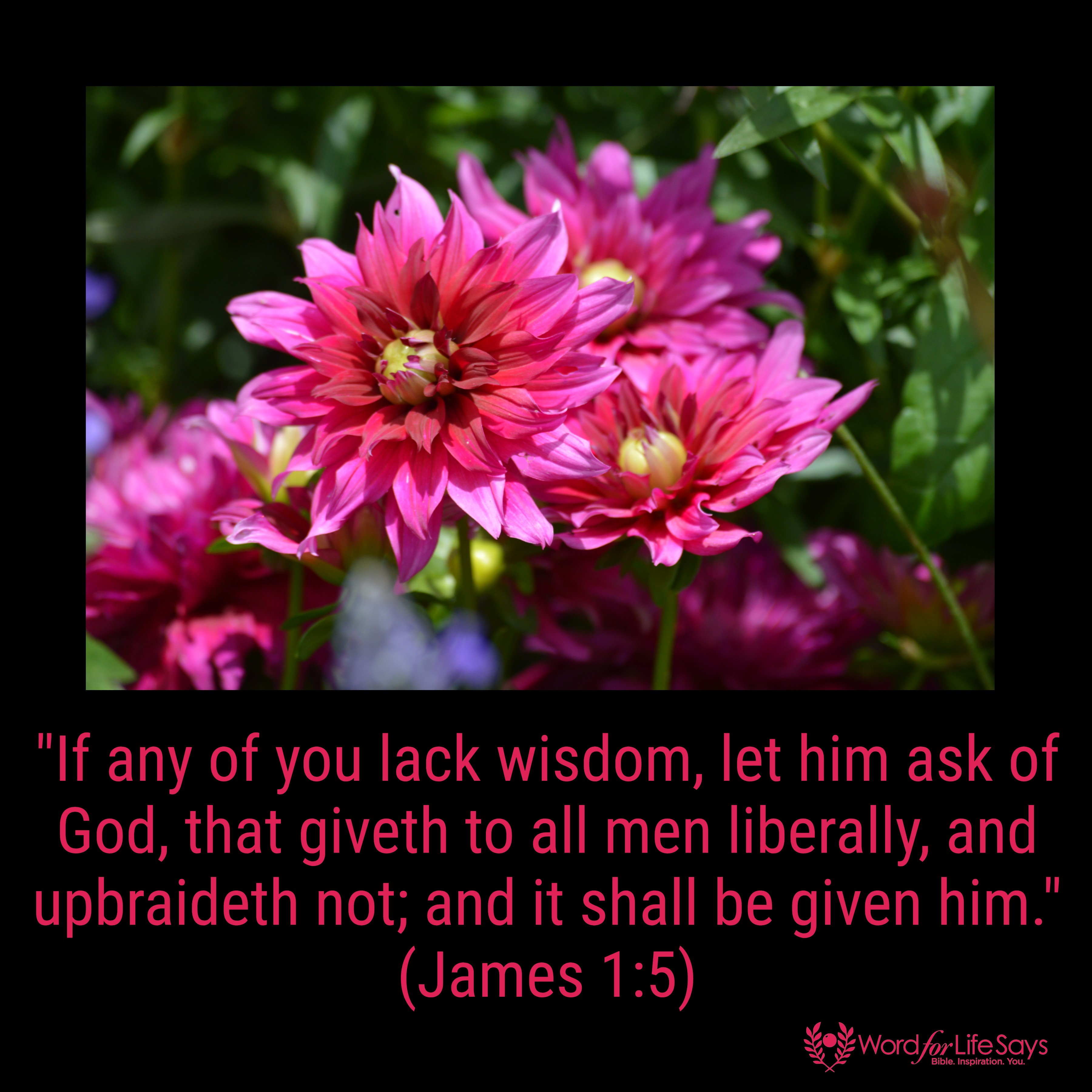
“If any of you lack wisdom, let him ask of God, that giveth to all men liberally, and upbraideth not; and it shall be given him” (James 1:5) is written in the opening chapter of this small, yet power-packed book, and in it James provides just that, wisdom that can be used in one’s daily life.
Practical living according to Scripture is the best way I would sum up the book of James. Although Christians may face many challenges and adversities, it does not exempt them from taking responsibility for their personal actions. If anything, it shows more who they are or are not.
From the attitudes we carry to living out the Word in our lives through its application and service toward others, to how we speak and view others – all of these take their proper place in the whole of the Christian’s walk of faith, and all of it matters.
And what better way to do this than through our practical, day-to-day living.
In this new series, I have grouped together some holy reminders for this practical living from the book of James to be used as individual lessons, or as the title suggests, grouped in a series. I am working on more lessons to add to this series and plan to update you as each becomes available.
As always, while I provide resources and activities for lessons and lesson development, I encourage you to do your own personal studies as well.
To access the lessons, simply click on the links below. Enjoy!
Why do we count it all joy? Because what we’re going through is producing a beautiful character in us. Because God will give us, in faith, the wisdom to deal with it all. And because we have a sure reward when this is all over with.
There are enough hearers, observers, and viewers of the faith. God needs some action heroes that will allow the Word to work in their lives. God needs more “doers!”
Faith is not silent. Faith is full of action. Faith is alive. Faith is shared through works to testify of its genuineness and sincerity. Faith does more than move mountains. If it is lived out in the lives of the men and women of God, it can help move hearts toward salvation!
Our words are powerful! As this lesson shows, they can be used to hurt or to heal; to edify or to tear down. James wants us to choose life with the words that we speak.
VERSE DISCOVERY: James 2:1-13 (KJV, Public Domain)
We all remember those playground days when the team captains stood in the front of the group declaring in order the people that were worthy to be on their team. One by one they would call out the names, from the greatest to the least that would help them win the game. Sometimes this decision was not made on ability so much as favoritism. Some in the crowd dared not look up, afraid of the desperation showing in their eyes of not being called last again.
This playground mentality humiliated some for the benefit of others, something James would not let Christians get away with in the church.
In light of one verse that says, “But we are all as an unclean thing, and all our righteousnesses are as filthy rags” (Is. 64:6a), how would we feel if God looked at our sin-stained status and judged us unworthy to receive His favor? Let’s get into this lesson so that we may learn to appreciate all that God has done for us and that we might learn to express kindness toward one another by not yielding to the unfair preference of some while willfully neglecting others.
Favoritism is Not Allowed
James 2:1 “My brethren, have not the faith of our Lord Jesus Christ, the Lord of glory, with respect of persons.”
“Have not the faith of our Lord Jesus Christ . . . with respect of persons.” Let us view our “faith” in light of what it really is. We were no good before Christ or had any goodness of our own to speak of or rely on. We have no righteousness of our own, Philippians 3:9. Our world before our faith in Christ is described as “dead in trespasses and sin,” (Eph. 2:1). We were not fit for a heavenly home.
But, “He was delivered for our offences, and was raised again for our justification,” (Rom. 4:25). Christ is He “Who his own self bare our sins in his own body on a tree, that we, being dead to sins, should live unto righteousness: by whose stripes ye were healed,” (1 Pet. 2:24). Knowing what He did for us and where He brought us from, we are commanded not to use our faith as an occasion to have “respect of persons.” One is not to use their time of assembling together to belittle some and exalt others through outward-appearing preferences of whom we count worthy or not.
James 2:2-4 “For if there come unto your assembly a man with a gold ring, in goodly apparel, and there come in also a poor man in vile raiment; And ye have respect to him that weareth the gay clothing, and say unto him, Sit thou here in a good place; and say to the poor, Stand thou there, or sit here under my footstool: Are ye not then partial in yourselves, and are become judges of evil thoughts?”
The word “partial” speaks of prejudice. Prejudices come in all shapes and forms. Regardless of how it comes, it seeks to pass judgment on another based on what one sees or perceives on the outside without knowing the person, their inside story, or their situation.
In this lesson, “partial” or the prejudices spoken against revolve around the unfavorable preference for those who are rich over those who are poor.
“Goodly apparel” versus “vile raiment.” These were the precursors James is addressing by which men “become judges of evil thoughts.” Outward appearances became the criteria by which one determines where one is worthy to be seated. If this is the case, then those to whom James is writing can themselves be classified as one who shows that in their way of thinking they are “then partial in yourselves.” A wrong spirit of dividing and categorizing people based on a superficial standard dwells in them.
It is so easy, by human standards, to fall into the trap of viewing with the eyes and judging one’s status. This is called “stereotyping,” when one thinks they know you by how you appear on the outside and places you in a certain category and determines for themselves, based on nothing else, that is where you belong.
Even the prophet Samuel fell into this dangerous mindset in searching for the next king of Israel. Judging by the mighty men before him, one of these, all appearing to fit the outer criteria, had to be the one. God rebuked such notions and told him, “Look not on his countenance, or on the height of his stature; because I have refused him: for the LORD seeth not as man seeth; for man looketh on the outward appearance, but the LORD looketh on the heart,” (1 Sam. 16:7).
With such a profound biblical example of exactly what James is teaching, let us take heed to this warning found in Leviticus 19:15 which says, “Ye shall do no unrighteousness in judgment: thou shalt not respect the person of the poor, no honour the person of the mighty: but in righteousness shalt thou judge thy neighbor.” Our fair and just God wants us to mimic His holy character and treat others fairly without personal preferences.
Our faith is founded in Christ, who Himself said, “Judge not according to the appearance, but judge righteous judgment,” (Jn. 7:24). Place seating, such as was the case that James is confronting, according to “goodly apparel” versus “vile raiment” is judging “according to appearance.” It is sizing up people according to what they can afford to buy or do for another.
This is unjust thinking. God wants equal opportunity Christians for God Himself shows no partiality, Romans 2:11. His Son, the Lord Jesus Christ, came and died so that the whole world, not just some specific groups whom others count worthy, might be saved, John 3:16. When one goes against His basis of salvation and is biased in showing partiality according to what is seen on the outside of a man, they “become judges of evil thoughts.”
Fulfill the Royal Law
James 2:5 “Hearken, my beloved brethren, Hath not God chosen the poor of this world rich in faith, and heirs of the kingdom which he hath promised to them that love him?”
“Hath not God chosen the poor of this world rich in faith, and heirs of the kingdom?” Jesus once taught, “The life is more than meat, and the body is more than raiment” (Luke 12:23). Yet, these temporary things are what people strive for the most to achieve. One can have all the treasures in the world and “is not rich toward God,” (Luke 12:21). These persons shall never inherit His “kingdom” in that coming day.
Those whose boast is in their material wealth, those whose pride rests in all they have acquired, are lacking the most important thing to enter that kingdom: a “love” relationship with “Him.” Revelation 3:17 shows how the accumulation of things will never satisfy that holy requirement: “Because thou sayest, I am rich, and increased with goods, and have need of nothing; and knowest not that thou art wretched, and miserable, and poor, and blind, and naked.”
In other words, according to the world’s system of judging success, these individuals thought they had what it takes to enter that “kingdom.” Yet, they were really the ones who lacked the most. Jesus’ instructions were, “I counsel thee to buy of me gold tried in the fire, that thou mayest be rich…” (Rev. 3:18). Jesus is and has been proven to be the only way to enter that “kingdom” and He wants people to depend on a “love” relationship with Him, not material possessions.
Matthew 5:3 also tells us, “Blessed are the poor in spirit: for theirs is the kingdom of heaven.” Those who recognize their depravity are prone to be more dependent on the grace of another, be it in the natural or spiritual. The natural poor have nothing great to boast of, no apparent accumulation of goods and accolades to give just cause to receive favor. The same is true for the spiritually poor. These are usually the ones marked as being “rich in faith” because they depend on what God can do and has done for them, and not their own selves or riches.
James 2:6-7 “But ye have despised the poor. Do not rich men oppress you, and draw you before the judgment seats? Do not they blaspheme that worthy name by the which ye are called?”
James drew his readers in to really examine their unjust actions. Their inequality of treatment toward the “poor” was wrong and they did their fellow man a great disservice by despising them. This treatment of being “despised” for their lack goes beyond just making them feel rejected; rather, through their preference for the rich they are showing hatred toward the “poor.”
To James, this made no sense because it is the rich who are always at enmity with them. He questions them, “Do not the rich oppress you, and draw you before the judgment seats? Do not they blaspheme that worthy name by the which ye are called?” This, to him, was all backward thinking.
Those in power and authority often act with great contempt toward the common man and sometimes toward God also, thinking their status in life affords them special privileges above others. They would “oppress” their fellow man and take them to court, using their wealth to gain favor not normally available to the poor.
If you will allow me to paraphrase, James said, “Not in here. Not in the church.” This is a place for all humanity to humbly submit in worship before the Lord and no partiality is allowed, no respect of persons. When they come into this building, the only thing that matters is what the inner man possesses and professes, and not their outward possessions.
James 2:8-9 “If ye fulfill the royal law according to the scripture, Thou shalt love they neighbour as thyself, ye do well: But if ye have respect to persons, ye commit sin, and are convinced of the law as transgressors.”
“If ye fulfill the royal law according to scripture.” One day, a lawyer thinking to trip Jesus up on His words, asked, “Master, which is the great commandment in the law?” (Mt. 22:36). Jesus took no time in answering him and immediately said, “Thou shalt love the Lord thy God with all thy heart, and with all thy soul, and with all thy mind. This is the first and great commandment,” (Mt. 22:37-38).
But Jesus did not stop there. This was a prime teaching opportunity to let them know how they treat people matters. Therefore, He went on to say, “And the second is like unto it, Thou shalt love thy neighbor as thy self” (Mt. 22:39), words James also reminds them of.
Treat people as you would want to be treated. The Bible tells us “God is love” (1 John 4:8), therefore, those that belong to Him should operate in love also. Love is an energy that supplies the deepest crevices of man, filling a longing that has been present since conception. Everybody wants to be loved, no matter their status in life, and the church should be a supply source of His great love.
“But if ye have respect to persons, ye commit sin.” In Matthew 22, when Jesus listed these two greatest commandments He also stated, “On these two commandments hang all the law and the prophets,” (vs. 40). How we treat people really does matter. Showing “respect” to one who seems more affluently endowed could cause unfair actions toward those who are not, thereby committing sin.
Think about it. One of the greatest commandments spoken by our Lord was focused on how we treat others. To go against that grain of the love that He lived and died for is to go against Him. When one chooses to side with the rich (or any unjust group), they choose to partake in the characteristic of oppression that exudes from that individual.
James 2:10-11 “For whosoever shall keep the whole law, and yet offend in one point, he is guilty of all. For he that said, Do not commit adultery, said also, Do not kill. Now if thou commit no adultery, yet if thou kill, thou art become a transgressor of the law.”
Sin is sin! If one treats his fellow man wrong in any of the ways the Word of God lists, he is just as guilty as if he had committed any other sin. Therefore, he is teaching Christians to avoid it. Don’t do it. Do not behave in or mimic these practices. It is not just an unpleasant way of acting – it is a sin!
One can cross every supposed “T” and dot every “I” of the law, but if “they offend in one point, he is guilty of all.” “All unrighteousness is sin,” exclaims 1 John 5:17. If it goes against God’s commands, it is sin no matter how small or large we may view it. “For thou art not a God that hath pleasure in wickedness: neither shall evil dwell with thee,” the psalmist said in Psalm 5:4. God hates all sin, Psalm 11:5.
Mercy Receives Mercy
James 2:12-13 “So speak ye, and so do, as they that shall be judged by the law of liberty. For he shall have judgment without mercy, that hath shewed no mercy; and mercy rejoiceth against judgment.”
One day judgment is coming and how we treat others will be compensated, for good or bad. If no “mercy” was shown toward one’s fellow man then don’t expect “mercy,” James taught. In other words, he was teaching them the same way they judged whether one was worthy to sit here or there is the same way they will be judged. “For with what judgment ye judge, ye shall be judged: and with what measure ye mete, it shall be measured to you again,” (Mt. 7:2). All decisions have repercussions. Measure for measure, payday is coming. There are eternal rewards or judgments for how we treat one another.
PDF Printable Sunday School Lesson Pack (With easy to read instructions following the P.E.A.R.L. format on how to conduct each lesson with areas for adding personal notes): Sunday School Lesson – No Respect of Persons
Suggested Activities:
Blank Journal Pages: These pages, one designed for adults and one for children, can be used to bring out, remember, or write a particular part of the lesson you wish for you and/or your class to focus on. Click>> Blank Adult and Kid’s Journal Pages to access the journal pages.
Unity Craft: Use my Outlines People Template to trace a Unity Chain of people. Print the template onto cardstock and cut it out. Use the template as a tracing pattern on any paper you choose to make your chain of people as long as you want it to be. Then, cut it out and decorate to represent many people from all walks of life. Or, you can use them as shown in the Better Together Craft below. Just decorate your people however you wish.
Better Together Craft: Although this was originally used for an Adam and Eve lesson for husbands and wives, I think it can be used here as well, because uniting people together will demonstrate that we are better together (similar to the chain craft above, but with words). Decorate as you wish. Using the Better Together Craft pdf template, create this craft following the directions as a reminder of God’s great design.
Try Me on for Size Shoe Game: This is an interesting game I created. Pile everyone’s shoes in a pile in the middle of the room. Take a blindfolded volunteer to rummage through the shoes and try to put on the first shoe they pick up. While still blindfolded ask does it fit? Is it too big or too small? What can you tell about this person who wears this shoe, and so on? Literally, they are putting themselves in another’s shoes. Teach them this is how James wants us to relate to others. We are to go beyond what we think we see and consider individuals a little more closely. Then, give another student a chance to go. When the new volunteer is blindfolded, mix the shoes up, and start again.
What to do with this day when things aren’t clicking and time keeps ticking? When things refuse to fall into the designated places you had for them? When it feels like it’s completely squashed before it starts? So many plans lay ahead but the weight, the feeling, and the pressure of it all leaves one with a sense of having things unaccomplished and unfulfilled. To look on the outside, it seems that everyone else is getting on with this day and their doings, but the fight in here, right now, and the press that comes with it, it just doesn’t seem to want to work out. All the gears for all the mechanics of this day are present, in place, and spinning, but they are just not grabbing correctly to move what we are trying to achieve successfully.
What to do with this day when there seems to be conflict and strain with one another? When relationships don’t hug the way you want them to hug or love in a way you want to be loved? When misunderstandings, assuming, and yes, even one’s own personal views on a matter put barriers between the spirit of fellowship and love. When hurts cause one’s steps to move ever so fragile as if on eggshells, fearing the disappointment and disapproval of someone else?
What to do with this day when rogue feelings break away from the pack you had planned for the day and invade and try to rob you of the potential joy that lay ahead in the hours to come? Thieves of insecurity. Thieves of shame. Thieves of feeling woefully torn. These thieves come with many hideous and damaging names. The day was brand new and fresh at the start, but that didn’t stop these unwanted parasitic nuisances from latching on and tainting it with the feelings of mess-ups, adversity, pain, and disappointments from your yesterdays.
So, what to do with these kinds of days when our plans, people, or feelings just don’t want to cooperate with the vision you had set for it?
Give it to God! That one answer tells us how to deal with it, the proper response to it, and what to do with the rest of it. This is not some Christian rhetoric or cliche. It is a solid truth that we can stand on and base our faith upon. We give it to God.
The real truth is that at any given time on any given day, we will all or have all experienced one or many of the daily upsets listed above (and sometimes even more than these). It is all a part of life, a part that can really throw us off-kilter if we don’t process it right and deal with it in the right way.
Therefore, when everything is going absolutely bonkers, sometimes without rhyme or reason; when nothing within our power or control is working, we give it all to Him who has all power and control. Not as a mythical genie creature whose bottle we rub to have things or people turn out how we want them to. But, as releasing it to His majesty and sovereign will. It’s saying, “I trust you, God.” Whether this day turns out how I configured it or not, my plans, my people, my times, my heart, and my feelings are all in Your hands.
God is not only the Creator of all the universe and the Author of all mankind, but He is concerned about your daily needs for each individual day also. All the areas that need filling, all the upsets that need dealing with, all the plans that need to be taken care of, and all the worries that bog us down – He’s concerned about it all.
But, as we release the day to Him we must also realize His best answer for us may be to not move everything or anything into the places where we see fit. Sometimes, His best answer for what we are going through with this day is to let us learn from it, experience it, and still maintain trust in Him. Regardless of how it goes forward, despite what we feel in the process, no matter who we are dealing with and how we are dealing with them – He still sees it all, knows it all, and has it all in His loving and powerful hands.
So, when days like this come, we give it to God, step back, and just trust Him for every part of it.
Here are some verses and prayers to hold in your heart when the days just aren’t going right for you:
Proverbs 3:5-6 “Trust in the Lord with all thine heart; and lean not unto thine own understanding. In all thy ways acknowledge him, and he shall direct thy paths.”
Father God, I acknowledge that I don’t know everything about this day, my future, or even how to properly respond to it all. I pray for Your leading to show me the right path to walk so that my life might be pleasing in Your sight. In the name of Jesus Christ, Amen.
Jeremiah 29:11 “For I know the thoughts that I think toward you, saith the LORD, thoughts of peace, and not of evil, to give you an expected end.”
Father God, the end of all things may be vague to me or even remain a mystery. Help my heart hold on to the very real fact that You knew me from the beginning and You know how my story ends; and that if I am in Your hands, then I am in Your plan. In the name of Jesus Christ, Amen.
Psalm 126:6 “He that goeth forth and weepeth, bearing precious seed, shall doubtless come again with rejoicing, bringing his sheaves with him.”
Father God, my tears and confusion for the day, You see it all. Help me to know that it is not all in vain. Let my confidence be in You and Your love for me above all else, knowing that for every sadness, there will be joy. When You restore, for every sorrow sown there will be a reaping of happiness and peace. In the name of Jesus Christ, Amen.
I am more in love with Jesus today, and each day that follows, than when I first started out. Through experiences and growth in this spiritual journey, I have come to recognize the sweetness I have found in my Savior. The more I have gone through, and the more He has brought me through, the more I appreciate Him for holding my hand every step of the way.
In human relationships, there seems to be more excitement at the beginning of this adventure called love. We can’t wait to see what happens next or cannot wait for the next visit or phone call. But as I have come to know my Savior over these years, my excitement in Him builds more and more. Every day brings new revelations of how awesome His love is for me – and as one who sits back in the sun just to hear the birds sing – I sit in the splendor of His radiant presence and enjoy His love that sings over me.
His awesome love story with us is not like any other. It is complete yet renewing every day. As a fountain that never runs dry, it is full, yet it is constantly “pouring” into our lives (Romans 5:5, NKJV), uncontainable and overflowing, giving us more and more of Him each day. His love is not a one-shot deal. But it’s our covering, our reliance, our safety blanket, the cradle in which we rest in the comfort and care of the one who loves us best.
The awesomeness of His love story toward us was solidified when He was nailed to the cross. But can I tell you, it’s so much more than that? He didn’t stop there but chose every day of our lives to be there for us wherever we go – fully caring, fully involved, and fully in love with each of us.
Why?
Because He has a “steadfast love” for us (Psalm 86:15, ESV). His love is faithful, present, and enduring. It is not easily swayed or moved from where we are, no matter how ugly it may appear at times.
When people would have given up on us in those ugly moments, He still moves toward us.
Why does He do that? Because He chooses to.
In most relationships, people come to a mutual understanding of love before they move forward. Jesus is different. His love for us was never dependent on what we did or didn’t do (remember those He prayed for while suffering on the cross). He never waited for us to make the first move or come to some mutual understanding of what this love would be all about. But in the awesomeness of His love, Jesus moved forward in loving us while we were still “sinners” (Romans 5:8).
He has never waited for us to get it right or come out of those ugly shadows before we were counted worthy of His love. As a matter of fact, He showed us love before we showed signs of loving Him back. In His passion for us, He always made the first move. The Bible tells us, “We love him, because he first loved us,” (1 John 4:19).
So, if you are in doubt today about the awesomeness of His love story over you, no matter what voices are telling you, I am here to tell you differently. You and me are all unequivocally loved by Jesus and there’s nothing we can do about it because He already did it all. His love is constantly pouring into us, never giving up on us, and has already made the first move toward us. All we can do is accept His love and sit back and bask in the awesomeness of it. Now, that’s something to get excited about!
If you haven’t already, give Jesus your heart today and accept what He is already willing to give you. Find a good Bible-based church and experience His awesome love story up close and personal. He’s waiting for you.
“And the Lord your God will drive out those nations before you little by little; you will be unable to destroy them at once, lest the beasts of the field become too numerous for you.” Deuteronomy 7:22, NKJV
Here we go again. A new idea, a new project, and the excitement within us wells until we are busting at the seams to implement or work it into our already busy lives.
Don’t get me wrong, the wonderful creativity that God has placed in us yearns to be expressed in multiple ways. And thankfully we are always learning about different things or different ways to do the things we are already doing.
The only problem is, our enthusiasm and excitement can get the best of us sometimes. We can rush ahead and try to take on or accomplish several projects at once, juggling and spinning many plates at the same time, wondering why we are exhausted and overwhelmed while still dealing with what is in front of us daily.
When Moses was preparing the hearts of the Israelites to conquer the promised land, he relayed God’s plan of progression. God could, no doubt, take on multiple nations and worlds at one time if He wanted to because He is God, the Creator of all. But for these people, as they entered the land to begin their conquest, they would do it a little at a time.
Our heavenly Father is a wise, gentle, and gracious God knowing how easily it is for our human nature to become overwhelmed by taking on too much at once.
Is this you today? Have you ever stood back and wondered how in the world will you get all of this done, or where do you even begin?
Listen to the wisdom of our gracious God and get to your tasks step by step, one thing at a time, a little at a time.
Many have taken on the idea of an octopus mentality – arms, ideas, and projects flying in every direction all at once, and we wonder about our feeling of overwhelm, multitasking, often to our own detriment.
Our zeal gets the best of us, and we add another plate to the spinning mess we are already juggling.
Step back, my friend, and reevaluate what you are doing and what is the ultimate final goal you would like to achieve. What are the most important things for that project, that day, or that time? What steps need to be taken for the greatest end result?
Now, let’s break it up and take it on a little at a time so as not to frazzle our energies or our minds.
We are not God. We cannot take on the whole universe at once, but if we heed His wisdom perhaps our days can be a little less hectic, and a little more productive.
Please Note: Ads below or referenced on this site are prefabricated and mass-produced (of which I currently have no control over) and DO NOT necessarily represent the views and/or beliefs of this site and its admin.
When it doesn’t fall into place as you imagined… be patient.
When it doesn’t seem fair… be patient.
“And we know that all things work together for good to them that love God, to them who are the called according to his purpose.” Romans 8:28
Everything that is not like God will fade away, but you who endure to the end and remain patiently in hope, will see the reward of your perseverance. “Be patient therefore, brethren, unto the coming of the Lord. Behold, the husbandman waiteth for the precious fruit of the earth, and hath long patience for it, until he receive the early and latter rain.” James 5:7



















 Word For Life Says...