
Now is a powerful word . . .

Now is a powerful word, my friend. It speaks of the present moment. It tells the story of your today. What is today saying? It is saying because you are here; because you are experiencing me, His grace is working in your now moment. Oh, for feet that could travel to the past and remedy […]

The Grace of Now — Word For Life Says…

Sunday School Lesson – “The Shepherd and His Sheep” Psalm 23

VERSE DISCOVERY: Psalm 23 (KJV, Public Domain)

Psalm 23 is probably the most famous chapter in the entire Bible.  It’s one that children learn to recite from an early age.  Yet, let’s not take it for granted because of its familiarity.  Rather, with child-like faith let us grasp the beauty of those blessed words that unfold before us in those six verses as David’s description of God and His relationship with His people is made known in this poetically beautiful psalm.

The LORD is My Shepherd

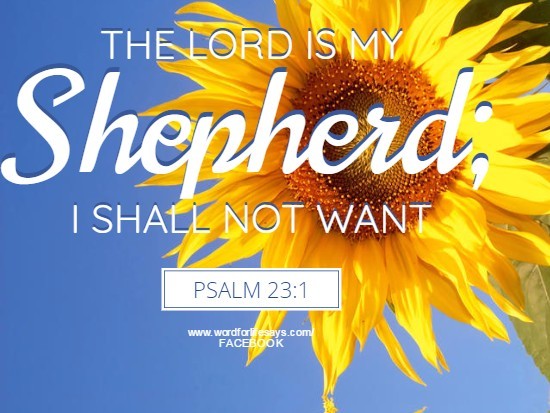
Psalm 23:1a “The Lord is my shepherd . . .”

As a teenager, David knew exactly what it was to be a shepherd.  His profession was to tend to his father’s sheep (see 1 Samuel 16:11).  Before the anointing oil from Samuel’s flask dripped upon his head, his life was spent walking through the valleys and hills of the land, caring for, finding food for, and protecting the sheep that were put under his charge.

Now, no longer a teenager, but a king, David could look back at those experiences he had, his job, and his relationship with the sheep, and compose a beautiful song that celebrates God’s ultimate care for us using the same Shepherd/sheep analogy.  Words that will inspire the believing heart to see God as everything we could ever need no matter what life throws at us.

With that, David opens this psalm by penning the words, “The LORD is my shepherd.”  As with David’s pre-king occupation, a shepherd’s job and life were spent in a selfless manner.  The sheep dominated his day-in and day-out thinking.  How to provide for them?  Where to lead them?  Are there any dangers ahead or behind them?  The shepherd’s life was also pretty much isolated.  Leading the sheep often meant time away from home.  Perhaps, when Samuel came to see and anoint this future king, that’s why David’s family forgot about the boy in the fields.  He was always working and caring for the sheep and maybe he was hardly seen in their presence.

Looking back on those days it wasn’t hard for David to see God as the ultimate Shepherd and himself counted as a sheep who is totally dependent on the care and the protection of the Shepherd.  The description of God in the role as a shepherd actually predates David’s time and is seen in books of the Bible in the time of Genesis (see Genesis 49:24).  So, David’s thinking along those lines is right up the alley with the patriarch Jacob/Israel when he too saw God in this fashion and referred to Him as such when discussing God’s protection over Joseph when he was attacked by those who hated him.

As sheep, if left on their own, they will fall prey to so many elements of this world, be it animals who wanted to eat them, circumstances and weather that may threaten them or the lands where they graze.  They are docile animals awaiting the leadership of the shepherd.  As such, David too saw his own relationship with the Lord in the same manner.  “LORD” in all caps stands for Yahweh, the name Israel identified as the holiest of all in reference to the only true God alone.  So, there is no mistake about who David says is his true Shepherd.  “My shepherd,” he says, is God alone (80:1; 100:3; Ezekiel 34:11-12).

I Shall Not Want

Psalm 23:1b-6 “. . . I shall not want.  He maketh me to lie down in green pastures: he leadeth me beside the still waters.  He restoreth my soul: he leadeth me in the paths of righteousness for his name’s sake.  Yea, though I walk through the valley of the shadow of death, I will fear no evil: for thou art with me; thy rod and thy staff they comfort me.  Thou preparest a table before me in the presence of mine enemies: thou anointest my head with oil; my cup runneth over.  Surely goodness and mercy shall follow me all the days of my life: and I will dwell in the house of the Lord for ever.”

Here, my friends, is where we get to savor the sweetness found in this holy relationship.  This is where our desire should be increased for Him as the former shepherd turned king whets our appetites with this description of God’s abundant love over us both now and forever.

This short, but powerful psalm, inspires us to see ourselves physically under the spiritual promises written within.  These illustrations that David paints with his words give us these vivid pictures of God’s tender loving care, in action, over His sheep.

“I shall not want,” David speaks, showing us the extension of the Shepherd’s nurturing watchfulness for His flock of sheep.  Being a member of the Shepherd’s divine keep, David saw there is nothing lacking in God’s provision for His people or in our relationship with Him.  Did not the Apostle Paul state in the book of Philippians, “But my God shall supply all your need according to his riches in glory by Christ Jesus,” (4:19).  It is by the hand of the Lord that we are sustained and maintained.  It is by His loving care we are thoroughly and completely cared for and provided for.  The Bible says, “No good thing will he withhold from them that walk uprightly,” (Psalm 84:11).  Anything we NEED (not our wants, as many seem to think) for our Christian journey, God is our unfailing provider.  God is for His people – Always!  We do not serve a God of lack.  He will provide!  Whatever you NEED, God’s got it!  God is attentive to the state of His people, His sheep.  He does not leave them wanting for care.  He not only provides, but He does so much more . . .

“He maketh me to lie down in green pastures: he leadeth me beside the still waters.”  In this reference, David saw in one’s relationship with God, peace that can’t be found anywhere else.  The phrases “lie down” and “still waters” show the sheep being unafraid due to the shepherd’s attentive leading.  Sheep are naturally fearful animals, but these references show the sheep are at rest, at peace in His presence.

The Bible gives us many references to the peace that we find in our relationship with God.  Some of my favorites are:

    • Isaiah 26:3 “Thou wilt keep him in perfect peace, whose mind is stayed on thee: because he trusteth in thee.”
    • John 14:27 “Peace I leave with you, my peace I give unto you: not as the world giveth, give I unto you. Let not your heart be troubled, neither let it be afraid.”
    • John 16:33 “These things I have spoken unto you, that in me ye might have peace. In the world ye shall have tribulation: but be of good cheer; I have overcome the world.”
    • Philippians 4:6-7 “Be careful for nothing; but in every thing by prayer and supplication with thanksgiving let your requests be made known unto God.  And the peace of God, which passeth all understanding, shall keep your hearts and minds through Christ Jesus.”

All of these solidify the type of relationship the sheep have with the shepherd, the type of relationship we experience in Jesus Christ, our ultimate Shepherd (John 10:11).  Many are grasping at various things and pursuits to fill their life with peace.  This peace and serenity can only be found under the protection of the Shepherd.

“He restoreth my soul.”  The need for restoration means one’s energies have been spent.  This life can wear people down, especially when they are insistent on going their own way.  As the shepherd leads his sheep to refreshing places, God stands ready to replenish the weary and broken soul.  Often in life, as Isaiah put it, “All we like sheep have gone astray; we have turned every one to his own way . . .” (Isaiah 53:6), and the soul is in need of being restored.

David knew personally and could speak from experience what it was to wander away from the Shepherd spiritually and to feel the need to be brought back into a correct soul position with God.  He prayed in Psalm 51, “Restore unto me the joy of thy salvation; and uphold me with thy free spirit” (v. 12) after he was confronted about his sin involving Bathsheba.  Our ultimate restoration of the soul can only be found in Jesus Christ, our Good Shepherd.

“He leadeth me in paths of righteousness for his name’s sake.”  God will guide the soul that chooses to follow Him to the right path.   When we were children, most of us know what it was like to partake in a good game of “Follow the Leader.”  Anything the leader does or says is to be matched by the other participants.  God gives direction for the purpose of leading His people who will choose to follow Him on the right path that will lead to glory for, “All the paths of the LORD are mercy and truth unto such as keep his covenant and his testimonies,” (Psalm 25:10).

Finding rest for your soul doesn’t just happen by being in green meadows, but it happens by staying on the true and tried course already laid out for us through God’s Word.  Jeremiah 6:16a says, “Thus saith the LORD, Stand ye in the ways, and see, and ask for the old paths, where is the good way, and walk therein, and ye shall find rest for your souls. . .”  Righteousness is the good way.  Righteousness is the path walked before by others and it is the path that will lead us to life eternal.  Unfortunately, for those whom Jeremiah spoke to, the latter part of that verse says, “But they said, We will not walk therein,” (Jeremiah 6:16b).  They chose to butt up against the Lord’s leading like stubborn goats instead of following His shepherding as faithful sheep should.

This type of combative attitude will not lead one to glory, nor will it bring glory to His “name.”  God’s name is to be glorified in our lives (see Psalm 29:1-2; Romans 11:36; 1 Corinthians 10:31; 1 Peter 4:11).  His name is honored when we live for Him.  Previously, I wrote:

“Too many go through their day without ever considering the fact that, Hey, He is God, and He should be before all others. With that realization in hand, I want my life to reflect that great truth. I want every word, every action, and every thought to magnify the greatness of who He is and all of His glory. When I go about my day, I want people to see Him in me. Do I make mistakes? Oh, yeah! But I have a goal. I aspire to do better and to be better every day. God has been so good and wonderful to me, and I feel that as His child the least I can do is show Him the honor due Him.” (Honor God/Word for Life Says).

David recognized that as a sheep, he depended on the Shepherd to keep his feet walking on the right path.  And as such, there is no “fear” in this sheep/Shepherd relationship.  When the ways get dark and hard to travail; when the path becomes treacherous and enemies hide in crevices to try to attack – God, as the Shepherd, stands in protection mode over His sheep/people.

Once again, David could look back over his own life and see where God had previously delivered him.  There was more than one time when David was being pursued by King Saul who hated him and wanted to kill him.  Through the course of that running, David, in the time of his afflictions, wrote in Psalm 34, “I sought the Lord, and he heard me, and delivered me from all my fears” (v. 4).  When he was on the run from his own son Absalom, who sought to take his life and his throne, David expressed confidence in God, saying, “I will not be afraid of ten thousands of people, that have set themselves against me round about,” (Psalm 3:6).  He may have been on the run from men at various times, but he was never far from God, he was never far from the Shepherd.  His trust is in God who makes him feel safe no matter what is going on around him.

So, he says, “Yea, though I walk through the valley of the shadow of death, I will fear no evil; for thou art with me.”  The attendance of the Shepherd, even in the darkest of places, makes the sheep feel undeniably safe.  “The LORD is my light and my salvation,” David proclaims in Psalm 27, “whom shall I fear? the LORD is the strength of my life; of whom shall I be afraid?” (v. 1).

Then, he goes on to say, “Thy rod and thy staff they comfort me.”  The shepherd’s rod and staff were used as tools of protection from enemies and for the sheep themselves.  He could use it to defeat a ravenous creature that set its sights on having sheep for dinner, or he could use the hook of the staff to save the sheep when he himself wandered where he shouldn’t and fell.  It has been proven throughout David’s life repeatedly that he could depend on God’s loving care in the same manner.

“Thou preparest a table before me in the presence of mine enemies.”  When the Shepherd is on guard (which God always is), it doesn’t matter who snarls at the sheep.  The Shepherd not only is the comfort of His people, but He goes “before” them to protect them and to provide for them.  Any good shepherd will not let his sheep wander into places without first checking the landscape ahead of them.  He goes and examines the land and areas to not only abundantly provide for them but to also take stock if there is anything there that could cause harm to the sheep.

Please note: Some, when studying this passage, switch the way they view these remaining two verses from the picture of a shepherd to that of a host laying out a banquet table, which could easily be applied to this lesson as well.  I will choose to stick along the lines of the shepherd analogy, keeping in line with David’s opening subject of God identified as the Shepherd and with this subject’s theme.  Both support the text, and both can be viewed along the veins of God being a wonderful provider who gives extraordinary care to His people.

The phrase, “Thou anointest my head with oil;” depending on how you viewed the first part of this verse, its meaning would vary.  In the hospitality-based culture of the ancient Hebrews, it was customary to anoint one’s head with oil, amongst other practices.  Look at Jesus’ response when He went to Simon’s house and Simon failed to do the duty that was expected:

“And he turned to the woman, and said unto Simon, Seest thou this woman? I entered into thine house, thou gavest me no water for my feet: but she hath washed my feet with tears, and wiped them with the hairs of her head.  Thou gavest me no kiss: but this woman since the time I came in hath not ceased to kiss my feet.  My head with oil thou didst not anoint: but this woman hath anointed my feet with ointment.  Wherefore I say unto thee, Her sins, which are many, are forgiven; for she loved much: but to whom little is forgiven, the same loveth little.” (Luke 7:44-47).

These were ways to express honor and respect and help refresh one when coming into a house, particularly to a dinner or feast.  But if we look at the anointing oil from the standpoint of being used by the shepherd instead of a host, it could be seen as being used for medicinal purposes and in other areas of care for the sheep (ex. as an insect repellent).

Either way you look at it, the “oil” represents care and devotion to the one to whom it is applied, which is what God does for His people.

“My cup runneth over” gives the impression of providing in abundance.  God loves His people and has no problem supplying what they need.  God never waivers in the care of His people and can be seen as a constant source of trust and rest.

“Surely goodness and mercy shall follow me all the days of my life” expresses the idea of God’s faithful care in this life.  God’s mercy, grace, and every loving attribute we can align to His holy name shows His “goodness” is alive and active even in our broken days.  If you are reading this, you have experienced God’s goodness today.  If you are hearing these words being taught to you, you have been a partaker of the gift He has blessed humanity with.  God’s goodness leads one down the path closer to Him if they will but trust and follow it (Psalm 25:8).

God is good (see Psalm 100:5; Nahum 1:7; Matthew 19:17) and God does good (see Psalm 119:64; Genesis 1)!  God cannot separate Himself from who He is and what He does!”

And in dealing with the life to come, David said, “I will dwell in the house of the LORD for ever” which speaks of the assurance he has in God, knowing that as His child, as His sheep, as His people, he could look forward to spending eternity in the presence of God.  There is a blessed future for the people of God.  Whether you view God as a great and gracious host welcoming one to a banquet supper (compare Revelation 19:7-9) or as the Shepherd leading His people to quiet waters (compare Revelation 7:16-17), both speak of an eternity of being where He is, and the faithful followers of Christ are secured in that coming day because of His care for His sheep.

“He shall feed his flock like a shepherd: he shall gather the lambs with his arm, and carry them in his bosom, and shall gently lead those that are with young.” Isaiah 40:11

PDF Full Printable Sunday School Lesson Pack (With easy to read instructions following the P.E.A.R.L. format on how to conduct each lesson with areas for adding personal notes): Sunday School Lesson – The Shepherd and His Sheep

Suggested Activities:

Opening: 

  • Prepare yourself to be knowledgeable about the shepherd/sheep relationship. Research the many ways of the farmer/shepherd and the care they have for their sheep.  What happens if one gets lost?  What happens if one falls on their back?  What is the best way to lead a sheep, feed them, and care for them?
  • Present either digital or printed pictures to support any facts or answers to any of the questions you may have found. Students will then have a clearer understanding of not only what a farmer/shepherd does for the sheep and the nature of the sheep themselves, but it makes for an easy transition into the lesson.
  • Alternatively, or in conjunction with, bring into the class wool yarn, wool laundry balls, a blanket, jacket, etc. made of wool. Ask students about its materials, what and how it is made, and wait for answers.

If you are familiar with the art of crocheting, knitting, or weaving, a live demonstration may be a nice addition to the lesson, especially if the hands of your students are interested in participating and learning.

Game: Leading the Sheep Golf Game – Play like you would golf but instead of holes in the ground, use shoeboxes or other small cardboard boxes with holes cut in the front (resembling a cartoon mouse hole). Boxes can be decorated and marked to show how many points each one is worth (also consider decorating or naming the boxes with examples from the lesson such as: green pastures, still waters, table of abundance, overflowing cup, or the house of the Lord).

To play the game, use wool laundry balls (to represent the sheep) and a plastic golf club, baseball bat, or something similar (to represent the shepherd’s staff).  Each participant’s job is to lead/golf the sheep into one of these desired places.  The player with the most points at the end of the game is the winner.  But please note, we are all winners when we decide to follow Jesus, our ultimate shepherd. Make this game as simple or as elaborate as you like.

Craft Idea: Younger students can also design a paper bag puppet to look like a shepherd. Use a pipe cleaner to shape into the design of the staff.

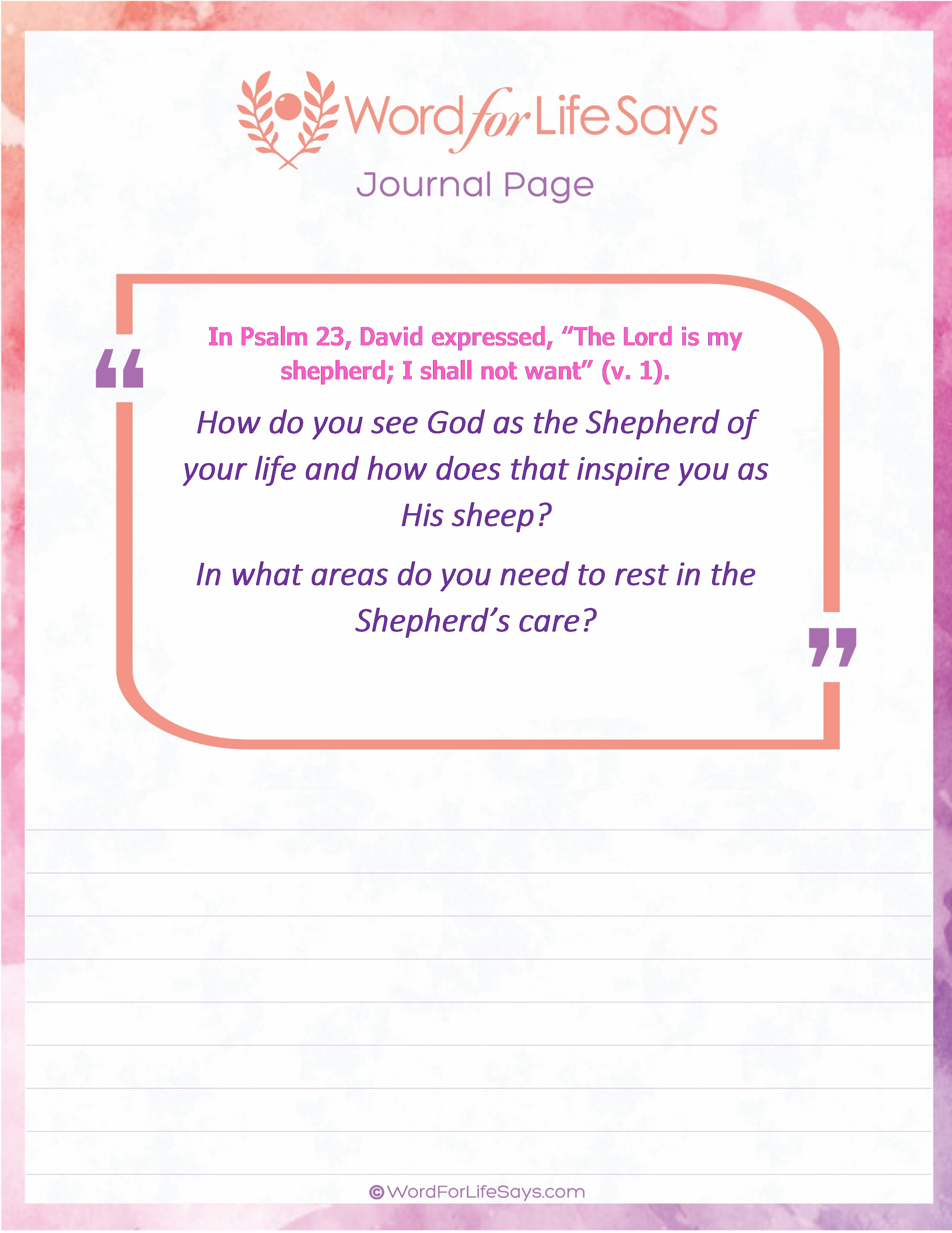
Adult Journal Page: Adult Journal Page – The Shepherd and His Sheep
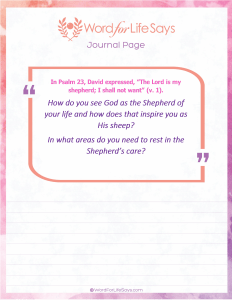
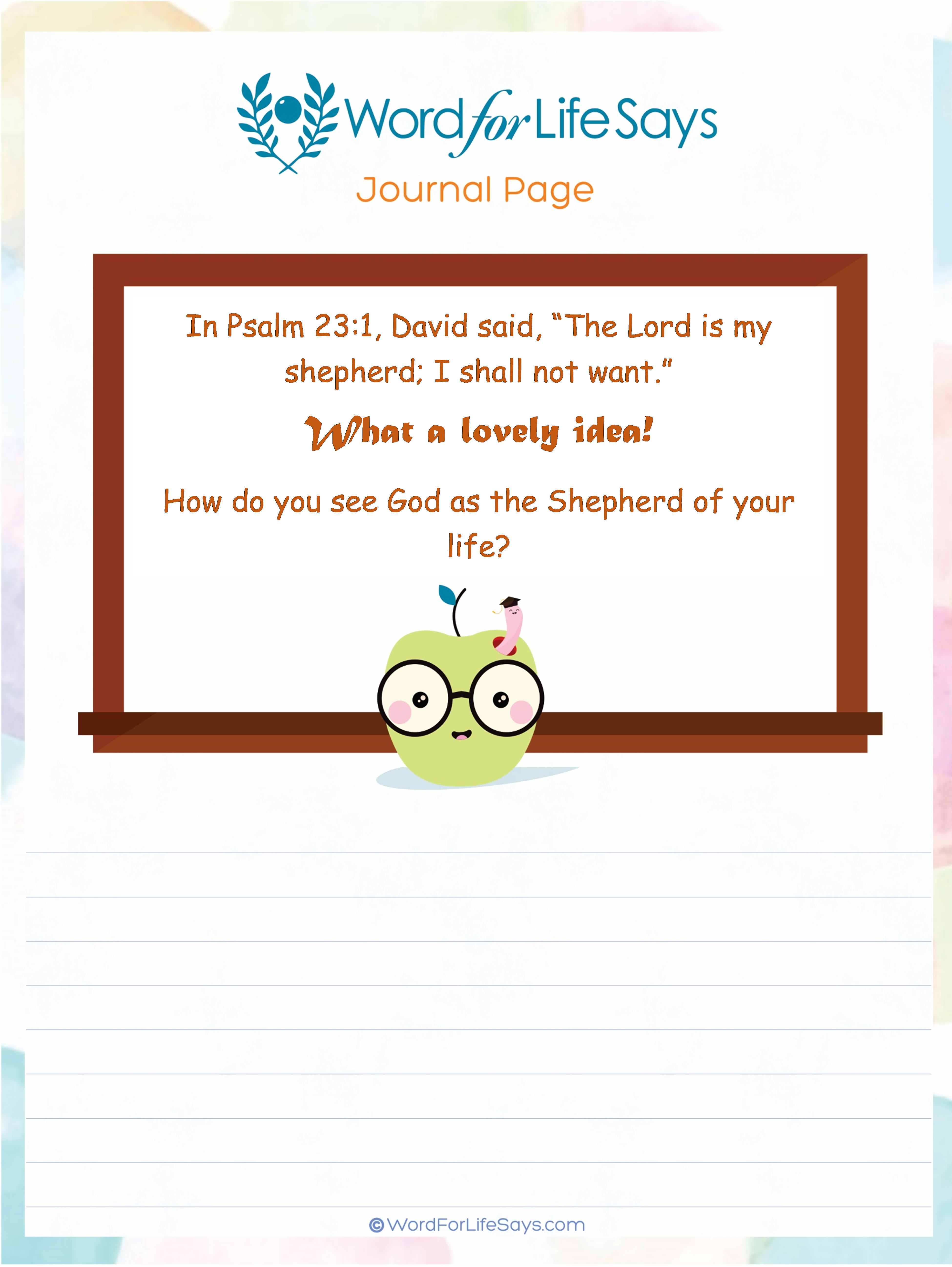
Kid’s Journal Page: Kid’s Journal Page – The Shepherd and His Sheep
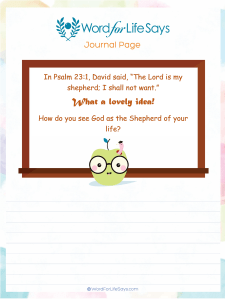
Blank Journal Pages: These pages, one designed for adults and one for children, can be used to bring out, remember, or write a particular part of the lesson you wish for you and/or your class to focus on.  Click>>Blank Adult and Kid’s Journal Pages to access the journal pages.

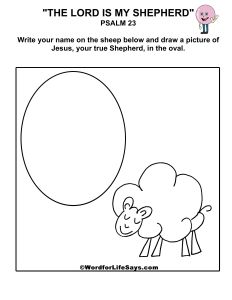
Draw the Scene: The Lord is My Shepherd Draw the Scene
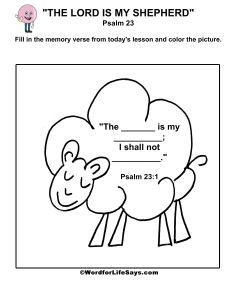
Memory Verse: The Lord is My Shepherd Memory Verse
Coloring Page: The Lord is My Shepherd Coloring Page
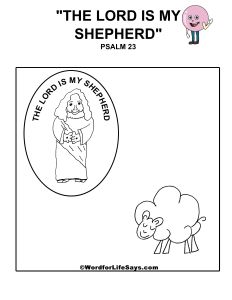
How Many Words: The Lord is My Shepherd How Many Words

Wordsearch: The Shepherd and His Sheep Wordsearch  Answers: The Shepherd and His Sheep Wordsearch Answers

Crossword: The Shepherd and His Sheep Crossword  Answers: The Shepherd and His Sheep Crossword Answers

Word Scramble: The Shepherd and His Sheep Word Scramble  Answers: The Shepherd and His Sheep Word Scramble Answers

Copyright © Word For Life Says.com (Sharing any posts or lessons can only be done through the share buttons provided on this site from the original posts, lessons, and articles only. You can reblog from the original posts only using the reblog button provided, or share using the share buttons provided from these social media platforms: Facebook, Twitter, or Pinterest, etc., and they must be shared from the original posts only. All other repostings are prohibited. Posts and other items of interest found on this site MAY NOT BE COPIED AND PASTED, downloaded, uploaded, etc to another website or entity not listed (physical or electronic).  See COPYRIGHT PAGE for more details.

Please Note: Ads below or referenced on this site are prefabricated and mass-produced (of which I currently have no control over) and DO NOT necessarily represent the views and/or beliefs of this site and its admin.

If only… — Word For Life Says…

Faith is not at all passive.  Nor is it just about dreaming.  It is also about doing. Today, we can believe for more. Hope for more. And, put faith into action because our God “is able to do exceeding abundantly above all that we ask or think, according to the power that worketh in us” Ephesians 3:20.

If only… — Word For Life Says…

Purpose in the Struggle | Another Look at the Hardships Faced in Our Christian Journey

Why, we may wonder, why God does not just remove every obstacle and resistance to our faith?  Why in this journey must we fight?  Why must we strive against adversity in reaching where we are aiming to be?

Can a faith that is not exercised truly be called faith?  For if the road traveled is always smooth and the pathways are always leveled plains, how then will we ever learn to climb?  How will we learn to exert our muscles and pull our weight to mount upon the top? 

More strength only comes by using more strength.  More faith only comes by being forced to use more faith.  We can only learn to climb by experience.  We can only learn to push ahead by continuing to push ahead.  We can only learn to fight by being made to fight.

There are things that God knows His people will only learn by going through them.  That’s why Judges 3:2 says, “Only that the generations of the children of Israel might know, to teach them war, at the least such as before knew nothing thereof;”. 

When choosing multiple services in life we tend to want to choose those with experience.  Take getting a simple hair cut for example.  We want those who have had plenty of practice perfecting their skill before attempting to put scissors near our heads which could alter the way we look for good or for bad.

God has many plans and purposes for His people but what we fail to see or have the patience for is the seasoning of the saint, the molding and perfecting that goes on behind the scenes.

I guarantee no one whom you have read about or seen doing great exploits for the Lord, just fell into that role ready to go.  There was some teaching.  There was some humbling.  There was some learning along the way.  It may have been behind closed doors and away from the eyes of the public, but God takes the time to make sure His vessels are properly prepared to go forth and hold all the potential and purposes He has for them.

The children of Israel might have been concerned as to why certain enemies were left in the neighboring surroundings.  By them, God was testing His people.  By them, God was teaching those to war who had never known war before.  God was causing faith muscles to be exercised.  He was training hearts to not focus on what they see in the enemy but on what they know about their God.

“Beloved, think it not strange concerning the fiery trial which is to try you, as though some strange thing happened unto you:” (1 Peter 4:12).  There is no struggle or contention that does not come without a purpose.  Though it may not be pleasant it is plentifully seasoning your walk with the Lord.  Like the children of Israel, it is teaching your hands to war.

One can never be a good soldier without ever facing contentions.  One can never learn to fight unless they have been made to fight.  One can never learn to pray in earnest if they never had that petition that would draw them to the knee with fervency.  And one could never learn to seek and lean on Him if their heart were never stirred to do so through the challenges faced.

“Wherein ye greatly rejoice, though now for a season, if need be, ye are in heaviness through manifold temptations: That the trial of your faith, being much more precious than of gold that perisheth, though it be tried with fire, might be found unto praise and honour and glory at the appearing of Jesus Christ:” (1 Peter 1:6-7).  It may not always feel like it, and it may not always feel good, but there is purpose in the hardships we face, especially when it comes to our faith which is found more praiseworthy in the eyes of Christ than gold that will perish.

Sometimes we may not understand everything and we may ask, “Why?”  But as we journey, may our eyes never leave Him who promised and is faithful (Hebrews 10:23).  Take heart, dear friend.  Through it all, at the end of our Christian race, we may look back and see the fruit those hard times produced, and we may see the purpose in the struggles.

“But he knoweth the way that I take: when he hath tried me, I shall come forth as gold.” (Job 23:10).

“For our light affliction, which is but for a moment, worketh for us a far more exceeding and eternal weight of glory;” (2 Corinthians 4:17).

“And we know that all things work together for good to them that love God, to them who are the called according to his purpose.” (Romans 8:28).

Copyright © Word For Life Says.com articles/lessons/worksheets may not be copied or redistributed without the express written permission of WordforLifeSays.com.  Please see the COPYRIGHT PAGE for more details.  Blessings to you.

Please Note: Ads below or referenced on this site are prefabricated and mass-produced (of which I currently have no control over) and DO NOT necessarily represent the views and/or beliefs of this site and its admin.

Your Heart, God’s Temple

“So was ended all the work that king Solomon made for the house of the Lord. And Solomon brought in the things which David his father had dedicated; even the silver, and the gold, and the vessels, did he put among the treasures of the house of the Lord.” 1 Kings 7:51

As you read and study, you begin to realize the amount of lavished riches that went into constructing and furnishing the original temple that Solomon built for the house of the LORD (and, rightly so). Yet, as lavished and as wonderful a sight it must have been to behold and walk through, with silver and gold this and that everywhere, the grand temple in which God truly desires to live is in the simplicity of the human heart; a place where He can abide and guide by His Spirit.

It may not appear to the human eye to be as beautiful and as ornamentally decked out as that magnificent building, but to God, a heart that loves Him, and makes room for Him to dwell – there are no luxurious accommodations found on this earth that can compare.

Jesus taught, “If a man love me, he will keep my words: and my Father will love him, and we will come unto him, and make our abode with him” (John 14:23), showing it is the temple of our hearts where He desires to reside.

Paul taught in Corinthians: “Know ye not that ye are the temple of God, and that the Spirit of God dwelleth in you?” (1 Corinthians 3:16), and “. . . for ye are the temple of the living God; as God hath said, I will dwell in them, and walk in them; and I will be their God, and they shall be my people” (2 Corinthians 6:16).

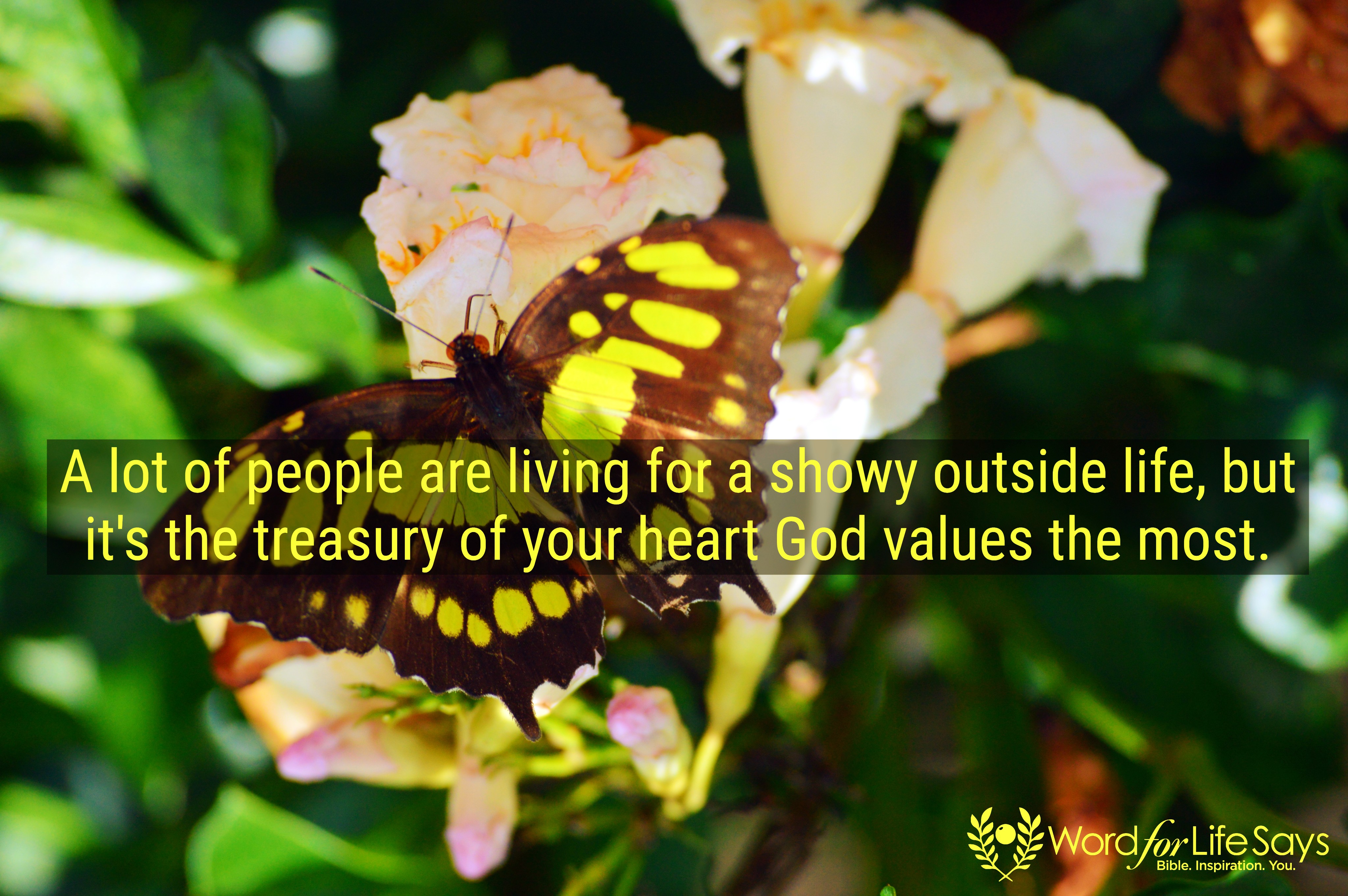
A lot of people are living for a showy outside life, but it’s the treasury of your heart God values the most because it is in this place He wants to reign, rule, and abide through His Spirit. The lavished, ornamental details of a physical building cannot compare to a heart that has been made a ready place for God to dwell.

While we are still called to gather together to worship God, learn of His Word, and edify one another (Hebrews 10:35), everyone has the individual responsibility to prepare their hearts to be a place where God wants to be.

“Now therefore ye are no more strangers and foreigners, but fellowcitizens with the saints, and of the household of God; And are built upon the foundation of the apostles and prophets, Jesus Christ himself being the chief corner stone; In whom all the building fitly framed together groweth unto an holy temple in the Lord: In whom ye also are builded together for an habitation of God through the Spirit.” Ephesians 2:19-22 (I suggest reading Ephesians 2 in its entirety)

“For God, who commanded the light to shine out of darkness, hath shined in our hearts, to give the light of the knowledge of the glory of God in the face of Jesus Christ. But we have this treasure in earthen vessels, that the excellency of the power may be of God, and not of us.” 2 Corinthians 4:6-7

“To whom God would make known what is the riches of the glory of this mystery among the Gentiles; which is Christ in you, the hope of glory.” Colossians 1:27

Copyright © Word For Life Says.com articles/lessons/worksheets may not be copied or redistributed without the express written permission of WordforLifeSays.com.  Please see the COPYRIGHT PAGE for more details.  Blessings to you.
Please Note: Ads below or referenced on this site are prefabricated and mass-produced (of which I currently have no control over) and DO NOT necessarily represent the views and/or beliefs of this site and its admin.

God’s Design | A Lesson from the Confident Bird


This morning, I saw
high in the tree,
a confident, little bird
looking down at me.

I thought, if that were me,
on the branches that swayed,
I would not be so confident.
I would be very afraid.

The bird looked at me,
as if to say,
he had no reason to fear,
for God made him this way.

To fly high, and conquer
heights unknown.
To soar was his gift,
upon the winds that blow.

What’s true for the bird,
is true for me too.
For I have gifts and talents,
special things I can do.

If the little bird was confident
in God’s designed plan,
I, too, can be sure
in God’s design for who I am.

“I will praise thee; for I am fearfully and wonderfully made: marvellous are thy works; and that my soul knoweth right well.” Psalm 139:14

“For we are his workmanship, created in Christ Jesus unto good works, which God hath before ordained that we should walk in them.” Ephesians 2:10

Now there are diversities of gifts, but the same Spirit.  And there are differences of administrations, but the same Lord.  And there are diversities of operations, but it is the same God which worketh all in all.” 1 Corinthians 12:4-6

Copyright © Word For Life Says.com articles/lessons/worksheets may not be copied or redistributed without the express written permission of WordforLifeSays.com.  Please see the COPYRIGHT PAGE for more details.  Blessings to you.
Please Note: Ads below or referenced on this site are prefabricated and mass-produced (of which I currently have no control over) and DO NOT necessarily represent the views and/or beliefs of this site and its admin.

“Regrowth!” — Word For Life Says…

Every day we are given is another chance for us to experience regrowth.  Is there something we let go of? Something we didn’t guard or tend to as we should have? Something we may have neglected? Today is a day to start over. It is a day to step out again and believe that God still has a place and work for you to do in His kingdom. Use where you are and grow from there. Today is just as good as any other day to relish in the mercies of those regrowth periods God allows in our lives.

“Regrowth!” — Word For Life Says…

Laboring Women

“And I intreat thee also, true yokefellow, help those women which laboured with me in the gospel, with Clement also, and with other my fellowlabourers, whose names are in the book of life.” Philippians 4:3

Laboring women.  Those two words together more than likely bring immediately to our minds the idea of childbirth, which is a unique celebration in and of itself.  Yet, the Bible has a way of showing people beyond the norms of what may immediately come to mind.  It highlights the character, contributions, giftings, and skills of those, men or women, who were used by God or allowed God to use what they had or could do to further Kingdom business.

While we are familiar with Ruth, Deborah, and Esther in the Old Testament, and with names like Mary (take your pick), Pricilla, and Dorcas in the New Testament, what we find in the pages of Scripture that there are numerous characters (men and women alike, although I’m focusing on a female point of view here), whose lives and contributions made a significant impact even though they were not mentioned by name.

Paul made special mention in the verse above to the Philippian church to “help those women which laboured with me in the gospel.”  These women supported his ministry.  These unsung, nameless warriors are only known by mention here and the people they served then.  We don’t know who they are or how they helped in such a way for this honorable mention here – but help, they did, therefore Paul wanted the church to keep in mind the way their works provided service.

Another thing we don’t see here is the struggle to be seen.  We don’t see a fight or contentions arising because they wanted the recognition of their name and actions to be made known.  It’s as if it was just their pleasure to serve the gospel and to help in whatever capacity they could.

Their service mattered and made a difference.  And while they are not named here, the “Book of Life” holds their names.  Father God knows who they are, and He knows who you are.

You may not always receive the pat on the back, the acceptance, the “Good job!”, you are looking for, but what you do for Christ, what you do for the furtherance of the ministry of the Kingdom of God matters as well, and it is important.

Your name may not be published far and wide ascribing your accomplishments.  But if it is published in that Book of Life, have no fear of missing out because the Holder of that holy record sees everything you do for His Kingdom, and you can trust that He will reward you accordingly.

God sees and knows what you do for Him!

Further Inspiration:

“Overlooked?  Not By God!”

“Shamgar, Who?”

“FRAGILE!”


Handle with care I wish I could post,
a stick it note to remind of what matters the most.

Distractions, directions unprofitable and robbing;
relentless in their unfocused pulling and prodding.

But my days are few upon this earth,
to make an impact of valued worth.

The reins have to be taken back;
no longer the less valuable plans to detract.

Focus, you only have one life to live.
Frail, is this only life to give.

Here today, and gone tomorrow;
let me cherish each one without resentment and sorrow.

Life is fragile and can break like a dam.
So, Lord teach me to measure my days, that I may know how frail I am.

To gain the worth of each day given.
This time on earth; this limited edition.

Invest in the works, the love and matters of the soul.
To fulfill His glory is our heavenly goal.

“LORD, make me to know mine end, and the measure of my days, what it is; that I may know how frail I am,” (Psalms 39:4).

The Cup, the Kiss, and the Kingdom

Text Free Image by Jeff Jacobs from Pixabay

“And we know that all things work together for good to them that love God, to them who are the called according to his purpose,” Romans 8:28.  How many times have we reflected upon or claimed that verse over our own lives?  How many are the troubles we have endured when we pull this promise out of the pocket of Scripture to reassure our hearts during tumultuous times?

And, my friend, why would we not?  This, as with too many promises to name, support us through the many difficult situations we face.  They fill our hearts with a hope that we may not physically be able to see, yet through faith in Him, our faith in God’s promises let us know our hope is not without a firm foundation.  Our hope has its source in One.

One who never fails.  One who will not suffer one jot or tittle to fall without the performance of what was written and hoped for, Matthew 5:18.

Our hope is in Him who took it all upon His person that He might secure it all for our person.

The cup would not go down like sweet juice, Matthew 26:42.  It was filled with bitterness.  It was filled with hurt.  It was filled with wrath.  It was filled with the sin of humanity.  Jesus Christ would drink every drop, leaving no remnant of moisture behind in the cup, for it was for complete salvation – it was to be the complete offering He has come to this moment in time.

Our Lord did not forsake the cup that was given to Him.  He drained its contents upon His very life, counting God’s will to be higher, determining the Father’s will to be accomplished above all.

The drowsy disciples saw Him praying.  They feel the earnestness of His resolve and soul.  Even the three closest to Him still could not wrap their heads around the contents of that cup He drank.  So, they slept.

Nevertheless, He submits wholly to emptying its fullness upon His life.

There was one who cared not about the suffering in the cup He drank.  This one’s focus was on selfish gain.  Going to the private place where Jesus shared close companionship with His disciples, a place usually of respite has now become a place of betrayal and a kiss would be the telling sign.

“Hail, master,” he spoke as if this were an ordinary day of greeting.  As if subterfuge was not in his heart, Matthew 26:49.

He made his deal.  The silver jingled in his pockets as he embraced the One who could give him riches in glory untold, Matthew 26:14-16.

“Friend, wherefore art thou come?” Jesus questioned, Matthew 26:50.  Both of these men have arrived at this place in the garden at this point in history.  Each is there though to fulfill very different purposes.  Judas has come in selfishness.  Jesus has come in selflessness.

Jesus has come to “seek and to save that which was lost” Luke 19:10.  He has come to this point in time to “give his life a ransom for many” Mark 10:45.  Their reasons for being there on that night are as vastly separated as heaven and hell.  Judas wants to finance an earthly kingdom or himself.  Jesus Christ has come to build a Kingdom not made with hands, 2 Corinthians 5:1.

To His disciples, He often taught on the nearness of the kingdom of God (Matthew 10:7; Mark 1:15).  Parables were told to give those who would listen, not just with their ears, but with their hearts, a clearer glimpse into who would be in that kingdom and what it would be like (Matthew 13:24-53; Luke 18:16).

Securing souls for the Kingdom, and giving mankind a fighting chance, was the reason for this pivotal moment in this garden of conflict.

This conflict that brought so much pain to total innocence was not without purpose.  As horrible as this night appeared, and as horrific the events which followed would be, Jesus knew that God would work something good, even out of this evil.  It was “for the joy that was set before him [He, Jesus] endured the cross. . .” Hebrews 12:2.

Christ had many joys to look forward to when this was all over, but one of His greatest joys, I believe, is to see the Kingdom full of believing saints.  Hearts, who in their lifetime, believed and surrendered, will pass through those heavenly gates.

Jesus did not come to earth for Himself.  He did not go before multitudes to convince them of a better way for Himself.  He did not climb Calvary’s cross and submit to death for Himself.

No.  No.  A thousand times, NO!  But for you.  For me.  For us, He became “the way, the truth, and the light” John 14:6.  For people such as us, He was the greatest gift of love manifested, John 3:16.

He became sin that we might be freed from sin, (2 Corinthians 5:21; 1 John 2:2; Hebrews 9:28).  He became our precious Lamb of God, 1 Corinthians 5:7.

The cup that was filled with wrath opened the gate for forgiveness and restoration.  The kiss of betrayal put in motion the events that led to the cross.  And it is at the cross, you will find the Key to the Kingdom.

Copyright © Word For Life Says.com articles/lessons/worksheets may not be copied or redistributed without the express written permission of WordforLifeSays.com.  Please see the COPYRIGHT PAGE for more details.  Blessings to you.

Please Note: Ads below or referenced on this site are prefabricated and mass-produced (of which I currently have no control over) and DO NOT necessarily represent the views and/or beliefs of this site and its admin.