“Don’t Change Your Glory!”

“Hath a nation changed their gods, which are yet no gods? but my people have changed their glory for that which doth not profit,” Jeremiah 2:11, KJV

Changing your glory?! What does that even mean? It means anything that takes precedence over your worship of the one true God. It’s exchanging the life that was once rendered to service and obedience to God, to fulfill one’s own will and desires.

In God, we have love and security. In Him, we find peace, refuge, and salvation. Yet, every day the battle ensues for us to give it all up to follow after that which “does not profit.” It reminds me of the story of the prodigal son. He had a hard time seeing what he really had going for him at home where he was. He thought the grass was greener on the other side and his perception of the other side drew him away from the blessedness he already had. He gave up everything his father secured for him to go off in the wild blue yonder to pursue his own desires.

Such was the calamity that befell the Israelites also. They had exchanged the worship of the one true God to follow after idols. This same God, whom throughout history, has sought to love them, protect them and pour out His promises on them. He has stomped down enemies for them. He has overthrown kingdoms for them. He has multiplied them, blessed them, led them, covered them, fed them and saved them. Yet, they had reached a point when they decided in themselves that they needed more.

I once heard someone teach that grass is still grass, no matter what “side” it’s on. Here, the prodigal son and the Israelites have been deceived into believing more in the imagination of the “other side” than in the reality of the powerful love they already had. It’s a truth thing! We have to be sure that truth is not misinterpreted because it can hinder one’s growth or cause one to step all the way out of the faith to the point of changing their glory.

From the beginning of time truth has been under attack and glory has been fought against. But, Hebrews 10:35 tells us, “Cast not away therefore your confidence, which hath great recompence of reward,” (KJV). In the garden, Adam and Eve cast away their confidence and believed deception. The Israelites cast away their confidence and went after that which does not profit. The prodigal son cast his confidence away and broke the relationship between him and his father. The book of Hebrews was written to the saints – to the church – to them already in a relationship with God through Christ, and the yellow tape of “CAUTION” has been spread out! It is warning those who are thinking about following the footsteps of those I mentioned. Hebrews is encouraging them not to give up on their faith! Don’t break your relationship with God! Don’t exchange your glory!

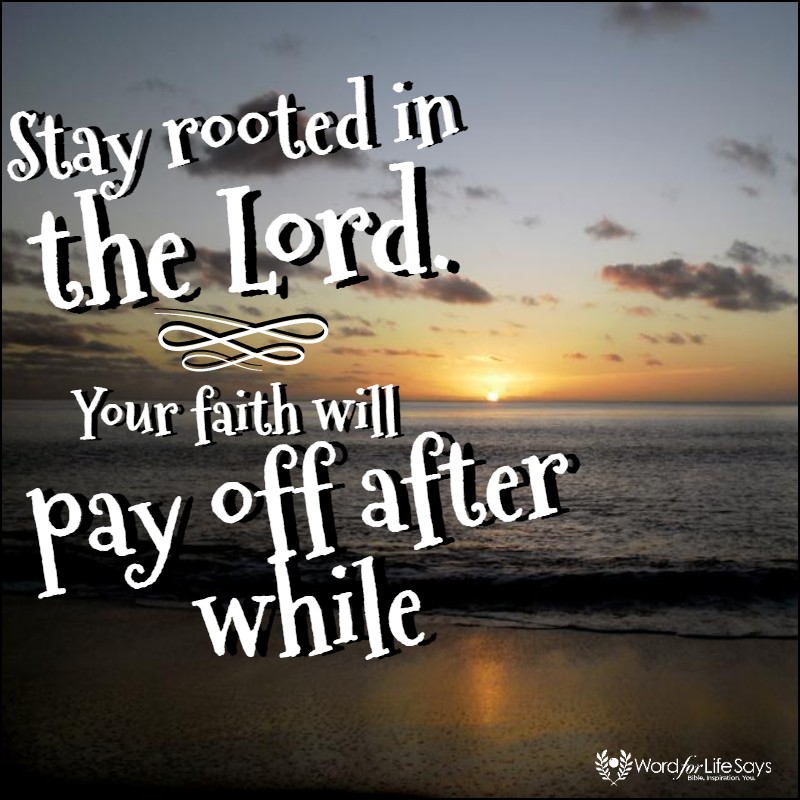
There are a lot of things and imaginations that seek to draw you away. Hebrews teaches that if we will just hold on to the truth, to the confidence, the reward is coming! 1 Corinthians 15:58 supports this by admonishing us to “. . . be ye steadfast, unmovable, always abounding in the work of the Lord, forasmuch as ye know that your labour is not in vain in the Lord, (KJV). If you stay rooted in the Lord, it will all pay off in a little while. It’s not in vain! Don’t change your glory!

Hold on! “For ye have need of patience, that, after ye have done the will of God, ye might receive the promise,” (Hebrews 10:36, KJV). Wait for it! Do His will! Receive His promises! But, don’t change your glory! “Now the just shall live by faith: but if any man draw back, my soul shall have no pleasure in him. But we are not of them who draw back into perdition; but of them that believe to the saving of the soul,” (Hebrews 10:38-39, KJV).

There are many things that appear to profit but end in ruin. Ask Adam and Eve, or the prodigal son, or even the ancient Israelites. They suffered from the choices they made. Today, we can look at their examples and decide to do it differently. We don’t mock them, but we learn from them what we don’t want to do. And, we don’t want to change our glory!

Copyright © Word For Life Says.com articles/lessons/worksheets may not be copied or redistributed without the express written permission of WordforLifeSays.com.  Please see the COPYRIGHT PAGE for more details.  Blessings to you.

Please Note: Ads below or referenced on this site are prefabricated and mass-produced (of which I currently have no control over) and DO NOT necessarily represent the views and/or beliefs of this site and its admin.

“Singing in the Rain!”


Today, like most days here lately, it’s rainy, dreary and of the dismal sort.  It’s the kind of cold, wet rain that settles down in your bones which you can’t seem to warm up from.  It makes you want to crawl back under the covers and wait for a better day.

But real life is here with a call each and every day that must be answered, compelling us to rise and get going no matter what the weather is outside.  Answering that call on a  morning such as this, I remember one day when I drove across the highway to take my daughter to her college campus.  On the way home I saw something that put a smile on my face.  A man was walking in the rain with a bright orange raincoat.  He was literally bouncing along with happiness in his steps.  His mouth was moving and he appeared to be singing.  It was as if he was dictating his day; as if he was telling the rain he was not going to let the dreariness get him down.

Oh, how true does that ring out in life?  How many dreary situations have kept us from enjoying the day; from enjoying each and every moment God has given us above ground?  Unfortunately, as life goes on we find that every day is not peaches and cream.  Times of trouble and hardship can arouse the rainy day blues in anybody.

Psalm 137:4 asks, “How shall we sing the LORD’S song in a strange land?”  How many times have we felt it hard to work up the happiness inside when going through difficult times?  But Psalm 43:5 declares, “Why art thou cast down, O my soul? and why art thou disquieted within me? hope thou in God: for I shall yet praise him, who is the health of my countenance, and my God.”

In other words, Sing in the Rain!  

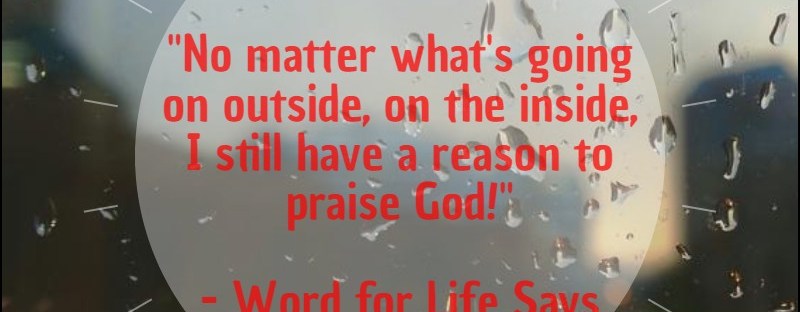
I feel like getting on board with the attitude of the guy in the orange raincoat.  There you can catch me Singing in the Rain today, too.  After all, we still have a reason to praise God no matter what.  My hope for this day and every day is in Him.  

God Bless!

Copyright © Word For Life Says.com (Sharing any posts or lessons can only be done through the share buttons provided on this site from the original posts, lessons, and articles only. You can reblog from the original posts only using the reblog button provided, or share using the share buttons provided from these social media platforms: Facebook, Twitter, or Pinterest, etc., and they must be shared from the original posts only. All other repostings are prohibited. Posts and other items of interest found on this site MAY NOT BE COPIED AND PASTED, downloaded, uploaded, etc to another website or entity not listed (physical or electronic).  See COPYRIGHT PAGE for more details.

When Little Means a Lot!

There are few places in life where it seems anything associated with the word little is appreciated.  And while our culture and this world tend to only see the big things, the grand, the outlandishly oversized as important to regard, the Bible continually teaches us that those things that we consider to be little, mean so much more.

For instance, Psalm 37:16 lets us know, “A little that a righteous man hath is better than the riches of many wicked.”  It’s all a matter of where value is placed.  The values that the righteous man has within him because of his relationship with God far exceed the value of things, stuff, and money many wicked together can possess.  Jesus said, “Lay not up for yourselves treasure upon earth . . . but lay up for yourselves treasure in heaven . . .” (Mt. 6:19-20).  Little possessions may not account for much here, but a heart rich in Jesus is worth so much more, here, and in heaven.

Another thing our culture celebrates is the idea of success, especially what appears to be an instant or overnight success.  In an age where clicks to like can boost an “influencer’s” reputation or clout, it Is not hard to imagine the rise of some to happen so quickly.  And yet, the Bible asks this in Zechariah: “For who hath despised the day of small things?” (4:10).

All success is not bad.  In fact, we are encouraged many times in the Bible to work, work hard, and put in full effort.  But what is bad is the worship of success and the comparison trap it can bring.  The groundwork of what God wants to do in your life is going to need an awesome foundation, and any good foundation takes time to build.

Clicks, likes, and human recognition may not have you shooting ahead fast as lightning, but your progress in God, your progress in what and how He is leading you to build, is worth so much more, even if it takes a little bit longer.

A little in God’s kingdom can do mighty works.  And the Bible teaches us “if ye had faith as a grain of mustard seed” (Lk. 17:6; Mt. 17:20, and 21:21), you can do amazing things.  It’s not always about increasing, as the disciples once asked (Lk. 17:5), it’s about working with what you presently possess.  And if what you presently possess is not much, God can multiply that if you just will use your little bit.

With God, size doesn’t matter, but source does.  If you look at what you have and you depend on that as your source, that is not faith – God’s not interested in that.  But if He’s your authentic, true-enough source; if it is to Him you are raising your eyes to heaven, with your two fish and five little loaves (Mt. 14:17-19) – now, that kind of reliant faith is something He can work with.

Friends, I have only touched the tip of the iceberg here to teach you that with God, a little means a whole lot.  But I hope it’s enough to encourage you to stop comparing where you are with another’s progress.  Don’t let discouraging thoughts discount the value in you.  You are important.   What you have is important, no matter how any other views it, even if it appears to only be a little.

“There be four things which are little upon the earth, but they are exceeding wise:

The ants are a people not strong, yet they prepare their meat in the summer;

The conies are but a feeble folk, yet make they their houses in the rocks;

The locusts have no king, yet go they forth all of them by bands;

The spider taketh hold with her hands, and is in kings’ palaces.” Proverbs 30:24-28

Little things can make a big difference.

Copyright © Word For Life Says.com articles/lessons/worksheets may not be copied or redistributed without the express written permission of WordforLifeSays.com.  Please see the COPYRIGHT PAGE for more details.  Blessings to you.

Please Note: Ads below or referenced on this site are prefabricated and mass-produced (of which I currently have no control over) and DO NOT necessarily represent the views and/or beliefs of this site and its admin.

I Say to You, Arise!

Photo by Max Andrey on Pexels.com

“I say unto thee, arise.” Mark 5:41

It’s too late.  The time for a turnaround has passed.  The episode of this life is gone and there’s nothing we can do about it.

“There is nothing we can do about it.”  Sound familiar?  How many times in our lives have these words been spoken by others, or even by us?  These words surface when we are at a loss for how to handle what’s before us.  It could be that we have tried, perhaps multiple times, to work on a solution in the midst of a mess, but our trying has fallen flat, and it just didn’t come together as we had hoped.

At this point, the white flag of surrender is raised, and we give up.  Looking at what seems to be irreversible and impossible, a solution unrecognizable to us, it is easy to believe that the time of hope is no more. “Why troublest thou the Master any further?” (v. 35).  For them, they knew what death looked like and the time for help has gone by according to what they believed to be true, so they spoke, “Thy daughter is dead.”

But when you invite Jesus to your house.  When you ask for Him to get involved with the problem, there is nothing too hard for God (Jeremiah 32:17, 27).

“As soon as Jesus heard the word that was spoken, he saith unto the ruler of the synagogue, Be not afraid, only believe” (v. 36).  Jesus stepped in and took immediate action against anyone who would try to stand in the way of this miracle from going forth.  As soon as He heard the negative report, He countered it with His own promise: “Be not afraid, only believe.”  Their news was dismal, and they were ready to close the case on the possibility of something good coming from this hurt, but Jesus had better in mind.

There is no situation that is beyond His power to help when it is relinquished into the hands of our God.  Instead of holding on to what you see and feel, hold on to your faith.  During these crucial moments, give Jesus space to work a miracle.  Others may not understand, and the full revelation may escape you, nevertheless, “let your requests be made known unto God” (Philippians 4:6) and believe.

“I say to you, arise” (NKJV).  The command for life to return to this daughter speaks hope: “It is not too late!”  Where we may see the end, Jesus sees a new beginning.  In what area are you hoping to see a turnaround? Believe, trust, and arise!

Father God, we are praying for Your touch in the midst of whatever we are facing.  Healing, deliverance, or just circumstance – Father God, we need You.  We believe that You can work the impossible.  We believe that Your favor and blessings and miracles are still in effect today.  And whatever it looks like, it is not too far gone for You.  Father God, we believe that You can restore, you can bring it back to wholeness and healing, and cause us to arise.  “I will lift up mine eyes unto the hills, from whence cometh my help.  My help cometh from the Lord, which made heaven and earth” (Psalm 121:1, 2) is my heart’s prayer, and it is in Your hands, O God, we place it all.  In the name of Jesus Christ, our Savior, we pray, AMEN!

“Wait on the Lord: be of good courage, and he shall strengthen thine heart: wait, I say, on the Lord.” Psalm 27:14

Copyright © Word For Life Says.com articles/lessons/worksheets may not be copied or redistributed without the express written permission of WordforLifeSays.com.  Please see the COPYRIGHT PAGE for more details.  Blessings to you.

Please Note: Ads below or referenced on this site are prefabricated and mass-produced (of which I currently have no control over) and DO NOT necessarily represent the views and/or beliefs of this site and its admin.

One Sure-Fire Way!

If you have ever had hiccups the advice comes out of the woodwork on how to deal with them. “Hold your breath” some will say. While another may tell you to drink this or that, believing this will be the cure.

Growing up, we received a lot of advice on how to do this or get rid of that, or how to treat a specific ailment. Some refer to these homegrown remedies as old wives tales, and yet, history shows that some actually help in dealing with illness and the like (chicken noodle soup is a definite go-to for me). And it doesn’t matter if you didn’t agree, you would never convince those who pass down these remedies that it doesn’t work, for they have seen it help in the past and are convinced it can still help today.

David knew a thing or two about going through some things. Adversity was no stranger to his doorstep and yet, for all he faced, he always managed to stay in the faith.

How did he do this?

One way we can see this happening is through his own testimony found in Psalm 16:8 where he states, “I have set the LORD always before me . . .” Was this David’s sure-fire remedy for remaining when others would have moved?

Let’s examine the facts. When facing Goliath, David said, “Thou comest to me with a sword, and with a spear, and with a shield: but I come to thee in the name of the Lord of hosts, the God of the armies of Israel, whom thou hast defied” (1 Samuel 17:45).

When dealing with Saul’s mess, the Bible says, “David behaved himself wisely in all his ways; and the Lord was with him” (1 Samuel 18:14). Leaving it all in the hands of God, David refused to lay a hand on king Saul (1 Samuel 24:12, 13).

When his son, Absalom, drove David from his kingdom in his rebellion, and Zadok desired to bring the ark of the covenant, David spoke, and said, “Carry back the ark of God into the city: if I shall find favour in the eyes of the Lord, he will bring me again, and shew me both it, and his habitation” (2 Samuel 15:25). 

When cursed by Shimei, David refused to allow vengeance to take place on his behalf. Rather, he said, ” . . . let him curse; for the Lord hath bidden him. It may be that the Lord will look on mine affliction and that the Lord will requite me good for his cursing this day” (2 Samuel 16:11, 12). 

And when faced with his own sin, David said, “I have sinned against the Lord” (2 Samuel 12:13). To God he said, “For I acknowledge my transgressions: and my sin is ever before me” (Psalm 51:3). “Create in me a clean heart, O God; and renew a right spirit within me”(51:10).

David found God even in the adversities he encountered. The rest of Psalm 16:8 is when David proclaimed, “Because he is at my right hand, I shall not be moved.” Keeping God before his face was David’s way of being able to come through many difficult times, and yet still be dubbed “a man after God’s own heart” (1 Samuel 13:14; Acts 13:22).

We can learn a thing or two from David.

How can we keep the Lord always before us?

  1. Simply put, don’t take your eyes off God. When Peter was invited to walk the waves with Jesus, his focus shifted to what was before him instead of the Christ who stood with him, and he began to drown (Matthew 14:25-30). Peter may have seen Jesus physically, but David saw God with a heart of faith and that’s where he kept his focus.
  2. Don’t compromise your beliefs. If God is before you, His word, His instructions are before you (Psalm 16:7), and like the three Hebrew boys, there is no fear of the furnace that will cause you to sway from that truth (Daniel 3:16-18). Hold on to His unchanging hand.
  3. Establish your hope in God alone (Psalm 16:11), now, and in the time to come. One day, this will all be over and we will see God face to face (Revelation 22:3-4).

David’s sure-fire way of dealing with this life will work in your life, too. With that king of old, we too can say, “I have set the Lord always before me.”

Image by Radosław Cieśla from Pixabay 

Copyright © Word For Life Says.com articles/lessons/worksheets may not be copied or redistributed without the express written permission of WordforLifeSays.com.  Please see the COPYRIGHT PAGE for more details.  Blessings to you.

Please Note: Ads below or referenced on this site are prefabricated and mass-produced (of which I currently have no control over) and DO NOT necessarily represent the views and/or beliefs of this site and its admin.


The View That Will Change Your Life Forever

Some views will change your life forever.  The scenic wonder as you look out over the mountaintops. The sun that sets below the horizon daily.  The waves that crash on the ocean shores where land and sea collide.  Seeing and feeling the peace of a forest walk as nature saturates your senses.  When our eyes meet with places like these, there seems to be an extraordinary pull within us that longs for us to want to relive that experience day after day.  What your eyes see and what you experience has a way of affecting you on the inside.

But what about what your heart sees?  How do you respond to the vision of Jesus before you today?  When you look at Him, who do you see?

One day Jesus had a private moment with His disciples. In that moment, He wanted to know what they saw, not with their eyes, but with their hearts.  After asking about the opinions of others (Mt. 16:13), He wanted to know what those around Him thought for themselves: “But whom say ye that I am?” He asked (Mt. 16:15). 

With that questioning digging into their personal understanding of Him, only one spoke in revealed truth that centered itself in his very being and wouldn’t let go.  Only one man, by the name of Peter, saw Jesus for so much more.  “Thou art the Christ, the Son of the living God,” (Mt. 16:16) he said without hesitation or flinching, being fully confident in his answer.

In Jesus, I believe he saw not just the miracles, and wonders, and powerful teaching.  He saw Him for who He was: “The Son of the living God.”

When you see Jesus for who He really is, your life will be filled with wonder in a way you have never experienced before, and you will be changed forever.  When the veil of truth is pulled back and revelation dawns upon your knowing heart, and heaven shows you the Son, things will never be the same. 

As your eyes of faith look upon Him and your soul is drawn to Him, you find in Christ what you have been searching for all your life.  Forward you walk.  Closer to thee, O Lord, I must be, becomes the craving of your inner man, and it cannot be satisfied with another.

I know how the world views Him.  They call Jesus many things and have many opinions.  But as I rise this day and every day, I see your glory.  I see Your hand in the very details of my life.  I feel you in my heart, and as with Peter, I see the Son before me.  That is a view that has changed my life forever. 

Blessings ~

Father God, we are praying today for many souls to see You for who You are.  We are praying for eyes and hearts to be opened to the eternal truth: salvation can be found in no other, but only in Jesus Christ can lives be truly changed forever (Jn. 14:6).  May many grab hold of this truth today and believe and receive Him for themselves.  In the name of Jesus Christ, we pray, AMEN!

Above image by David Mark from Pixabay

Copyright © Word For Life Says.com articles/lessons/worksheets may not be copied or redistributed without the express written permission of WordforLifeSays.com.  Please see the COPYRIGHT PAGE for more details.  Blessings to you.

Please Note: Ads below or referenced on this site are prefabricated and mass-produced (of which I currently have no control over) and DO NOT necessarily represent the views and/or beliefs of this site and its admin.

Sunday School Lesson – “Raising Lazarus: Jesus’ Authority Over Death” John 11:38-44

VERSE DISCOVERY: John 11:38-44 (KJV, Public Domain)

Have you ever watched a dramatic movie just to get that knot in your throat when the scene turns too intense? You know what’s on the screen is not real, yet unbidden tears begin to form in the corner of your eyes.  You wipe and wipe, hoping nobody else sees you crying over a movie, but they just won’t stop flowing.

Quite possibly, you have seen this movie before and you know the story will turn out for good, but your heart was just so touched by what was before you that you cannot help but let the emotions of the scene get to you.

In today’s lesson, we come upon a scene that takes a dramatic turn and puts a knot in the throat of our Savior. This does not only become a scene where He shows His undying compassion for those He loves by the shedding of His own tears, but He also shows His complete authority and victory over death and the grave before He ever went to the cross.

Jesus Comes to the Grave

John 11:38 “Jesus therefore again groaning in himself cometh to the grave. It was a cave, and a stone lay upon it.”

Jesus was out of the area when He received the summons that something terrible had happened to a very good friend of His. Lazarus was sick and the situation did not look good.  His sisters Mary and Martha sent a messenger to the Lord, saying, “He whom thou lovest is sick,” (John 11:3).

The first response when one hears news of a dire emergency occurring with a family member or a friend is to hurry and get to where that individual is, to offer any support and aid that one can to help remedy the situation. This may be the reason his sisters sent for Jesus in the first place.  As we learn, things did not work out as they had planned, but the situation was not out of the control of God.  His plan would be made manifest, and glory would be rendered to Him at the outcome of it all.

When He received the news about Lazarus, Jesus spoke without wavering, “This sickness is not unto death, but for the glory of God, that the Son of God might be glorified thereby,” (John 11:4). Therefore, the Bible tells us He waited and did not immediately run to his side.

Some may think this is heartless. Not so, and if you read carefully, you will see that Jesus loved these people greatly (see John 11:5).  God was on the verge of transitioning the faith of those who would witness this great miracle to a brand-new level of belief in Jesus Christ, His Son.  Lazarus’ death would be the tool that would do just that.  So powerful was the event that is about to take place that later “the chief priests consulted that they might put Lazarus also to death; Because that by reason of him many of the Jews went away, and believed on Jesus,” (John 12:10-11).

So, Jesus waits two more days before He made His way to where Lazarus was (see John 11:6). When He arrives, no surprise to Him, but just for narrative purposes we are told in the Bible that Lazarus has been in the grave “four days already,” (John 11:17).

Martha, upon finding out of the Lord’s arrival ran to Him and said, “Lord, if thou hadst been here, my brother had not died,” (John 11:21). She knew that while Lazarus was still alive if Jesus had intervened death, all of this could have been avoided, and they would not be having this conversation today.

With no great, flowery words we often hear as sentiments of condolences at the passing of a loved one, Jesus simply stated, “Thy brother shall rise again,” (John 11:23). Martha knew of the resurrection, and she had that kind of faith in Jesus for the “last day” (see John 11:24), but today she still stands in grief wondering why Jesus hadn’t come on time.

When Mary was called to join them, she expressed the same sorrowful sentiment, “Lord, if thou hadst been here my brother had not died,” (John 11:32). Seeing His friends weeping and this whole sad scene playing out before Him, it caused Him to “groan in the spirit,” and He was “troubled” (John 11:33).  His own tears began to flow.

Looking at Him, and seeing His love for the one who was dead, people began to question, “Could not this man, which opened the eyes of the blind, have caused that even this man should not have died,” (John 11:37)? At this point, many of them still saw Jesus as just a “man.”  And as a man, they were looking at what Jesus could’ve done while Lazarus was alive as opposed to what He can do now even in his death.  In their humanity, they focused on what could have been prevented, instead of Jesus as the Savior who has the power to overcome it.

Arriving at the text of our lesson, verse 38 tells us, “Jesus therefore again groaning in himself cometh to the grave.” Here, Jesus is at the graveside of Lazarus and despite His all-knowing nature, He still groans again.

The fact of the matter is Lazarus was a friend of His and this tragic event touched Him on a personal level. Could it be that although He is fully God, that even in His humanity here on earth grief hit hard?  He was surrounded by weeping friends, and one is laying lifeless in the grave.  He was going to gain victory over it all, but for now, He groaned.

The Bible says that Jesus was “touched with the feeling of our infirmities,” (Hebrews 4:15). What that means is He knows what this human life is all about, the good times and the sad.  He feels what we feel.  He understands the hardships we face in the flesh; therefore, He groans.

Once I wrote, “Isn’t it nice to know that not only do we NOT carry our burdens alone, but we have a Savior that knows what those burdens feel like? Out of the depths of sorrow and pain – He knows.  Through the roads of striving and the paths of hatred – He knows.  During the darkness of nights, He already knows.  Our weaknesses have become His; He knows them, has lived through them, and has borne them.  Jesus knows!” (Jesus Knows/Wordforlifesays.com).

Jesus Says Take the Stone from the Grave

John 11:39 “Jesus said, Take ye away the stone. Martha, the sister of him that was dead, saith unto him, Lord, by this time he stinketh: for he hath been dead four days.”

“Take ye away the stone.” The scene was heart-wrenching and troubling; now Jesus asked what may seem to be an unthinkable and irrational request to some.

Unthinkable?  Maybe for another, but not for Jesus.

Irrational? Not at all.  Jesus was asking permission to gain access to the problem.

There are steps of faith and participation Jesus asks His followers to take. If you will remember back in 2 Chronicles 20:17 the people were told to get battle ready and go out against their enemy even though they would not need to fight in that battle.  We have the responsibility to activate our faith in Him by following through on His requests even if it seems irrational.

By removing the stone, they would not only be giving Jesus access to Lazarus, but they were giving Him access to their faith. When one opens their faith, they give Jesus a chance to speak life into it and do the impossible.

“Lord, by this time he stinketh.” Martha spoke up at the thought of it all. One did not just go around opening the graves of dead people except to add more dead people to it.  Little did she know Jesus wanted to free him that was dead and deliver him from that situation.

It should not be surprising that Martha is the one that spoke up. She was the worrier of the family.  When Mary spent time at the feet of Jesus, taking in the words He spoke and strengthening her faith, Martha was busy worrying about the things of this life (see Luke 10:38-42).

“For he hath been dead four days.” Four days gives us the impression that decay could have possibly started to set in in Lazarus’ body. For the human eye, this may look like a point of no return.  But for Jesus, it’s not too late.

Jesus’ power and authority over death are not restricted because Lazarus is in the grave and in a possibly decomposing state (think of the valley of dry bones in Ezekiel 37).  Lazarus’s sister wanted to confine the possibility of Jesus being able to do something about his condition within a certain time frame.  Once that time expired, to her, all hope expired with it.

Earlier she and her sister both expressed to Jesus, “Lord, if thou hadst been here, my brother had not died,” (John 11:21, 32). But now, she sees the situation as past the point of remedy.  She believes it is too late.

There is nothing that God cannot do: “For thou art great, and doest wondrous things: thou art God alone,” (Psalm 86:10).  Jesus can “do exceeding abundantly above all that we ask or think,” (Ephesians 3:20).  Jesus didn’t need her to rehearse how many days have passed.  For Him, it’s never too late!

John 11:40 “Jesus saith unto her, Said I not unto thee, that, if thou wouldest believe, thou shouldest see the glory of God?”

Before this moment of questioning, there was given a promise. Jesus assured her then, “I am the resurrection, and the life: he that believeth in me, though he were dead, yet shall he live: And whosoever liveth and believeth in me shall never die.  Believest thou this?” (John 11:25-26).

Her response then was, “Yea, Lord: I believe that thou art the Christ, the Son of God, which should come into the world,” (John 11:27). She was most likely concerned with the hereafter when she made her declaration of faith.  But Jesus was ready right now to do the impossible.  He was ready now to manifest “the glory of God.”

How do we see the glory of God manifested in our own life? By believing.

In an article titled, “Do More Than Pray – Believe!” I wrote:

“Sometimes in life, I think we tend to downplay the importance of our faith and what we believe. We hear about it so much that I think as Christians we have become desensitized to its power in both our spiritual and our natural lives.  This is not what it should be since we are told in four verses of the Bible, “The just shall live by his faith,” (Hab. 2:4; Rom. 1:17; Gal. 3:11; Heb. 10:38, KJV).

Our faith, our belief should be the marker for everything in our lives. Not just for salvation, but for every action and prayer.  We know all the right words to say and all the proper “Christian” motions to make, but is our faith alive and put into full force action?” (Wordforlifesays.com)

What Jesus was asking her was to believe beyond what she can see now, and she will have access to witnessing something truly miraculous taking place.  She was to put her faith “into full force action.” As Christians, we too are called to put our faith on display and let Jesus have access to the dead things so that He can raise them to life again.

Previously in John 11:4, when first called to come to Lazarus’ aid, Jesus spoke, “This sickness is not unto death, but for the glory of God, that the Son of God might be glorified thereby.” Knowing the power He would soon exhibit, He stated confidently again in verse 11, “Our friend Lazarus sleepeth; but I go, that I may awake him out of sleep.”

God’s glory was about to shine for the whole world to see.

The Grave is Opened and Jesus Prays

John 11:41-42 “Then they took away the stone from the place where the dead was laid. And Jesus lifted up his eyes, and said, Father, I thank thee that thou hast heard me.  And I knew that thou hearest me always: but because of the people which stand by I said it, that they may believe that thou hast sent me.”

With the stone rolled away from the grave, “Jesus lifted up his eyes.” What a beautiful picture this depicts, the King of all creation standing humbly with the naysayers while His whole focus is on heaven. He intercedes and approaches heaven where His Father sits attentively upon His holy throne.  A privilege, mind you, that He has now given to all His children (Hebrews 4:16).

“And said, Father, I thank thee that thou hast heard me.” To me, this is one of the most special phrases in the Bible. Aloud, Jesus let us know that our prayers do not fall on deaf ears.  Repeatedly we are taught that God hears when we pray, and here in this moment, Jesus gives us an exact illustration of the faith we too can have when approaching the throne of grace.

“God has so many wonderful characteristics and attributes, but one of the things that always strike me as impressive is the fact that He hears my prayers, Psalm 54:2. In all lowliness of mind and heart, we come before Him freely. The Sovereign of the universe becomes attentive to us, and to our needs, and bows down His ear to take on our concerns and needs. He doesn’t have to, but He is mindful of us, Psalm 8:4. He centers Himself to focus wholly and completely on us.” (Know that God Hears/Wordforlifesays.com).

That’s amazing!

When Jesus approached God in prayer, He went in expectation, totally sure “that thou hearest me always.”

When one prays, expect to receive an answer, expect to see some sort of fulfillment come from your prayers. Look for something to happen because of your praying.  Even if the answer doesn’t look the way you imagine it should, your prayers do not fall on deaf ears.  Be confident that God hears you.  God is attentive to you.  God does not leave you in a state of wanting.  David said, “The LORD is my shepherd; I shall not want,” (Psalm 23:1).  There will be results.

Believe in the goodness of God. Believe in your relationship with Him as a child of the heavenly Father.  Believe that He always seeks to give you His best (ex. John 3:16).  I often refer to God in my personal prayer as the Good Father who gives good gifts to His children (Matthew 7:11).  It’s something we must hold on to and depend upon.  Believe that God knows how to answer our prayers.

“That they may believe that thou hast sent me.”  Jesus wanted to show the people through His prayer, and through what was to follow, that He and His Father were hooked up together in this.  He wasn’t some rogue man seeking to attract crowds for self-sake.  He was the Son of God, working with God and His approval, seeking to convince as many as possible to believe in Him, to believe in the mission He came to accomplish on this earth, with the end result of saving their souls, not just raising Lazarus from the dead. He spoke, “That they may believe.”

Jesus Calls Lazarus Out of the Grave

John 11:43-44 “And when he thus had spoken, he cried with a loud voice, Lazarus, come forth.  And he that was dead came forth, bound hand and foot with graveclothes: and his face was bound about with a napkin. Jesus saith unto them, Loose him, and let him go.”

Jesus, before He ever went to the cross, proved His authority over death once again. On previous occasions, others who tasted death were brought back to life (see Matthew 9:25 and Luke 7:15).  Lazarus’s death, and the miracle of life being restored to him would be far more convincing of the power of Christ because he had been dead for a longer period.

Jesus once spoke, and said, “Verily, verily, I say unto you, The hour is coming, and now is, when the dead shall hear the voice of the Son of God: and they that hear shall live. Marvel not at this: for the hour is coming, in the which all that are in the graves shall hear his voice, And shall come forth; they that have done good, unto the resurrection of life; and they that have done evil, unto the resurrection of damnation,” (John 5:25, 28-29).

What Jesus was doing with Lazarus now was just a small example of His power and what He will do in that day to come. Therefore, He called Lazarus by name and commanded him, “Come forth.” The Bible then tells us, “And he that was dead came forth.”

Even in death, those who were and are in Christ Jesus, are secured. “Loose him, and let him go,” Jesus commanded.  The one who has been raised need not be bound any longer.  Graveclothes are for the dead, of which Lazarus was not anymore.  Therefore, they were commanded to be taken off him.  Lazarus was made totally free.

In conclusion, we can have faith, because we see:

Jesus showed His authority over death before the cross: as seen here in this lesson and through other death-raising miracles.

He showed His authority over death during His process of going to the cross: When Pilate spoke of his power to crucify Him, the Bible says, “Jesus answered, Thou couldest have no power at all against me, except it were given thee from above,” (John 19:11, emphasis mine).  Previously, when He spoke of His life to others He said, “No man taketh it from me, but I lay it down of myself. I have power to lay it down, and I have power to take it again,” (John 10:18, emphasis mine).

He showed His authority over death on the cross: “When Jesus therefore had received the vinegar, he said, It is finished: and he bowed his head, and gave up the ghost,” (John 19:30, emphasis mine; see also Matthew 27:50 and Luke 23:46).

He showed His authority over death when He rose on the third day: “And that he was buried, and that he rose again the third day according to the scriptures,” (1 Corinthians 15:4, emphasis mine).

And He has authority over death forevermore: “I am he that liveth, and was dead; and, behold, I am alive for evermore, Amen; and have the keys of hell and of death,” – Revelation 1:18, emphasis mine).

PDF Full Printable Sunday School Lesson Pack (With easy to read instructions following the P.E.A.R.L. format on how to conduct each lesson with areas for adding personal notes): Sunday School Lesson – Raising Lazarus: Jesus’ Authority Over Death

Suggested Activities:

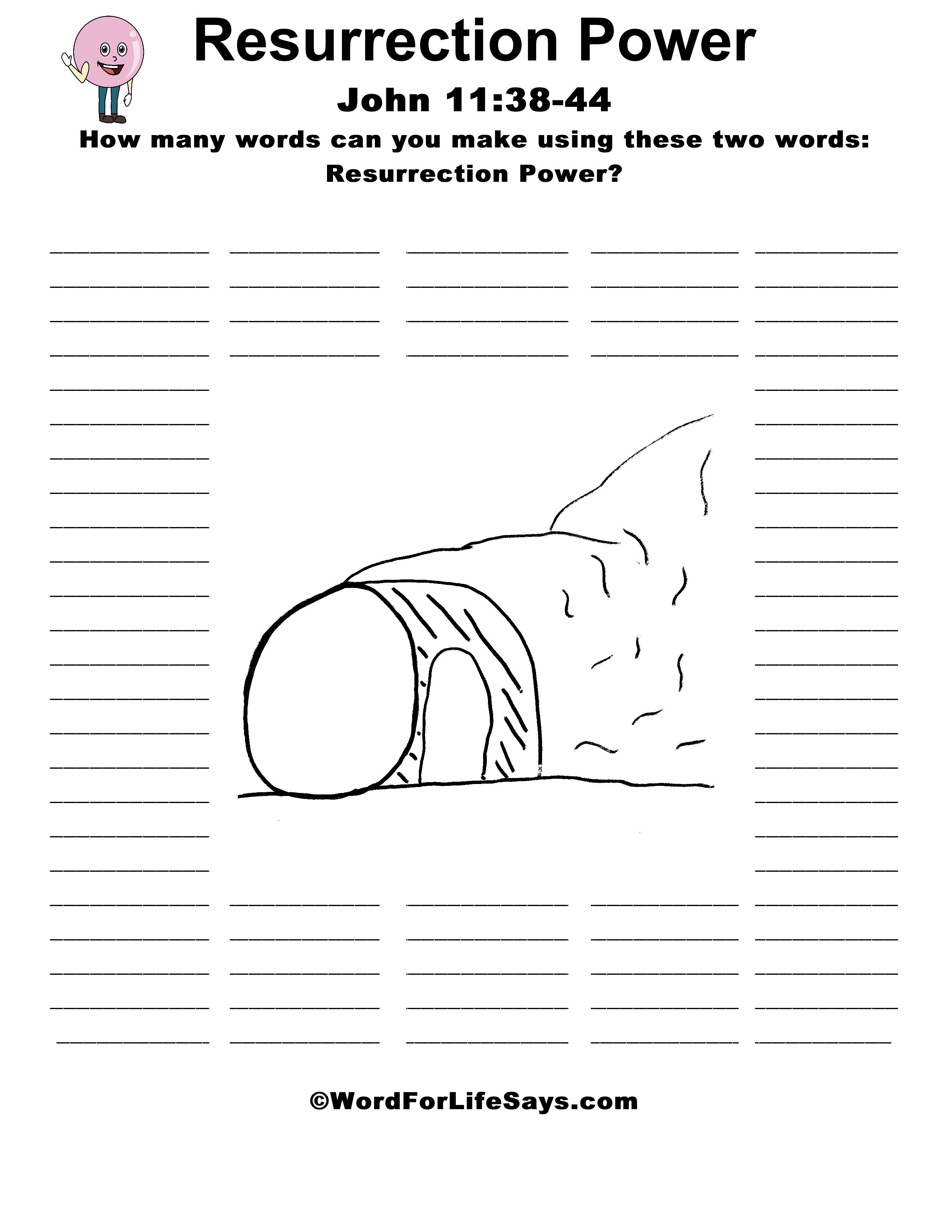
Lesson Opener: “Resurrection Power” (see the attached lesson pdf link above for details on an activity to open this lesson)

Adult Journal Page: From the lesson of Jesus raising Lazarus from the dead (John 11:38-44), we are reminded of many wonderful truths, such as Jesus’ love and compassion for people (Jesus wept), activating our faith through believing His promises and acting upon them (rolling away the stone), squashing doubts about what Jesus can do (“Said I not unto thee, that, if thou wouldest believe, thou shouldest see the glory of God?” (v. 40)), to believing for the impossible, and God hears our prayers.  These, and many more truths come alive in this story.  Which part or parts are the most encouraging to you, and why?  Write your response on the Adult Journal Page – Raising Lazarus

Kid’s Journal Page: Kid’s Journal Page – Raising Lazarus

Blank Journal Pages: These pages, one designed for adults and one for children, can be used to bring out, remember, or write a particular part of the lesson you wish for you and/or your class to focus on.  Click>>Blank Adult and Kid’s Journal Pages to access the journal pages.

Draw the Scene:  Raising Lazarus Draw the Scene

How Many Words:  Resurrection Power How Many Words

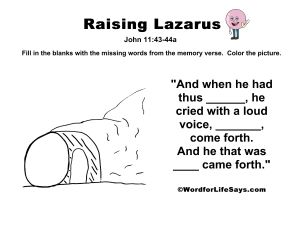
Memory Verse: Raising Lazarus Memory Verse
Word Search: Raising Lazarus Word Search  Answers: Raising Lazarus Word Search Answers

Crossword: Raising Lazarus Crossword  Answers: Raising Lazarus Crossword Answers

Word Scramble: Raising Lazarus Word Scramble  Answers: Raising Lazarus Word Scramble Answers

Copyright © Word For Life Says.com (Sharing any posts or lessons can only be done through the share buttons provided on this site from the original posts, lessons, and articles only. You can reblog from the original posts only using the reblog button provided, or share using the share buttons provided from these social media platforms: Facebook, Twitter, or Pinterest, etc., and they must be shared from the original posts only. All other repostings are prohibited. Posts and other items of interest found on this site MAY NOT BE COPIED AND PASTED, downloaded, uploaded, etc to another website or entity not listed (physical or electronic).  See COPYRIGHT PAGE for more details.

Please Note: Ads below or referenced on this site are prefabricated and mass-produced (of which I currently have no control over) and DO NOT necessarily represent the views and/or beliefs of this site and its admin.


Standing on the Edge

Sometimes you may come to a place that seems impossible to pass.  This is a place that edges the border of what we have been delivered from to where we are being brought to.  It is in situations like these, when God shows up, there is no doubt that His hands have been working something extraordinary through it all.  The waters may crash on the shores before and the enemy’s army may be rolling behind, but God sees you, standing there on the fringe, in a world where these two impossibilities meet, yet in Him, there is nothing impossible.  In Him, there is always a way.  In Him, you are not in a helpless position.  In Him, the victory is already won.  Before you ever came to this place, He already knew what He would do.  So rest, weary one, in His sovereignty.  Rest in His plan.  You may not understand it, but He does.  You may not know how it will work out, but He does.  This will be performed by His strength, His wisdom, and His Spirit (Zechariah 4:6), not by anything we say or do.  In getting past this place, all glory, honor, praise, and credit go to God.  He is the one who will get you to the other side in peace and wholeness, with singing and rejoicing (Exodus 15:1-21).  To you who are standing on the edge, in Him, you are not standing alone.

 “And Moses said unto the people, Fear ye not, stand still, and see the salvation of the Lord, which he will shew to you to day: for the Egyptians whom ye have seen to day, ye shall see them again no more for ever.

The Lord shall fight for you, and ye shall hold your peace.

And the Lord said unto Moses, Wherefore criest thou unto me? speak unto the children of Israel, that they go forward:

But lift thou up thy rod, and stretch out thine hand over the sea, and divide it: and the children of Israel shall go on dry ground through the midst of the sea.

And I, behold, I will harden the hearts of the Egyptians, and they shall follow them: and I will get me honour upon Pharaoh, and upon all his host, upon his chariots, and upon his horsemen.

And the Egyptians shall know that I am the Lord, when I have gotten me honour upon Pharaoh, upon his chariots, and upon his horsemen.” Exodus 14:13-18

Copyright © Word For Life Says.com articles/lessons/worksheets may not be copied or redistributed without the express written permission of WordforLifeSays.com.  Please see the COPYRIGHT PAGE for more details.  Blessings to you.
Please Note: Ads below or referenced on this site are prefabricated and mass-produced (of which I currently have no control over) and DO NOT necessarily represent the views and/or beliefs of this site and its admin.

The Sound of the Trump

Photo by Pixabay on Pexels.com

They have seen the plagues inflicted upon their enemies.  They have tasted freedom they thought they never would have after their people had been in bondage for over four hundred years.  Two months of traveling the road led them to the base of this mount: Sinai.  The place where they would meet God and enter into a covenant relationship with Him.

Moses had his instructions to sanctify the people, the children of Isreal, and prepare them for this great meeting.  Rules have been put in place and boundaries marked out.  God’s commands for this meeting must be followed through correctly and He said, “When the trumpet soundeth long, they shall come up to the mount,” (Exodus 19:13).

The time has come.  With thundering and lightning enveloping the mountain (Exodus 19:16a), saturating it with the symbol of God’s awesomeness, then they heard “the voice of the trumpet exceeding loud” (Exodus 19:16b).  God is calling for His people to come for this holy encounter.  It was time for them to move forward to be where He is.

This event and these verses reminded me of Paul’s encouragement in 1 Thessalonians 4:16-17 and the hope that promise brings.

First, we remember when Jesus ascended into heaven and the disciples were told by two angels, “This same Jesus, which is taken up from you into heaven, shall so come in like manner as ye have seen him go into heaven” (Acts 1:11).

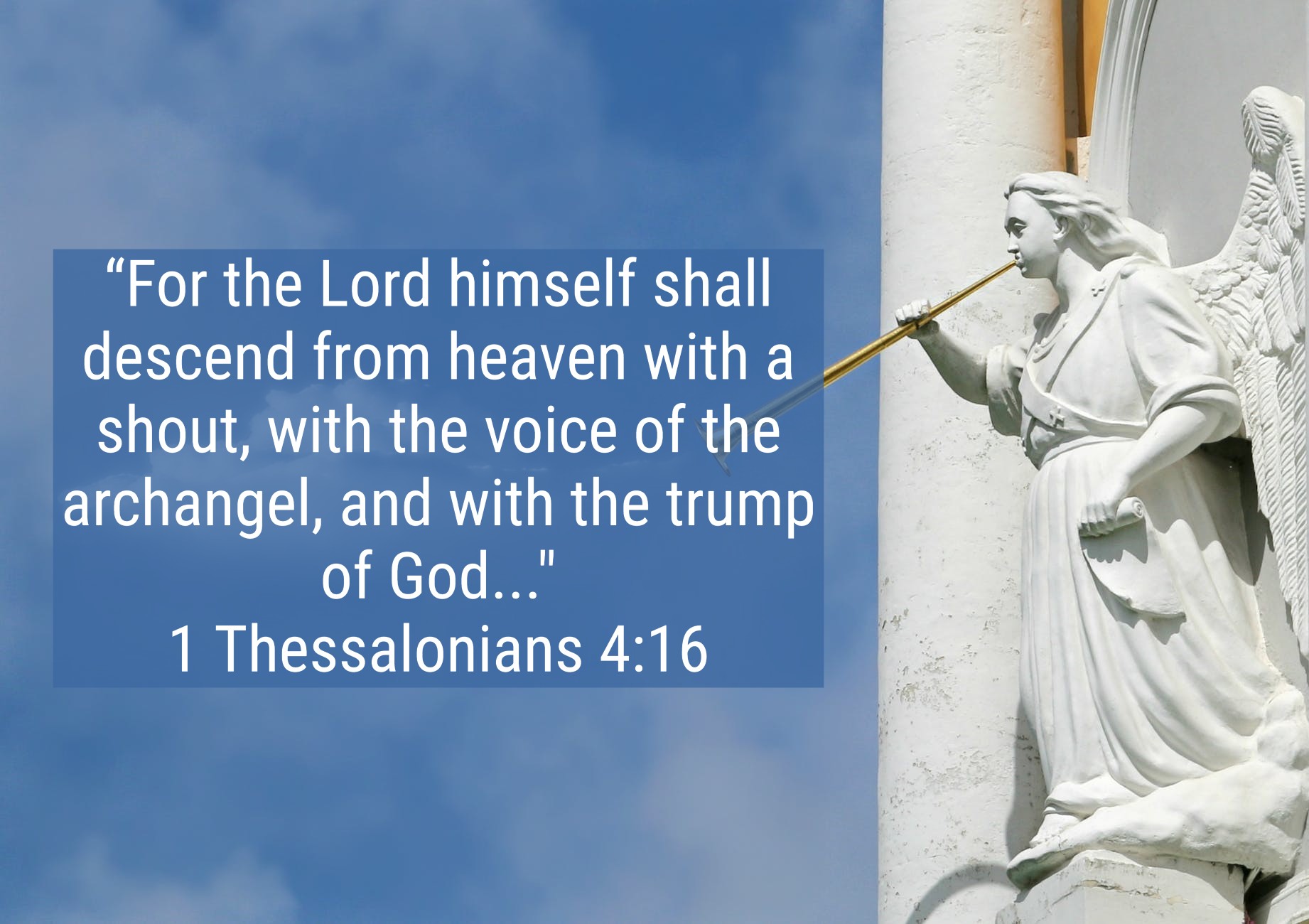
Through Paul’s teaching, 1 Thessalonians gives a glimpse of what that time would be like when Jesus returns: “For the Lord himself shall descend from heaven with a shout, with the voice of the archangel, and with the trump of God: and the dead in Christ shall rise first: Then we which are alive and remain shall be caught up together with them in the clouds, to meet the Lord in the air: and so shall we ever be with the Lord,” (16-17). 

With His dissension, every eye shall see Him (Revelation 1:7).  And like on that ancient Mount, “the trump of God” will blow.  Rather than calling His people to come closer to the mount, He will be calling His saints to come home, and again, we read, “the dead in Christ shall rise first: Then we which are alive and remain shall be caught up together with them in the clouds, to meet the Lord in the air: and so shall we ever be with the Lord,” (16-17). 

When the true King returns, it will be our turn to come closer to Him than ever before; to be where He is forever, never to be removed.  No more hopelessness.  No more sorrow.  No more pain.  No more heart-breaking acts, sicknesses, and troubles.  All the worries, questions, concerns, and hardships of this life will be gone forever.

Are you ready for the sound of the trump?

Copyright © Word For Life Says.com articles/lessons/worksheets may not be copied or redistributed without the express written permission of WordforLifeSays.com.  Please see the COPYRIGHT PAGE for more details.  Blessings to you.

Please Note: Ads below or referenced on this site are prefabricated and mass-produced (of which I currently have no control over) and DO NOT necessarily represent the views and/or beliefs of this site and its admin.

Appreciating Calvary!

“And when they were come to the place, which is called Calvary, there they crucified him, and the malefactors, one on the right hand, and the other on the left.” Luke 23:33

When approaching this subject and talking about “Appreciating Calvary,” I am speaking of the finished work of the cross that Christ Himself accomplished in that place.

One of my favorite hymns to sing, written by William Reed Newell, says, “Mercy there was great and grace was free, Pardon there was multiplied to me, There my burdened soul found liberty – At Calvary!”

Calvary is that place we sing of.  Calvary is the place of the skull.  That same Calvary in our beloved hymn is the place which was also known as Golgotha Hill.

It was the place where the condemned were taken.  A place where life was taken.  It was a place of pain, and where life would come to an end.  No one who mounted a cross in that place expected to leave that cross, except by way of death.

And Calvary, a place just outside of the walls of Jerusalem became a place synonymous with that suffering.  It became a place known for its executions.  In that, it also became the place for the most wellknown execution of all time, that our Lord and Savior, Jesus Christ.

Why is this so important?  Because He was, and is, so important.

History doesn’t record the name of others who died on that hill, for many have lost their lives in that place.  Calvary was not new to having blood flow down its hills.  Calvary was not new to having bodies bolstered high on its hill, exposing the shame of the condemned to everyone who walked by.

Calvary was not new to what the torture felt like that was carried out on its hills, but it wasn’t until Jesus became the one who walked up Calvary, His body already dealing with the pain of the scourging and whips; it wasn’t until Jesus, being fully submitted to the Father’s will, laid down His own life on that old rugged beam, that Calvary started to mean more than what it was used for.

I don’t know who died on that hill before Jesus.  And although some try to put names to the two thieves hanging next to Him, the Bible doesn’t mention them by their names (they are only noted by their actions).

But there is only one Man’s actions that made Calvary a significant place in history, and that’s Jesus.  It is only one name that climbed that hill that was worth remembering, and that’s Jesus.  It’s what Jesus did at Calvary that makes us appreciate it.  It is what Jesus performed on the cross on that hill that makes us want to pay attention to it and study it.  We want to know about Calvary because that’s where Jesus died for my sins and yours.

Before Jesus laid on that cross, He said, “Except a corn of wheat fall into the ground and die, it abideth alone: but if it die, it bringeth forth much fruit” (John 12:24).

Before Jesus carried that beam up that hill, He said, “And I, if I be lifted up from the earth, will draw all men unto me.  This he said, signifying what death he should die” (John 12:32-33).

Before one nail ever entered His flesh, He once told His disciples, “Therefore doth my Father love me, because I lay down my life, that I might take it again.  No man taketh it from me, but I lay it down of myself. I have power to lay it down, and I have power to take it again. This commandment have I received of my Father” (John 10:17-18).

Before He was sentenced to death, Jesus confidently told Pilate, “Thou couldest have no power at all against me, except it were given thee from above. . .” (John 19:11).  You are not taking My life from Me!  I know what I came to Calvary to do!  I came to Calvary, at this appointed time, in this appointed place, to do the will of My Father!   Before the foundation of the world, I was appointed here to offer mankind so much more, and Calvary was the place to make it all happen.

Calvary is the place of fulfillment.  Calvary is the place where the Passover Lamb was sacrificed.  Calvary was the place where things would be different now.  Calvary was the place where all things would be made new.  All because of what Jesus did on Calvary!

There, He hung and bled.  There, He cried out and died.  Because of what happened there, the veil was torn, the dead were raised, and souls would be released from eternal bondage, and so much more!

How much more, you may ask?  Let me show you what Jesus, Himself said from that place on Calvary.

On Calvary, Jesus showed us what true forgiveness looks like, saying, “Father, forgive them, for they know not what they do.”  Instead of ranting and raving; instead of cursing and trying to get even; instead of hating those who put Him on the cross, Jesus prays to the Father for their forgiveness.

The pain He was feeling would not stop until He did.  Even when His body is finally put in the grave, the unbelievers would still be mocking Him, but He didn’t let that deter Him, His heart was set on forgiveness!

On Calvary, Jesus also gave the offer of something better.  The offer of heaven was given to the repentant thief.  Jesus said from the cross, “Verily I say unto thee, Today shalt thou be with me in paradise” (Luke 23:43).  While He was losing His life, Jesus showed just how important souls are to Him.  Heaven is waiting for those who believe!  Heaven is yours if you are repentant!  What this world throws at you does not have the final say!  The promise is there!  The promise is for us.  There is a place referred to as Paradise and Jesus offered it to this previous sinner.

Your sins do not have to keep you where you are!  Jesus showed us on Calvary, that there is something better waiting for us ahead!  “Eye hath not seen, nor ear heard, neither have entered into the heart of man, the things which God hath prepared for them that love him” (1 Corinthians 2:9).  Calvary showed us, that something better is waiting on the horizon!

On Calvary, Jesus showed us that relationships matter.  On Calvary, Jesus shows how much He cares for and takes care of those He loves.  Looking down from the cross we are told, “When Jesus therefore saw His mother, and the disciple whom He loved standing by, He said to His mother, ‘Woman, behold your son!’  Then He said to the disciple, ‘Behold your mother!’   And from that hour that disciple took her to his own home,” (John 19:26-27, NKJV).

He had to go.  He had to die.  But that didn’t make it any easier for His mother to comprehend.  It was already prophesied to her, “(Yea, a sword shall pierce through thy own soul also,) that the thoughts of many hearts may be revealed” (Luke 2:35).  It didn’t soothe the heartbreak at all.  A mother’s love does not work like that.  It is a special connection of the heart that starts at the time of conception and never leaves her.  Jesus knew she needed special care.  This woman who had raised Him and loved Him through it all needed to be looked after in a special way.

In His time of desperation, it is a blessing that He shifted the focus and thought about Momma!

And in His time of desperation on that cross at Calvary, He shifted His focus from Himself, and thought about you, and took care of you, because He loves you: “For God so loved the world, that he gave his only begotten Son, that whosoever believeth in him should not perish, but have everlasting life” (John 3:16).  His relationship with you matters to Jesus, also.

On Calvary, Jesus fully felt the infirmity of mankind.  “And about the ninth hour Jesus cried with a loud voice, saying, Eli, Eli, lama sabachthani? that is to say, My God, my God, why hast thou forsaken me?” (Matt. 27:46, KJV).  Whatever the agony He felt in the garden that caused Jesus to sweat like great drops of blood during prayer (Luke 22:44), it wasn’t nothing compared to this moment.  Whatever agony His body felt as He hung with those nails impaled in His hands and feet, it was nothing compared to what He was feeling right now.

Placing all our sin upon Him, it is said, God turned His back on His Son.  He turned His back on Jesus, and Jesus felt the worst thing He had ever felt before separation from God.  He had a moment of not feeling the Father’s presence with Him.  When the Bible says, “For we have not an high priest which cannot be touched with the feeling of our infirmities; but was in all points tempted like as we are, yet without sin” (Hebrews 4:15), that is exactly what it means.

Jesus not only knew what it was to live in the flesh, but Jesus knew what it was to die in the flesh.  Jesus knew what it was like to live in the presence of God.  And through this moment, through this agony He currently felt, He felt the fullness of what man would feel if there was no reconciliation through His blood.  He felt man’s lost state.  He felt what man would feel like if God were to turn His back on them.  Jesus felt it all and refused to come down from that cross.  He refused to sin against the Father’s will, even in this!

On Calvary, Jesus fulfilled every prophecy.  From the cross, He said, “I thirst” (After this, Jesus knowing that all things were now accomplished, that the scripture might be fulfilled, saith, I thirst. – John 19:28).

Not even the smallest of details were overlooked on the cross.  What may seem like an insignificant thing, Jesus fulfilled it all because your salvation is important and my salvation is important, and that we are able to trust in His salvation is important.  One can only trust a God who keeps EVERY WORD, even down to the simplest, “I thirst”.

If it is prophesied, “My strength is dried up like a potsherd; and my tongue cleaveth to my jaws; and thou hast brought me into the dust of death” (Psalm 22:15), Jesus said, I’ll fulfill it.

If it is prophesied, “They gave me also gall for my meat; and in my thirst they gave me vinegar to drink” (Psalm 69:21), Jesus said, I’ll not leave this cross until I fulfill it.  The details of the prophecies are too important.  The details of the promises this cross would heal and give are too important.  Even the little details, I will do.  People have to know that even the little promises from the Father matter the most because they matter the most!

So, in the brokenness of His body, Jesus said, “I Thirst!”

On Calvary, Jesus spoke, “It is finished!”  The time of victory is almost here.  In Matthew 5:17-18 Jesus said, “Think not that I am come to destroy the law, or the prophets: I am not come to destroy, but to fulfil.  For verily I say unto you, Till heaven and earth pass, one jot or one tittle shall in no wise pass from the law, till all be fulfilled.”

Jesus didn’t tap out.  Jesus didn’t give up in the middle of the process.  Jesus didn’t let people, discouragement, or pain stop Him from fulfilling everything that that moment on Calvary was asking for, or for everything the Father asked of Him, because for Jesus, it wasn’t over until it was all over.

He didn’t stop!  He had every right to.  When they mocked Him, when they spit on Him, when they blindfolded Him, and slapped Him, and said, “Prophesy, who is it that smote thee?” (Luke 22:64), Jesus still didn’t stop.  He kept going.  He kept enduring everything the crucifixion was throwing at Him.

Jesus didn’t let none of it frustrate His purpose for coming to this earth.  He let none of it get in the way of the salvation it would bring.  Jesus let none of it stop Him from being able to utter those words “It is finished!”

Genesis 49:10-11 says, “The sceptre shall not depart from Judah, nor a lawgiver from between his feet, until Shiloh come; and unto him shall the gathering of the people be.  Binding his foal unto the vine, and his ass’s colt unto the choice vine; he washed his garments in wine, and his clothes in the blood of grapes:” “It is Finished!”

And finally, on Calvary Jesus spoke these words: “Father, into Your hands, I commend my spirit” (Luke 23:46).  Speaking these words, Jesus fulfills Psalms 31:5 which says, “Into thy hand I commit my spirit: thou hast redeemed me, O LORD GOD of truth.”

1 Peter 2:23 tells us of Jesus, “When He was reviled, reviled not again, when he suffered, he threatened not; but committeth himself to him that judgeth righteously.”

He put it in the hands of God.  He trusted God for the outcome.  He did everything He was supposed to do and to God, He was leaving the rest.  What a lesson for us to follow!

In John 16:28, Jesus said, “I came forth from the Father, and I am come into the world; again, I leave the world, and go to the Father.”

In Psalms 23:4, it promises, “Yea, though I walk through the valley of the shadow of death, I will fear no evil: for thou art with me; thy rod and thy staff they comfort me.”

Isaiah 12:2 confidendently tells us, “Behold, God is my salvation; I will trust, and not be afraid: for the Lord Jehovah is my strength and my song; he also is become my salvation.”

Jesus knew His body would see pain and death, but Jesus also knew that He body was promised not to see corruption.  This body that hung on the cross today, was going to be resurrected on the third day.  Therefore, “Father, into thy hands I commit my spirit!”  Release!  It was time to get out of here!

On Calvary, Jesus fulfilled every law.  On Calvary, Jesus fulfilled every requirement against us.  Everything we needed for a new life, started on that cross at Calvary.

In Christ, we are restored!

In Christ, we are blessed!

In Christ, we are made free!

In Christ, we are made new!

It had to happen!  It had to happen on Calvary!

My friend, today we are living on the other side of Calvary.  What our Lord Jesus did on that historical day that we call Good Friday wasn’t for Himself.  It was for you.  It was for me.  That indescribable gift of the life of Christ was laid down there in that place that we might one day rise in freedom.

Appreciate Calvary!

Blessings~

Copyright © Word For Life Says.com articles/lessons/worksheets may not be copied or redistributed without the express written permission of WordforLifeSays.com.  Please see the COPYRIGHT PAGE for more details.  Blessings to you. 

Please Note: Ads below or referenced on this site are prefabricated and mass-produced (of which I currently have no control over) and DO NOT necessarily represent the views and/or beliefs of this site and its admin.