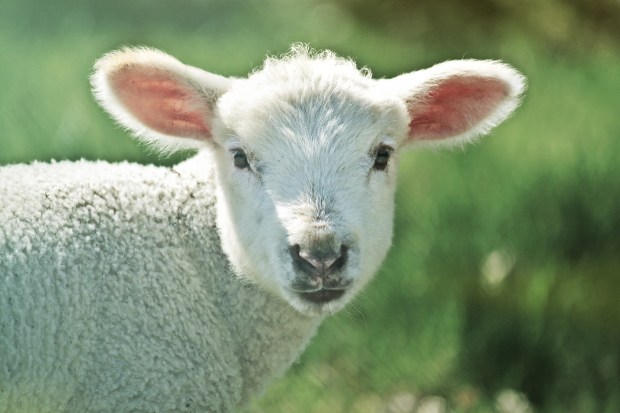
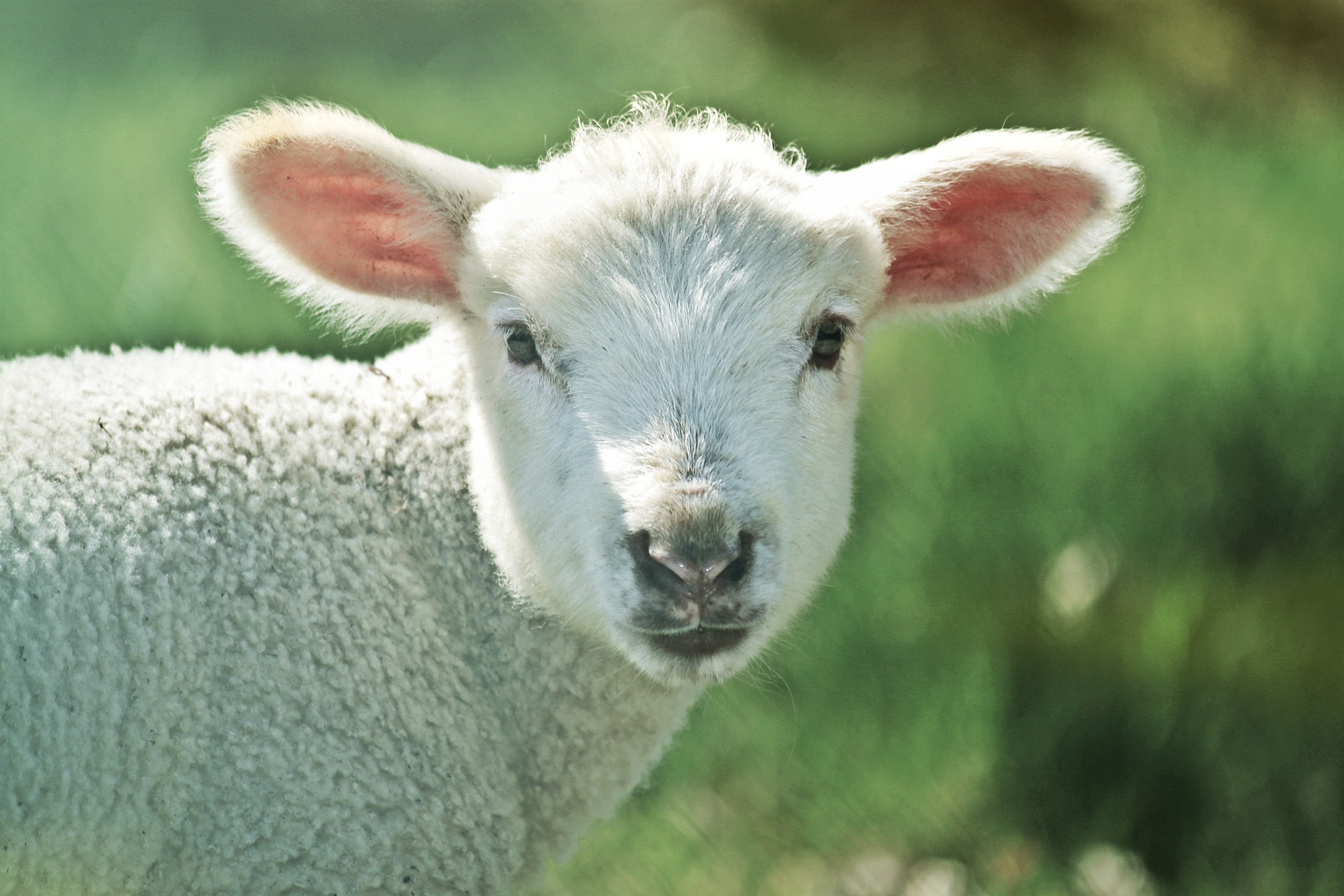
Above picture provided by Pixabay

VERSE DISCOVERY: Exodus 12:1-14 (KJV, Public Domain)
How fast are we to remember where God delivered us from, our personal journey to salvation? This lesson marks an exciting time of deliverance for God’s people, the children of Israel. From their bondage, He would crush the head of the enemy that oppressed them and deliver them with His mighty arm. In the process, God establishes a holy day, a feast for the people to remember and celebrate this special time of deliverance. Passover was to be forever a national time of remembrance and celebration for God’s people, and before they would step one foot out of Egypt, God already instituted it.
Instituting This Holy Day
Exodus 12:1-2 “And the Lord spake unto Moses and Aaron in the land of Egypt saying, This month shall be unto you the beginning of months: it shall be the first month of the year to you.”
God’s purpose in Moses returning to Egypt was to be the leader who would initiate and conduct His plan of deliverance for His people (Exodus 3:1-10). God heard the cries of His people, He remembered His covenant with their forefathers, and set the plan in motion for their release from bondage (Exodus 2:23-25; 3:11-22).
All events leading up to the Exodus were done except for one major, final event. Pharaoh has resisted Moses’ warnings repeatedly, and in doing so, he has resisted God Himself. All warnings to let His people go have fallen on spiritually deaf ears and hardened hearts. God has issued plague after plague; everything from turning water to blood, to lice and frogs overtaking the land and the people, to darkness so deep it could be felt, and so on. God’s power has been manifested, and the Egyptians saw enough of it that it should have compelled them to repent of their evil ways before God and release His people.
Alas, it was not to be so. One more plague was forthcoming. This was to be the worst of all. This would not only liberate God’s people, but it would humble the Egyptians under the mighty hand of God.
So sure was God that this would be the last straw for the Egyptians that He had to now get these lifetime slaves in a state of readiness with a mindset to be a people who will be free. In doing so, the first thing He announces, speaking to “Moses and Aaron” (Moses’ older brother who has been used as a mouthpiece of Moses and God), “This month shall be unto you the beginning of months” (see also Exodus 13:4).
Their lives were about to take a dramatic change for the good. The day of their freedom was now going to be a mark of remembrance and celebration for the Israelites. This would be the “beginning,” the starting point of their new journey in life according to God’s plan.
Note: Do you know, my friend, that God has a plan for your life too (see Psalm 138:8 and Philippians 1:6)? The Bible has so many verses that give us this assurance. But God’s plan for your deliverance will only and always have a starting point with making Jesus Christ your Savior (John 3:16; 14:6). If you have not done so already, I urge you to do it today.
God’s Word says, “For I know the thoughts that I think toward you, saith the Lord, thoughts of peace, and not of evil, to give you an expected end,” (Jeremiah 29:11). But, before anyone can reach an “expected end” they must have a starting point, and that starting point for God’s people would begin with the instituting of this holy day, a day set apart to remember where God brought them from.
Instructions for This Holy Day
Exodus 12:3-4 “Speak ye unto all the congregation of Israel, saying, In the tenth day of this month they shall take to them every man a lamb, according to the house of their fathers, a lamb for an house: And if the household be too little for the lamb, let him and his neighbor next unto his house take it according to the number of the souls; every man according to his eating shall make your count for the lamb.”
“Speak unto the congregation of Israel.” As the mouthpiece of God and His chosen leader for this mission, Moses was instructed to relay God’s mandates to His people. Moses would hear from God, and God would teach Moses what needed to be done. In return, Moses would teach and show the people God’s expectations and how to follow His instructions for this holy day.
“In the tenth day of the month they shall take to them every man a lamb, according to the house of their fathers.” Every Israelite, every man, every house was to participate in this feast that God was instituting. There is a revelation in the fact that God wanted ALL His people covered. God wanted ALL His people celebrating on the same page.
This is where unity comes to play a key role in their national deliverance. Jesus teaches His disciples in the New Testament that, “If a house be divided against itself, that house cannot stand,” (Mark 3:25). God wanted all His people free, standing, and marching victoriously out of the land of Egypt. For that to occur they ALL had to be covered.
“And if the household be too little for the lamb, let him and his neighbor next unto his house take it.” We are so used to doing our grocery shopping the modern way. I go to the store, and I get exactly what my family needs for a particular recipe (ex. 1 ½ lbs. of ground beef for meatloaf, 3 lbs. of chicken if I am in a fried chicken mood, and so on). During Moses’ day, the measurements were not so exact for meat. To slaughter a whole animal for only 4-6 people would be extremely wasteful. So, in these instructions, a community effort of sharing their resources comes into play. If an animal was much too large for one family, rather than let it go to waste, they were to share it with their “neighbor.”
Exodus 12:5-7 “Your lamb shall be without blemish, a male of the first year: ye shall take it out from the sheep, or from the goats: And ye shall keep it up until the fourteenth day of the same month: and the whole assembly of the congregation of Israel shall kill it in the evening. And they shall take of the blood, and strike it on the two side posts and on the upper door post of the houses, wherein they shall eat it.”
“Your lamb shall be without blemish.” A “blemish” is a flaw. It means it is not in its most perfect state. There is something wrong with it. This kind of animal may be okay for a regular Sunday dinner or a weekday supper, but this day was going to be a holy day with great spiritual significance attached to it, and there could be nothing wrong with the “lamb.”
Another reason there could be no “blemish” is that not only was this “lamb” part of the celebration meal, but this little guy was also a symbol of sacrifice. His “blood” would be used to cover the people, so to speak, on that fateful night to come: “And they shall take of the blood, and strike it on the two side posts and on the upper door post of the houses, wherein they shall eat it.”
What a beautiful picture of salvation represented here. 1 Peter 1:19 shows Jesus “as of a lamb without blemish and without spot,” whose precious blood bought us and covered us.
Exodus 12:8-11 “And they shall eat the flesh in that night, roast with fire, and unleavened bread; and with bitter herbs they shall eat it. Eat not of it raw, nor sodden at all with water, but roast with fire; his head with his legs, and with the purtenance thereof. And ye shall let nothing of it remain until the morning; and that which remaineth of it until the morning ye shall burn with fire. And thus shall ye eat it; with your loins girded, your shoes on your feet, and your staff in your hand; and ye shall eat it in haste: it is the LORD’S passover.”
Not only had God given extremely specific details in the choosing of the lamb, but he also gave very clear instructions on how it was to be prepared, cooked, and eaten.
They were to “eat the flesh in that night.” Everything was to be kept in the purest, freshest state possible. God left no room for contamination or impurities to enter this sacrifice. It had to be cooked: “roast with fire,” and then eaten immediately.
“Eat not of it raw, nor sodden at all with water, but roast with fire.” This is the second time He emphasized that it be “roast with fire.” Any other way of preparing or eating it would be a violation of the way God prescribed for this special sacrificial meal and therefore it would be rendered unacceptable (read Malachi 1:7-8, 12-14 for the chastisement of using unacceptable sacrifices).
God further instructed that everything be kept intact: “his head with his legs, and with the purtenance thereof.”
In keeping everything in the purest state possible, they were also instructed to “let nothing of it remain until the morning; and that which remaineth of it until the morning ye shall burn with fire.” There were to be no leftovers. No lamb sandwiches for the road the next day. Remember, this is not wastefulness, rather this lamb, as opposed to others for normal dinners, was a lamb of sacrifice and deliverance. He was a special lamb, for a special night, with a special purpose. Therefore, anything remaining they had to “burn.”
And they were to “eat it in haste.” God was going to do something amazing in that land that He had never done before, and He already knew how it would turn out. He already knew that His people would be free on this night. The people had to prepare themselves in faith as God was instructing them as if they too were, anticipating their own freedom. They had to eat with “loins girded, your shoes on your feet, and your staff in your hand.” They were to eat in readiness to move no matter what time it would occur.
I rode past a firehouse once, and they had their doors opened for all to see. There on the floor, I could see, positioned by the trucks, were their boots and gear just like you see on tv. When the alarm sounds, they run to the truck, step in the boots, pull the gear up, and go. They are always in a state of readiness to move, if necessary, day or night. This is similar to the idea of God instructing the people to eat with “loins girded, your shoes on your feet, and your staff in your hand.”
They were to be ready because their deliverance was surely coming!
Exodus 12:12 “For I will pass through the land of Egypt this night, and will smite all the firstborn in the land of Egypt, both man and beast; and against all the gods of Egypt I will execute judgment: I am the LORD.”
“For I will pass through the land . . . this night.” God was passing through with a purpose. On “this night” those of ancient Egypt will be humbled once and for all, and God’s people will gain their long-awaited deliverance. There is a “firstborn” in every family, in every house, and in every field. This meant there would not be a home that would not experience the horror that would be unleashed on “this night.” No Egyptian would be able to turn a blind eye any longer. They will feel the affliction for their own selves. They all will taste the wrath of the Lord on “this night.”
And every false idea about the supremacy of any false gods would be killed along with the firstborn. God will “execute judgment” and show, once and for all, that He is the only God. “For the LORD your God is God of gods and Lord of lords, a great God, a mighty, and a terrible…” (Deuteronomy 10:17). For He says, “I am the LORD.” And, after this night, all arguments against His deity will be put to rest (see also Numbers 33:4).
Exodus 12:13 “And the blood shall be to you for a token upon the houses where ye are: and when I see the blood, I will pass over you, and the plague shall not be upon you to destroy you, when I smite the land of Egypt.”
“When I see the blood, I will pass over you, and the plague shall not be upon you.” Had they have not followed God’s instructions in the way God prescribed, surely then, they too would have tasted the fate of the Egyptians that night. God only promised to “pass over” them when He saw the unblemished “blood” of the lamb on the doorposts. When He saw that they obeyed His instructions in readiness, then they would experience true deliverance.
That is a lesson for many to take for themselves today. Jesus, Himself spoke, “I am the way, the truth, and the life: no man cometh unto the Father, but by me” (John 14:6). There are not numerous ways to experience the freedom and deliverance of true salvation. Jesus is the only way. He is not one path to follow in the choice of multiple paths, but He said, “no man cometh unto the Father, but by me.” The book of Acts supports this great truth by letting us know that “Neither is there salvation in any other: for there is none other name under heaven given among men, whereby we must be saved” (4:12).
To be truly delivered must be done God’s way, in obedience to what He says. We cannot save ourselves. It cannot be according to our own plan or what we feel is the right way. Here, God told them the right way and the only way they would be able to walk out in freedom – the only way they would experience this great Passover, and that was through the blood of the lamb on the doorpost.
Remembering This Holy Day
Exodus 12:14 “And this day shall be unto you for a memorial; and ye shall keep it a feast to the LORD throughout your generations; ye shall keep it a feast by an ordinance for ever.”
“This day shall be unto you for a memorial.” This “feast to the LORD,” this day was to be commemorated “throughout your generations.” Passover was not about God’s people; it was about what God did for His people. It was a “feast to the LORD.”
The story and celebration of how God delivered them and brought them out of Egyptian bondage were to be passed down always like a treasured family heirloom. So much so God institutes it as law “by an ordinance for ever.” When Jesus Christ died for all mankind, He became our Passover lamb. “For even Christ our Passover is sacrificed for us,” is what 1 Corinthians 5:7 tells us.
We all have a starting point of when and where God saved us and brought us out of our own bondage to sin. Our job is not to forget what He has done for us either; rather, we are to remember with great appreciation and reverence our day of deliverance.
PDF Full Printable Sunday School Lesson Pack (With easy to read instructions following the P.E.A.R.L. format on how to conduct each lesson with areas for adding personal notes and other ideas available.): Sunday School Lesson – The First Passover
Suggested Activities:
Opening Lesson Idea:
Bring to class different decorations from different holidays and display them around the room. As your students come in, they may be somewhat confused about all the decorations.
Have fun with it and ask them, Aren’t you ready to celebrate! At the same time, point to the different decorations and comment that it is time to celebrate that particular holiday. Your class will no doubt correct you.
Ask, So, what are your favorite holidays to celebrate and why?
Say, Did you know the word holiday used to mean holy day? A holy day is a special day set apart and observed for a special reason. In today’s lesson, we are going to learn about a special holy day of remembrance God institutes for His people, the children of Israel. You may not be that familiar with this day. It may not have been on your list of favorite holidays to celebrate, but this day was especially important to God and His people.
Note: if your students did put Easter on their list of favorites you can link that with today’s lesson. Today’s lesson talks about the first Passover celebration. But did you know Jesus plays a key role in the Passover too?
Let’s learn a little more about Passover and tell me if you can pick up on the areas where you see Jesus come in. (For young children, you can make this a game. Using party favors that you blow or something similar, every time the lesson comes to a part where Jesus is mentioned, they can blow their party favors in celebration.)
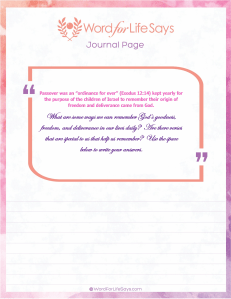
Adult Journal Page – Adult Journal Page – The First Passover
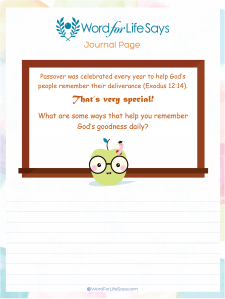
Kid’s Journal Page – Kid’s Journal Page – The First Passover
Blank Journal Pages – Blank Adult and Kid’s Journal Pages
Word Search: The First Passover Word Search Answers: The First Passover Word Search Answers
Crossword: The First Passover Crossword Answers: The First Passover Crossword Answers
Word Scramble: The First Passover Word Scramble Answers: The First Passover Word Scramble Answers
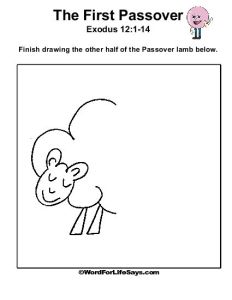
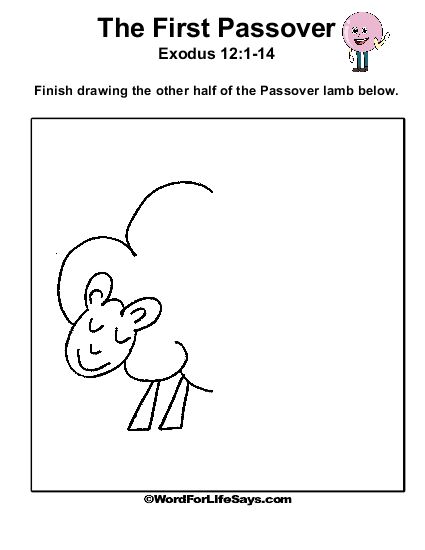
Draw the Scene: The First Passover Draw the Scene
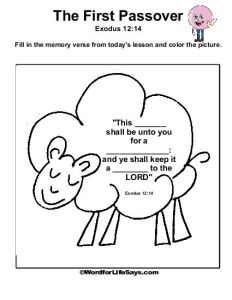
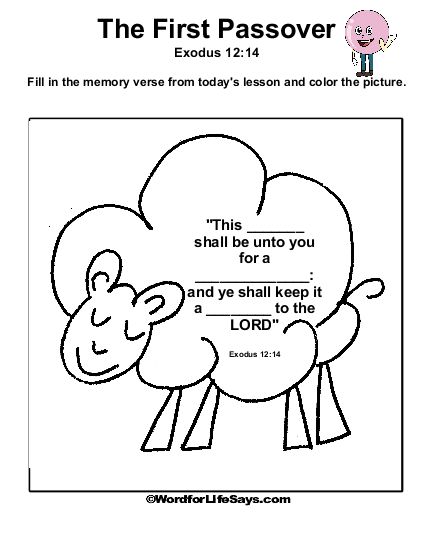
Memory Verse: The First Passover Memory Verse
How Many Words: The First Passover How Many Words
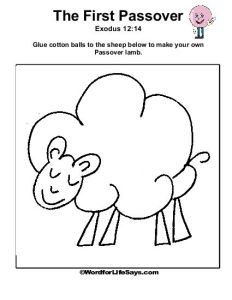
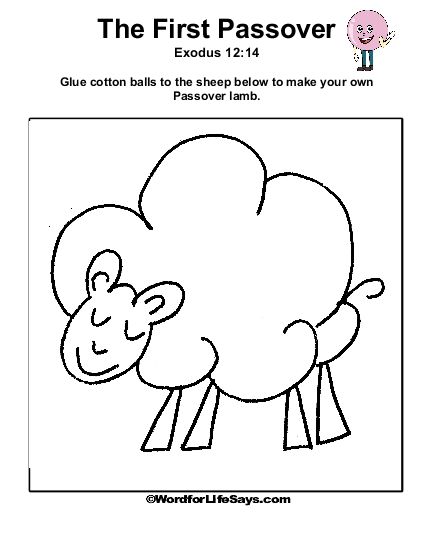
Passover Lamb Activity Sheet: The First Passover Activity Sheet





 Word For Life Says...