“Who’s Holding You?”

There is so much hurt and disappointment in the world today. So many people’s hearts are crying out for relief. These verses were laid heavily on my heart to send out as a spiritual S.O.S. to someone somewhere. I have clung to these in my own times of personal trial and I hope they help you also.  Be encouraged that God Almighty, no matter what you are going through today, is holding you in the palm of His hands!

 Thou art my servant; I have chosen thee, and not cast thee away.  Fear thou not; for I am with thee: be not dismayed; for I am thy God: I will strengthen thee; yea, I will help thee; yea, I will uphold thee with the right hand of my righteousness.  Behold, all they that were incensed against thee shall be ashamed and confounded: they shall be as nothing; and they that strive with thee shall perish.  Thou shalt seek them, and shalt not find them, even them that contended with thee: they that war against thee shall be as nothing, and as a thing of nought.  For I the Lord thy God will hold thy right hand, saying unto thee, Fear not; I will help thee.” (Isaiah 41:9b-13).

GOD IS HOLDING YOU TODAY!

“Be Happy!”

“Rejoice evermore,” 1 Thessalonians 5:16

“. . . Happy are the people whose God is the Lord!” Psalm 144:15

 Happiness.  Some say it’s overrated.  I tend to disagree.  The Bible speaks over and over again about being blessed, happy, joyful, glad and rejoicing.  With so many different ways of saying it, I believe the Lord has made His point.  He wants His people to be absolutely elated in who they are –  His child!

Too often, we as Christians are waiting for conditions to be right before we choose to be happy about it.  That’s contrary to the Word of God.  Many times when we see words synonymous with being happy in the Bible, there is usually a counterweight of circumstances which doesn’t seem favorable or applicable to happiness.  Take the Beatitudes for instance:

“Blessed are the poor in spirit: for theirs is the kingdom of heaven.

Blessed are they that mourn: for they shall be comforted.

Blessed are the meek: for they shall inherit the earth.

Blessed are they which do hunger and thirst after righteousness: for they shall be filled.

Blessed are the merciful: for they shall obtain mercy.

Blessed are the pure in heart: for they shall see God.

Blessed are the peacemakers: for they shall be called children of God.

Blessed are they which are persecuted for righteousness’ sake: for theirs is the kingdom of heaven.

Blessed are ye, when men shall revile you, and persecute you, and shall say all manner of evil against you falsely, for my sake.

Rejoice, and be exceedingly glad for great is reward in heaven . . .”

                                                                        (Matthew 5:3-12).

What the Lord Jesus Christ did was point out numerous circumstances of life that would normally account for not being happy.  But, by putting a statement of happiness in the front of it, He was relating that one doesn’t have to wait for the tides to turn in your favor to declare that blessedness.  The Beatitudes are about going through the storms of life even when the waves seem adverse and still seeing the promise of heaven at work.  Even when it feels overwhelming, to the point of feeling totally surrounded by trouble.  Jesus said happiness can still be found during those times.

How?  “Rejoice, and be exceedingly glad for great is your reward in heaven.”  I WILL NOT trivialize anyone’s hardships in life.  There are some unimaginable things that people have to face every day that hurt; that disappoint.  Situations that seem to do all they can to strip away one’s faith.  Our Lord is not denying the hurt, but what He is saying is there is still a reason to be joyful.

It would be totally unrealistic for one to tell another not to be upset over a wrong committed.  Yet, we have a deeper revelation that beyond this mess there is a reward.  Oh yeah, this stuff here stinks.  But, over there – AWESOME!

We may go through trials and tribulations like anybody else, but one thing we have as opposed to them is the comforting presence of our Heavenly Father.  “Yea, though I walk through the valley of the shadow of death, I will fear no evil: for thou art with me; thy rod and thy staff they comfort me,” (Ps. 23:4).  How can one not feel a measure of joy and comfort at words spoken such as these?

It just makes me feel that no matter what I am going through, I can “Rejoice evermore,” because, He is there.  He knows.  He comforts me.   He’s thinking about me.  He hears my prayers.  He sees the tears I shed.  I can feel His presence bottling every one of those tears up, working to wipe them away.  I may cry, but I can also rejoice because I have a true, living God who loves me and cares for me.

Not just words of rhetoric but words of substance.  Words that make me happy in spite of it all!  Today, I choose to be happy because I am in Him, and He is in me.  “Weeping may endure for a night, but joy cometh in the morning,” (Ps. 30:5).  The tears may cloud over my eyes and fall down my cheeks, but eventually, it has to move and make room for the happiness I have in Him.  I am blessed.

Copyright © Word For Life Says.com (Sharing any posts or lessons can only be done through the share buttons provided on this site from the original posts, lessons, and articles only. You can reblog from the original posts only using the reblog button provided, or share using the share buttons provided from these social media platforms: Facebook, Twitter, or Pinterest, etc., and they must be shared from the original posts only. All other repostings are prohibited. Posts and other items of interest found on this site MAY NOT BE COPIED AND PASTED, downloaded, uploaded, etc to another website or entity not listed (physical or electronic).  See COPYRIGHT PAGE for more details.

Sunday School Lesson – “Gabriel Foretells of Jesus’ Birth” Luke 1:26-38

VERSE DISCOVERY: Luke 1:26-38 (KJV, Public Domain)

One moment in time that would change history forever; affecting not only the life of one individual but for all mankind that ever was and that will ever be born upon the face of the earth.

Mary, the young Jewish woman from Nazareth, surely knew of the prophecy that was taught to her people down through the generations: “Behold, a virgin shall conceive, and bear a son, and shall call his name Immanuel,” (Is. 7:14).  But, never could she have imagined that she would be that one; that she would be that virgin spoken of so many years ago, (see Mt. 1:21-23).

As we enter into the celebration of the Christmas season let us not become so familiar with the story that we pass it by without a second glance.  Rather, as the angel Gabriel introduces to Mary the great feat that God is about to do in her life, let us reintroduce ourselves to His great power and plan to bring salvation to all men

Lesson Summary

Luke 1:26 “And in the sixth month the angel Gabriel was sent from God unto a city of Galilee, named Nazareth,”

In the verses leading up to our lesson a dramatic event unfolded.  Zacharias’ lot was drawn “to burn incense” in the temple of the Lord, (Luke 1:9).  Whilst there, “Gabriel,” the same angel in today’s lesson, informs Zacharias that he shall have a son that he “shall be great in the sight of the Lord,” (Luke 1:15).  Zacharias, though working in the temple of the Lord, doubted what God could do in his life.  This caused him to be stricken “dumb, and not able to speak, until the days that these things shall be performed,” (Luke 1:20).

His wife Elisabeth conceived as was told by the angel Gabriel and “hid herself five months,” (Luke 1:24).  Today’s lesson picks up “in the sixth month” where we see the same Gabriel who spoke to Zacharias in the temple now appearing to Mary in “Nazareth.”

Bethlehem is the song on our lips when celebrating the Christmas season.  It is, after all, the place of our Lord’s birth.  It is the place where Christ enters the world as any other babe would.  Over seven hundred years have gone by since the prophecy of Micah announced the promise that the Savior of the world would come from this place (Micah 5:2,3).

But before Bethlehem, there was Nazareth.  A place nobody paid much attention to.  A little village despised and rejected as not being worth consideration.

To this obscure place, the angel Gabriel was sent to announce to a young woman there her participating role in the coming of the Saviour into this world.

“Can there any good thing come out of Nazareth?” one asked (John 1:46a).  Another responded, “Come and see,” (John 1:46b).

Nazareth would no longer be a little-known or forgotten town.  Since the Saviour penetrated its borders and was hailed from this place, it would be on the lips of many throughout history (Mt. 21:11; Mk. 16:6; Lk. 18:37; 24:19; Jn. 19:19; Ac. 4:10; 22:8).

Luke 1:27 “To a virgin espoused to a man whose name was Joseph, of the house of David; and the virgin’s name was Mary.”

Mary was “espoused” or as we like to call it in modern terms “engaged” to a man by the name of “Joseph.”  Unlike modern times, to be engaged then carried far more weight of commitment then it does today.  Those “espoused” were considered husband and wife without partaking in the intimate affairs of the relationship at this time.  That would come a year later when she would go to be with him as a wife in every sense of the word.  At this point in their relationship, only a divorce could break off their engagement.

Luke 1:28-29 “And the angel came in unto her, and said, Hail, thou that art highly favoured, the Lord is with thee: blessed art thou among women.  And when she saw him, she was troubled at his saying, and cast in her mind what manner of salutation this should be.”

“The angel came in unto her, and said, Hail.”  In most depictions of this encounter, one gets the sense that this encounter took place outdoors.  But here it states that when the angel Gabriel greeted Mary, he “came in unto her,” giving us the impression that Mary was indoors during this holy encounter.

He spoke, “Thou art highly favoured.”  Now, to be real I think in our day we hear so much preaching on the word favor that we have missed the real significance of the word.  Too many people associate favor with the plethora of prosperity messages.  In the Bible, “favour” is associated with “grace,” and grace is, after all, God’s unmerited favor.

It’s something that is not earned or deserved.  But God, when he looked upon Mary saw something special in her to choose her to be the one to partake in this life-changing, world-changing, history-changing mission.  In God’s eyes, she was “highly favoured.”  I like the fact that the Bible does not go into greater detail of why God chose Mary outside of being “highly favoured,” lest we think of it as a list of criteria to try to emulate to gain favor when this is all done through grace.

“The Lord is with thee.”  How many times in her life would she need to reflect back on that promise?  When the news got out about her pregnancy; when all the gossips and tongue lashers had their way, how many times would she need to reach back to this promise that God is with her?  What about when uncertainty in the turbulent times of the day where people would seek to threaten the life of her child?  Or, even moving beyond this story to the scene of Jesus’ death, how often would she remind herself of those words of blessed assurance?  Is this not one of the greatest promises associated with the birth of the Messiah?  He is “Emmanuel, which being interpreted is, God with us,” (Matthew 1:23).

“Blessed art thou among women.”  No woman on the face of this earth would ever, and I do mean ever, experience what Mary did.  Not only in being chosen for this mission of God but also in every aspect of life this journey would take her through from His conception to death.  In that, she is “blessed.”  Women have conceived since the time of Eve, but none has ever been a virgin overshadowed by the Holy Ghost.  Women have carried children in their womb, but none else has ever or will ever carry the Son of God.  She is “blessed.”

“She was troubled at his saying… what manner of salutation this should be.”  One of my favorite verses in the Bible is a humbling verse and it asks, “What is man, that thou art mindful of him? and the son of man, that thou visited him?” (Psalm 8:4).

This could be imagination on my part, but I believe one of the reasons behind Mary being “troubled at his saying” and her questioning of “what manner of salutation this should be” is rooted in the same spirit of humility that Psalms 8:4 expresses.  “What is man?” – “Who am I?” must have been running through her head that an angel of God would greet her so.

There would also be a healthy dose of godly fear intermingled with her personal response.  After all, it isn’t every day that God dispatches a messenger from heaven to speak face to face with a person.  This was truly an awe-inspiring event.  Anytime an angel appeared to speak directly to an individual it was often “troubling” to the receiver (compare to Luke 1:12).

Luke 1:30-33 “And the angel said unto her, Fear not, Mary; for thou hast found favour with God.  And, behold, thou shalt conceive in thy womb, and bring forth a son, and shalt call his name JESUS.  He shall be great, and shall be called the Son of the Highest: and the Lord God shall give unto him the throne of his father David: and he shall reign over the house of Jacob for ever; and of his kingdom there shall be no end.”

“Fear not, Mary: for thou hast found favour with God.”  Gabriel spoke words meant to calm the fright she was experiencing on the inside.  “Fear not” is one of my favorite sets of words in the Bible.  It is spoken over and over again on many occasions to many different people; approximately 365 times, one for every day of the year.  My favorite is found in Isaiah 41:10 where these words of assurance are found saying, “Fear thou not; for I am with thee: be not dismayed; for I am thy God: I will strengthen thee; yea, I will help thee; yea, I will uphold thee with the right hand of my righteousness.”  “Fear not” pleads with mankind and is pleading with Mary to trust God wholeheartedly.

Gabriel then reiterated that Mary “hast found favour with God.”  With the task she is about to receive she would need this double dose of reassurance of God’s favor over her life.

“Thou shalt conceive in thy womb, and bring forth a son, and shalt call his name JESUS.”  “Shalt” means that it is going to happen.  God has a plan for her that begins and ends with “JESUS.”  She, in the very near future, would carry a child in her “womb.”  Though her year of being espoused is not yet up and the final marriage preparations have not been done, she is told she will “bring forth a son and shalt call his name JESUS.”  When the angel spoke to Joseph in Matthew 1:21, he confirmed the name of this special child would be “JESUS.”  That name, with the meaning of salvation, is where many would find life eternal (see John 20:31).

“He shall be great, and shall be called the Son of the Highest.”  He would be no ordinary child by any means of the word.  Jesus will later say of Himself, “I am from above: ye are of this world; I am not of this world,” (Jn. 8:23).  He knew His origin was different than any other man that had been born on the earth.  Here, Gabriel tells Mary her son will be from the “Highest,” (see also John 3:31).

“And the Lord shall give unto him the throne of his father David.”  For centuries the hopes of the Jewish people’s awaited Messiah sprang from the promise that God made to His servant David when He said, “And thine house and thy kingdom shall be established for ever before thee: thy throne shall be established for ever,” (2 Samuel 7:16, see also 1 Chronicles 17:14).

David desired to build God a physical house, but God desired to build off his legacy a spiritual house that will never fail.  The son that Mary would carry in her womb would hold the keys to that spiritual house.  He would be the one to occupy the “throne” forever.

“He shall reign… and of his kingdom there shall be no end.”  Earthly kings would come and go down through the course of time.  Some would be good kings, and some would be evil.  For some they would do what was right in the eyes of God while others would rule as polar opposites.  One thing they all had and still have in common is no matter who they are, and no matter the motivation, the location, or the rule – sooner or later their reign will end.  Either by death, usurping of the throne, or by some other kingdom-shifting event they would eventually lose their right to rule.

The child that Mary would carry would always “reign.”  Even when it looked like death may have won for a short space of time – He was just revving up to rule forever.

Luke 1:34 “Then said Mary unto the angel, How shall this be, seeing I know not a man?”

When all was said and done and her stomach would begin to grow with child, most people would never believe Mary’s statement: “I know not a man.”  People judge by what they see with their natural eyes.  But, for Mary her statement would forever stand as truth in the eyes of all who believe that this virgin would conceive the Son of God.

Mary knew the means in which one would normally conceive a child.  She also knew that though she was espoused, she has remained untouched in this manner.  The Bible confirms that “before they came together, she was found with child of the Holy Ghost,” (Matthew 1:18).  Her questioning was more of a “How in the world will this happen?” statement rather than of doubt.  She knew her pure state.  How was God going to accomplish such a thing in her?  Her body would produce a miracle – but, how?

Luke 1:35 “And the angel answered and said unto her, The Holy Ghost shall come upon thee, and the power of the Highest shall overshadow thee: therefore also that holy thing which shall be born of thee shall be called the Son of God.”

“The Holy Ghost shall come upon thee, and the power of the Highest shall overshadow thee… shall be called the Son of God.”  Gabriel answered Mary’s question.  In His own way, a way that only God Himself can explain or understand, “The Holy Ghost” will come upon her and “the power of the Highest shall overshadow” her.  Though the Holy Ghost had previously and temporarily empowered people to do something for God, here He was playing a key role in the incarnation of Christ in whom “dwelleth all the fulness of the Godhead bodily,” (Col. 2:9).  John 1 recognized Jesus as the only begotten Son of God, (VSS. 14, 18).

Luke 1:36-37 “And, behold, thy cousin Elisabeth, she hath also conceived a son in her old age: and this is the sixth month with her, who was called barren.  For with God nothing shall be impossible.”

“Elisabeth, she hath also conceived a son in her old age.”  The angel encouraged Mary with this sweet reminder of the grace of God at work, there was a miracle in the womb of her cousin.  How many times had God blessed a barren womb in the Bible?  Elisabeth’s son would fulfill a prophecy of his own (see Isaiah 40:3) and would forever be remembered for his greatness in going before the Lord.  Even Jesus spoke of John and said, “For I say unto you, Among those that are born of women there is not a greater prophet than John the Baptist,” (Luke 7:28).

“For with God nothing shall be impossible.”  Oh, how often have we quoted this and yet underestimate His power at work in it?  God, the Creator of all heaven and earth, was still fashioning things into existence in a miraculous way.  “Nothing” is outside of the scope of the power of God!  There isn’t “no-thing” that He can’t do!  “God hath spoken once; twice have I heard this; that power belongeth unto God,” (Psalm 62:11).  Revelation 19:1 declares, “Alleluia; Salvation, and glory, and honour, and power, unto thee Lord our God.”  With God, it will happen!

Luke 1:38 “And Mary said, Behold the handmaid of the Lord; be it unto me according to thy word.  And the angel departed from her.”

Mission accomplished.  The angel delivered his message and departed after she accepted the mission at hand.  Let us not downplay Mary’s acceptance of this calling.  The situation could have ended her life.  The situation would bring shame and ridicule to her and her family.  It is hard to accept some of the things that God asks of His people.  At one point in His own ministry, Jesus’ teachings would invoke this response: “This is an hard saying; who can hear it?” (John 6:60) questioned some who followed Him.

For Mary, the task she was accepting was in fact very hard, but she acquiesced to the hand of God and His will over her life.  Jesus later would accept the harder calling of God, and said, “O my Father, if this cup may not pass away from me, except I drink it, thy will be done,” (Matthew 26:42).  Following God’s way will not always be easy, but it will always be right.

These little details that surround the greatest story ever told can get lost in the bustle of the celebration.  But, if we take the time to sit and listen as Mary did with the angel, we too can find assurance in the plans that God has for us in our lives.

PDF Printable Sunday School Lesson Pack (With easy to read instructions following the P.E.A.R.L. format on how to conduct each lesson with areas for adding personal notes): Sunday School Lesson – Gabriel Foretells of Jesus’ Birth

Suggested Activities:

Adult Journal Page: Adult Journal Page – Gabriel Foretells of Jesus’ Birth

Kid’s Journal Page: Kid’s Journal Page – Gabriel Foretells of Jesus’ Birth

Draw the Scene: Gabriel Foretells of Jesus’ Birth Draw the Scene

Craft Idea:  Bouncing off the idea expressed in the Draw the Scene section, for a simple Craft Idea students can cut out different pictures of an angel, a woman, and other items out of old magazines, books, or even different coloring books in an almost collage format to recreate the scene of Gabriel speaking to Mary as in today’s lesson.

Memory Verse: Gabriel Foretells of Jesus’ Birth Memory Verse

Word Scramble: Gabriel Foretells of Jesus’ Birth Word Scramble  Answers: Gabriel Foretells of Jesus’ Birth Word Scramble Answers

Word Search: Gabriel Foretells of Jesus’ Birth Word Search  Answers: Gabriel Foretells of Jesus’ Birth Word Search Answers

Crossword: Gabriel Foretells of Jesus’ Birth Crossword  Answers: Gabriel Foretells of Jesus’ Birth Crossword Answers

Sunday School Lesson – “An Angel Foretells of John’s Birth” Luke 1:8-20

VERSE DISCOVERY: Luke 1:8-20 (KJV, Public Domain)

Before Gabriel spoke to Mary, he appeared to another person in relation to the future Messiah.  He came to a man by the name of Zacharias and foretold of the child he would father.  This child would grow to be a messenger before the Lord and would be he of whom it was prophesied as the one who would be characterized as, “The voice of one crying in the wilderness, Prepare ye the way of the Lord, make his paths straight,” (Mark 1:3). 

Imagine for a moment, the president, king, or any head of a country, coming to an area to visit.  Before their arrival, another would have been sent ahead to announce and make the proper preparations before they get there.  Such as it was in ancient times when kings came into town.  And, so is the ministry of John the Baptist, the child whom Gabriel speaks of in today’s lesson as a promise to Zacharias, when the King of all kings makes His arrival on this earth.

Zacharias’ Duty

Luke 1:8-10 “And it came to pass, that while he executed the priest’s office before God in the order of his course, According to the custom of the priest’s office, his lot was to burn incense when he went into the temple of the Lord.  And the whole multitude of the people were praying without at the time of incense.”

Righteous before God.  Walking in the commandments.  Blameless.  These are some of the noteworthy characteristics of Zacharias and Elisabeth his wife (see Luke 1:5-6).

Although he was a faithful priest in the eyes of the Lord and his wife modeled the same holy qualities, they had no child.  Being well-advanced in years, their time for this possibility seemed to be over until God steps in and shakes up their way of thinking and reorders their life with a great and precious promise.

The number of priests available to serve in those days was very large.  But 1 Chronicles 24:1-19 had a plan in place to bring order and divide the priests into what it calls “divisions”.  There were 24 in all and from these divisions, the duties that were to be performed in the temple were selected by “lot.”  Using the term “lot” it describes the system of selection that depended on God to choose who will do what and when they will do it by the drawing or casting of lots.

On this particular day, Zacharias had the privilege to experience the opportunity to serve before the Lord.  “According to the custom of the priest’s office” (see 2 Chronicles 8:14), as the lots were cast for the duty of burning incense (see 1 Chronicles 23:13; 2 Chronicles 29:11), Zacharias’s name was chosen to perform this job “in the temple of the Lord.”

This was a highly desired position and considered a great honor.  Before the morning sacrifice and after the evening sacrifice was offered, the chosen priest would burn incense before the altar symbolizing the prayers of the people who were positioned outside of the temple (“praying without”), during this time.

An Angel Encounter

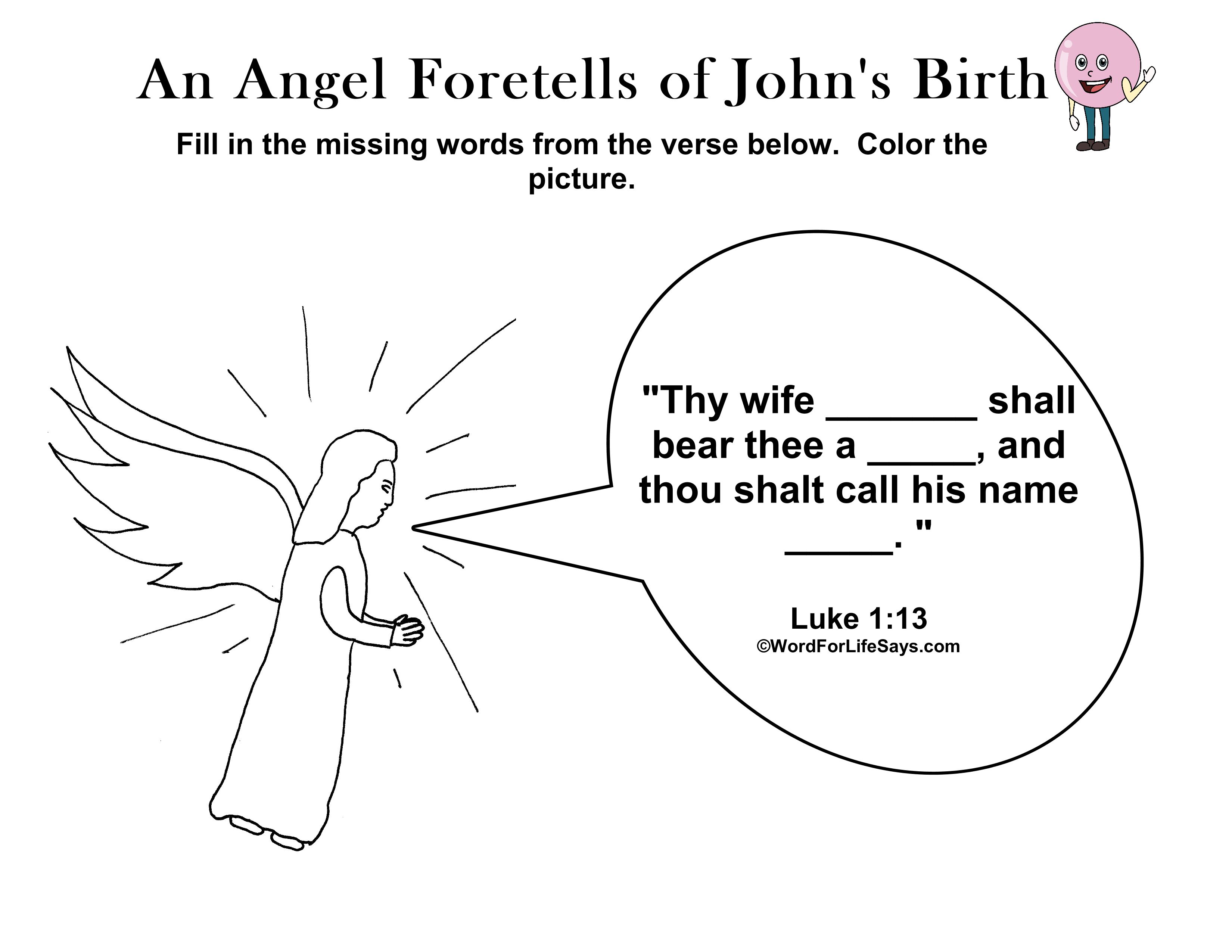
Luke 1:11-14 “And there appeared unto him an angel of the Lord standing on the right side of the altar of incense.  And when Zacharias saw him, he was troubled, and fear fell upon him.  But the angel said unto him, Fear not, Zacharias: for thy prayer is heard; and thy wife Elisabeth shall bear thee a son, and thou shalt call his name John.  And thou shalt have joy and gladness; and many shall rejoice at his birth.”

Above all else, we believe God to be sovereign.  We believe Him to be in charge of time and circumstance.  And, although Zacharias is considered old at this time, we believe God held his name in remembrance to appear on the scene and receive the promise of he who would be chosen and work to prepare the way of Christ at this chosen time in history.

While reverently going about his duties which, as already noted, had to be performed twice a day (see Exodus 30:7-8), “there appeared unto him an angel of the Lord.”  Imagine, if you will, being in that holy atmosphere where one might not hear anything but the burning of coals and the shuffling of his own feet; an atmosphere where everything is sacred and yet, God chose you to come before Him in the temple to perform this holy calling.

With the aromas of spices filling the air, off to the right side of the altar, beyond the ascending fragrant cloud, Zacharias sees “an angel of the Lord.”  Some depictions of this encounter may have Zacharias just hearing the angel, but the Bible says he “saw him.”

And when he “saw him, he was troubled, and fear fell upon him.”  Throughout the Bible, any time an angel appeared directly to an individual it was often unsettling and troubling to the individual (see 1 Chronicles 21:30; Matthew 28:2-4).  God does not do anything frivolously, especially regarding having a heavenly host appear to mankind.  This was an occasion to take seriously.  Not knowing at that time, the exact reason for the visit, “fear fell upon him.”

“But the angel said unto him, Fear not, Zacharias.”  Zacharias’s reaction wasn’t necessary, and the angel sought to ease the millions of horrific thoughts that may be running through his mind.  God’s dispatched angel came with a message of promise, not of peril; therefore, he spoke, “Fear not;” the same comforting words he will give to Mary in Luke 1:30.

“For thy prayer is heard.”  Zacharias was a righteous man and he was a praying man and according to God’s holy word, “The eyes of the LORD are upon the righteous, and his ears are open unto their cry, “(Psalm 34:15; see also 1 Peter 3:12).  Knowing the heartbreak and shame of being childless; I don’t know how many years Zacharias prayed, but in His perfect, pre-ordained time, God let him know He “heard.”

In a previous article titled Know That God Hears, I wrote: “Our deepest heart’s desires do not fall on deaf ears.  God is not playing cat and mouse with us.  He wants us to seek Him that He may be found: “Seek ye the LORD while he may be found, call ye upon him while he is near,” (Isaiah 55:6).  Then, He can respond!” (Word For Life Says)

And, respond He did.  The angel told Zacharias of what would be.  He said, “Thy wife Elisabeth shall bear thee a son, and thou shalt call his name John.”  A woman, who like her husband is “well-stricken in years,” (Luke 1:7) will finally, not only have a child and know the joy of motherhood, but she will “bear thee a son.”

Just think, after all those years of let downs.  After feelings of disgrace have surely washed over them and it seemed all hope is gone – God favored them.  They would know what it is like; they will experience their very own fulfilled promise in the form of a son named “John.”

His birth would not only bring “joy and gladness” to the parents whose hearts longed to hear a babe crying in their home, and to hold and coddle their own flesh and blood – but, “many shall rejoice at his birth.”

As time goes by and Elisabeth does give birth, we see in Luke 1:58, “her neighbours and her cousins heard how the Lord had shewed great mercy upon her; and they rejoiced with her,” (emphasis mine).  I believe the angel’s words were meant to have a much farther reach of impact in the lives of the people who will respond to his call of repentance, and eventually be led to Christ.

John’s Foretold Character

 Luke 1:15 “For he shall be great in the sight of the Lord, and shall drink neither wine nor strong drink; and he shall be filled with the Holy Ghost, even from his mother’s womb.”

“Before I formed thee in the belly I knew thee; and before thou camest forth out of the womb I sanctified thee, and I ordained thee a prophet unto the nations” (Jeremiah 1:5) is what God told the prophet Jeremiah about his calling on his life.  But here in this lesson, we see that not only from the womb can one’s purpose and calling be laid out, but even before conception, John was ordained into this role God had planned for him.  Nothing is hidden or a surprise to God.  He knows our days “when as yet there was none of them” (Psalm 139:16).

“For he shall be great in the sight of the Lord.”  When Jesus came on the scene, during His years of ministry, He testified of John and said, “For I say unto you, Among those that are born of women there is not a greater prophet than John the Baptist,” (Luke 7:28; see also Matthew 11:11).  Jesus’ ministry obviously is superior in depth and importance than that of John the Baptist’s (read John 1:29-34 for John’s own testimony of the Lamb of God’s ministry; He [Jesus] that is preferred before him [John the Baptist]).

Nevertheless, because of his position and unique ministry as the one who would prepare the way before the Savior, John the Baptist stands out and is extraordinary among the name of the prophets.  From the time of the womb, he would bear witness of the Christ (see Luke 1:41; John 1:15, 29-34).

“And he shall drink neither wine nor strong drink.”  This is reminiscent of the instructions we see given to Samson’s parents when an angel appeared to them.  The withholding of oneself from “strong drink” as well as other strict requirements, was in keeping with what is known as a Nazarite vow (compare Judges 13:4-5).  This devoted life would be a sign of the holy and set apart nature of the individual; that God was doing something special in his life.

“And he shall be filled with the Holy Ghost, even from his mother’s womb.”  John the Baptist would be heavenly empowered and enabled from the womb to fulfill the role as that prophesied voice and that holy messenger, heralding to all who would listen, before the arrival of the Savior (compare Isaiah 40:3).  Anything done for God must be Spirit-powered.  Many today try to operate in their own power but fall short of producing godly fruit for the Kingdom.  John’s life and mission would be infused with “Holy Ghost” power!

John’s Foretold Ministry

Luke 1:16-17 “And many of the children of Israel shall he turn to the Lord their God.  And he shall go before him in the spirit and power of Elias, to turn the hearts of the fathers to the children, and the disobedient to the wisdom of the just; to make ready a people prepared for the Lord.”

“Many of the children of Israel shall he turn to the Lord their God.”  When John the Baptist came into his ministry, he is seen “preaching in the wilderness of Judaea, And saying, Repent ye: for the kingdom of heaven is at hand,” (Matthew 3:1-2).  People from all over the area came: “Jerusalem, and all Judaea, and all the region round about Jordan, And were baptized of him in Jordan, confessing their sins,” (Matthew 3:5-6).  He was working to turn hearts back “to the Lord their God.”  He was winning souls to the Kingdom, fulfilling this prophecy over his life.

John’s style of clothing (camel’s hair garments) and eating choices (locusts and wild honey) did not detract from the impact he made on those who came out to see and hear him.  The love for people, the Kingdom, and the ingrained ministry in him compelled him to reach out and help those who were seeking “the Lord their God.”

“And he shall go before him in the spirit and power of Elias.”  In the Old Testament, it was prophesied, “Behold, I will send my messenger, and he shall prepare the way before me…” (Malachi 3:1).  When we study the New Testament, particularly the sayings of Jesus on the subject, we see that John was, in fact, he that came “in the spirit and power of Elias [Elijah],” (read Matthew 17:11-13 for further clarification).

“To turn the hearts of the fathers to the children.”  In correlation with this prophecy of John the Baptist being compared to Elijah, here too we see another O.T. promise being fulfilled through his life and ministry.  With almost exact wording, Malachi 4:5-6 talks about Elijah coming again with a focus on restoring familial relationships.  The very fabric that makes up the strength of the home is relationships; those connections would have “hearts” renewed in love and peace for one another again.

Some may see it in a different way, but regardless of how one views it, his ministry softens “hearts” that will be ready to receive the healing that Christ will offer.

When John the Baptist does arrive on the scene to do the work of the Lord, the people would have been 400 years without hearing the voice of a true prophet of God.  The above quotation from Malachi 4:5-6 was among the last words spoken by a prophet in the Old Testament.

“And the disobedient to the wisdom of the just; to make ready a people prepared for the Lord.”  The ministry of John the Baptist would change hearts and minds from unjust behavior to “just” behaviors; leading people to look for the greater gift of salvation which is found in Jesus Christ.  As such, he was making “ready a people prepared.”  John the Baptist can be seen as the opening act, while Jesus Christ, without a doubt, is the main event.

Zacharias’ Doubt

Luke 1:18-20 “And Zacharias said unto the angel, Whereby shall I know this? for I am an old man, and my wife well stricken in years.  And the angel answering said unto him, I am Gabriel, that stand in the presence of God; and am sent to speak unto thee, and to shew thee these glad tidings.  And, behold, thou shalt be dumb, and not able to speak, until the day that these things shall be performed, because thou believest not my words, which shall be fulfilled in their season.”

“Whereby shall I know this? for I am an old man, and my wife well stricken in years.”  Surprised at the announcement.  Overwhelmed at the possibility.  Over-thinking the proposed miracle.  All this and more led Zacharias down a path of doubt.

Here, Zacharias’s prayer was heard, and God sent a messenger to declare he’s getting what he prayed for.  But the faith that caused him to ask in prayer was missing at the declaration of the miracle.  Rather than respond with rejoicing, he responded with questioning.

What happened?

He looked with human eyes at human conditions and made up his mind for God, that it just wasn’t possible.  Let us be reminded of this great biblical truth: “But without faith it is impossible to please him: for he that cometh to God must believe that he is, and that he is a rewarder of them that diligently seek him,” (Hebrews 11:6; emphasis mine).

Zacharias was a “diligent” seeker of the Lord (as noted earlier in this lesson).  God was ready to reward him, but he just couldn’t see with his natural eyes the miracle ahead.  Therefore, he asks, “Whereby shall I know this?”

What God speaks always comes to pass, so the angel, who is revealed as the same “Gabriel” who speaks with Mary – his response below is just.

“I am Gabriel, that stand in the presence of God; and am sent to speak unto thee, and to shew thee these glad tidings.”  Coming as a holy messenger of God, what “Gabriel” brought was good news!  As if it isn’t awesome enough to see an angel, period – this one brought a promise with him.  Most would think this is convincing enough, but for Zacharias, he met the miracle with misgivings about his situation and wanted something more: “Whereby shall I know this?”

Thus, the angel Gabriel said, “Thou shalt be dumb, and not able to speak, until the day that these things shall be performed.”  If we fast forward to the birth of John, particularly the eighth day when it was time for him to be circumcised according to custom, which would also be the same time when he officially gets his name, we see Zacharias wrote the babe’s name “John” on a tablet.  And when he did so, “his mouth was opened immediately, and his tongue loosed, and he spake, and praised God,” (Luke 1:59-64).  Until that day he was “not able to speak” according to Gabriel’s words because he “believest not.”

Remember, what God promises, He is able to perform (Romans 4:21).  Believe Him for it all.

PDF Printable Sunday School Lesson Pack (With easy to read instructions following the P.E.A.R.L. format on how to conduct each lesson with areas for adding personal notes): Sunday School Lesson – An Angel Foretells of John’s Birth

Suggested Activities:

Adult Journal Page: Adult Journal Page – An Angel Foretells of John’s Birth
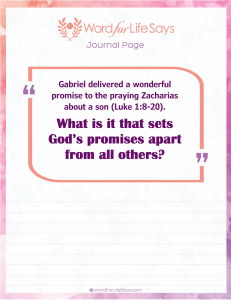
Kid’s Journal Page: Kid’s Journal Page – An Angel Foretells of John’s Birth
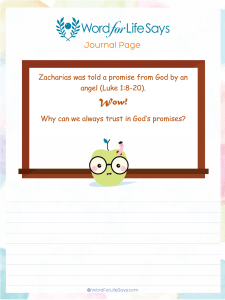
Memory Verse: An Angel Foretells of John’s Birth Memory Verse
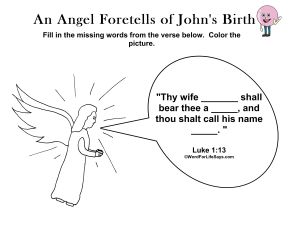
How Many Words: An Angel Foretells of John’s Birth How Many Words

Draw the Scene: An Angel Foretells of John’s Birth Draw the Scene

Word Search: An Angel Foretells of John’s Birth Word Search  Answers: An Angel Foretells of John’s Birth Word Search Answers

Crossword: An Angel Foretells of John’s Birth Crossword  Answers: An Angel Foretells of John’s Birth Crossword Answers

Word Scramble: An Angel Foretells of John’s Birth Word Scramble  Answers: An Angel Foretells of John’s Birth Word Scramble Answers

“God is Working it Out!”

God is working it out - my pic

Here’s a little bit of encouragement for your day: “God is working it out!”

Reading in the book of Ruth, I couldn’t help but rejoice with happy crying in my heart. When I see her story I can’t help but to be encouraged by what God did for her.

Let’s face it. She, according to those in the land, was really a nobody.  She was a woman of sorrow having lost her husband, her support, and now she has walked away from her homeland to follow Naomi.  Living in a strange place as a foreigner to all around she tried to acclimate to her new surroundings and help Naomi the best she could.

What the story doesn’t tell us are all the emotions that must have been going on with Ruth. Did she question her life?  Her decisions?  Did she feel lost sometimes as she sought to do the right thing out of love?  Did she ever pray in her heart for an understanding of all the why’s that were going on in her life at that moment?  Did she look at her adversity and think there was nobody to care; nobody who really pays attention to little old me?

She had a rough go at it but her story is so encouraging to me. As I look through the pages that tell the events of her life I can’t help but see God in the midst of it all.  It may not have been immediately prevalent to her at the moment, but for us who read her story, we can see Him at work orchestrating the events until they come to the fruition of a blessed end.

The whole time – through all her sadness, doubt, discouragements, and feelings of hopelessness, God was there, in the midst,  working it out.

This leads me to question our life today. What is it that we are going through?  What is attacking us today with doubt and questioning?  What sadness are we battling with?  It’s so hard to think with a clear mind sometimes when we are in midst of our own struggles, but after reading her story I can’t help but believe that God is standing in heaven, looking down, and working it out for us as well.

We may not see it immediately, but like Ruth, during the time of harvest our Boaz (which stands for our blessing – not necessarily the man himself) will appear and we will reap the promises of God. We just have to hold out for the harvest, and keep being faithful, keep working, and keep gleaning the fields until our time of blessings comes to pass.

God is putting all the pieces together.  He is working it out for us!

“And we know that all things work together for good to them that love God, to them who are the called according to his purpose.” Romans 8:28

Copyright © Word For Life Says.com (Sharing any posts or lessons can only be done through the share buttons provided on this site from the original posts, lessons, and articles only. You can reblog from the original posts only using the reblog button provided, or share using the share buttons provided from these social media platforms: Facebook, Twitter, or Pinterest, etc., and they must be shared from the original posts only. All other repostings are prohibited. Posts and other items of interest found on this site MAY NOT BE COPIED AND PASTED, downloaded, uploaded, etc to another website or entity not listed (physical or electronic).  See COPYRIGHT PAGE for more details.

“God Has the Power to Help!”


We quote it, sing songs about it, outwardly rejoice in it; but, how much do you really believe it or apply it to our lives, circumstances, and troubles?

If we were to review some of the marvels of God as we know it, we would see out of nothing a world being brought into existence.  We would see where there is no life, the dead have been raised to life.  We would see on the strength of nothing but His command, stars and planets being suspended in midair, hanging on absolutely nothing, as if an invisible hook were holding them in place.

All of these events testify to His power and strength to do what we readily admit is impossible.  But, God’s power goes beyond Creation, performing miracles, and shocking us with the impossible that becomes very possible in His hands.  God’s power is also alive and very available to help each and every one of us in our lives today, as well.

And, here is the beauty in that.

His power to help is not contingent on anything we bring to the table.  It does not matter our skills or abilities, our wealth, or the lack thereof.  It doesn’t even matter the number of this or that that we try to bring into the mix of everything He wants to do in our lives.

In 2 Chronicles 14:11, we see where it says, “And Asa cried unto the LORD his God, and said, LORD, it is nothing with thee to help, whether with many, or with them that have no power: help us, O LORD our God; for we rest on thee, and in thy name we go against this multitude. O LORD, thou art our God; let not man prevail against thee,” (emphasis mine).  This Scripture prayer has often been my own that I have personally prayed and incorporated in my requests to God when I felt totally overwhelmed.  For many times I know I had nothing to offer.  I know I had no power to personally make a change in a certain circumstance.  I didn’t have the numbers that would chalk up to win on my behalf.  There were times when I know I didn’t have the experience that says I was qualified to do this or that.  I had absolutely nothing to add to the mix to benefit me for a positive outcome.  Yet, it is nothing for God to still step in and help and to show His power strong in my life and yours.

If you are struggling with the same feelings or dealing with a daunting situation, know that God’s power can and will still work for you today.  What we have is not as important as what God has, and what He can do in our lives today.  He is the one who has the power to help!

Copyright © Word For Life Says.com (Sharing any posts or lessons can only be done through the share buttons provided on this site from the original posts, lessons, and articles only. You can reblog from the original posts only using the reblog button provided, or share using the share buttons provided from these social media platforms: Facebook, Twitter, or Pinterest, etc., and they must be shared from the original posts only. All other repostings are prohibited. Posts and other items of interest found on this site MAY NOT BE COPIED AND PASTED, downloaded, uploaded, etc to another website or entity not listed (physical or electronic).  See COPYRIGHT PAGE for more details.

“Seek God First…”

God knows what we really stand in need of; He knows the good that will help us the most. Seek Him first, with a heart of faith, and let Him work out the blessings that come to us. Even the strongest of the strong will eventually know lack but they that trust in God, shall not want any good thing! “The young lions do lack, and suffer hunger: but they that seek the LORD shall not want any good thing.” Psalm 34:10

“The Lord is on my Side!”

Oh, the grace of another day.  Yet, every day is not peachy, rather often with it comes turmoil, upset, and unrest.  Sometimes, battling the seen and the unseen.  Sometimes, fighting to keep one’s spiritual head above the waters of this life that seek to take you under.  Oh, the peace to know that despite it all, the Lord is on my side.

If you’ve ever gone to the circus, one of the most impressive feats to witness in the performances there are the trapeze acts.  It never seems to lose its awesomeness as we watch men and women fly through the air with what appears to be a complete disregard for life and limb.  Actually, it is quite the opposite.  They fly through the air with abandon because of the trust they exhibit in their partner to be by their side and to catch them at that pivotal moment; to catch them when it matters most.  There is an awesome relationship of trust that goes on between the two.  One that neither can doubt in lest the outcome be less than desirable.

What about our relationship with God?  Do we exhibit the same trust in Almighty God that these acrobats seem to place in human confidence?  Do we sport the confidence that He is by our side to catch us when we need Him the most?

Sometimes it may feel like you are in the boxing ring alone.  Well, you’re not!  Sometimes it may appear that you are fighting armies that encamp against you by yourself.  You’re not!  God is on our side and He promised to never leave us nor forsake us, Hebrews 13:5.

Daily, we are upheld by Him!  Our lives are not in our own hands rather in the hands of Him that never fails!  We may swing to and fro, sometimes feeling up and sometimes down, yet He is the ever-present strength that keeps us flying high above all these adversities, above all these troubles, above all these trappings of this world.

Difficulties will arise.  Oh yes, they will.  But, Jesus said, “These things I have spoken unto you, that in me ye might have peace. In the world ye shall have tribulation: but be of good cheer; I have overcome the world,” John 16:33.  In other words, He is on our side.  He is our overcomer.  He is our victor.  He is our deliverer that will see us past all that is presently before us that we might experience the peace that He so offers.

“Let not your heart be troubled, neither let it be afraid,” John 14:27.  Some may say this is easier said than done especially when the upsets of life seem to be all around and the strength to carry on, well, it’s just plain hard to find.  You’re exhausted!  I get it.  God gets it.

That’s why His Word declares and reminds every one of us, we don’t have to carry on on our own.  The Lord is on your side.  You are not in this alone.  This is the message of the whole Bible.  No matter how dim, gloomy and bleak it may seem, we are not in this alone.  We have a Strength that is beyond our human capabilities.  We have a Force fighting for us that cannot be reckoned with by human standards.  We have the one and only true God and He is on our side!

Who are you flying with today?  Secure your life in Him, let go and know that “The LORD is on my side,” Psalm 118:6.  Trust Him, He will catch the life that honestly reaches out for Him, trusts, and believes.

Copyright © Word For Life Says.com articles/lessons/worksheets may not be copied or redistributed without the express written permission of WordforLifeSays.com.  Please see the COPYRIGHT PAGE for more details.  Blessings to you. 

Please Note: Ads below or referenced on this site are prefabricated and mass-produced (of which I currently have no control over) and DO NOT necessarily represent the views and/or beliefs of this site and its admin.

Sunday School Lesson – “Saved by Faith” Luke 7:36-50

VERSE DISCOVERY: Luke 7:36-50 (KJV, Public Domain)

Forgiveness is something none will make it to heaven without.  It doesn’t matter who you are or what one has done in life, from the highest to the lowest, without accepting the life Christ offers through His salvation and forgiveness, we will not make it in.  The Bible records, “If You, LORD, should mark iniquities, O Lord, who could stand? But there is forgiveness with You, that You may be feared,” (Psalm 130:3-4).

Who could stand?  Absolutely no one! (See Romans 3:10). Without His covering and remission of sins, the pathway to heaven will be blocked.  It doesn’t matter if one’s walk of life is a Pharisee or a prostitute (as some suppose the woman in this lesson was).  There is not an individual who is worthy enough to enter the gates of glory without Jesus’ forgiveness.

Question: What would happen if today God sat down and took account of all the wrongs we have done?  What would it be like if we stood before Him unable to pay what we owe?  We were there!  Jesus knew the predicament that humanity was in.  He knew that man could never get himself out of the debt of sin, so through Him we obtain that freedom along with grace, mercy and compassion as a people who don’t deserve it.

The Bible reminds us, “But God commendeth his love toward us, in that, while we were yet sinners, Christ died for us,” (Romans 5:8).  I guarantee if we were to look at ourselves, we could not fathom how many times our accounts would have gone unpaid had it not been for the blood of Christ. But thank God, He acted in love to save to us!  No just us – but everyone who comes to Him in faith regardless of the background of sin.

The verses of study in this lesson will tell of one woman’s enormous expression of love for Jesus at having her sins forgiven and the criticism it brought.

 A Sinner’s Precious Gift

Luke 7:36-38 “And one of the Pharisees desired him that he could eat with him.  And he went into the Pharisee’s house, and sat down to meat.  And, behold, a woman in the city, which was a sinner, when she knew that Jesus sat at meat in the Pharisee’s house, brought an alabaster box of ointment, And stood at his feet behind him weeping, and began to wash his feet with tears, and did wipe them with the hairs of her head, and kissed his feet, and anointed them with the ointment.”

It wasn’t unusual then nor is it today for a respected teacher/preacher of God’s word to be invited to dine with officials.  Jesus opened Himself to people from all walks of life (even the Pharisees who were often seen at odds with Him), and without reservation “he went into the Pharisee’s house, and sat down to meat.”

We are not told exactly how long He was there but during the process of the meal came a disturbance at dinnertime.  “A woman in the city, which was a sinner, when she knew that Jesus sat at meat in the Pharisee’s house, brought an alabaster box of ointment.”  At this point of the lesson it is not immediately known her plans but just the fact that this woman of ill repute, who many suppose her to be a prostitute, dared entered a Pharisee’s house and draw near to a respected Rabbi drew eyes of speculation at her coming.

Some reading her story today may think how bold of her to come near to Jesus in her dejected state.  Rest assured, those at dinner didn’t think her bold.  They probably thought her even more rude and full of sin to think to defile the atmosphere with her presence.  Honestly, what Pharisee would normally let the likes of her come into his very home?  It was unheard of.  Since the crowds often gathered to hear Jesus speak wherever He went, she came in amongst some of the others until who she is caught the attention of the religious elite.

Nonetheless, she was there with all that she had in her facing the shame of her wrongs she saw etched in the faces of the onlookers.  Yet, they were not the audience whose attention she was seeking.  Her heart drew her to the feet of Jesus.  This is where she stood humbly holding her precious gift, an “alabaster box of ointment,” (an expensive gift to say the least which spoke volumes of her sacrifice).  With the feelings of all that she was as opposed to all that He would do for her – it was overwhelming.  This is what happens when sin meets with Savior.  The tears would not be bidden to stop.  The heart and spirit within spoke through the flow from her eyes.

Living in sin for so long she recognized her unworthiness before the Sovereign.  It doesn’t take a genius for us to see that she saw herself and Jesus in a different light than everyone else present.  Did no one else there see their sin for what it was?  Did any present even believe they had sin to repent of?  Or, was it just the nature of her sin drew extra scowls as opposed to the hidden things in other’s hearts?

Regardless, her heart response came through “weeping, and began to wash his feet with tears, and did wipe them with the hairs of her head, and kissed his feet, and anointed them with the ointment.”  Her actions there may have seemed inappropriate to those eyeballing her, but she received no correction from Jesus.  Sorrowfulness over one’s sins is always a most appropriate response and she expressed that sorrow in the humblest way she knew how.

The feet were particularly dirty, especially in the day where sandals and dirt roads met daily.  From a previous article titled Wash Me Jesus, I wrote (speaking of Jesus washing the disciples’ feet):

“In case you didn’t know, this was a very gross job reserved for the lowest of servants in the house.  The roads were not paved but rather dusty and muddy and littered with all types of animal material left behind (if you catch my meaning).  Open sandals were the norm of fashion which really didn’t do anything to keep the elements of all that had been stepped on out.  Feet stank and were blistered, sore and probably repulsive to us today.  No such thing as a pedicure back then.” (Word For Life Says)

Yet, this is where this sinful woman positioned herself and performed the task that others didn’t want.  She did it without complaint, rather she cried over her pitiful state compared to His holiness.  Her tears become the water basin and her hair became the towel.  Anointing his feet with the costly gift of love, somehow, she knew despite its extravagance, it would never be enough to repay what He would do in taking away her sins.  Therefore, with love and sorrow meeting together in her heart, she kissed His feet unashamedly.

Christ’s Precious Gift

Luke 7:39-43 “Now when the Pharisee which had bidden him saw it, he spake within himself, saying, This man, if he were a prophet, would have known who and what manner of woman this is that toucheth him: for she is a sinner.  And Jesus answering said unto him, Simon, I have somewhat to say unto thee. And he saith, Master, say on.  There was a certain creditor which had two debtors: the one owed five hundred pence, and the other fifty.  And when they had nothing to pay, he frankly forgave them both. Tell me therefore, which of them will love him most?  Simon answered and said, I suppose that he, to whom he forgave most. And he said unto him, Thou hast rightly judged.” 

As if her actions weren’t appalling enough, Simon the Pharisee thought Jesus’ were more so.  The self-righteous have a way of silently judging the actions and suppositions of others while maintaining a high regard for their own interest and view of self.

This Pharisee was taken aback more by Jesus, I think, then this woman.  She was a noted sinner, and nobody expected better of her.  But, Jesus…  He had his mind made up about Him.  Whatever reason pressed on him to invite Jesus to dinner in the first place, the fact is at this point he thinks of Jesus in a low fashion to the point of questioning in himself whether or not He is truly a man of God at all or not: “If he were a prophet, would have known who and what manner of woman this is that toucheth him: for she is a sinner.”

The word “if” tells the story of where he believes Jesus is coming from.  A prophet is a holy man of God.  Throughout history they have been special vessels set aside to be God’s spokesmen.  One who claims connections with God as tight as Jesus claims should know or at least sense sin when they see it.  Therefore, why would He let the likes of her even come near Him, let alone touch Him as she has done? One conclusion comes to mind as far as the Pharisee sees.  To him, Jesus is not a real prophet.

Too bad so many focus only on what appears to be so on the outside in that day as well as our own.  Earlier, explaining His choice to eat with sinners, Jesus taught, “They that are whole need not a physician; but they that are sick,” (Luke 5:31).  Jesus was not, and has never, and never will entertain sin!  Please get that right!  However, Jesus knows that people from all manner of life need a Savior regardless of how the rest of the world views them.  It may be harder for those such as the self-righteous Pharisees to see their need, but for this woman and others like her, she had no problem weeping at the feet of Jesus.

Jesus, knowing what he was thinking, used this as an opportunity to shed some spiritual light on the darkness of his heart and others in the room who may be inwardly scowling as well.  With a parable He spoke of a “creditor which had two debtors: the one owed five hundred pence, and the other fifty.”  Both owed the creditor, one more than the other, significantly so; yet, neither had means to pay back accordingly.  In either situation they were both subject to whatever the creditor should do to penalize their faulty stance.

In that day they couldn’t file bankruptcy and get a clean slate to start over.  There were no government assisted credit remediation programs.   In other areas of the Bible it tells of stories where children could be taken to work off debt (2 Kings 4:1-7); he and all his family could be sold into slavery (Matthew 18:24-25); and, so on.  A debt owed would be a debt repaid one way or another.  I find it no small coincidence that when teaching the disciples how to pray they Lord’s Prayer, the words rendered in midst, plead: “Forgive us our debts, as we forgive our debtors,” (Matthew 6:12), for truly it is and was a debt owed that could never be repaid by human standards.

Nonetheless, in the telling of His parable, Jesus noted the actions of the creditor.  He took it upon himself, as the one who had the power to demand payback, to remit the balance and cancel the charge against both.  “He frankly forgave them both.” 

Simon was probably startled a little by its telling because not too many persons would cancel a debt so easily and not demand payment.  Rarely does one walk away from money, especially if it was yours to begin with.  The creditor had the right to obtain what was lawfully his, but he chose, out of compassion (we are assuming), not to do so.

Drawing him out of his musings, Jesus asked, “Which of them will love him most?”  Simon’s response, whether he wanted to admit it or not, was appropriate.  He said, “I suppose that he, to whom he forgave most.”  He that stood to lose the most but gained the most grace instead – it is he that will be the most grateful and “love him most.” 

When forgiveness erases debt and pardon has been enacted that a life may remain to thrive in freedom, it inspires love.  “He that covereth a transgression seeketh love…” (Proverbs 17:9).  If this is true for a man how much more with God?  Jesus therefore said, “Thou hast rightly judged.”

Luke 7:44-47 “And he turned to the woman, and said unto Simon, Seest thou this woman? I entered into thine house, thou gavest me no water for my feet: but she hath washed my feet with tears, and wiped them with the hairs of her head.  Thou gavest me no kiss: but this woman since the time I came in hath not ceased to kiss my feet.  My head with oil thou didst not anoint: but this woman hath anointed my feet with ointment.  Wherefore I say unto thee, Her sins, which are many, are forgiven; for she loved much: but to whom little is forgiven, the same loveth little.”

If Simon failed to do what was according to custom for an honored guest one must question his real motives for inviting Jesus to dinner at all.  Was there a genuine interest in Jesus and what He represents, or was it another worked up ploy of some of the Pharisees to trap Jesus in words or actions?  At this point one can only speculate.

According to custom everything the woman did in an over the top fashion should have already been performed as normal service for a guest coming into a house, especially the house of a respected Pharisee.  We have already discussed about the feet being washed (which Simon failed to provide for).  But, other social codes performed were the kiss of greeting by the host (which Simon failed to do; for examples see Romans 16:16, 1 Corinthians 16:20, 2 Corinthians 13:12), and anointing the head with oil (which again, Simon fell short of social courtesy).  These were ways to express honor and respect, and help refresh one when coming into a house, particularly to a dinner or feast.  But this sinful woman offered up extravagant oil for His feet whose perfume would fragrance the whole house.

Jesus said of her, “Her sins, which are many, are forgiven; for she loved much.”  Her actions spoke volumes of being remorseful and repentant.  No, her works did not save her.  No, her expensive gift did not make room in heaven for her.  At some point she realized the great relief Jesus could bring to her messed up life.  Did she hear Him through a previous teaching?  Who knows?  What matters now is her humility of heart before the Savior seeking forgiveness.

Jesus said, “For she loved much” because she was forgiven much.  Whereas one who believes they are alright may not express the same deep regard for forgiven sin.  As opposed to “whom little is forgiven,” that individual may take for granted the gift of grace, as hinted at in the story of the two debtors.

Luke 7:48-50 “And he said unto her, Thy sins are forgiven.  And they that sat at meat with him began to say within themselves, Who is this that forgiveth sins also?  And he said to the woman, Thy faith hath saved thee; go in peace.”

“Thy sins are forgiven,” were the blessed words the Savior spoke over the sinner here and in our life as well.  Jesus didn’t justify what she did, but He forgave her.  Let me make this very clear again, God will never, ever condone our sin or pat us on the back for it, but we can be free from them.  Like that woman, we could be standing in the midst of our mess, but He is ready, holding the keys to your release.  “If we confess our sins, he is faithful and just to forgive us our sins, and to cleanse us from all unrighteousness,” (1 John 1:9).   Turn to Him in all humility of heart, confess and accept it today!

“Thy faith hath saved thee; go in peace.”  Coming to Jesus with all our wrongs and trusting Him to heal and forgive is a walk of faith; steps that begin with believing in Him as the Savior of our soul.  It’s the only way to find true peace in one’s life.

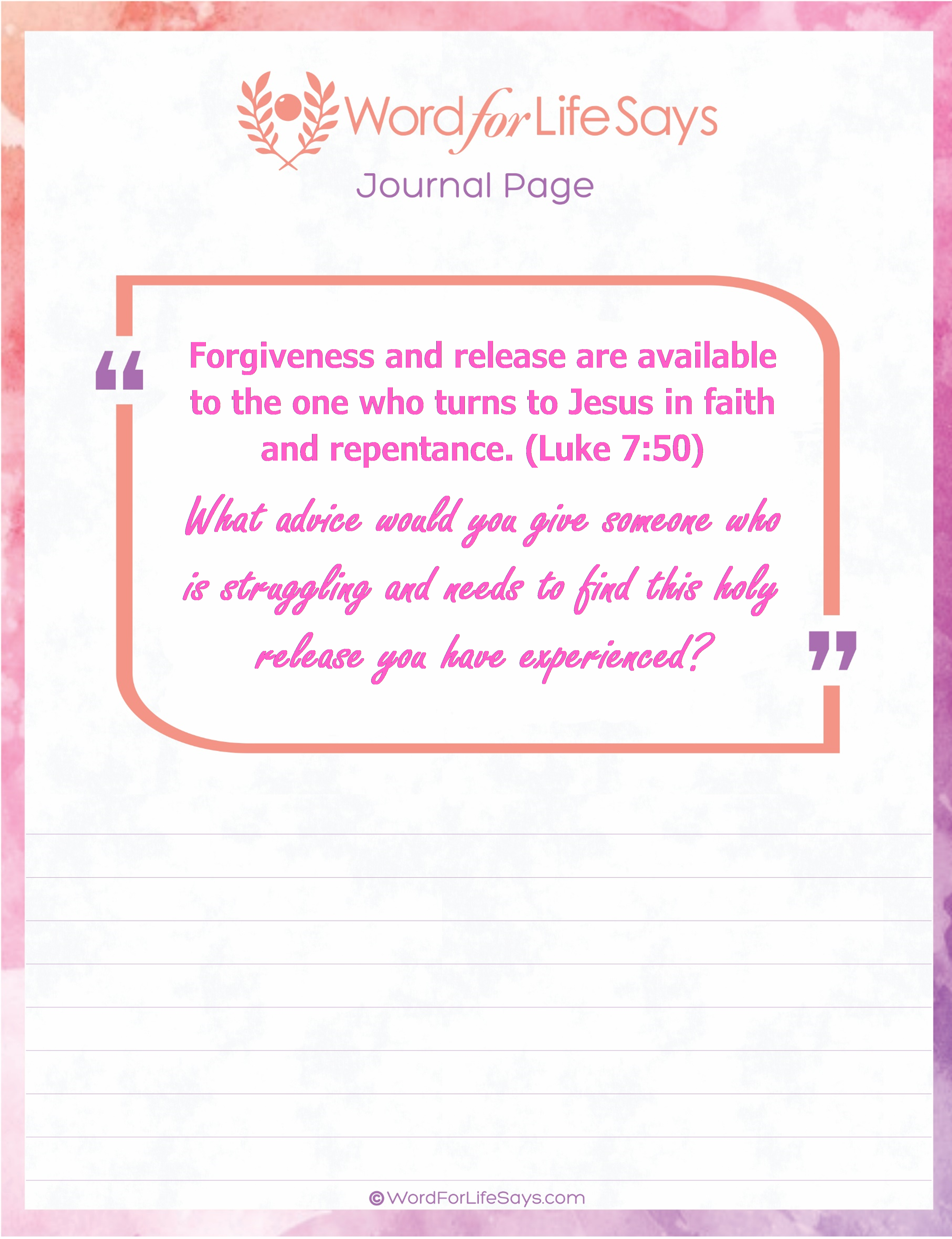
No matter who you are or where you are from, Jesus can forgive any sins of those who come to Him in faith and trust in His free gift of salvation.  Today, if you are not born again and you want to find release as the woman in today’s lesson did, I urge you to take care of it immediately.  Above, I quoted 1 John 1:9 which was written to a church of believers who already knew Christ as their Savior.  If you want your confession to work you must be born again, then like the woman we too can find release and forgiveness.

Speaking with Nicodemus one night, Jesus said, “Verily, verily, I say unto thee, Except a man be born of water and of the Spirit, he cannot enter into the kingdom of God,” (John 3:5).  “Then Peter said unto them, Repent, and be baptized every one of you in the name of Jesus Christ for the remission of sins, and ye shall receive the gift of the Holy Ghost,” (Acts 2:38).

Be blessed, come to Him in faith and accept His forgiveness today!

PDF Printable Sunday School Lesson Pack (With easy to read instructions following the P.E.A.R.L. format on how to conduct each lesson with areas for adding personal notes): Sunday School Lesson – Saved by Faith

Suggested Activities:

Adult Journal Page: Adult Journal Page – Saved by Faith

Kid’s Journal Page: Kid’s Journal Page – Saved by Faith

Word Search: Saved by Faith Word Search  Answers: Saved by Faith Word Search Answers

Crossword: Saved by Faith Crossword  Answers: Saved by Faith Crossword Answers

Word Scramble: Saved by Faith Word Scramble  Answers: Saved by Faith Word Scramble Answers

Alabaster Flask Lace-Up Craft: Alabaster Flask Lace-Up Craft (Cardstock is best to use.  I used gold ribbon due to the expensive nature of the gift and cut a slit for “oil” to flow out of the top.  Enjoy!)

1459970919486-1

Alabaster Flask Lace Up Craft-001

Draw the Scene: Saved By Faith Draw the Scene


Memory Verse: Saved By Faith Memory Verse


How Many Words: Saved by Faith How Many Words


“Think of His Grace!”

It amazes me how quickly we, as humans, and operating in our human nature, want to write things in the story of others that God never intended, nor did it come to His mind.  We tend to write negative responses in the lives and the stories of others while forgetting that the very grace that was poured into our life, can be poured in another as well.
When we were in our messes; when we, as individuals, were outside of the will of God, God didn’t give up on us.  He didn’t give things in our story that were not going to work out for our own good.  Rather, in His grace, He made a way for our personal redemption.  In His grace, He wrote a better ending to our story than we could ever imagine.

Before you judge another or look down on someone because the season they are in right now doesn’t look right to you, remember the grace that was once shown to you, and freely extend that same grace to another.

God’s grace is a beautiful thing and without it, none of us would be here today, and none of us could make it.  None of us had the power to save ourselves.  None of us was capable of doing for us what Jesus did.  But God’s grace stepped in our lives and He raised us out of the muck and mire of our sins.  He lifted us out of our personal ruts and restored us to something wonderful and with purpose.

Think on God’s grace today.  Let it be that gentle reminder of what God has done for you, and let that motivate you to share this same grace toward another.

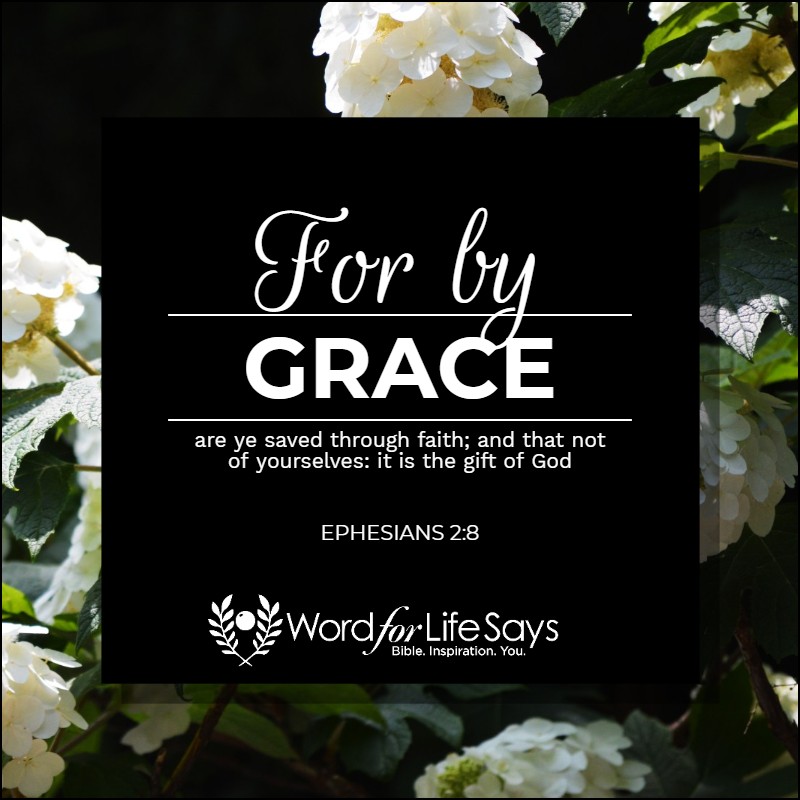
“For by grace are ye saved through faith; and that not of yourselves: it is the gift of God:” Ephesians 2:8.