
Limiting God | Reposting Encouragement

Today, I am reposting encouragement. May you walk in the fullness of God’s unlimited blessings, because almost everybody wants to see a mighty move of God in their life.  But often, some things get in God’s way; obstacles that act as barriers to blessings.  There are two very specific items I want to deal with in this article that the Bible clearly shows us to be things that limit God’s power to work in an individual’s or a people’s life.

But, before I move any further in this article, I want to clarify a few things: 1) Just because one may be in the waiting process, it doesn’t mean these items that are going to be discussed apply to that individual or their situation.  Sometimes, for His own wise reasons, God just has us waiting for His right time to move.  And, 2) The two items that are going to be listed here are not the only things that form themselves as a blockade to one’s blessings.  A truly seeking heart will prayerfully peel back the layers of self for a close-up examination of the inner man to see if there is anything else that may be getting in the way.

As I was reading my Bible, I came across Psalm 78:41, which states, “Yea, they turned back and tempted God, and limited the Holy One of Israel.”  This psalm recites Israel’s history, and it highlights several of their rebellious moments.  Particularly, God’s deliverance of them from Egypt, and their provocation of Him in the wilderness, through sin.  The verse above brings out those same disobedient actions as limiting God.  Their sin made a mark or drew a line, prohibiting them from the fullness of God and what He had to offer.  Rather, they ended up provoking Him to anger.

Disobedience is one thing that will definitely limit God’s ability to work in you, through you, and for you.  Disobedience evicted Adam and Eve from the Garden of Eden (Genesis 3:1-11) when God’s blessing was for them to live in paradise.  Disobedience turned Lot’s wife into a pillar of salt (Genesis 19:17, 26) when God’s blessings wanted to deliver them from that city of sin.  Disobedience caused Jonah to end up in the belly of a fish (Jonah 1:3, 15-17) when God’s blessing was for him to be a great witness to a great city.  And, there are oodles of more cases noted in the Bible.  Disobedience will always forfeit God’s best in one’s life.

As I was pondering this verse in the Psalm about limiting God, I was reminded of a time when Jesus wasn’t able to do great works in Nazareth, His hometown.  Matthew 13:58 tells us, “And he did not many mighty works there because of their unbelief.”  He was limited by their unbelief.

Now, we all know by now Jesus’ ability to do absolutely anything.  One thing He won’t do is infringe, encroach upon, or overstep one’s belief.  Mankind is a creature made with free will.  It is His hope and desire that one would fully believe who He is and all that He says He can do.  But it is a choice that every individual must make, by faith, for himself or herself.

The Bible tells us in no uncertain terms that, “Without faith it is impossible to please him:” (or, to agree with Him), “for he that cometh to God must believe that he is, and that he is a rewarder of them that diligently seek him,” (Hebrews 11:6).

God is the God of all possibilities, but a lack of faith and belief will hinder those possibilities.  Unbelief caused the first group that attempted to enter the Promised Land to be made to turn back (Hebrews 3:19).  God’s best wasn’t for them to wander in the wilderness for forty years.  His blessing was for them to go in and possess it at that time.  Their own unbelief refused the blessing for them.  Going back to Psalm 78 in the recitation of their history, there are other noted instances where the unbelief of the people came to the forefront (Psalm 78:22, 32).

In the New Testament, if it had not been for Jesus on the boat with His disciples, they may have perished in the storm.  Jesus had already done miracles and even taught many powerful parables, but when the storm blew, they freaked out and asked Jesus, “Master, carest thou not that we perish?” (Mark 4:38).  But after Jesus stilled the storm He asked them this one question: “How is it that ye have no faith?” (Mark 4:40).  Faith matters.

Back to Jesus’ experience in Nazareth, in parallel verses found in Mark, the Bible tells us, “He marvelled because of their unbelief” (Mark 6:6).

God, throughout the Bible, wants the best for His people.  God would rather add blessings to our account rather than subtract them.  If God blesses and takes care of the birds of the air and the grass in the field (Matthew 6:25-29), “shall he not much more clothe you, O ye of little faith,” (Matthew 6:30).

But He says in Matthew, “Seek ye first the kingdom of God, and his righteousness; and all these things shall be added unto you,” (Matthew 6:33; emphasis added).  Go after a life of obedience and faith!  Reject those hindrances to the blessings.  The things that stand in one’s way and limit God’s moving in their life have to be put down so that He can raise His people higher.

We hear a lot of inspirational messages dealing with the subject of “No Limits.”  And, that’s wonderful!  But, in order to have a life of no limits, one needs to make sure God isn’t being limited in their life through disobedience and unbelief.

Copyright © Word For Life Says.com (Sharing any posts or lessons can only be done through the share buttons provided on this site from the original posts, lessons, and articles only. You can reblog from the original posts only using the reblog button provided, or share using the share buttons provided from these social media platforms: Facebook, Twitter, or Pinterest, etc., and they must be shared from the original posts only. All other repostings are prohibited. Posts and other items of interest found on this site MAY NOT BE COPIED AND PASTED, downloaded, uploaded, etc to another website or entity not listed (physical or electronic).  See COPYRIGHT PAGE for more details.

“Forget, and Be Fruitful!”

While every day we have is a gift, admittedly, some days are harder to move past than others.  Hurts, disappointments, and pain can sit on people like heavy weights.  Past negatives can seem like an insurmountable mountain we may struggle to climb. So, I pray today’s devotion will help to lighten the steps on the path you are walking and encourage your heart to keep moving forward productively in faith.

And one person who can teach us that is Joseph. He was a man who suffered trials, unfair treatment, and affliction, and yet overcame them all.  His relationship with his brothers was filled with ridicule, lack of support, jealousy, and hatred, which caused them to look unfavorably upon him.

Eventually, their hostility toward their brother led them to do the unthinkable and cast him away by selling him into slavery. The sting of their betrayal was with Joseph as his new life began as a slave in Egypt. But thankfully, this would not be the end of his story, nor would his heart rest in bitterness here.

Though in his land of affliction he originally found favor, unfortunately, there he was also lied about and mistreated, adding salt to the open wounds he had already suffered, eventually finding himself thrown in prison.

And although he was held in prison, prison didn’t have a hold on him. Joseph’s character never changed. In prison and alone, he was still willing to help others by working, being faithful, and using the gift that God instilled in him in revealing dreams.

Unfortunately, once again, he was overlooked and forgotten and left to deal with life alone.  The awesome thing about his story (and ours) is that even if he felt like it at times, Joseph was never alone.  God had a great plan for his life.

Many of us are familiar with how God elevated Joseph from his affliction and blessed him with a position of great honor in the palace after revealing the meaning of Pharaoh’s dream.  Eventually, he became governor over all Egypt, where everyone bowed to him except Pharaoh.  What a change of life and position!

After coming to power, Joseph married and had two sons: “And Joseph called the name of the firstborn Manasseh: For God, said he, hath made me forget all my toil, and all my father’s house.  And the name of the second called he Ephraim: For God hath caused me to be fruitful in the land of my affliction,” (Genesis 41:51-52). 

His story shows that when stepping into new days, we do not have to carry the unwanted baggage of days before. We can declare, as Joseph did, that we are ready to move on and be fruitful in the place God has us in right now, for that’s what his declaration in naming his sons meant.

Every day, God has opened a world of opportunity for us to forget the past and move on into something greater.  We may not be the governor of Egypt, but I don’t believe God has allowed us to see this new day for naught.  We were designed to make the most of our time here and now and be fruitful right where we are.

Fruitfulness is a desire of God for His people: “And he shall be like a tree planted by the rivers of water, that bringeth forth his fruit in his season; his leaf also shall not wither; and whatsoever he doeth shall prosper,” (Psalm 1:3). 

Therefore, today is the time to venture forward in faith and be productive.  Today, we can release the weight, lay down the heaviness, and walk confidently and abundantly into where God has us for this season. This is your time. Today is the day of new beginnings!

Image by Diego Ortiz from Pixabay

Copyright © Word For Life Says.com (Sharing any posts or lessons can only be done through the share buttons provided on this site from the original posts, lessons, and articles only. You can reblog from the original posts only using the reblog button provided, or share using the share buttons provided from these social media platforms: Facebook, X, or Pinterest, etc., and they must be shared from the original posts only. All other repostings are prohibited. Posts and other items of interest found on this site MAY NOT BE COPIED AND PASTED, downloaded, uploaded, etc to another website or entity not listed (physical or electronic).  See COPYRIGHT PAGE for more details. 

You Are the One

You are the One we look to for hope and healing.
You are the One who gives new life so appealing.

You are the One who brings wholeness from brokenness.
You are the One who restores ruins and messes.

You are the One, the mender of breaches.
You are the One for whom my soul gladly reaches.

You are the One who shelters and saves.
You are the One who raises the dead from graves.

You are the One, all-encompassing truth.
By faith, my sight needs no visible proof.

For You are the One who saves from eternal fire.
You are the One, my glory and holy desire.

You are the One who bears us on eagle’s wings.
You are the One who carries us forever to eternity.

You are the One who saves to the utmost.
You are the One in whom my soul gladly boasts.

You are the One, the only one God true and right,
to Whom none can compare, my soul’s joyful delight.

“To whom then will ye liken God? or what likeness will ye compare unto him?” Isaiah 40:18

“Hear, O Israel: The LORD our God is one LORD:” Deuteronomy 6:4

“I am the Lord, and there is none else, there is no God beside me: I girded thee, though thou hast not known me: That they may know from the rising of the sun, and from the west, that there is none beside me. I am the Lord, and there is none else.” Isaiah 45:5, 6


Text Free Image by Myléne from Pixabay

The Infighting Must Stop


There is an old hymn written by Joseph C. Ludgate titled “Friendship with Jesus.”  In this hymn, the refrain sings out the sweetness of being in fellowship with the Savior:

“Friendship with Jesus!
Fellowship divine!
Oh, what blessed, sweet communion!
Jesus is a Friend of mine.” (©Ludgate,1898.)

But what about our fellowship with one another?  How often have the hands of division ripped away the core foundation of our Christian faith by seeking to tear apart what Christ has established: fellowship among those who are recognized as being of Him; that blessed, sweet communion with one another?

Unity among the body of believers was so important that Jesus prayed, “That they all may be one; as thou, Father, art in me, and I in thee, that they also may be one in us: that the world may believe that thou hast sent me,” (John 17:21).  Jesus knew that if His disciples would ban together as one they could positively impact the world, helping many believe in Him.  Vice versa, if divisions and contentions prevailed it would not work to draw people to Himself, to His kingdom message; rather, it would repel.

How often are we fighting amongst ourselves, in our congregations, or even with different denominations because they serve differently than we do?

John, the disciple of Jesus said one day, “Master, we saw one casting out devils in thy name; and we fobade him, because he followeth not with us.  And Jesus said unto him, Forbid him not: for he that is not against us is for us,” (Luke 9:49-50).

Instead of rebuking the one who was accused of: “he followeth not with us,” Jesus set the record straight among His own disciples that they should not be focused on a reason for division. Jesus said, “For he that is not against us is for us.”

Too often great emphasis is put on how one group may do things differently as opposed to another group, or how one may work the gift that God has given them over another.  One may not care for the way another does something for God’s kingdom but Jesus Himself said, “For he that is not against us is for us.”  If someone is working to build up the kingdom of God, do not forbid them just because they are not following what you are doing.  Don’t forbid them just because they are not in your clique.  Don’t forbid them because they worship differently than you do.

There is no room for division in the body of Christ.  There is no room for infighting among the members of God’s family.  The Apostle Paul put it like this by saying, “For as the body is one, and hath many members, and all the members of that one body, being many, are one body: so also is Christ” (1 Corinthians 12:12).

In 1 Corinthians 1:12-13, attempting to squash division, Paul said, “Now this I say, that every one of you saith, I am of Paul; and I of Apollos; and I of Cephas; and I of Christ.  Is Christ divided? was Paul crucified for you? or were ye baptized in the name of Paul?”

Over and over again we see the Bible proclaim unity among God’s people and division to be put away with. While we may have differing doctrinal beliefs, love must be the motivator for addressing those differences because Jesus also said, “By this shall all men know that ye are my disciples, if ye have love one to another,” (John 13:35; see also 1 John 4:20-21).  

Remember Jesus’ prayer that I quoted above, “That they all may be one; as thou, Father, art in me, and I in thee, that they also may be one in us: that the world may believe that thou has sent me.” Is this why the world can’t see the Christ in us and believe because there is too much infighting?  Does our rejection of another who “followeth not with us,” push the world away from believing in the Christ we proclaim and follow?

Regarding the Scriptures, and seeing Jesus’ prayer, I would have to conclude that it can play a part.  Let us learn from our Lord and say, “For he that is not against us is for us.” Let us work to build up God’s kingdom together.  We are all fighting in the same war.  Let’s edify one another and not tear down.

Disagreements Don’t Need To End In Disaster

Text Free Image by Brian Merrill from Pixabay


“Indulge in Nostalgia!”

“And those twelve stones, which they took out of Jordan, did Joshua pitch in Gilgal.  And he spake unto the children of Israel, saying, When your children shall ask their fathers in time to come, saying, What mean these stones?  Then ye shall let your children know, saying, Israel came over this Jordan on dry land.” Joshua 4:20-22

One of my favorite things to do when the weather is nice is to open up all my windows and to put a fan in my bedroom window.  Why the bedroom particularly?  For some reason or another, no matter where I live, when there is a fan in my bedroom window, it makes the air smell just like my grandma’s house when I was growing up, particularly her upstairs and bedroom.  Sometimes, I long for weather not too hot and not too cold, just so that I can have a fan in the bedroom window that blows out that smell.  And when it does, I look for reasons throughout the day to visit my bedroom, to inhale deeply and to let my mind wander to another time.

Smells have that effect on me, nostalgically letting me remember times past.  While the fan smell is my favorite, another smell is stuff burning.  Not like a house catching fire or anything, but rather a pit-beef joint cooking or a log in the fireplace.  This smell reminds me of my paternal grandparents.  They live in the South and during the summer we would visit.  There I witnessed something I hadn’t seen before.  In the evening, they took their trash to a heap outside and set it on fire.  No trash trucks to pick it up twice a week.  They just light it up and watch it go.

It’s good to indulge in a little bit of nostalgia once in a while, especially when it comes to remembering God’s deliverance.  After a certain amount of time goes by, whether it becomes a time of prosperity or a time of hardship, it’s so easy to forget.  The daily grind and routine schedules tend to overshadow what previously occurred.  That can be a good thing when someone is trying to get over hurtful things, but when one wants to remember a glorious time it can be dangerous.

The danger of forgetfulness can leave us with a warped outlook on life.  “Why does this always happen to me?”  “Things never turn in my favor.”  “It’s useless for me to even try!”  Words such as “always, never and useless” denote negativity when used this way. This negative browbeating overshadows the good.  We use words so lightly, but what would the true outcome be if I were to really question, do things really never ever turn in your favor?  Is it really useless for you to try?  The answer, most likely, would be no.

Through times of hardship and prosperity, our perspective on life can get blurred.  That’s why God mandated for these stones to be set up as a memorial.  These stones would stand as a physical reminder of God’s deliverance; of a time when He altered nature and did the impossible just so that His people could gain their promise.

We may not have physical stones, but I do believe we have “markers” in our memory that can transport us to our time of deliverance.  Things that help us to remember that no matter what state one may find themselves in now, God is still on the throne and He is still working it out on our behalf.  Things that help us to remember, He is the one that saved me, and He is the one that ushered deliverance in my life and yours.

That’s why it’s good to indulge in nostalgia.  It opens the door to the good old days.  The thought of it can instantly put a smile on my face when I think of memories past.  Now, imagine doing that with God’s deliverance.  Sometimes we need to remember, on purpose, where He brought us from and how He brought us through.  Set that up as a “marker” to help you remember His goodness no matter what life may bring.

Copyright © Word For Life Says.com (Sharing any posts or lessons can only be done through the share buttons provided on this site from the original posts, lessons, and articles only. You can reblog from the original posts only using the reblog button provided, or share using the share buttons provided from these social media platforms: Facebook, Twitter, or Pinterest, etc., and they must be shared from the original posts only. All other repostings are prohibited. Posts and other items of interest found on this site MAY NOT BE COPIED AND PASTED, downloaded, uploaded, etc to another website or entity not listed (physical or electronic).  See COPYRIGHT PAGE for more details.

Sunday School Lesson – “In the Beginning | The Creation Story” Genesis 1:1-27

VERSE DISCOVERY: Genesis 1:1-27 (KJV, Public Domain)

Taking in the world view as a whole, we will see that all that is before us has a starting point. Every person we see began at the time of conception. Every leader had a first step that led to their position. Every nation had the birth of its people coming together as unified persons. Every plant started with a seed. And every building with a first brick being laid.

Creation has its origin as well. And it does not start with a cosmic bang. The wisdom, intelligence, plan, and sovereignty of God, thought through, designed, and put together all of the creation story.

How it All Started

Genesis 1:1, 2 “In the beginning God created the heaven and the earth. And the earth was without form, and void; and darkness was upon the face of the deep. And the Spirit of God moved upon the face of the waters.”

“In the beginning” is not only the lesson/series title but also the biblical designation of when everything that follows these words actually occurred.

From the start, we are told about the start, and how it all began with “God.” (visit “God the Main Character” and “This Was God’s Doing | God is the Creator of All” found on site for further reading)

God, Himself, has no origin, as Isaiah verifies. Still, He is responsible for the origination of all: “Hast thou not known? hast thou not heard, that the everlasting God, the Lord, the Creator of the ends of the earth, fainteth not, neither is weary? there is no searching of his understanding” (40:28).

From His eternal nature and wisdom, all the creation story below starts with God for He “created the heaven and the earth” (see also Job 26:7). All the history of all the beginnings has its foundations laid by our Heavenly Father: “And, Thou, Lord, in the beginning hast laid the foundation of the earth; and the heavens are the works of thine hands” (Hebrews 1:10; see also Deuteronomy 10:14).

The whole scope of every part of creation is attributed to God alone (Genesis 2:4; Psalms 102:25; Isaiah 44:24; Revelation 14:7). Everything our eyes can see and not see, is in existence because the breath of God spoke it here; because He fashioned it: “By the word of the Lord were the heavens made; and all the host of them by the breath of his mouth” (Psalm 33:6), and by faith, it is to be believed: “Through faith we understand that the worlds were framed by the word of God, so that things which are seen were not made of things which do appear” (Hebrews 11:3).

Nothing was anything before God created it: “Where wast thou when I laid the foundations of the earth?” He asked Job, “declare, if thou hast understanding” (38:4). “Who hath laid the measures thereof, if thou knowest? or who hath stretched the line upon it?  Whereupon are the foundations thereof fastened? or who laid the corner stone thereof;” (Job 38:5,6; I suggest reading Job 38 entirely).

Even the “earth” itself was “without form, and void; and darkness was upon the face of the deep” (see also Jeremiah 4:23). “He hath made the earth by his power, he hath established the world by his wisdom, and hath stretched out the heaven by his understanding” (Jeremiah 51:15).

After the complete declaration of verse 1, accrediting God alone as Creator of all, the complexities and intricacies of all that it entails begin to come to life, starting with the state of the earth itself.

Originally called into creation, there was nothing there. But out of this nothingness, something beautiful would form from the formless. That without content and composure would be permeated with the purpose of God’s design.

As of yet, it lay empty in its state without the specifics of creation, but God was getting ready to change it into something more: “And the Spirit of God moved upon the face of the waters.”

Psalm 104:30 says, “Thou sendest forth thy spirit, they are created: and thou renewest the face of the earth.” God as One, shows every part of Himself (Father, Son, and Spirit) being present at the time of creation (see also John 1:1-3).

The same “Spirit,” with a capital S, found throughout the Bible as the promised Comforter (John 14:6), the “Spirit of truth” (John 14:7), the One who filled believing men and women, and in Paul’s prayer for strength in the inner man (Ephesians 3:16), is the same Spirit at work at creation in the beginning.

Day #1

Genesis 1:3-5 “And God said, Let there be light: and there was light. And God saw the light, that it was good: and God divided the light from the darkness. And God called the light Day, and the darkness he called Night. And the evening and the morning were the first day.”

“And God said.” Each day of the six days of creation began with these three words. By God’s design and by His word, the voice of God broke through the nothingness, took authority over the creation story, and spoke His divine will for each day.

And for day one, the command was, “Let there be light.” One of my favorite games to play as a child was focused on light: “Spotlight Tag.” It was played at night when it became dark enough outside. It was a game somewhat like hide-and-seek except the finding and tagging was done with flashlights. When the children hid, they could only be found when the person that was “it” shone a light on them, saying, “Spotlight on ________ (whoever it was).”

Light is pivotal when one wants to illuminate something.

On day one, light was created and entered the world. Although not noted by a specific source as the flashlight was at this point, it still came with the purpose of adding illumination and delineation from the present darkness where none existed before.

And the light was considered “good” by God. Now there was a defining separation. Light and darkness could not cohabitate, rather they are given their own special designations with God calling the light “Day” and the darkness He called “Night.”

 Day #2

Genesis 1:6-8 “And God said, Let there be a firmament in the midst of the waters, and let it divide the waters from the waters. And God made the firmament, and divided the waters which were under the firmament from the waters which were above the firmament: and it was so. And God called the firmament Heaven. And the evening and the morning were the second day.”

On day two the heavens were created, referred to as “firmament,” or as we know it, the sky. In verse two, we see there was no distinction between the waters that were upon the earth, no space between the waters that were above or below (v. 7), The firmament provided this space of separation. It set boundaries and these boundaries were called “Heaven” (v.8). There is now a visible sky with clouds floating upon the waves of the atmosphere. The Bible tells us, “The heavens declare the glory of God; and the firmament sheweth his handywork” (Psalm 19:1).

Day #3

Genesis 1:9-13 “And God said, Let the waters under the heaven be gathered together unto one place, and let the dry land appear: and it was so. And God called the dry land Earth; and the gathering together of the waters called he Seas: and God saw that it was good. And God said, Let the earth bring forth grass, the herb yielding seed, and the fruit tree yielding fruit after his kind, whose seed is in itself, upon the earth: and it was so. And the earth brought forth grass, and herb yielding seed after his kind, and the tree yielding fruit, whose seed was in itself, after his kind: and God saw that it was good. And the evening and the morning were the third day.”

Day three was particularly active in that we see more form come to that which was formless. We see God’s design begin to come alive more vividly as the putting together of different aspects of creation takes on more definition and purpose.

Now the waters under the heavens are called to move into more defined spaces, gathering into “Seas.” And out of these Seas, “dry land” was called forth and recognized as “Earth.”

Although we refer to the whole planet as Earth, in the beginning, it was the designation of the ground beneath the feet.

If you find yourself in the privileged position to stand on the shore of any massive body of water where the land and seas meet, take a moment while looking out at the vastness of it all and appreciate the fact that this is here because the voice of God commanded it to be (see also Psalm 95:3-5).

“And so it was” reminds us that whatever God speaks must happen and obey as He commands.

Then, the earth was called to bring “forth grass, the herb yielding seed, and the fruit tree yielding fruit after his kind, whose seed is in itself, upon the earth.”

Every imaginable and unimaginable plant, tree, herb, and seed was called into existence. The apple you eat today was originally called to inhabit the earth by the voice of God.

When they were called into existence, all types, be they perennials, annuals, weeds, fruit, or what have you, they came forth and followed the marching orders of God and took up residence and established roots of fruitfulness upon the once barren dry land.

Every conceivable produce has ancestor heritage in one form or another that goes back to the time of the beginning, and many reappear through Scripture attached with significant meaning.

Day #4

Genesis 1:14-19 “And God said, Let there be lights in the firmament of the heaven to divide the day from the night; and let them be for signs, and for seasons, and for days, and years: And let them be for lights in the firmament of the heaven to give light upon the earth: and it was so. And God made two great lights; the greater light to rule the day, and the lesser light to rule the night: he made the stars also. And God set them in the firmament of the heaven to give light upon the earth, And to rule over the day and over the night, and to divide the light from the darkness: and God saw that it was good. And the evening and the morning were the fourth day.”

On day one light was called, here specific “lights” (with an s) are created “in the firmament of the heaven to divide the day from the night.”

The day will come when there will be no longer a need for these specific lights (Rev. 22:5; Is. 60:19), but while they are here, they help us manage the telling of times and seasons (Psalm 104:19).

They not only illuminate the sky in their given tasks, but they give us points of reference in our grand scale of living.

The “two great lights” we refer to as the sun and moon are given the charge to rule over the day and night (compare Psalm 74:16). Worshipping these objects of creation has been a downfall of humanity since the beginning. While we don’t do that, we can be appreciative of these huge visible reminders of God’s handiwork throughout history from the start of it all.

When you feel the warmth of the sun on your face or you view the moon rising in the star-lit sky, you can thank God for what He has done then, and what He can and will do now, and in the times to come.

“He made the stars also.” Scientists may attribute the stars in the sky to an extremely complex process of gas and dust, but in the beginning, we are assured that the significance of their presence high above is because God made them also regardless of their makeup, and He knows each one individually: “He telleth the number of the stars; he calleth them all by their names” (Psalm 147:4).

Using the simple process of His authoritative speech and power over all creation, in the same way He called everything else forth, is the same way the stars arrived in the skies above.

“God set them in the firmament.” God specifically placed them in the right place to perform their jobs perfectly. Careful planning indeed.

In our homes, we place ornaments and knick-knacks in precisely the best location for style and aesthetics, but the carefulness of God’s placement of these lights was for neither style nor aesthetics, they were divinely purposed (compare Jeremiah 31:35).

In Psalm 104:2 we see the psalmist attributing to God as the one “who stretchest out the heavens like a curtain.” Can a man even fathom to catch one star that falls from the sky, let alone stretch out the heavens with galaxy upon galaxy and universe upon universe?  God can.  As a matter of fact, in His wisdom in the beginning all He had to do was speak a word and creation obeyed and came into existence.  All in the sky that looks to be stretched out as a cosmic curtain twinkling above our heads is because God is the one who made it to be so.

Side Note: With such carefulness and attention to detail in the creation of this world, do not think that your life is any less purposed or carefully planned by God’s divine plan as well: “When I consider thy heavens, the work of thy fingers, the moon and the stars, which thou hast ordained; What is man, that thou art mindful of him? and the son of man, that thou visitest him?” (Psalm 8:3,4). I’m so glad He is mindful of us.

Day #5

Genesis 1:20-23 “And God said, Let the waters bring forth abundantly the moving creature that hath life, and fowl that may fly above the earth in the open firmament of heaven. And God created great whales, and every living creature that moveth, which the waters brought forth abundantly, after their kind, and every winged fowl after his kind: and God saw that it was good. And God blessed them, saying, Be fruitful, and multiply, and fill the waters in the seas, and let fowl multiply in the earth. And the evening and the morning were the fifth day.”

Life appears. Living and moving creatures come forth. The existence of sea life begins to swim and move in the waters. Imagine them taking their places, setting up habitats among the reefs, and going about their business as if they had always been.

Psalm 104:25-26 tells us, “So is this great and wide sea, wherein are things creeping innumerable, both small and great beasts.  There go the ships: there is that leviathan, whom thou hast made to play therein.” “Innumerable” creatures come to life by God’s design.

For every creature dwelling there we know nothing about, God knows the makeup of their design from the inside out. He knows their identity. He knows the places they swim and hide. What seems impossible to explore and uncover all the intricacies of all life that may dwell in the deepest of the waters, God already understands their mysteries and purpose.

On this same day, birds take to the sky. Wings spread and life begins to soar. Dipping and diving below the clouds, they test their created abilities to new heights and just fly. Amazing! (Check out this poem I wrote about a bird and be encouraged by God’s design.)

Oh, the beauty that must have been in the Heavenly Father’s sight as He witnessed all this new life take off and begin to inhabit the places He created.

“It was good.” You know that space in your house that you finally got decluttered and organized, and now you don’t have to cringe when walking by it anymore? In fact, you go out of your way to look at the transformed space it has become, and you think to yourself, how wonderful and good it is.

My friend, God’s good is so much more.

“God blessed them.” God did something He had not done with the previous days of creation. He commanded a blessing over life: “Be fruitful, and multiply, and fill the waters in the seas, and let fowl multiply in the earth.” Life is of utmost importance to God and protecting life that it continues was in the grand scale of His perfect plan.

Day #6

Genesis 1:24-27 “And God said, Let the earth bring forth the living creature after his kind, cattle, and creeping thing, and beast of the earth after his kind: and it was so. And God made the beast of the earth after his kind, and cattle after their kind, and every thing that creepeth upon the earth after his kind: and God saw that it was good. And God said, Let us make man in our image, after our likeness: and let them have dominion over the fish of the sea, and over the fowl of the air, and over the cattle, and over all the earth, and over every creeping thing that creepeth upon the earth. So God created man in his own image, in the image of God created he him; male and female created he them.”

“The living creature.” As the sea life and birds populated the waters and sky, so too did these come forth to inhabit and populate the earth.

Notice there is no discrepancy in the creation story. No parts are left unfinished or wanting. All are in His mind, and all come to fruition in His story.

“And it was so.” The course of the creation story continued to follow the protocol it was given. Every being formed, gained breath, and became everything God designed them to be. As they entered the realm of creatures that are now living, they entered fulfilling divine purpose: “I have made the earth, the man and the beast that are upon the ground, by my great power and by my outstretched arm…” (Jeremiah 27:5).

“After their kind.” Today, through years of studies by many professionals, we recognize the specific genetic makeup of the various beings that dwell on this earth. Interestingly, and encouraging for the believer, is that we recognize the hand of God in authoring these specific genetic makeups.

Every living creature had the built-in ability to reproduce after its own kind, or its own genetic makeup. From the beginning, it has always been so.

Therefore, there are no needed discussions for evolutionary this and that. What it is, is what it produces. Outside of the interference of man, what it is, is what it will keep producing.

“And God said, Let us make man in our image, after our likeness.” Evolutionary experts will try to take you through billions of years of history to explain the origin of life, civilization, and this world, which they have never known or seen. But “theory” tells them they are right.

Yet, there is a God who has always been and always will be who recorded our earth’s history for us, letting us know that we are a beautiful part of His holy plan.

Here’s the thing, both require some sort of leap of faith. But the walk of faith we have seen played out in the historical, written record of the Bible, along with other non-biblical texts that support its work, in addition to great archeological discoveries doing the same, tells us, beyond a shadow of a doubt, that their theories are wrong, and our God is right: “Have we not all one father? hath not one God created us?…” (Malachi 2:10).

Therefore, in the beginning, this is how it all went down according to the authority of God’s written record, the Holy Bible, which says, “Thy hands have made me and fashioned me…” (Psalm 119:73; emphasis added).

And I assure you, my friend, on that same authority, “God created man in his own image, in the image of God created he him; male and female created he them.”

I have only touched on the creation of man here because I have an entire lesson dedicated to that subject, along with the seventh day of rest in part two of the “In the Beginning” Series.

“For the invisible things of him from the creation of the world are clearly seen, being understood by the things that are made, even his eternal power and Godhead; so that they are without excuse” Romans 1:20

PDF Printable Sunday School Lesson Pack (With easy to read instructions following the P.E.A.R.L. format on how to conduct each lesson with areas for adding personal notes): Sunday School Lesson – In the Beginning – Part 1 The Creation Story

Suggested Activities:

Lesson Prep Opening Idea: “In the beginning…” As our lesson will state, everything has a beginning except for God who is from “everlasting to everlasting” (Psalm 90:2). Therefore, in the beginning of the world and the universe as we know it today, God was already there, orchestrating events and the particulars of the creation story.

Every day of creation began with “And God said.” To demonstrate this as an opening object lesson, set up a row of dominoes in whatever configuration you would like. The first domino is the “beginning” domino, and when it falls over, at its moving, all the other parts of the configuration will move and fall as well.

During the days of the creation story, whenever God, in the beginning, spoke, that part of creation came to pass and fell into its proper place (topple the first domino and watch the effect take place).

Journaling: Tonight, if the skies are clear (or on the next clear night), take a few minutes to stargaze and/or take out your cell phone and photograph the wonders above that you see.  Allow yourself a few minutes to reflect on the greatness of God based on what you have observed.  Jot down what you see or feel on this Blank Journal Page and let the awe of God wash over you as you reacquaint yourself with the majesty of His power and wisdom in the creation story.

Or as Day #3 in the lesson suggests, if you find yourself in the privileged position of standing on the shore of any massive body of water where the land and seas meet, take a moment while looking out into the vastness of it all and appreciate the fact that this is here because the voice of God commanded it to be, and record your thoughts and inspiration (this can be done with any or all days or points of the creation story).

Further Journaling Options:

Adult Journal Page: Adult Journal Page – The Creation Story

Kids Journal Page: Kids Journal Page – The Creation Story

Earth Mobile Craft: Using a hanger, wooden rod, or stick, students can attach the earth printable to remind them of God’s power displayed in the creation story. Color and cut the printable and duplicate the smaller circles until you have seven (one for each day). In the smaller circles, draw pictures or write words describing what occurred during that particular day in the beginning. Note: While we may have to hang a paper earth on something to keep it up, God hangs the real earth on nothing but His power to keep it up (Job 26:7). PDF: The Creation Story Earth Mobile Craft

 

Apple Stamp Picture: Regarding day 3 of the creation story, I wrote in the lesson, “The apple you eat today was originally called to inhabit the earth by the voice of God.” As a reminder that everything was called by God, make an apple stamp picture. Cut apples in half, dip in paint, and allow students to make and decorate apple stamp pictures. Attach or write Genesis 1:11 “And God said, Let the earth bring forth grass, the herb yielding seed, and the fruit tree yielding fruit after his kind, whose seed is in itself, upon the earth: and it was so.”

(Something similar can be done with day 4 using star stickers on a page for decorating with the corresponding verse from Genesis 1:16 “He made the stars also.”) As a side note, any day of creation can be pinpointed and punctuated with corresponding pictures and verses.

Memory Verse Game: Using an inflatable globe (or ball as a substitute), teach students the memory verse by having them rehearse the verse every time the ball lands in their hands. Put the ball into play in whatever form you like (ex. Toss it in the air and whoever catches it repeats the memory verse. That one, in turn, can toss it into the air or to another student, then they too must repeat the verse, and so on.)

Another version of this is to play music. As the globe or ball is passed around the circle of students, when the music stops, whoever has the globe or ball is to say the memory verse. What a fun way to remember God created all.

Word Search: The Creation Story Word Search  Answers: The Creation Story Word Search Answers

Crossword: The Creation Story Crossword  Answers: The Creation Story Crossword Answers

Word Scramble: The Creation Story Word Scramble  Answers: The Creation Story Word Scramble Answers

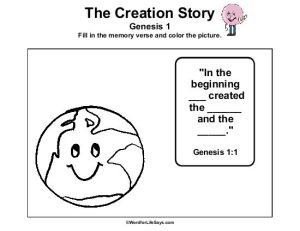
Memory Verse: The Creation Story Memory Verse
How Many Words: The Creation Story How Many Words
Text Free Top Image by WikiImages from Pixabay

Complaintus Interruptus Devotional + 7 Bible Verses that Deal with Complaining

Now, if you grew up like me watching Saturday morning cartoons (which were the best) with a bowl of cereal in hand, you have probably spent your fair share of time being entertained by a certain coyote and a particular bird who were always trying to outwit one another.  One of the humorous things about the show was the fake scientific or Latin names given to these characters that expressed some funny trait about who they were or what they were doing.  Thus, in parodic form was the title of this article born of the humorous need to make it sound really scientific.

One day, I was walking with my husband and something was really bothering me I had dealt with during the day and I couldn’t wait for an opportunity to unload what occurred.  It was like I was trying to play double-dutch jump rope, looking for the right time when I could jump in and unleash my complaint.

Walking side by side with him to go into our church that evening, while right on the tip of my tongue, ready to come out, my complaint was interrupted.  We ran into another church member and what she said to my husband escaped me, but my husband’s response didn’t.  He said, “I won’t complain.”  And he wasn’t saying it in a lackadaisical church manner, for he put emphasis on his point by refusing to acknowledge the reason for the complaint.  Obviously, I was floored.  Here I am holding something that’s just itching to get out and I experienced a case of “complaintus interruptus.”

 And sometimes, that’s not a bad thing.

Often in life, we do deal with things and we look to unload the weight of it onto others.  Sometimes we feel that if we can just talk about it with someone, that act alone can help us to feel better.  And in most cases, that’s true as long as we are seeking to do it constructively, and not just to do it for the sake of wanting to complain.

There is a big difference.  Out and out complaining is negative and tells those around us that I am just not happy about a situation and I want to gripe about it.  It’s not seeking resolution, it’s just seeking to show discontent, tear down, and spew out unnecessary drama.  Whereas, constructively telling someone of your concerns and upsets, not to unleash or accuse, but to seek counsel that will help you deal with the situation, is a positive move in the right direction to wrangle in the feeling of upset and misunderstandings one may be facing.

We find cases of both in the Bible to teach us the do’s and do not’s of what goes on in these situations.  First, we have the gripers, or murmurers, as the Bible calls them.  Those, who for the mere sake of wanting to expose their displeasure, pop the cork off their mouth and let the unhappiness flow.  We can find these types of characters throughout the Bible, particularly in those whom God delivered from Egypt. Yet, they constantly found something to complain about and it seemed they were never quite happy with what God was doing (see Exodus 14:11 and 16:2-3; Numbers 14:27 for some examples).

For these types of people, God was greatly displeased (Numbers 11:1; 21:5-7).  After only three days of their journey (compare Exodus 15:22-23) they expressed to God their discontent about their wandering situation even though it was these same people who cried out to God for deliverance because of their taskmasters.  It was hard for these people to overcome testing because their complaining spirit always seemed to win out over their emotions, thwarting their focus and devotion from God and His deliverance.

Then, we have those like King David who, in Psalms prayed, “I cried unto the LORD with my voice; with my voice unto the LORD did I make my supplication.  I poured out my complaint before him; I shewed before him my trouble,” (Psalm 142:1-2).  He comes before God humbly, with a prayerful spirit, seeking help and consolation, not to grumble or show his displeasure about his situation.  Simply put, he was going through trouble and he took that supplication and situation to the Lord in prayer.

The Bible invites us to give our worries, upsets, and problems to God by saying, “Casting all your care upon him; for he careth for you,” (1 Peter 5:7; see also Psalm 55:22).  This is a constructive and positive way of dealing with the hurts and disappointments of life.  We take it to the Lord in prayer and we leave it there.  We express to Him, reverently, how we feel, how we are hurting and upset, and we let Him take the wheel, and we leave it alone.  It is a matter of trusting God with our problems, and not demanding something from Him through our murmuring.

God loves those who sincerely seek Him in prayer but He doesn’t like complaining.  Sometimes we need to check ourselves and put a hand up to stop the words flowing before what we think we need to say comes out of our mouths.  Perhaps we need a case of complaintus interruptus to corral wayward thoughts and words.

Some Verses to Ponder:

Philippians 2:14 – “Do all things without murmurings and disputings.”

Ephesians 4:29 – “Let no corrupt communication proceed out of your mouth, but that which is good to the use of edifying, that it may minister grace unto the hearers.”

Lamentations 3:39 – “Wherefore doth a living man complain . . .”

1 Corinthians 10:10 – “Neither murmur ye, as some of them also murmured, and were destroyed of the destroyer.”

Psalms 39:1 – “I said, I will take heed to my ways, that I sin not with my tongue: I will keep my mouth with a bridle, while the wicked is before me.”

Philippians 4:11 – “Not that I speak in respect of want: for I have learned, in whatsoever state I am, therewith to be content.”

Hebrews 13:5 – “Let your conversation be without covetousness; and be content with such things as ye have: for he hath said, I will never leave thee, nor forsake thee.”

Text Free Photo Credit: Pixabay

Jesus Loves You To The End!

jesus-loves-you_4394_1024x768

“Having loved His own who were in the world, He loved them to the end,” John 13:1

The love of Jesus is unwavering and our rock-solid truth to stand upon through the storms and trials of life.

Eventually, the love of friends fades.  As years go by, we grow up and move on with our lives.  Even some familial relationships can wane with the passing of time.  But there is one love that never quits on you.  His promise was to never leave you nor forsake you, Heb. 13:5.  He showed His devotion to His disciples right up to the end.  And daily, He shows His devotion to each and every one of us by continually being there for us, loving us, interceding for us, and hearing us when we call.

I am personally amazed at His undying devotion to us.  Through all of our faults, shortcomings, and mess, He still stays committed to us even “to the end.”  This is a source of comfort and reassurance for them that are His.  Despite the tragedies of life or how much we feel like we are not measuring up, we have a Savior, nay a friend that sticks closer than a brother, Pro. 18:24.

The times and tides of life may ebb and flow, come and go, but Jesus is our stable and trustworthy source never to be moved.  He is committed completely to you in love. Somebody once said, “It isn’t over ‘til it’s over!”  And since we are here today, alive and with breath in our bodies, it’s not the end.  Bolster your faith and encourage your heart today in the great truth that no matter what it may look like right now, Jesus loves you to the end! 

Photo Credit: Wallpaper4god

“A Good Steward”

“And unto one he gave five talents, to another two, and to another one; to every man according to his several ability…” Matthew 25:15

So often when one speaks of the idea of stewardship the mind automatically travels down the road to finances. The overall idea of finances and stewardship has been linked together for ages, even since the Bible times – and that’s a correct assessment. I want us to look beyond the management of “talents,” looking rather to talents. Huh!

Well, we have the Bible definition to deal with and then we have our English definition. Talents in the Bible refer to 3,000 shekels of silver while one’s talent in the English refers to that special something that God had planted on the inside of each of us. That skill or ability that comes so naturally, it just flows from one’s being. I think the idea of stewardship or being a manager can nicely encompass those God-given delectables on the inside of each of us.

I really think it is something special that God created these two words, though spelled the same, yet have different meanings, and then, gave a management directive over both of them. Paul charged Timothy and said, “Neglect not the gift that is in thee,” (1 Timothy 4:14). Paul knew that God had bestowed something amazing on the inside of this young man, yet, if it were going to prosper and flourish in him, he would have to pay careful attention to guard it.

Ask any gardener about the care that they take of their land once the seed has been planted. There are many steps to ensure growth. Just as with Adam in the Garden of Eden, God has planted the seed but has given each of us the charge to nurture it. That’s what stewardship is all about. Being careful to manage the thing/gift that God has put me in charge of.

Do you know how much the world needs the unique stuff that God has placed inside you? There can be a million preachers. There can be a million teachers. There can be a million givers. There can be a million ushers, janitors, authors, or whatever! There can be a million of anything that can be fathomed, but nobody can do it like YOU!

You are special. You are unique. Stop hiding your talents, your skills, that special something that God put in you. Stop burying it (Matthew 25:18). Rather do as Paul instructed Timothy and pay careful attention to it. Do what you have to do to cause that seed that God planted in you to grow to the point that it is flourishing on the outside of you. Then, the whole body of Christ can profit from that great gift in you.

“As every man hath received the gift, even so minister the same
one to another, as good stewards of the manifold grace of God,”
1 Peter 4:10.


“Today, I Want to Be Me!”

“I will praise thee; for I am fearfully and wonderfully made: marvelous are thy works; and that my soul knoweth right well,” Psalm 139:14

Oh, the creative power that took place for you to be here today.  From the moment of conception, and from the time cells began to divide within themselves, you were and are a product of beautiful design.  Uniquely, you are made just the way God intended.  And, since we know that He doesn’t make any mistakes, whatever we view as shortcomings in our lives may be there for a much higher purpose.  Our so-called defaults are part of the plan that God has laid out in your life.

What would happen if every Christian really armed themselves with this beautiful truth?  How would that personally make us feel?  How would it affect the way we live, the way we walk and talk?  More importantly, how would it affect the way we move in our Christian walk?  How much more would we be apt to express our faith knowing the value He places in each and every one of us?

I believe if Christians really got a hold of this truth they would turn the world upside down.  They would step out with a newfound faith knowing that they are something really special before God; knowing that their worth is not in how the world sees them; rather, how God sees them.  What does He think about me?

Let me tell you what He thinks about you. Jesus said in Luke 12:6-7, “Are not five sparrows sold for two farthings, and not one of them is forgotten before God?  But even the very hairs of your head are all numbered.  Fear not therefore: ye are of more value than many sparrows.”  “Ye are of more value!”  Humanity is the apex of all His creation.  He made sure everything that was created was put in the proper place and in the proper order for us.  We are the only part of creation where God claimed Himself, “Let us make man in our image, after our likeness: and let them have dominion . . .” (Gen. 1:26).  Not only created but we were created in “His image.”  Not only in “His image,” but we are also created to have “dominion;” authority over all the earth including the thoughts that come to make us feel less than anything He said of us!

Today, I want to be me.  I want to walk like I walk.  Express me like only I can.  I want to relish in the wonderful thought that when no one else is taking notice of me, He is.  Because He designed me this way and I know the care that went into this design, I can rest and enjoy myself.  I can love me some me.  Even when it seems no one else does, I can love me, because He loves me.

If He says I’m good just like this then all I have to do is learn to work in what He gave me and just be me.  “Marvelous are thy works; and that my soul knoweth right well.”  Does your soul know that you are a marvelous work of God?  Can you believe that today so that you can just enjoy being yourself?  You are so incredibly special.  Let no one rob you of the precious way that God sees you.

“Know ye that the Lord He is God: it is He that hath made us and not we ourselves. . .” (Ps. 100:3).  I’m so glad I didn’t do this myself.  That would be impossible because there is so much that goes into this that we will never figure it out.  Then again, I don’t have to because He already did.  He stepped back and looked at creation and said, “It was very good,” (Gen.1:31).

I am good!  From the time that He has “covered me in my mother’s womb,” (Ps. 139:13), I am just the way He wants me to be.  So, today, I can be me!  Now, that’s something to 🙂 about!