
VERSE DISCOVERY: Exodus 3:1-12 (Public Domain)
1) “Now Moses kept the flock of Jethro his father in law, the priest of Midian: and he led the flock to the backside of the desert, and came to the mountain of God, even to Horeb.
2) And the angel of the Lord appeared unto him in a flame of fire out of the midst of a bush: and he looked, and, behold, the bush burned with fire, and the bush was not consumed.
3) And Moses said, I will now turn aside, and see this great sight, why the bush is not burnt.
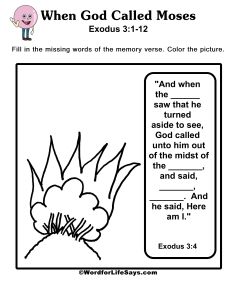
4) And when the Lord saw that he turned aside to see, God called unto him out of the midst of the bush, and said, Moses, Moses. And he said, Here am I.
5) And he said, Draw not nigh hither: put off thy shoes from off thy feet, for the place whereon thou standest is holy ground.
6) Moreover he said, I am the God of thy father, the God of Abraham, the God of Isaac, and the God of Jacob. And Moses hid his face; for he was afraid to look upon God.
7) And the Lord said, I have surely seen the affliction of my people which are in Egypt, and have heard their cry by reason of their taskmasters; for I know their sorrows;
8) And I am come down to deliver them out of the hand of the Egyptians, and to bring them up out of that land unto a good land and a large, unto a land flowing with milk and honey; unto the place of the Canaanites, and the Hittites, and the Amorites, and the Perizzites, and the Hivites, and the Jebusites.
9) Now therefore, behold, the cry of the children of Israel is come unto me: and I have also seen the oppression wherewith the Egyptians oppress them.
10) Come now therefore, and I will send thee unto Pharaoh, that thou mayest bring forth my people the children of Israel out of Egypt.
11) And Moses said unto God, Who am I, that I should go unto Pharaoh, and that I should bring forth the children of Israel out of Egypt?
12) And he said, Certainly I will be with thee; and this shall be a token unto thee, that I have sent thee: When thou hast brought forth the people out of Egypt, ye shall serve God upon this mountain.”
Lesson Introduction:
Going back into history a little more, Moses’ path in life was far from ordinary. From the time of his birth, he was deemed a “beautiful child” (Ex. 2:2). When she could no longer hide him from the Egyptians who oppressed her people, Moses’ mother went to great lengths to save his life, leading him to become Pharaoh’s daughter’s child (Ex. 2:5-10).
Being raised in the house of Pharaoh did not block his view of the suffering of his people. Taking matters into his own hands at one point caused him to flee for his own life, beginning the next leg of his life’s journey in Midian (Ex. 2:1.1-15). There, he established a new life. He even married and had sons in the process (Ex. 2:21-22; 18:3-4).
Time went by, but the problem in Egypt remained. The Bible says, “The children of Israel sighed by reason of the bondage, and they cried, and their cry came up unto God by reason of the bondage. And God heard their groaning, and God remembered his covenant with Abraham, with Isaac, and with Jacob,” (Ex. 2:23b-24). God was ready to deliver His people from bondage. For that, He would raise up a man, a prophet, to lead them. And this man’s name, as we have already been focusing on, was Moses, the subject figure of this week’s lesson.
Lesson Summary:
For Moses, an ordinary day turned extraordinary. The mundane task of tending the flock of his father-in-law took a dramatic turn, one that would change the course of his life forever.
It all started when “Moses kept the flock of Jethro his father in law, the priest of Midian: and he led the flock to the backside of the desert, and came to the mountain of God, even to Horeb.” By this time in his life, Moses is at the ripe old age of 80. Any of those terrible thoughts of his previous life in Egypt have probably faded as he has been settled for some time in his new life of shepherding his father-in-law’s flock.
His goal for that day when he woke up and ventured out was to find the best pasture for the flocks to graze and feed. That’s it. His ambitions didn’t go any higher than that. The simple life is what he lived and what he had grown accustomed to. No drama. No hardness. No dealing with extraordinary circumstances that were beyond his control. Simply, find pasture, feed the flock, and get on with the day as usual. The furthest thing from his mind on that day was a personal encounter with God.
Please Note: God never has to ask our permission when He wants to call us into service. He doesn’t focus on our convenience or acceptance of the call. He calls us according to His perfect timetable and empowers us with His Spirit to follow through on the course He has laid out for us. Be it an ordinary day or not, when God is ready, He will reveal Himself to us. In that, He asks us to trust Him and follow His lead.
While going about his daily routine, his mundane tasks, his inconsequential chores on the “backside of the desert” on “the mountain of God, even to Horeb” (later to be referenced to as Mt. Sinai, the place where Moses will receive the Ten Commandments), his day was interrupted by a sight he had never seen before. There, before him, was a “bush burned with fire, and the bush was not consumed.”
The Bible describes the event as something divine in nature going on. God was getting ready to not only change Moses’ everyday course forever, but He was ready to speak a new calling into his life. He was going to take him from the ordinary shepherd that he was today and make him a notable instrument in freeing His people from the bondage of Egypt for a better tomorrow. But first, He had to get his attention. With that, an “angel of the LORD appeared unto him in a flame of fire out of the midst of a bush.”
For Moses, at that time, all it appears he is fascinated with is the fire that does not affect the bush that is set to flames. This miraculous occurrence is intriguing to him, and in his curiosity, he is resolved to find out more and investigate the matter thoroughly. He said, “I will now turn aside, and see this great sight, why the bush is not burnt.” Seeing a bush on fire in the heat of the desert is nothing new. Seeing a bush on fire in the heat of the desert that doesn’t burn up, well that’s a whole other story worth finding out about more.
“When the LORD saw that he turned aside to see, God called unto him out of the midst of the bush and said, Moses, Moses.” If the last thing he expected to see on this unusual day was a burning bush that was not consumed, then surely, he would have never imagined hearing a voice coming “out of the midst of the bush” saying his name, “Moses, Moses.”
What a frightful and awesome experience it must have been to hear the words of the living God being uttered in His powerful and true oration. And to not only hear His words but to hear Him call you by your name, personally. But that’s how God is. He knows us wonderfully. He knows us completely. He knows us each, individually, on a one-on-one basis.
Jesus even spoke in the New Testament, saying, “He calleth his own sheep by name,” (John 10:3). To Him, you are somebody. To Him, you are valued. To Him you are important. To Him, you are not invisible. He knows you. He knows your name. How wonderful is that? We serve a personal God! Hallelujah!
To the calling of his name out of the flames, Moses’ response was, “Here am I.” This is the same way Samuel responded when he thought Eli was calling him. Turns out the voice he was hearing was from God as well, and he was instructed to respond to Him, saying, “Speak, LORD; for thy servant heareth” (see 1 Samuel 3:4-10).
When God calls, we must be responsive to answering His call. He’s not calling without purpose. He doesn’t want to deal with inactivity or an indifferent attitude. We must be willing to hear and receive from Him and follow through on what He instructs us. This is something Moses would initially struggle with, but through God’s working and leading, he became a powerful leader of God’s people with his name etched in history forever.
“And he said, Draw not nigh hither: put off thy shoes from off thy feet, for the place whereon thou standest is holy ground.” As Moses was coming nearer to the object of his attention, the burning bush, God stopped him from proceeding farther. One cannot tread the presence of God with a heavy foot. We must recognize the severity of being in the presence of the true and living, holy God. He is omnipotent. He is the Sovereign of the universe, the Creator of all. He is divine all by Himself. He is God all by Himself. He declared in Isaiah, “Before me there was no God formed, neither shall there be after me. I, even I, am the LORD; and beside me there is no savior . . . ye are my witnesses, saith the LORD, that I am God,” (43:10-12).
Being the awesome God that He is, required, and still requires respect before drawing nigh unto His indescribable presence. “Put off thy shoes!” Recognize where you are and who you are approaching! This is a sacred place.
“Moreover he said, I am the God of thy father, the God of Abraham, the God of Isaac, and the God of Jacob.” God introduces Himself (compare to Genesis 15:7) to Moses and identifies exactly Who it is that is speaking to him from the midst of the bush. Referencing his own father and the patriarchs, God identifies Himself as the same God who is and has been in covenant relationship with His people Israel. He is the same God of the Hebrews that initiated with Abraham this awesome promise and carried it through his lineage and down the line to where Moses and his people are today. The years have not whittled away that covenant. It is still intact, and God was ready to show up and show out on His people’s behalf.
“And Moses hid his face for he was afraid to look upon God.” Rightly so! The presence of God is awesome and terrible all at the same time. At this present time, Moses has yet to enter the intimacies of being in a personal relationship with God. One where he becomes familiar with God and God refers to him as a friend (see Exodus 33:11). Even still, when Moses did gain the boldness to ask God, “I beseech thee, shew me thy glory,” (Exodus 33:18) God’s response was, “Thou canst not see my face: for there shall no man see me, and live,” (Exodus 33:20).
God then begins to talk to Moses about the situation at hand: “the affliction of my people which are in Egypt.”
God’s people weren’t always “afflicted” in Egypt. Earlier, when Joseph, through much historical detail (read Gen. 39-47 for full details), helped not only the Egyptians through a harsh time of famine but also his own family, the family of Jacob through whom the promises of God flowed, they all enjoyed a time of favor in Egypt. Pharaoh told Joseph, “Thy father and thy brethren are come unto thee: The land of Egypt is before thee; in the best of the land make thy father and brethren to dwell” (Gen. 47:5-6).
But, when that Pharaoh died, this “affliction” they now faced was spurned by the fears of a new Pharaoh (Ex. 1:8-11). The children of Israel now suffered mightily and served as slaves for the Egyptians. Over 400 years have gone by, and God says He has, “heard their cry by reason of their taskmasters; for I know their sorrows.”
Though, throughout their history, their lives went from fantastic to fearful, God’s ears were opened and attentive to their cries the whole time. In a time after this, David will also acknowledge the God who hears his cries, saying, “In my distress I called upon the Lord, and cried unto my God: he heard my voice out of his temple, and my cry came before him, even unto his ears,” (Ps. 18:6). The point is God always sees and hears the troubles of His people and He knows “their sorrows.”
“I am come down to deliver them out of the hand of the Egyptians.” Our God is a God of action. God gets involved in the situation. Dear friends, you are never left to fight through this world alone, no matter how you feel or how dark the days may seem.
God not only sees and hears, but He also initiates a plan for their deliverance. Those who are currently in Egypt have never tasted freedom before. It is something they have only ever dreamed about. They know nothing about life outside of slavery. God was going to change it all and “deliver them out of the hand of the Egyptians.” The Egyptians may have a tight hold on them now, but God was going to snatch them out of the hand of the enemy.
In other words, God came to meet them in their deepest time of need, at a time when the stripes of the taskmasters were too much to bear. God will come to meet you in your time of need to bring you out! You may think you are in the worst place possible, but rest assured, wherever you are, you will never be out of the reach of God.
“To bring them up out of that land . . . unto a land flowing with milk and honey.” God’s purpose was not only to deliver them from the evil clutches of the Egyptians but to “bring them” unto something better: their Promised Land, the land that was given as a promise to Abram [Abram was Abraham’s name at that time] (for the promise see Genesis 12:7; 13:14-15; 15:18; 17:2, 7-8). The land may have been currently inhabited by the “Canaanites, and the Hittites, and the Amorites, and the Perizzites, and the Hivites, and the Jebusites,” but that same land has been allotted to the people of God as part of their covenant/promise heritage (refer to Genesis 15:18-21; Psalm 105:6-11). When God delivered His people, these evil nations would be evicted from inhabiting their promise, and that land of prosperity would be given over to His people (compare Deuteronomy 6:3; 11:22-25; Psalm 105:44).
“Behold, the cry of the children of Israel is come unto me.” Here is a reiteration that God hears their “cry.” He also is noted as seeing “the oppression.” He sees the harshness of their situation. It has “come unto” Him. It does not escape His knowledge! God is closely knit to His people. What we feel, He feels. What we experience, He knows all about it. Even today, the Bible assures us, “We do not have a High Priest who cannot sympathize with our weaknesses” (Hebrews 4:15a).
One of the greatest lies of the enemy is to speak against the faithfulness of God by trying to convince people that God doesn’t care; by persuading them that He has turned a blind eye to the troubles we face.
Nay, but God sees it! Your battle and your scars are not invisible to God. You are not invisible to God! He is paying attention to each and every one of us. “What is man, that thou art mindful of him? and the son of man, that thou visitest him?” David asked, knowing the true insignificance of man compared to all of creation in Psalm 8:4. Yet, God is mindful; He is paying attention!
Not only has He seen, but all His senses are put on high alert, and He has heard. Did not the psalmist declare, “I called on the LORD in distress; the LORD answered me and set me in a broad place” (Psalm 118:5; NKJV)?
“I will send thee unto Pharaoh, that thou mayest bring forth my people.” God’s purpose for appearing and speaking to Moses wasn’t for naught. He had an assignment for him. Moses is going to be a key in the deliverance of God’s people from the Egyptians. This is his calling. This is the ministry God has ordained for his life. Moses is being sent in as the man for the job.
His mission would entail him going before Pharaoh and bringing God’s groaning people out through signs and wonders performed in Egypt, the going through of the Red Sea, and even through their 40 years of wilderness wanderings, Acts 7:35-36; thus fulfilling more of His faithful promises to Abraham: “they shall come out with great substance,” (Gen. 15:14) and “in the fourth generation they shall come hither again,” (Gen. 15:16).
With such a heavy calling, Moses asked, “Who am I?” If anyone felt inadequate about a task before him, Moses did. To find out that God wanted to use him personally in such an extraordinary way was a little more than he could take in. “Who am I?” Moses spent the last 40 years shepherding animals and now God suggested that he would begin to shepherd His people “out of Egypt.”
“Certainly I will be with thee,” was God’s promise to him. God never called anyone to a task and abandon them. Later, after Moses passes off the scene God will have to reassure his successor, Joshua, in the same way, saying, “For the Lord thy God is with thee whithersoever thou goest,” (Joshua. 1:9). There is comfort that comes with knowing that God is in the midst no matter how overwhelmed we may feel by the job He has given us.
“And this shall be a token unto thee.” Not only did God’s promise simply say that He would be with him, but God also backed it up with action. He said, as proof, “When thou hast brought forth the people out of Egypt, ye shall serve God upon this mountain.” And, when they reach that point, they will realize that it was not their own hand that delivered them. They were brought out because God was with them the whole time, thus fulfilling His promise.
Lesson Conclusion:
Moses was a prophet that was chosen by God for the specific ministry of leading His people out of bondage and shepherding them through their time in the desert.
Jesus had a definite calling for His life; He had a mission. That mission was prophesied of in the Old Testament and fulfilled in the New Testament. Moses once spoke of Him, and prophesied, “The LORD thy God will raise up unto thee a Prophet from the midst of thee, of thy brethren, like unto me; unto him ye shall hearken,” (Deuteronomy 18:15). Jesus Christ would be the fulfiller of that prophesy and so many more, and He would become the ultimate Shepherd of God’s people (John 10:1-15).
What is God calling us to do? What areas do we feel Him nudging us into service? Has the call been answered? These are questions we must ask and answer for ourselves.
PDF Full Printable Sunday School Lesson Pack (With easy to read instructions following the P.E.A.R.L. format on how to conduct each lesson with areas for adding personal notes): Sunday School Lesson – When God Called Moses
SUGGESTED ACTIVITIES:
House of Cards Object lesson: When God calls someone to service, it requires us to lay down our will and build upon His will. When we follow God’s will and ways, we build upon a firm foundation (you can use sturdy children’s blocks that interlock to demonstrate this, or something similar). But going our own way is like trying to build a house with a deck of cards (demonstrate). They are flimsy and not very strong. When the least little bit of breeze comes through, the house falls, and you must rebuild it again.
Note: The parable of the wise and foolish builders can also help demonstrate this (Matthew 7:24-26).
Moses, in today’s lesson, opened himself to hear and receive God’s will for his life when he said, “Here am I.” Although he felt unqualified, God knew he was the man for the job. Let’s get into it and learn more about When God Called Moses.
Game: Following the call of God requires that we lay down our will and pick up God’s will. Sometimes, people have a hard time with this, and they want to do their own thing. This idea can be demonstrated by playing a game of Tug of War. Put a flag or a marker in the middle of the rope. Attach a paper or a ribbon with the words “God’s Ways” on one side of the rope and on the other side, attach one with the words “Our Way.” Proceed to play the game as usual, noting this is not what’s supposed to happen when God asks us to get on board with His plans. Jesus, when faced with the tough job of going to the cross, said, “Father, if Thou be willing, remove this cup from Me; nevertheless not My will, but Thine be done” (Luke 22:42).
Craft Idea: The Prince and the Shepherd: Find pictures of a prince and one of a shepherd for students to color and cut out. Once they have finished that, they can glue them onto craft sticks to use as puppets in the retelling of Moses’ story. It would be a bonus idea to add a sheep to it as well to help reenact the lesson.
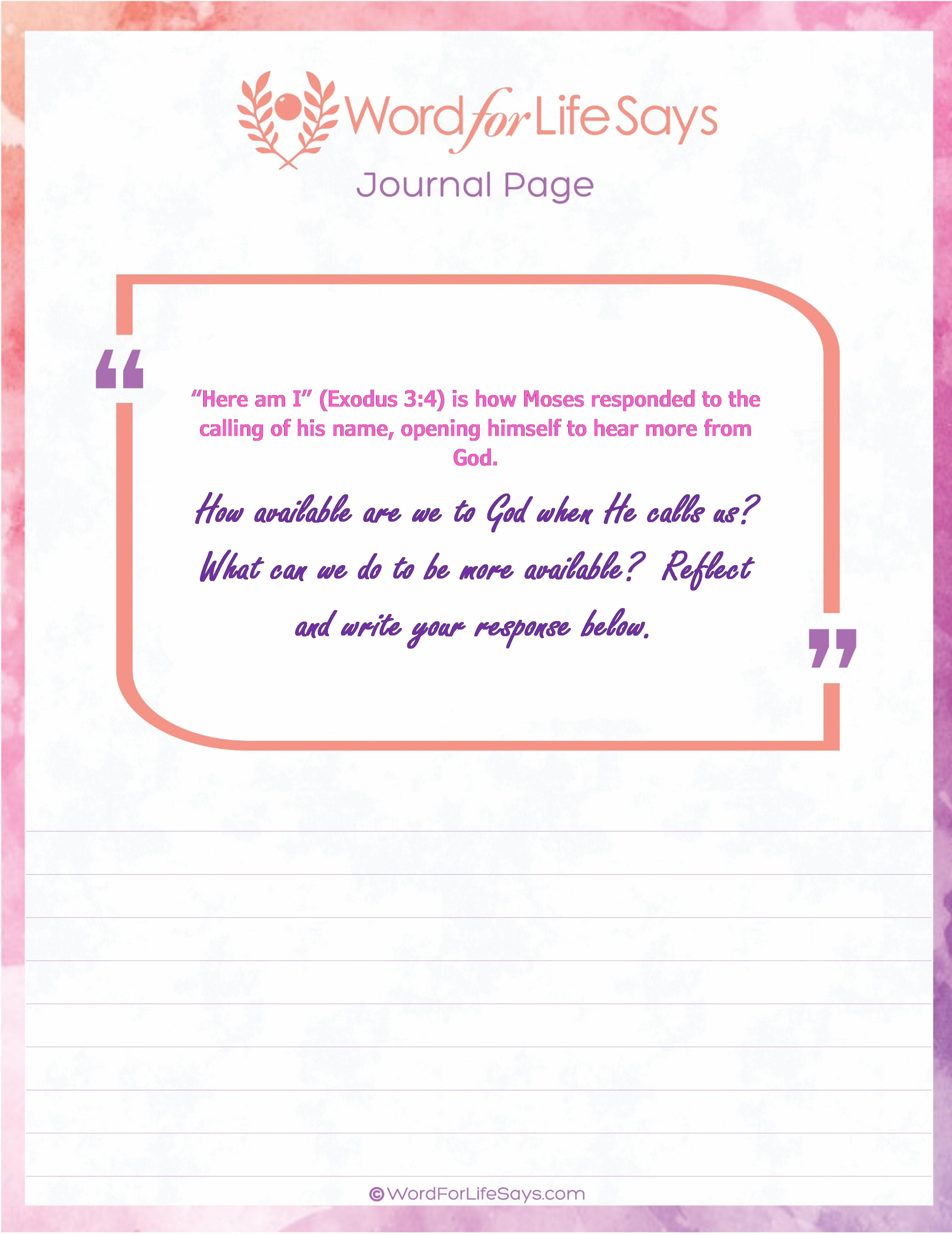
Adult Journal Page: Adult Journal Page – When God Called Moses
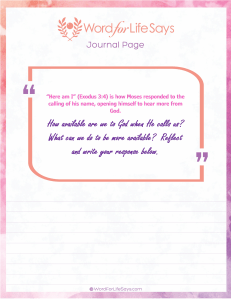
Kid’s Journal Page: Kid’s Journal Page – When God Called Moses

Blank Journal Page: These pages, one designed for adults and one for children, can be used to bring out, remember, or write a particular part of the lesson you wish for you and/or your class to focus on. Click>>Blank Adult and Kid’s Journal Pages to access the journal pages.
Draw the Scene: When God Called Moses Draw the Scene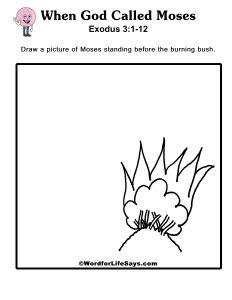
Memory Verse: When God Called Moses Memory Verse
Word Search: When God Called Moses Word Search Answers: When God Called Moses Word Search Answers
Crossword: When God Called Moses Crossword Answers: When God Called Moses Crossword Answers
Word Scramble: When God Called Moses Word Scramble Answers: When God Called Moses Word Scramble Answers
Copyright © Word For Life Says.com (Sharing any posts or lessons can only be done through the share buttons provided on this site from the original posts, lessons, and articles only. You can reblog from the original posts only using the reblog button provided, or share using the share buttons provided from these social media platforms: Facebook, Twitter, or Pinterest, etc., and they must be shared from the original posts only. All other repostings are prohibited. Posts and other items of interest found on this site MAY NOT BE COPIED AND PASTED, downloaded, uploaded, etc to another website or entity not listed (physical or electronic). See COPYRIGHT PAGE for more details.






 Word For Life Says...