
More Than Noise

Photo by rovenimages.com on Pexels.com

“Though I speak with the tongues of men and of angels, and have not charity, I am become as sounding brass, or a tinkling cymbal. And though I have the gift of prophecy, and understand all mysteries, and all knowledge; and though I have all faith, so that I could remove mountains, and have not charity, I am nothing. And though I bestow all my goods to feed the poor, and though I give my body to be burned, and have not charity, it profiteth me nothing.” 1 Corinthians 13:1-3

“Roses are red, Violets are blue…” is the beginning of many poems regarding love. Going back through history with many versions attached, these words declare verbally (and sometimes funny), how one feels about another.

But I will tell you, while words are nice and sweet and can edify (Proverbs 16:24; 25:11; Ephesians 4:29), there is no substitute for love produced through action.

Substance. Making a difference. The Christian life is so much more than just talking and telling. It is more than sounding off. It is love with motion behind it outflowing from one’s being into the lives of others.

With God, love is the number one principle because He is love (1 John 4:16). As those who have been adopted by His grace, love should be our natural response to others as well. It’s the emblem of our Heavenly Father, not carried about on our chests or in words only, but seared upon our hearts that propel us forward.

Love is our regulator.  It governs how we behave and treat one another. It serves as a thermometer to measure that we are fervent in the things that God is fervent for.

Love is about serving like Christ did (and we all know what His love looked like, John 3:16). It is about using what God gifted you with to help one another under that same umbrella of love He operated in.

Since that’s exactly how God does everything, under love, we too should be imitators of our Father.  Outside of it, we are “nothing.”  It doesn’t matter how important one thinks their gift or contribution is, if love is not the motivator, then the gift is empty.  That box has nothing to offer the world except a bunch of extra noise; or, as Paul puts it, “sounding brass, or a tinkling cymbal.”  

I don’t know about you, but I want to be more than noise, more than fluff.  I want to have substance working at the core of my gift.  I want lives to be changed and hearts to be lifted through what God has placed in me.  This should be the attitude of every Christian.  Not to get ahead, but to make a difference.  Being a vessel so filled up with love and anointing, mixed with His special stuff He put on the inside of us so that we could help shift the atmosphere for some and help steer them on a course closer to God.

This can only happen if love is operating at the helm.

Jesus once encouraged His disciples by telling them, “For verily I say unto you, That whosoever shall say unto this mountain, Be thou removed, and be thou cast into the sea; and shall not doubt in his heart, but shall believe that those things which he saith shall come to pass; he shall have whatsoever he saith,” (Mark 11:23).  Yet, Paul says you can “remove mountains” all you want, but if love is not what’s lifting your faith to do that than forget about it. Although the action may be carried out, the core of it doesn’t mean anything.

Paul was not by any chance contradicting what Jesus said because everything Jesus did from birth to death was done through love, and His disciples are always expected to follow in His footsteps.

Neither is Paul denouncing doing things for others such as one who would “bestow all . . . goods to feed the poor” or the sacrificing of oneself (he gave the example of being “burned”); but what he is saying is that without love, it will not last; it will not make the difference that He is looking for and it will not please God because we are told, “And whatsoever ye do, do it heartily, as to the Lord, and not unto men,” (Colossians 3:23) and that can only be done through love.

Later, Paul wrote another letter to the Corinthian church that says, “Wherefore we labour, that, whether present or absent, we may be accepted of him,” (2 Corinthians 5:9).  Everything must be “accepted of him.”  But, without love (charity) all our works and gifts put together add up to a big, fat zero.  There is no gain or “profit” from it.

The world we live in today needs more than talk, more than noise. They need to see, feel, and experience the substance of love in action through those who have been redeemed by love in action.

Today, look for ways to be more than noise. Look for ways to be that force of love in action for another.

Blessings~

Navigating Thorny Places

Here we go again.  At the rear end of my backyard stands a wide, tall, bush-like tree extending forward eleven feet, and who knows how many feet wide along the back fence.

Moving into this house, it was one of the drawing factors because it offered complete privacy from the neighbors behind.

But, when a game of playing with any type of ball or frisbee takes place, that flying object will almost always end up lost in the massiveness of this so-called bush tree.  Then, it is up to me to try to climb under, or in, or around this massive monster to retrieve the lost object.

It is not as difficult as it sounds (unless you are afraid of bugs and other critters), except the yard behind me has an over-energetic raspberry patch whose branches have wiggled their way through our massive monster, making navigating it harder due to its thorny reach.

Thorns hurt.  If you have ever grabbed a branch filled with thorns, or a rose, you know what I mean.  If you have accidentally brushed against one of these protruding antagonists, you can feel my pain of having to try to navigate this area and come out unscathed.

But the truth is, my friend, we will not go through this world unscathed.  There are going to be things that hurt us.  There is suffering we may encounter or thorny places we may have to navigate as we travel this road called life.

Jesus said, “In the world ye shall have tribulation…” (John 16:33), yet when afflictions come, we forget these words and those of Peter who said, “Beloved, think it not strange concerning the fiery trial which is to try you, as though some strange thing happened unto you,” (1 Peter 4:12).

Why?  Because when it hits us personally, it feels different.  It hits too close to home, and we want to shut the doors on them, yet these hard times, these thorny places, seem to find you anyway.

Knowing that it is all a part of our existence and living on this earth does not make it easier.  But maybe we can learn from others how they navigated their thorny places.

IN THE BEGINNING

Please know, that when God perfectly created this world, our life was intended to be a garden of peace.  We were never supposed to have to deal with thorny places.  But because of sin, because of the curse, Adam was told, “Cursed is the ground for thy sake; in sorrow shalt thou eat of it all the days of thy life; Thorns also and thistles shall it bring forth to thee…” (Genesis 3:17b-18a).

Where there was no sorrow, now sorrow exists.  Where there were no thorny places, now they have come forth making what we have to do here harder than God ever intended.

PAUL’S THORN

The Apostle Paul knew personally about thorns.

Paul’s resume is doubtless impressive. In addition to having authored two-thirds of the New Testament – his missionary journeys, works, and miracles allowed him to not only see things but also inthe supernatural workings of the Lord in his life.

Through it all, he could have boasted (Philippians 3:4-6), yet he stated in Philippians 3:8, “I count all things but loss for the excellency of the knowledge of Christ Jesus my Lord… and do count them but dung, that I may win Christ.”

After rehearsing the measure of suffering he had endured for the ministry (2 Corinthians 11:22-29), he stated, “If I must needs glory, I will glory in the things which concern mine infirmities,” (2 Corinthians 11:30).

Although he experienced “visions and revelations of the Lord” (2 Co. 12:1), some where he was “caught up to the third heaven” (2 Co. 12:2), “into paradise, and heard unspeakable words, which is not lawful for a man to utter” (2 Co. 12:4), he knew it would be a foolish thing to boast (2 Co. 12:5,6).

As if to draw a line in the sand, Paul was given “a thorn in the flesh” to prevent any measure of self-exaltation that would cross the lines of humility and usefulness where he stood. 

Jesus taught in parables regarding thorns that would encumber and choke one’s progress in the word of God “through cares and riches and pleasures of this life” preventing them from coming to a place of fruitfulness (Luke 8:14).

It would seem as though, for Paul’s spiritual benefit, a thorn was used to keep him in a place of fruitfulness rather than from it.

THE THORNS OF JESUS

Thorns are not easy for anybody to bear with.  Through the humiliation and suffering of our Lord Jesus Christ, before His crucifixion, as if to add insult to injury, He was given thorns that would tear into His literal flesh: “And they clothed him with purple, and platted a crown of thorns, and put it about his head,” (Mark 15:17).

His thorns were not to keep Him from being exalted, for God would ensure His name is exalted above every name (Philippians 2:9-11).  Anything revolving around the crucifixion and the cross, including the thorns, was to identify with and for the man (humans) He came to save, and to be obedient to the will of God, although being equal with God, Himself (Philippians 2:6-8). 

Hebrews confirms that Jesus felt and experienced the fullness of humanity (yet without sin) while maintaining His full deity (Hebrews 4:15).  That includes the sufferings that came with it all, and the thorns as well.

When trying to move through the difficulties of life, how do we do it?  It is always easier to tell one about what they’re going through and what they should do, but the hows of knowing a way to move through these prickly patches is a whole other story.

Thankfully, the Bible and the lives of how these two thorn-bearers handled the inflictions upon them can help.

LEAN ON GOD’S SPIRITUAL SUPPORT SYSTEM

The same God who has been with you is the same God whose grace sustains you.

From Paul, we learn a lot about this.  Although he prayed, as many would, for the thorn to be removed, God’s answer was for His best plan to be carried out in Paul’s life.  And to do that, as uncomfortable and burdensome Paul may view it the thorn must remain.

Even though the thorn was to remain, God gave Paul an answer we can all glean comfort from when we are dealing with our own protruding antagonists: “My grace is sufficient for thee: for my strength is made perfect in weakness…” (2 Corinthians 12:9a)

We will never have all the answers to the ins and outs and the behind-the-scenes going on in our lives.  But we have God, the only true living God, who supplies us with sufficient grace through it all.

God gave him the spiritual support he needed to go through these troubles in the form of grace.  He didn’t answer the prayer in the way that Paul prayed for it, but he was guaranteed that in all that he was encountering, God had a heavenly supply that would keep him in his most useful state.

So often we pray to be useful for God’s kingdom, and yet, the way it comes out may not be at all like we imagined.  But just because we didn’t imagine it this way, doesn’t mean God can’t use it.  Because He can, my friend.  He can.

God told Paul, “For my strength is made perfect in weakness.”  When we think we don’t have much to give.  When we compare our journey to this and that and feel like we come up short, we may be in the exact spot where God can manifest His strength the most.

If we think we have all the answers, as long as we can find sufficiency in ourselves and in our own strength, it is easy to lean on that.  It is not until we know that without Him, I would fail.  Not until we see and rely on God as our all-in-all, can He get the most out of us.

Therefore, Paul’s response was most appropriate: “Most gladly therefore will I rather glory in my infirmities, that the power of Christ may rest upon me.  Therefore I take pleasure in infirmities, in reproaches, in necessities, in persecutions, in distresses for Christ’s sake: for when I am weak, then am I strong,” 2 Corinthians 12:9b-10).

Paul doesn’t celebrate or take pleasure in pain, rather he settles himself in them because of the useful state it allows him to remain in before God.  It’s as if to say regardless of where this leads or what I must endure, I’m choosing to continue in this ministry and leave the outcome to God.

COMMIT IT INTO THE HANDS OF GOD

And for Christ, as He hung on the cross with the crown of thorns upon His head, and saw the angry stares of the people, with their jeering and angry words hurled at Him, He committed the whole process of the cross into the hands of God.

He refused to relieve Himself from it.  He refused to back down.  He persevered through the pain.

When they entered Gethsemane to arrest Him, He could have escaped.  Before they laid one stripe upon His back, He could have called down blindness upon His prosecutors as the angels did at the door of Lot (Genesis 19:10-14).  Before one nail inserted itself into the flesh that would die for all humankind, He could have stopped it but that would not have been in the will of God.

So, regardless of the cost, the pain, and the persecution, Jesus committed it all to God’s hand and submitted to His holy will: “Nevertheless not my will, but thine, be done” (Luke 22:42).  That included the whole package deal of the cross, including every single thorn God wanted Him to feel and wear.

And through His submission came our salvation.

When we release it all into God’s hands, we know it is in a place where it won’t fail from His purpose.  God can do perfectly in one moment what we struggle and strive for our entire lives to accomplish.

The pain of thorny places may make us feel like our world is spinning out of control.  But anything committed into the hands of God will come out the way He orders it, even if it doesn’t look or feel like we think it should.

We all deal with thorns, but it doesn’t mean we are in a place of disfavor.  It could very well be that we are in a place of maximum usefulness.  Where we see weakness, God may see His strength overcoming it.  Where we see thorns, it may be a place where God wants to perform a great work in you.

Text Free Photo by Radovan Zierik on Pexels.com

Laboring Women

“And I intreat thee also, true yokefellow, help those women which laboured with me in the gospel, with Clement also, and with other my fellowlabourers, whose names are in the book of life.” Philippians 4:3

Laboring women.  Those two words together more than likely bring immediately to our minds the idea of childbirth, which is a unique celebration in and of itself.  Yet, the Bible has a way of showing people beyond the norms of what may immediately come to mind.  It highlights the character, contributions, giftings, and skills of those, men or women, who were used by God or allowed God to use what they had or could do to further Kingdom business.

While we are familiar with Ruth, Deborah, and Esther in the Old Testament, and with names like Mary (take your pick), Pricilla, and Dorcas in the New Testament, what we find in the pages of Scripture that there are numerous characters (men and women alike, although I’m focusing on a female point of view here), whose lives and contributions made a significant impact even though they were not mentioned by name.

Paul made special mention in the verse above to the Philippian church to “help those women which laboured with me in the gospel.”  These women supported his ministry.  These unsung, nameless warriors are only known by mention here and the people they served then.  We don’t know who they are or how they helped in such a way for this honorable mention here – but help, they did, therefore Paul wanted the church to keep in mind the way their works provided service.

Another thing we don’t see here is the struggle to be seen.  We don’t see a fight or contentions arising because they wanted the recognition of their name and actions to be made known.  It’s as if it was just their pleasure to serve the gospel and to help in whatever capacity they could.

Their service mattered and made a difference.  And while they are not named here, the “Book of Life” holds their names.  Father God knows who they are, and He knows who you are.

You may not always receive the pat on the back, the acceptance, the “Good job!”, you are looking for, but what you do for Christ, what you do for the furtherance of the ministry of the Kingdom of God matters as well, and it is important.

Your name may not be published far and wide ascribing your accomplishments.  But if it is published in that Book of Life, have no fear of missing out because the Holder of that holy record sees everything you do for His Kingdom, and you can trust that He will reward you accordingly.

God sees and knows what you do for Him!

Further Inspiration:

“Overlooked?  Not By God!”

“Shamgar, Who?”

“Be Empowered!”

Photo by Snapwire on Pexels.com

And lest I should be exalted above measure through the abundance of the revelations, there was given to me a thorn in the flesh, the messenger of Satan to buffet me, lest I should be exalted above measure.

For this thing I besought the Lord thrice, that it might depart from me.

And he said unto me, My grace is sufficient for thee: for my strength is made perfect in weakness. Most gladly therefore will I rather glory in my infirmities, that the power of Christ may rest upon me.” 2 Corinthians 12:7-9

Oh, that thorn in the flesh syndrome. That persistent thing that seems like it will never be gone from your life. I would venture to say that most people have dealt with or are currently dealing with that one nagging thing that keeps – well, nagging you! That one thing that causes us to say, “Lord, if You would just move this one thing from my life, I would be alright.” Thorns are hurtful. They are irritating. And yes, they can get in the way of the one who wants to enjoy the blossom. There may be a beautiful rose on the end of the stem, but the thorns can hinder the full enjoyment of holding on to it.

There are times when one may be trying to enjoy the beauty of God’s promises that hurtful things may arise. As one tries to draw nearer and nearer to Him, particular thorns may make it hard to hold on. Thorns can “spring up and choke them,” Matthew 13:7. Nevertheless, despite what our outside circumstances may be telling us, we are taught that we can still live an empowered life. Though we have “infirmities” (and we all do), “grace” is still at work. Grace – that unmerited favor makes room when obstacles get in the way. And God says His grace is “sufficient.” It is enough.

There is only one man who lived in this world perfectly, and that’s our Lord Jesus Christ. The rest of us are surviving off God’s grace. We depend on it every single day though we are undeserving of it. He has empowered us through our Lord Jesus Christ to progress on this journey despite all our shortcomings. Every obstacle that we face in life is not going to go away. Oh, how I wish it would. But, what the apostle Paul is teaching us is that we can still succeed in Christ. We can still have a blessed Christian life through His power that “rest upon” us.

Have you ever played tag as a kid? Somebody tried to tag you and get you out, but you gave them the slip and got away. Have you ever, in a victorious romp, stuck your thumbs in your ears as a kid while waving your fingers and chanting, “Nana nana, boo, boo?” Paul had a victorious romp of his own. After he prayed, he realized despite all he was going through, the grace of God was still at work in his life and that it was God’s strength that was being made perfect in Paul’s weakness.  Therefore, Paul confidently declared, “Most gladly… will I rather glory in my infirmities.” 

Don’t you love that? Despite it all, God is still at work in us and through us. He is perfecting some stuff in us and for us, and we can rejoice with Paul.  We are not rejoicing because of the trouble or hurt we experience or encounter. We are rejoicing because we believe in God’s grace, and that allows the power of Christ to rest upon us because we have yielded to Him.

The empowered life is one that yields to Him and recognizes it is His strength being perfected in us. The empowered person can still push forth knowing that God is still at work: “If God be for us, who can be against us?” Romans 8:31. The hurt may not be over or gone but it’s as if God is reminding us: “I have all you need to make through.”

Please note: Talking about empowerment can easily cause one to divert and take a humanistic view. But, I have strived to keep this God-centered. Everything we need is in Him, and when we can grab hold of that, we become truly empowered.

Copyright © Word For Life Says.com (Sharing any posts or lessons can only be done through the share buttons provided on this site from the original posts, lessons, and articles only. You can reblog from the original posts only using the reblog button provided, or share using the share buttons provided from these social media platforms: Facebook, Twitter, or Pinterest, etc., and they must be shared from the original posts only. All other repostings are prohibited. Posts and other items of interest found on this site MAY NOT BE COPIED AND PASTED, downloaded, uploaded, etc to another website or entity not listed (physical or electronic).  See COPYRIGHT PAGE for more details.


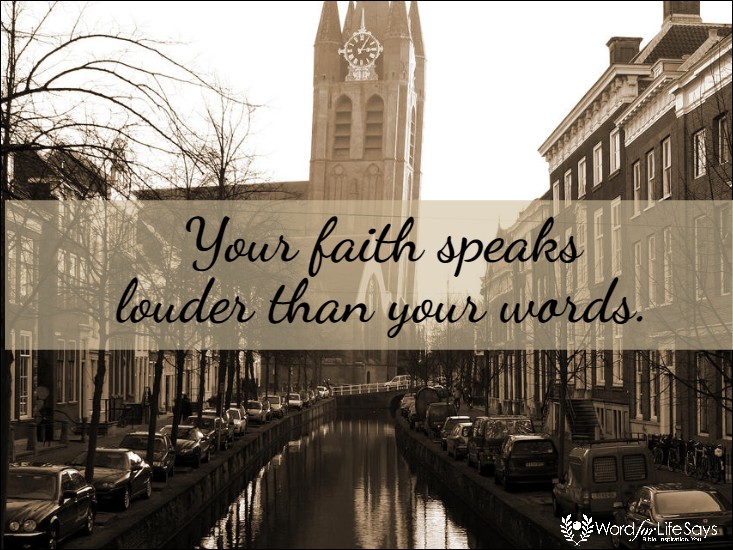
“Your Faith Speaks more than Your Words!”

What people witness in your life resounds more than the words that are coming out of your mouth.  Evidence of belief; proof of faith is the visual representation that most want.  Many mistake others as not wanting what we have or not wanting the faith, yet they haven’t seen enough of it in action to provoke them to seek after what we say we have.

So, the old phrase still rings true today: “Seeing is believing.”  To a world lost, who have no hope, they look for a ring of hope they can grab onto to prevent them from drowning in the deep abyss of the darkness of this world.  They want a way out.  Many don’t want to sink deeper into despair, deeper into the unknown where there is no light to guide the way.  They want to see what you say you see.  They want to feel what you say you feel.  They want what you say you have but do they see it currently active in you to propel them from wanting it to actually seeking for it?

Your faith speaks louder than your words.  Paul told the church at Thessalonica, “Your faith to God-ward is spread abroad; so that we need not to speak any thing.” 1 Thessalonians 1:8.  If necessary I believe Paul would have testified on their behalf, he would have spoken up for them to assure others of their faith.  But, their faith was so active, their faith was so alive and in operation that he didn’t feel a need to speak at all.  Their faith did the talking for them.  Their faith is what people noticed, not the words they spoke from their mouths.

A lot of people do a lot of talking these days and sometimes it’s hard to decipher truth from fiction.  Jesus gave us a key that lines right up with what Paul wrote in his letter.  Jesus said, “Ye shall know them by their fruits,” Matthew 7:16.  If one comes upon a tree that has apples growing upon it then they are to assume it is an apple tree.  The same is true with a life of faith.  What they see coming out of you, or as Paul referred to as “gone out” is what matters the most.  You can say that you are an orange tree but if I see apples then I will classify you like an apple tree.  If you say that you have great faith but all I see is the opposite than I will not view you as having great faith.  I will mark you by what I see.

Your faith matters in this world.  More importantly, your faith on display matters to those around you so much that one should not have to speak up or testify for you, all they should be able to do is look at your faith in action and mark you as a person of faith.

“Walk In Grace!”

My Project 228-001

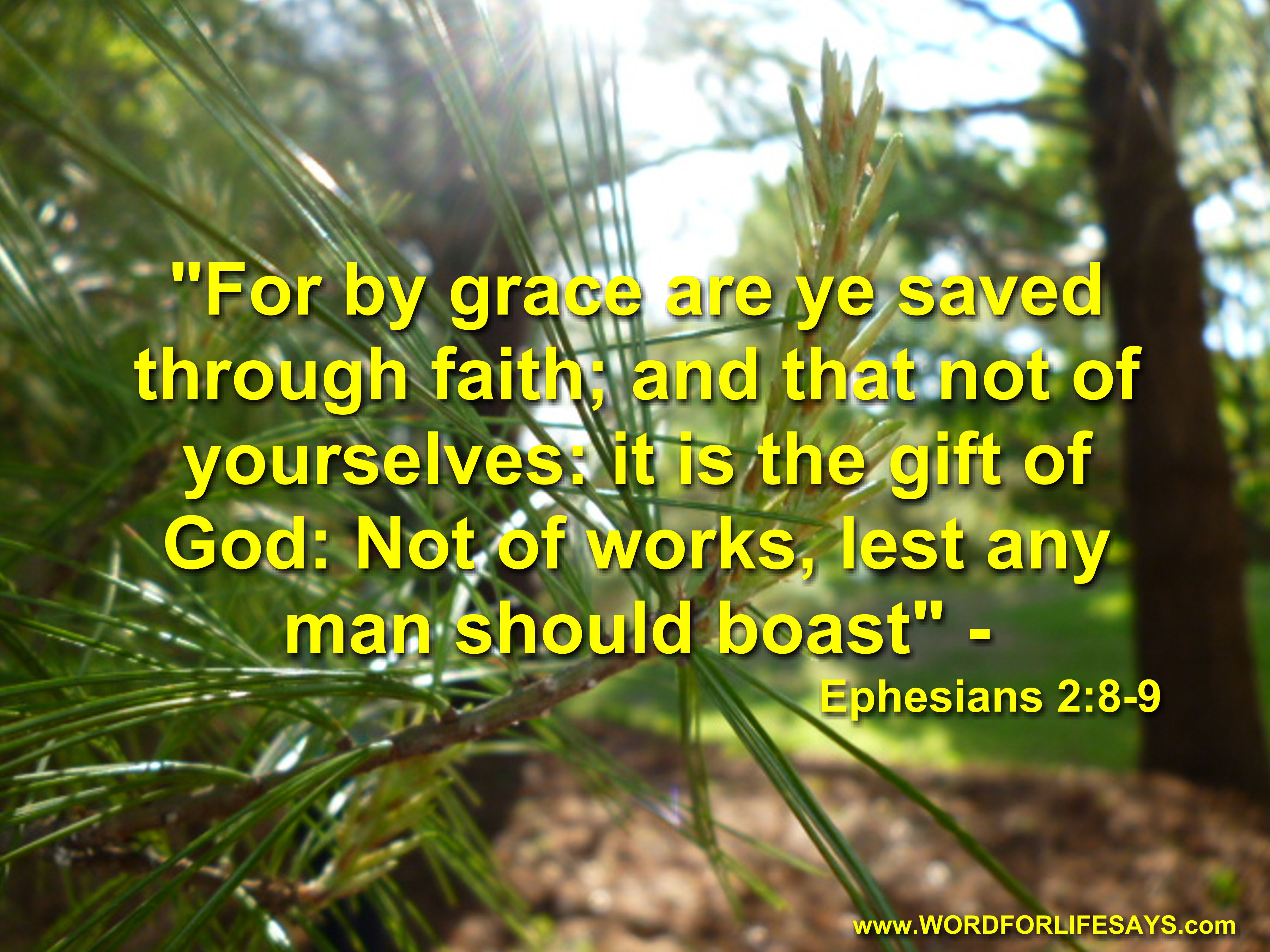
“For by grace are ye saved through faith; and not that of yourselves: it is the gift of God: Not of works, lest any man should boast,” Ephesians 2:8-9


“I don’t deserve it, but Lord I thank You!  I didn’t do anything to earn it, but again, Lord I thank You!”  That’s the feeling the word grace evokes in me.  It’s like walking on the clouds of heaven while here on earth; experiencing release and freedom in all that Christ has secured for me.

Grace is personal.  Though Christ died for all, it has to touch each one on an intimate level.  It takes hold of and absorbs in the spirit of man, this wonderful gift of God.  It allows the one who follows after it to get a glimpse of what it truly may be like in heaven when all the shackles of this earthly bondage are removed.  It is ours, personally and individually, to experience for them that are found in Him.

Isn’t it wonderful – this gift of His?  Isn’t it magnificent that no matter our status in life or how hard we work it can never be earned?  It can never be put in our repertoire of attainments to salvation.  It is a gift!

Gifts are meant to be received.  On a number of occasions my husband and even my children have tried to give me something out of the blue.  While I am very grateful for the consideration that they want to give me something, I often wind up doing a lot of questioning trying to ascertain the reason for them wanting to give it in the first place.  I want to know what I did to deserve it.  “Oh, you don’t have to go through such lengths. And, yada, yada, yada . . .”   In turn, what was a thoughtful expression is now tainted by frustration in the giver.  They become frustrated with me for doing so much questioning instead of just receiving; for implying the only reason I am worthy is become of some work I must have done for them.

Human perception of this kind of outpouring of love has been marred by this sinful world.  In it dwells the attitude of “if you do for me, then I’ll do for you.”  “If you scratch my back, then I’ll scratch yours.”  It is hard for one to believe in a motivation of pure love; to believe that one would give just because they love.

Paul laid the truth out for us.  “And you hath he quickened, who were dead in trespass and sins; Wherein in time past ye walked according to the course of this world, according to the prince of the power of the air, the spirit that now worketh in the children of disobedience: Among whom also we all had our conversation in times past in the lust of our flesh and of the mind; and were by nature the children of wrath, even as others,” (Ephesians 2:1-3).  We were “by nature children of wrath.”  In other words, we were no good, no goods who deserved absolutely nothing.

Verse 4 steps in and shows the love of God at work.  “But God, who is rich in mercy, for his great love wherewith he loved us.”  He didn’t do it for us because of some great checklist we marked off as job complete, now I deserve this.  His love gave us the gift to receive, “Not of works, lest any man should boast,” (vs. 9).  “That in the ages to come he might shew the exceeding riches of his grace in his kindness toward us through Christ Jesus,” (vs. 7).

This is one of those lessons that you really have to let the Word speak for itself, lest mankind try to put their own spin on it.  God loves us!  “For God so loved the world, that He gave His only begotten Son, that whosoever believeth in Him should not perish, but have everlasting life,” (John 3:16).  When we accept that love and are saved through Christ, then we have an opened door to accept the gift of grace along with it.  I depend on His grace daily!  I choose to “WALK IN GRACE” today.  It’s a choice.  Read the entire chapter 2 of Ephesians.  See what you were and what He has made you now.  See where you were, and now where He wants to take you.  Compare what you did to what He has done for you.  Now, CELEBRATE! AND, WALK IN THE GRACE HE GIVES. 


What Would It Have Been Like? – “To Be the Philippian Jailer”

We may not know the words of their melody, but we can be assured the praises they were singing before the Lord was spiritually moving.

That’s one of the dramatic things about this night.  After being beaten with rods and receiving many stripes these songs of praises could not be silenced. Some of it fell on deaf ears yet, some were listening.  If it were just Paul and Silas, then they could have quietly worshipped and kept it to themselves.  But, they were not alone in this prison, on this night.  Other inmates needed to believe that there is still a reason to rejoice in the midst of these darkest times.

Not everyone was attentive.  The melodious tune was not picked up by all as a listening pleasure.  The jailer, who earlier was given the charge to keep the prisoners locked up securely (Acts 16:23), was fast asleep.  So deep was his slumber it took the earth to begin to quake to rouse him from his midnight dreams.

Once awakened, the dreams dissipated and the reality of all that appears to have transpired sets in.  The prison doors are not only unlocked, but they are fully opened giving a free course of exit to any who wished to leave.  After all, it is a prison and who would rightly want to stay beholden by chains.

The jailer knew the vehement attitude the multitudes had against the two who were bound in the inner prison.  The charge to contain them at all costs was serious.  So serious, the jailer thought, “Since I have fallen asleep on my duty and have given the opportunity of freedom to them that were bound, I must now seal my failure with my own death.  For surely, when the magistrates come and find out my fault, I shall pay with my life anyway.”

Determined not to let this go any further, the jailer drew his sword to perform the unthinkable.  When out of the dark, a voice arose above his desperation and called out, pleading with him to spare his own life.

What would it have been like?  What would it have been like to walk in the Philippian jailer’s shoes on that night?  One moment, he is captured by failure and facing death to sighing audibly a cry of relief at the voice of deliverance.

The law was the law and had he not heard that calling voice, he would surely be dead by now.

Unbelief demands evidence.  Grabbing the closest light, he runs back into the depths of the prison walls and comes face to face with the convicted.  “But, what’s this?  Why didn’t they flee?  The shackles are loosed; the doors are opened, and yet, they remain?”  He thought, “Why?”

The jailer found out that though these men were convicted and sentenced by law, they carried a deeper conviction in their souls.  Beaten, yet they sit.  “Surely, this can’t be possible?” his mind racing, trying to grasp everything at once and take it all in.

Then, as if a new page was turned in a book, a new chapter began in his life.  “Whatever faith and conviction these men have is superior to that which we have learned under Roman rule.”

“Sirs, what must I do to be saved?” (Acts 16:30).

What would it have been like to be the Philippian jailer, you ask?  Though we are not guards during the ancient rule, any of us can associate with the lost state of the jailer on that night.  He was condemned physically because of his failure.  He was condemned spiritually because, as David said, “I was shapen in iniquity, and in sin did my mother conceive me,” (Psalm 51:5).  The reality for the need of this salvation these men possessed pressed on the jailer as it did on us.

At one point or another, we have all had to run to the proverbial “altar” seeking, “What must I do to be saved?” as the jailer did.  Therefore, though much time has passed between him and us, the same cry of the heart gets the attention of the same God.

How many times had he kept guard of the convicted?  How many times had he led the bound to their deaths?  We don’t know.  But, we do know that it only took one time for him to come face to face with his own mortality to realize there has to be a change in his life.

And they spake unto him the word of the Lord, and to all that were in his house.  And he took them the same hour of the night, and washed their stripes; and was baptized, he and all his, straightway,” (Acts 16:32-33).  The humbleness of all that happened in those few short hours promoted an attitude of service and repentance.  He was ready to be cleansed and made whole from the inside out.  “Who knows what tomorrow would bring, but tonight, I have to get right with God,” he must have thought as he contemplated it all.  And, the Bible tells us that he was baptized!

You ask, what would it have been like?  My response, “Don’t you know already?”  To be surrounded by death every day, and as quickly as one comes up out of the water, they have crossed the threshold into the newness of life.

That’s the epitome of salvation for the jailer and for us.  “Believing in God,” (Acts 16:34), and have our whole lives turned around.  The jailer may have been the guard on duty that night, but he was the one set free!  For that’s what salvation does for all that come to Him.

What would it have been like?  I think we already know.  The circumstances may be different but the salvation is the same.

In the end, it all worked out.  The jailer may have wondered what tomorrow would bring.  After all, he wouldn’t feel right about locking these men back up, would he?  At the same time, their freedom still meant his death.  The Bible tells us, “And when it was day, the magistrates sent the serjeants, saying, Let those men go,” (Acts 16:35).

Could it be that God allowed Paul and Silas to go through all of that to save one soul, one household?  Using pure speculation here, I’d say, “Could be!”  To the reader it would appear so for the Bible doesn’t talk about anyone else making a life-changing conversion on that dramatic night.

The jailer may have sighed with relief when hearing the voice call out in the night, but now he really experiences what it feels like to be free.  God spared his life physically (again) and spiritually (forever).

The Bible doesn’t tell us what happened after the jailer received new life.  Does he stay on working as a guard?  Did he give it all up to spread his testimony of what God had done in his life?  We don’t know.  But, what we do know is that like us, his life was never the same again.

Copyright © Word For Life Says.com (Sharing any posts or lessons can only be done through the share buttons provided on this site from the original posts, lessons, and articles only. You can reblog from the original posts only using the reblog button provided, or share using the share buttons provided from these social media platforms: Facebook, Twitter, or Pinterest, etc., and they must be shared from the original posts only. All other repostings are prohibited. Posts and other items of interest found on this site MAY NOT BE COPIED AND PASTED, downloaded, uploaded, etc to another website or entity not listed (physical or electronic).  See COPYRIGHT PAGE for more details.

Your Faith Speaks more than Your Words!


What people witness in your life resounds more than the words that are coming out of your mouth.  Evidence of belief; proof of faith is the visual representation that most want.  Many mistake others as not wanting what we have or not wanting the faith, yet they haven’t seen enough of it in action to provoke them to seek after what we say we have.

So, the old phrase still rings true today: “Seeing is believing.”  To a world lost, who have no hope, they look for a ring of hope they can grab onto to prevent them from drowning in the deep abyss of the darkness of this world.  They want a way out.  Many don’t want to sink deeper into despair, deeper into the unknown where there is no light to guide the way.  They want to see what you say you see.  They want to feel what you say you feel.  They want what you say you have but do they see it currently active in you to propel them from wanting it to seeking it?

Your faith speaks louder than your words.  Paul told the church at Thessalonica, “Your faith to God-ward is spread abroad; so that we need not to speak any thing,” (1 Thessalonians 1:8b).  If necessary I believe Paul would have testified on their behalf, he would have spoken up for them to assure others of their faith.  But, their faith was so active, their faith was so alive and in operation that he didn’t feel a need to speak at all.  Their faith did the talking for them.  Their faith is what people noticed, not the words they spoke from their mouths.

A lot of people do a lot of talking these days and sometimes it’s hard to decipher truth from fiction.  Jesus gave us a key that lines right up with what Paul wrote in his letter.  Jesus said, “Ye shall know them by their fruits,” Matthew 7:16.  If one comes upon a tree that has apples growing upon it then they are to assume it is an apple tree.  The same is true with a life of faith.  What they see coming out of you, or as Paul referred to as “gone out” is what matters the most.  You can say that you are an orange tree but if I see apples then I will classify you like an apple tree.  If you say that you have great faith but all I see is the opposite than I will not view you as having great faith.  I will mark you by what I see.

Your faith matters in this world.  More importantly, your faith on display matters to those around you so much that one should not have to speak up or testify for you, all they should be able to do is look at your faith in action and mark you as a person of faith.

Your faith speaks more than your words!  Be blessed.

“Walk In Grace!”

My Project 228-001

“For by grace are ye saved through faith; and not that of yourselves: it is the gift of God: Not of works, lest any man should boast,” Ephesians 2:8-9


“I don’t deserve it, but Lord I thank You!  I didn’t do anything to earn it, but again, Lord I thank You!”  That’s the feeling the word grace evokes in me.  It’s like walking on the clouds of heaven while here on earth; experiencing release and freedom in all that Christ has secured for me.

Grace is personal.  Though Christ died for all, it has to touch one on a more intimate level.  It takes hold of and absorbs in the spirit of man, this wonderful gift of God.  It allows the one who follows after it to get a glimpse of what it truly may be like in heaven when all the shackles of this earthly bondage are removed.  It is ours, personally and individually, to experience for them that are found in Him.

Isn’t it wonderful – this gift of His?  Isn’t it magnificent that no matter our status in life or how hard we work it can never be earned?  It can never be put in our repertoire of attainments to salvation.  It is a gift!

Gifts are meant to be received.  On a number of occasions my husband and even my daughters have tried to give me something out of the blue.  I’m an at home mom and often these gifts come in the form of money.  While I am very grateful for the consideration that they want to give me something, I wind up doing a lot of questioning to try to ascertain the reason for them wanting to give it in the first place.  I want to know what I did to deserve it.  “Oh, you don’t have to go through such lengths. And, yada, yada, yada . . .”   In turn, what was a thoughtful expression is now tainted by frustration in the giver.  They become frustrated with me for doing so much questioning instead of just receiving; for implying the only reason I am worthy is become of some work I must have done for them.

Human perception of this kind of outpouring of love has been marred by this sinful world.  In it dwells the attitude of “if you do for me, then I’ll do for you.”  “If you scratch my back, then I’ll scratch yours.”  It is hard for one to believe in a motivation of pure love; to believe that one would give just because they love.

Paul laid the truth out for us.  “And you hath he quickened, who were dead in trespass and sins; Wherein in time past ye walked according to the course of this world, according to the prince of the power of the air, the spirit that now worketh in the children of disobedience: Among whom also we all had our conversation in times past in the lust of our flesh and of the mind; and were by nature the children of wrath, even as others,” (Ephesians 2:1-3).  We were “by nature children of wrath.”  In other words, we were no good, no goods who deserved absolutely nothing.

Verse 4 steps in and shows the love of God at work.  “But God, who is rich in mercy, for his great love wherewith he loved us.”  He didn’t do it for us because of some great checklist we marked off as job complete, now I deserve this.  His love gave us the gift to receive, “Not of works, lest any man should boast,” (vs. 9).  “That in the ages to come he might shew the exceeding riches of his grace in his kindness toward us through Christ Jesus,” (vs. 7).

This is one of those lessons that you really have to let the Word speak for itself, lest mankind try to put their own spin on it.  God loves us!  “For God so loved the world, that He gave His only begotten Son, that whosoever believeth in Him should not perish, but have everlasting life,” (John 3:16).  When we accept that love and are saved through Christ, then we have an opened door to accept the gift of grace along with it.  I depend on His grace daily!  I choose to “WALK IN GRACE” today.  It’s a choice.  Read the entire chapter 2 of Ephesians.  See what you were and what He has made you now.  See where you were, and now where He wants to take you.  Compare what you did to what He has done for you.  Now, CELEBRATE! AND, WALK IN THE GRACE HE GIVES!


“Walk In Grace!”

My Project 228-001

“For by grace are ye saved through faith; and not that of yourselves: it is the gift of God: Not of works, lest any man should boast,” Ephesians 2:8-9


“I don’t deserve it, but Lord I thank You!  I didn’t do anything to earn it, but again, Lord I thank You!”  That’s the feeling the word grace evokes in me.  It’s like walking on the clouds of heaven while here on earth; experiencing release and freedom in all that Christ has secured for me.

Grace is personal.  Though Christ died for all, it has to touch one on a more intimate level.  It takes hold of and absorbs in the spirit of man, this wonderful gift of God.  It allows the one who follows after it to get a glimpse of what it truly may be like in heaven when all the shackles of this earthly bondage are removed.  It is ours, personally and individually, to experience for them that are found in Him.

Isn’t it wonderful – this gift of His?  Isn’t it magnificent that no matter our status in life or how hard we work it can never be earned?  It can never be put in our repertoire of attainments to salvation.  It is a gift!

Gifts are meant to be received.  On a number of occasions my husband and even my daughters have tried to give me something out of the blue.  I’m an at home mom and often these gifts come in the form of money.  While I am very grateful for the consideration that they want to give me something, I wind up doing a lot of questioning to try to ascertain the reason for them wanting to give it in the first place.  I want to know what I did to deserve it.  “Oh, you don’t have to go through such lengths. And, yada, yada, yada . . .”   In turn, what was a thoughtful expression is now tainted by frustration in the giver.  They become frustrated with me for doing so much questioning instead of just receiving; for implying the only reason I am worthy is become of some work I must have done for them.

Human perception of this kind of outpouring of love has been marred by this sinful world.  In it dwells the attitude of “if you do for me, then I’ll do for you.”  “If you scratch my back, then I’ll scratch yours.”  It is hard for one to believe in a motivation of pure love; to believe that one would give just because they love.

Paul laid the truth out for us.  “And you hath he quickened, who were dead in trespass and sins; Wherein in time past ye walked according to the course of this world, according to the prince of the power of the air, the spirit that now worketh in the children of disobedience: Among whom also we all had our conversation in times past in the lust of our flesh and of the mind; and were by nature the children of wrath, even as others,” (Ephesians 2:1-3).  We were “by nature children of wrath.”  In other words, we were no good, no goods who deserved absolutely nothing.

Verse 4 steps in and shows the love of God at work.  “But God, who is rich in mercy, for his great love wherewith he loved us.”  He didn’t do it for us because of some great checklist we marked off as job complete, now I deserve this.  His love gave us the gift to receive, “Not of works, lest any man should boast,” (vs. 9).  “That in the ages to come he might shew the exceeding riches of his grace in his kindness toward us through Christ Jesus,” (vs. 7).

This is one of those lessons that you really have to let the Word speak for itself, lest mankind try to put their own spin on it.  God loves us!  “For God so loved the world, that He gave His only begotten Son, that whosoever believeth in Him should not perish, but have everlasting life,” (John 3:16).  When we accept that love and are saved through Christ, then we have an opened door to accept the gift of grace along with it.  I depend on His grace daily!  I choose to “WALK IN GRACE” today.  It’s a choice.  Read the entire chapter 2 of Ephesians.  See what you were and what He has made you now.  See where you were, and now where He wants to take you.  Compare what you did to what He has done for you.  Now, CELEBRATE! AND, WALK IN THE GRACE HE GIVES!