
Sunday School Lesson – “Ezekiel Sees a Life-Giving River” Ezekiel 47:1-12

One day, Jesus, walking with His disciples, felt compelled to go through Samaria (John 4:4).  Resting on a well while His disciples proceeded into the city to buy food (v.8), He had an encounter with a woman from Samaria who came seeking water (v.7).  Seeing her intent, Jesus asked, “Give me to drink.”

Her response was nothing unusual for the days they lived in.  Knowing the animosity that was between the Jews and the Samaritans, she stated what was to her a normal fact: “How is it that thou, being a Jew, askest drink of me, which am a woman of Samaria? for the Jews have no dealings with the Samaritans” (v.9).

Jesus, bypassing her hesitation to reach her heart, said to her, “If thou knewest the gift of God, and who it is that saith to thee, Give me to drink; thou wouldest have asked of him, and he would have given thee living water.  But whosoever drinketh of the water that I shall give him shall never thirst; but the water that I shall give him shall be in him a well of water springing up into everlasting life” (John 4:10, 14; emphasis added).

Water is life-sustaining.  No matter what climate or environment one dwells in, water is a mandatory need that must be met to thrive physically.  For Jesus, to identify what He has to offer as “water springing up into everlasting life” is triumphal.  It meets the soul’s deepest need and satisfies all that is required spiritually for one to enter life everlasting.

Living water springing up into everlasting life is picturesque of this lesson.  In this portion of Ezekiel’s visions (for he had many), there is a life-giving river that flows from the sanctuary of God, healing all it touches much like our Lord promised the woman at the well of Samaria.

Ezekiel 47:1, 2 “Afterward he brought me again unto the door of the house; and, behold, waters issued out from under the threshold of the house eastward: for the forefront of the house stood toward the east, and the waters came down from under from the right side of the house, at the south side of the altar.  Then brought he me out of the way of the gate northward, and led me about the way without unto the utter gate by the way that looketh eastward; and, behold, there ran out waters on the right side.”

When traveling through uncharted, unfamiliar territories, places where your feet have not stepped before, nor have your eyes seen, it is always wise to have someone along who can lead the way and show you things you may miss or not understand.

During this vision, Ezekiel has such a person to help him navigate and understand what he is witnessing.  The one escorting him is simply referred to as “the man” (Ezekiel 40:1-4), or “he” here in verse 1. 

The Bible does not clarify who “the man” is, but he has walked with Ezekiel through several visions, unfolding the truth of each one along the way.

Whoever “the man” was, he knew his way around and he knew what he was talking about.  Therefore, Ezekiel, in faith, continued to follow his lead, learning what God wanted him to learn along the way.  Truths for himself.  Truths for the people of the day.  And truth for us as well.

In this lesson, he is brought back to the door of the temple, or “house.”  It was here that he saw something unusual and out of the ordinary.  Water was flowing from under the threshold of the door of the temple.  This was a sight to see for Ezekiel, but even more so for us being that other verses of the Bible speak of the same thing occurring.   

Joel 3:18 speaks about “a fountain shall come forth out of the house of the LORD.”  And Zechariah 14:8 tells us, “living waters shall go out from Jerusalem.”

Traveling to the end of the Bible, there is a very vivid picture of this life-giving river and its source which was “Proceeding out of the throne of God and of the Lamb” (Revelation 22:1). 

Ezekiel became an eyewitness to a phenomenon of God.  A miracle was unfolding before his eyes, reminding us of what the prophet Isaiah once wrote: “Every one that thirsteth, come ye to the waters…” (55:1). 

There is a miracle unfolding in the house of God for all who will come to Him.

The man had taken Ezekiel out of the north gate and brought him around to the gate that “looketh eastward; and, behold, there ran out waters on the right side” (v. 2).

Some may ask why they traveled this path?  Why not just go directly out the east gate to witness this phenomenon?

Let us travel back in history a bit to find out.

First, let’s talk about Ezekiel and why he was having these visions in the first place.  He was a prophet/priest who was ministering God’s word to the captives in Babylon, and unfortunately, they were noted as being rebellious people (Ezekiel 2:3,7).

Through many demonstrations and illustrations, God relayed His message through Ezekiel to the people.  Then, we reach Ezekiel 8, where in another vision, Ezekiel is shown the following: “Son of man, seest thou what they do? even the great abominations that the house of Israel committeth here, that I should go far off from my sanctuary?…” (Ez. 8:6). 

Reaching Ezekiel 10, he then saw God’s glory depart from the temple because of the wickedness of the people.

By the time we reach Ezekiel 43, and after much goings on in between the two references, the Bible tells us, “And the glory of the Lord came into the house by the way of the gate whose prospect is toward the east” (Ez. 43:4). 

Because of this, Ezekiel 44:2 says, “Then said the Lord unto me; This gate shall be shut, it shall not be opened, and no man shall enter in by it; because the Lord, the God of Israel, hath entered in by it, therefore it shall be shut.”  So, no man can tread through there.

Ezekiel 47:3-5 “And when the man that had the line in his hand went forth eastward, he measured a thousand cubits, and he brought me through the waters; the waters were to the ankles.  Again he measured a thousand, and brought me through the waters; the waters were to the knees. Again he measured a thousand, and brought me through; the waters were to the loins.  Afterward he measured a thousand; and it was a river that I could not pass over: for the waters were risen, waters to swim in, a river that could not be passed over.”

After coming out of the gate and witnessing the “waters on the right side” (v. 2), our focus is then brought back to “the man” who was leading Ezekiel through this vision, and who now has a measuring “line in his hand.”

Moving “eastward,” in the same direction as the water flow, the man began to take measurements.  Marking out “a thousand cubits” following the water flow, they found the waters to be to the “ankles.”

Measuring in “cubits” was the normal practice of the day.  It was usually the length of a man’s elbow to the top of his middle finger, or approximately 18 inches long.

The man repeats his measurements of “a thousand cubits” three more times.  Going through the waters till we see the measurements and the depth of the water reach the “knees,” the “loins,” and lastly, until the waters are too deep for wading and the only choice left was to “swim” in it.

Although we are not given specifics for the growing depth and spreading of the waters, we fully appreciate all they touch and the effects they produce.

Ezekiel 47:6-10 “And he said unto me, Son of man, hast thou seen this? Then he brought me, and caused me to return to the brink of the river.

Now when I had returned, behold, at the bank of the river were very many trees on the one side and on the other.

Then said he unto me, These waters issue out toward the east country, and go down into the desert, and go into the sea: which being brought forth into the sea, the waters shall be healed.

And it shall come to pass, that every thing that liveth, which moveth, whithersoever the rivers shall come, shall live: and there shall be a very great multitude of fish, because these waters shall come thither: for they shall be healed; and every thing shall live whither the river cometh.

And it shall come to pass, that the fishers shall stand upon it from Engedi even unto Eneglaim; they shall be a place to spread forth nets; their fish shall be according to their kinds, as the fish of the great sea, exceeding many.”

The man, addressing Ezekiel asked, “Son of man, hast thou seen this?

In previous visions, when he witnessed the wickedness of the people and their abominations of worship, he probably wished he could unsee and forget that horrible sight.  But now, what he sees is so wonderful and so refreshing, because what he is witnessing is a testament to what God wants to do through His mercy and restoration power.

The Bible says, “Eye hath not seen, nor ear heard, neither have entered into the heart of man, the things which God hath prepared for them that love him” (1 Corinthians 2:9).  Yet, God allowed Ezekiel this illustrative preview of the glorious.

God has stuff in store that will blow your mind, and you want to be very attentive to see every bit of it.

Then he brought me, and caused me to return to the brink of the river.  Now when I had returned, behold, at the bank of the river were very many trees on the one side and on the other.”  Where the water flowed, vegetation appeared in abundance.  Both sides of the river were thick with “trees.” 

Trees that are planted by water tend to do great in their growth.  All they absorb from the river gives them the nutrients to not only develop and increase, but to thrive (compare Psalm 1:3).  One may assume that’s why there are “very many” of them present in the vision.

Then said he unto me, These waters issue out toward the east country, and go down into the desert, and go into the sea: which being brought forth into the sea, the waters shall be healed.”  No wonder there are so many trees.  “These waters” are healing waters.  This is the result of flowing from the sanctuary.  Anything that flows from where God resides must be healed or made whole.

That little trickle that started at the threshold impacted everything it touched, and what follows is abundance.  They are experiencing an outpouring of the bounty of God’s power in action.  God has the cure for everything that needs to be restored!

And it shall come to pass, that every thing that liveth, which moveth, whithersoever the rivers shall come, shall live: and there shall be a very great multitude of fish, because these waters shall come thither: for they shall be healed; and every thing shall live whither the river cometh.”  Don’t you love it when you see the word “shall” attached to the promises and blessings of God?  It speaks of the authority of the author of the words to make happen what was said to happen.  It is essentially a command word, and here the command is to “live.”

Wherever “these waters” flow, life flows with it.  Whatever the river touches, it will be penetrated by the power of God.  Wherever the currents move –  life, restoration, and healing will be stirred in the ripples of it.

Why?  “For they shall be healed.”  Since we’ve already discussed the healing of the waters in the previous section, let’s focus on what occurred after the waters moved through these rivers.

One thing we noticed is that now, as opposed to its previous condition, “there shall be a very great multitude of fish.” 

A significant note indeed, considering the body of waters being referenced is none other than the Dead Sea, whose extremely high salt content makes it impossible for life to exist there.

But when the waters that flow from the sanctuary touch that which was dead, life springs forth anew.  Fish are not only able to inhabit that which was considered uninhabitable, but they thrive “because these waters shall come thither.” 

Fishers shall stand upon it from Engedi even unto Eneglaim” and cast out their nets with guaranteed results of a good catch.

Today, there are myriad ways for people to catch fish.  Some launch out in boats.  Some have waterproof bibbed overalls that equip them to walk deeper in the water where the fish are.  Visiting beach areas you may find some positioning themselves on a pier or a bridge to let down their lines into the waters.

Depending on the type of fishing and fish one is looking for, methods such as airboats, sonar, different baits and bobbers are used to guarantee a good catch.  But none of those tricks and tactics would be needed in this river.  Put away your new-fangled gadgets and gizmos, because all they had to do was stand on the side, and fish. 

A fisherman’s paradise, if you will, because of the abundance.

So.  Many.  Fish.  This wasn’t a man-made, pre-stocked pond that made catching easy.  Nor was it a catch-and-release program.  The abundance experienced here was because of the miracle flowing from the sanctuary.

Not only was there abundance in numbers, but there was abundance in “kinds,” or species of fish: “Their fish shall be according to their kinds, as the fish of the great sea, exceeding many.”

Science has tried to put a number on the many species of fish that may swim in this planet’s waters.  But they are only what is known to us.  It seems the more we explore, the more we find out.  I don’t know how many different species of fish swimming in these waters in this lesson are, but it was so much that it was noted here: “exceeding many.”

Ezekiel 47:11 “But the miry places thereof and the marishes thereof shall not be healed; they shall be given to salt.”

God, on purpose, let an area remain unaffected by the flow of healing waters.  There are many speculations about why it goes untouched, but none substantiated by the Word.  For His reasons, God commanded it to remain as is.  This really exemplifies the sovereignty of God at work in all areas of life.  If He commands healing, then it shall be healed.  If He commands a condition to stay in the state that it is, then we can rest knowing that it is still a part of His perfect plan and that there must be a divine purpose at work even if we don’t know why.  Romans reminds us, “And we know that all things work together for good to them that love God, to them who are the called according to his purpose” (8:28). 

Ezekiel 47:12 “And by the river upon the bank thereof, on this side and on that side, shall grow all trees for meat, whose leaf shall not fade, neither shall the fruit thereof be consumed: it shall bring forth new fruit according to his months, because their waters they issued out of the sanctuary: and the fruit thereof shall be for meat, and the leaf thereof for medicine.”

We see nearly the exact thing written by John in Revelation 22:2 where it says, “In the midst of the street of it, and on either side of the river, was there the tree of life, which bare twelve manner of fruits, and yielded her fruit every month: and the leaves of the tree were for the healing of the nations.”

In both instances, there are the trees with fruit every month, and leaves adorned for healing or “medicine.”  All because of those life-giving waters that support them.

The culmination of all that God is doing and touching is with the end result of healing and restoration; to bring new life.

Is this not what Jesus promised the woman at the well?  “The water that I shall give him shall be in him a well of water springing up into everlasting life” (John 4:14). 

Everlasting life.  Does that not speak of being wholly restored and healed for all eternity?  Does that not reverse the curse of sin and bring life to the place that was dead?

Let us take heed to the call of Isaiah: “Ho, every one that thirsteth, come ye to the waters,” (55:1).  There is life, the power of His Spirit, waiting to touch and heal all that come.  “For the wages of sin is death; but the gift of God is eternal life through Jesus Christ our Lord,” (Romans 6:23).

PDF Full Printable Sunday School Lesson Pack (With easy to read instructions following the P.E.A.R.L. format on how to conduct each lesson with areas for adding personal notes): Sunday School Lesson – Ezekiel Sees a Life-Giving River

Water Bottle Verse:

Water is life-sustaining.  There is no hiding the value it has for our physical health.  But what about our spiritual health?

Jesus told the woman of Samaria, “If thou knewest the gift of God, and who it is that saith to thee, Give me to drink; thou wouldest have asked of him, and he would have given thee living water.  But whosoever drinketh of the water that I shall give him shall never thirst; but the water that I shall give him shall be in him a well of water springing up into everlasting life” (John 4:10, 14).

Copy, cut out, and attach/tape these verses to your water bottles (disposable or other) throughout this week.  These verses will not only serve as a reminder of what Christ offers us, but they can also be used as a witnessing tool to others. Click here for a free water bottle verse printable ► Water Bottle Verse

  • Game Idea for younger students: To the tune of “Head, Shoulders, Knees, and Toes” sing this modified version indicating the flow of the increasing, healing waters found in Ezekiel’s vision. Sing:

“Ankles, knees, hips, and shoulders,

Hips and shoulders.

Ankles, knees, hips, and shoulders,

Hips and shoulders.

Healing the trees,

And fish,

And waters.

Ankles, knees, hips, and shoulders,

Hips and shoulders.” © Word for Life Says

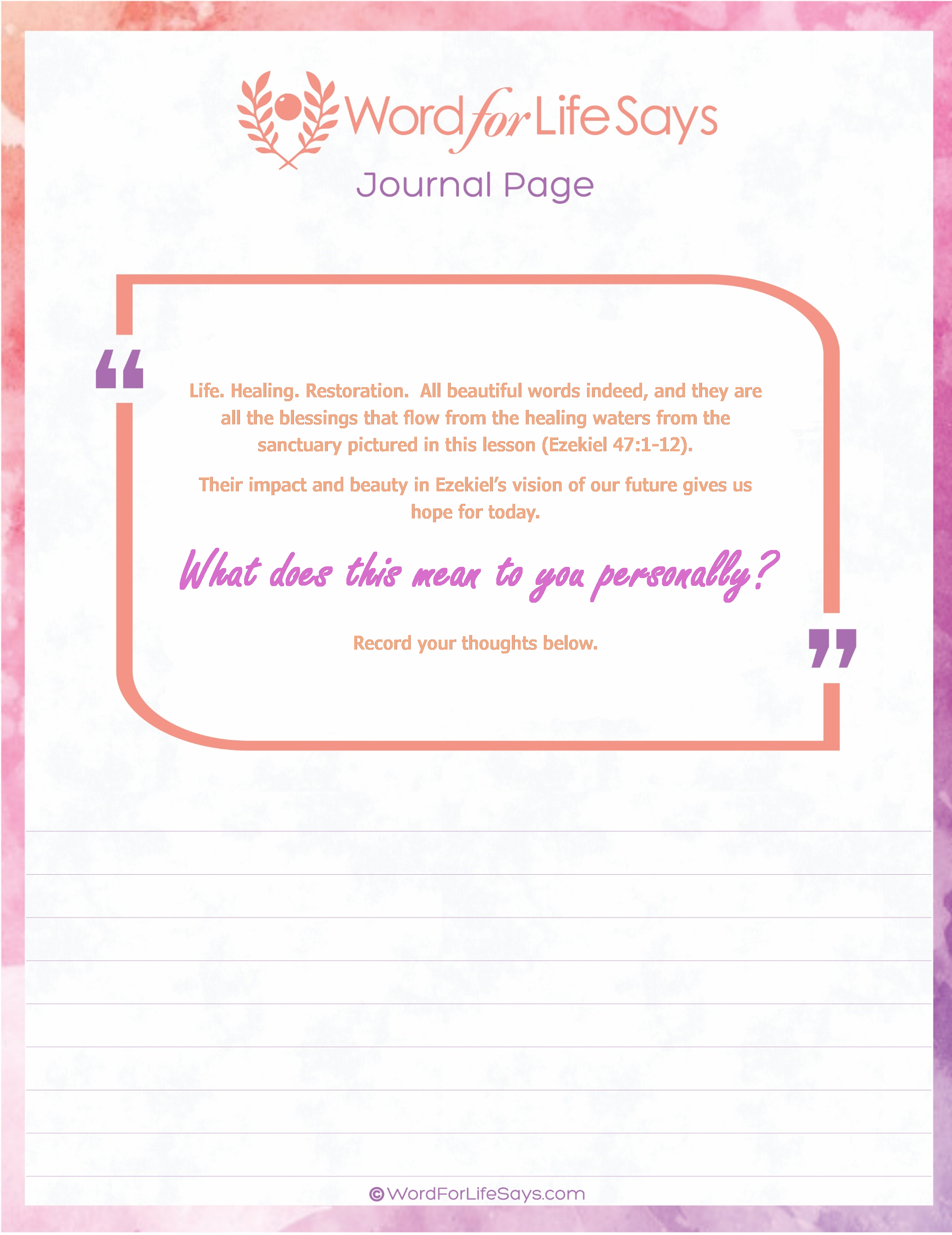
Adult Journal Page: Adult Journal Page – Ezekiel Sees a Life-Giving River
 

Kid’s Journal Page: Kid’s Journal Page – Ezekiel Sees a Life-Giving River

Blank Journal Page: These pages, one designed for adults and one for children, can be used to bring out, remember, or write a particular part of the lesson you wish for you and/or your class to focus on.  Click>>Blank Adult and Kid’s Journal Pages to access the journal pages.

Draw the Scene: Ezekiel Sees a Life-Giving River Draw the Scene

Simple Coloring Sheet: Ezekiel Sees a Life-Giving River Simple Coloring Sheet

Leaf Lace-Up Craft: This simple craft connects the children with the effects this life-giving river has on the fruit and the leaves of the trees.  Use PDF: Ezekiel 47 12 Lace Up Leaf to put together this simple, yet fun activity.  Print out on cardstock and use a hole punch to put holes around the leaf.  Use any materials you have lying around for lacing: yarn, string, pipe cleaners, etc.  I used crumbled party streamers.  Go figure!  Enjoy!

My Project 320-001

Ezekiel 47 12 Lace Up Leaf-001

Word Search: Ezekiel Sees a Life-Giving River Word Search  Word Search Answers: Ezekiel Sees a Life-Giving River Word Search Answers

Crossword: Ezekiel Sees a Life-Giving River Crossword  Crossword Answers: Ezekiel Sees a Life-Giving River Crossword Answers

Word Scramble: Ezekiel Sees a Life-Giving River Word Scramble  Word Scramble Answers: Ezekiel Sees a Life-Giving River Word Scramble Answers

Text Free Image Above by 15079075 from Pixabay

Sunday School Lesson – “The Shepherd and His Sheep” Psalm 23

VERSE DISCOVERY: Psalm 23 (KJV, Public Domain)

Psalm 23 is probably the most famous chapter in the entire Bible.  It’s one that children learn to recite from an early age.  Yet, let’s not take it for granted because of its familiarity.  Rather, with child-like faith let us grasp the beauty of those blessed words that unfold before us in those six verses as David’s description of God and His relationship with His people is made known in this poetically beautiful psalm.

The LORD is My Shepherd

Psalm 23:1a “The Lord is my shepherd . . .”

As a teenager, David knew exactly what it was to be a shepherd.  His profession was to tend to his father’s sheep (see 1 Samuel 16:11).  Before the anointing oil from Samuel’s flask dripped upon his head, his life was spent walking through the valleys and hills of the land, caring for, finding food for, and protecting the sheep that were put under his charge.

Now, no longer a teenager, but a king, David could look back at those experiences he had, his job, and his relationship with the sheep, and compose a beautiful song that celebrates God’s ultimate care for us using the same Shepherd/sheep analogy.  Words that will inspire the believing heart to see God as everything we could ever need no matter what life throws at us.

With that, David opens this psalm by penning the words, “The LORD is my shepherd.”  As with David’s pre-king occupation, a shepherd’s job and life were spent in a selfless manner.  The sheep dominated his day-in and day-out thinking.  How to provide for them?  Where to lead them?  Are there any dangers ahead or behind them?  The shepherd’s life was also pretty much isolated.  Leading the sheep often meant time away from home.  Perhaps, when Samuel came to see and anoint this future king, that’s why David’s family forgot about the boy in the fields.  He was always working and caring for the sheep and maybe he was hardly seen in their presence.

Looking back on those days it wasn’t hard for David to see God as the ultimate Shepherd and himself counted as a sheep who is totally dependent on the care and the protection of the Shepherd.  The description of God in the role as a shepherd actually predates David’s time and is seen in books of the Bible in the time of Genesis (see Genesis 49:24).  So, David’s thinking along those lines is right up the alley with the patriarch Jacob/Israel when he too saw God in this fashion and referred to Him as such when discussing God’s protection over Joseph when he was attacked by those who hated him.

As sheep, if left on their own, they will fall prey to so many elements of this world, be it animals who wanted to eat them, circumstances and weather that may threaten them or the lands where they graze.  They are docile animals awaiting the leadership of the shepherd.  As such, David too saw his own relationship with the Lord in the same manner.  “LORD” in all caps stands for Yahweh, the name Israel identified as the holiest of all in reference to the only true God alone.  So, there is no mistake about who David says is his true Shepherd.  “My shepherd,” he says, is God alone (80:1; 100:3; Ezekiel 34:11-12).

I Shall Not Want

Psalm 23:1b-6 “. . . I shall not want.  He maketh me to lie down in green pastures: he leadeth me beside the still waters.  He restoreth my soul: he leadeth me in the paths of righteousness for his name’s sake.  Yea, though I walk through the valley of the shadow of death, I will fear no evil: for thou art with me; thy rod and thy staff they comfort me.  Thou preparest a table before me in the presence of mine enemies: thou anointest my head with oil; my cup runneth over.  Surely goodness and mercy shall follow me all the days of my life: and I will dwell in the house of the Lord for ever.”

Here, my friends, is where we get to savor the sweetness found in this holy relationship.  This is where our desire should be increased for Him as the former shepherd turned king whets our appetites with this description of God’s abundant love over us both now and forever.

This short, but powerful psalm, inspires us to see ourselves physically under the spiritual promises written within.  These illustrations that David paints with his words give us these vivid pictures of God’s tender loving care, in action, over His sheep.

“I shall not want,” David speaks, showing us the extension of the Shepherd’s nurturing watchfulness for His flock of sheep.  Being a member of the Shepherd’s divine keep, David saw there is nothing lacking in God’s provision for His people or in our relationship with Him.  Did not the Apostle Paul state in the book of Philippians, “But my God shall supply all your need according to his riches in glory by Christ Jesus,” (4:19).  It is by the hand of the Lord that we are sustained and maintained.  It is by His loving care we are thoroughly and completely cared for and provided for.  The Bible says, “No good thing will he withhold from them that walk uprightly,” (Psalm 84:11).  Anything we NEED (not our wants, as many seem to think) for our Christian journey, God is our unfailing provider.  God is for His people – Always!  We do not serve a God of lack.  He will provide!  Whatever you NEED, God’s got it!  God is attentive to the state of His people, His sheep.  He does not leave them wanting for care.  He not only provides, but He does so much more . . .

“He maketh me to lie down in green pastures: he leadeth me beside the still waters.”  In this reference, David saw in one’s relationship with God, peace that can’t be found anywhere else.  The phrases “lie down” and “still waters” show the sheep being unafraid due to the shepherd’s attentive leading.  Sheep are naturally fearful animals, but these references show the sheep are at rest, at peace in His presence.

The Bible gives us many references to the peace that we find in our relationship with God.  Some of my favorites are:

    • Isaiah 26:3 “Thou wilt keep him in perfect peace, whose mind is stayed on thee: because he trusteth in thee.”
    • John 14:27 “Peace I leave with you, my peace I give unto you: not as the world giveth, give I unto you. Let not your heart be troubled, neither let it be afraid.”
    • John 16:33 “These things I have spoken unto you, that in me ye might have peace. In the world ye shall have tribulation: but be of good cheer; I have overcome the world.”
    • Philippians 4:6-7 “Be careful for nothing; but in every thing by prayer and supplication with thanksgiving let your requests be made known unto God.  And the peace of God, which passeth all understanding, shall keep your hearts and minds through Christ Jesus.”

All of these solidify the type of relationship the sheep have with the shepherd, the type of relationship we experience in Jesus Christ, our ultimate Shepherd (John 10:11).  Many are grasping at various things and pursuits to fill their life with peace.  This peace and serenity can only be found under the protection of the Shepherd.

“He restoreth my soul.”  The need for restoration means one’s energies have been spent.  This life can wear people down, especially when they are insistent on going their own way.  As the shepherd leads his sheep to refreshing places, God stands ready to replenish the weary and broken soul.  Often in life, as Isaiah put it, “All we like sheep have gone astray; we have turned every one to his own way . . .” (Isaiah 53:6), and the soul is in need of being restored.

David knew personally and could speak from experience what it was to wander away from the Shepherd spiritually and to feel the need to be brought back into a correct soul position with God.  He prayed in Psalm 51, “Restore unto me the joy of thy salvation; and uphold me with thy free spirit” (v. 12) after he was confronted about his sin involving Bathsheba.  Our ultimate restoration of the soul can only be found in Jesus Christ, our Good Shepherd.

“He leadeth me in paths of righteousness for his name’s sake.”  God will guide the soul that chooses to follow Him to the right path.   When we were children, most of us know what it was like to partake in a good game of “Follow the Leader.”  Anything the leader does or says is to be matched by the other participants.  God gives direction for the purpose of leading His people who will choose to follow Him on the right path that will lead to glory for, “All the paths of the LORD are mercy and truth unto such as keep his covenant and his testimonies,” (Psalm 25:10).

Finding rest for your soul doesn’t just happen by being in green meadows, but it happens by staying on the true and tried course already laid out for us through God’s Word.  Jeremiah 6:16a says, “Thus saith the LORD, Stand ye in the ways, and see, and ask for the old paths, where is the good way, and walk therein, and ye shall find rest for your souls. . .”  Righteousness is the good way.  Righteousness is the path walked before by others and it is the path that will lead us to life eternal.  Unfortunately, for those whom Jeremiah spoke to, the latter part of that verse says, “But they said, We will not walk therein,” (Jeremiah 6:16b).  They chose to butt up against the Lord’s leading like stubborn goats instead of following His shepherding as faithful sheep should.

This type of combative attitude will not lead one to glory, nor will it bring glory to His “name.”  God’s name is to be glorified in our lives (see Psalm 29:1-2; Romans 11:36; 1 Corinthians 10:31; 1 Peter 4:11).  His name is honored when we live for Him.  Previously, I wrote:

“Too many go through their day without ever considering the fact that, Hey, He is God, and He should be before all others. With that realization in hand, I want my life to reflect that great truth. I want every word, every action, and every thought to magnify the greatness of who He is and all of His glory. When I go about my day, I want people to see Him in me. Do I make mistakes? Oh, yeah! But I have a goal. I aspire to do better and to be better every day. God has been so good and wonderful to me, and I feel that as His child the least I can do is show Him the honor due Him.” (Honor God/Word for Life Says).

David recognized that as a sheep, he depended on the Shepherd to keep his feet walking on the right path.  And as such, there is no “fear” in this sheep/Shepherd relationship.  When the ways get dark and hard to travail; when the path becomes treacherous and enemies hide in crevices to try to attack – God, as the Shepherd, stands in protection mode over His sheep/people.

Once again, David could look back over his own life and see where God had previously delivered him.  There was more than one time when David was being pursued by King Saul who hated him and wanted to kill him.  Through the course of that running, David, in the time of his afflictions, wrote in Psalm 34, “I sought the Lord, and he heard me, and delivered me from all my fears” (v. 4).  When he was on the run from his own son Absalom, who sought to take his life and his throne, David expressed confidence in God, saying, “I will not be afraid of ten thousands of people, that have set themselves against me round about,” (Psalm 3:6).  He may have been on the run from men at various times, but he was never far from God, he was never far from the Shepherd.  His trust is in God who makes him feel safe no matter what is going on around him.

So, he says, “Yea, though I walk through the valley of the shadow of death, I will fear no evil; for thou art with me.”  The attendance of the Shepherd, even in the darkest of places, makes the sheep feel undeniably safe.  “The LORD is my light and my salvation,” David proclaims in Psalm 27, “whom shall I fear? the LORD is the strength of my life; of whom shall I be afraid?” (v. 1).

Then, he goes on to say, “Thy rod and thy staff they comfort me.”  The shepherd’s rod and staff were used as tools of protection from enemies and for the sheep themselves.  He could use it to defeat a ravenous creature that set its sights on having sheep for dinner, or he could use the hook of the staff to save the sheep when he himself wandered where he shouldn’t and fell.  It has been proven throughout David’s life repeatedly that he could depend on God’s loving care in the same manner.

“Thou preparest a table before me in the presence of mine enemies.”  When the Shepherd is on guard (which God always is), it doesn’t matter who snarls at the sheep.  The Shepherd not only is the comfort of His people, but He goes “before” them to protect them and to provide for them.  Any good shepherd will not let his sheep wander into places without first checking the landscape ahead of them.  He goes and examines the land and areas to not only abundantly provide for them but to also take stock if there is anything there that could cause harm to the sheep.

Please note: Some, when studying this passage, switch the way they view these remaining two verses from the picture of a shepherd to that of a host laying out a banquet table, which could easily be applied to this lesson as well.  I will choose to stick along the lines of the shepherd analogy, keeping in line with David’s opening subject of God identified as the Shepherd and with this subject’s theme.  Both support the text, and both can be viewed along the veins of God being a wonderful provider who gives extraordinary care to His people.

The phrase, “Thou anointest my head with oil;” depending on how you viewed the first part of this verse, its meaning would vary.  In the hospitality-based culture of the ancient Hebrews, it was customary to anoint one’s head with oil, amongst other practices.  Look at Jesus’ response when He went to Simon’s house and Simon failed to do the duty that was expected:

“And he turned to the woman, and said unto Simon, Seest thou this woman? I entered into thine house, thou gavest me no water for my feet: but she hath washed my feet with tears, and wiped them with the hairs of her head.  Thou gavest me no kiss: but this woman since the time I came in hath not ceased to kiss my feet.  My head with oil thou didst not anoint: but this woman hath anointed my feet with ointment.  Wherefore I say unto thee, Her sins, which are many, are forgiven; for she loved much: but to whom little is forgiven, the same loveth little.” (Luke 7:44-47).

These were ways to express honor and respect and help refresh one when coming into a house, particularly to a dinner or feast.  But if we look at the anointing oil from the standpoint of being used by the shepherd instead of a host, it could be seen as being used for medicinal purposes and in other areas of care for the sheep (ex. as an insect repellent).

Either way you look at it, the “oil” represents care and devotion to the one to whom it is applied, which is what God does for His people.

“My cup runneth over” gives the impression of providing in abundance.  God loves His people and has no problem supplying what they need.  God never waivers in the care of His people and can be seen as a constant source of trust and rest.

“Surely goodness and mercy shall follow me all the days of my life” expresses the idea of God’s faithful care in this life.  God’s mercy, grace, and every loving attribute we can align to His holy name shows His “goodness” is alive and active even in our broken days.  If you are reading this, you have experienced God’s goodness today.  If you are hearing these words being taught to you, you have been a partaker of the gift He has blessed humanity with.  God’s goodness leads one down the path closer to Him if they will but trust and follow it (Psalm 25:8).

God is good (see Psalm 100:5; Nahum 1:7; Matthew 19:17) and God does good (see Psalm 119:64; Genesis 1)!  God cannot separate Himself from who He is and what He does!”

And in dealing with the life to come, David said, “I will dwell in the house of the LORD for ever” which speaks of the assurance he has in God, knowing that as His child, as His sheep, as His people, he could look forward to spending eternity in the presence of God.  There is a blessed future for the people of God.  Whether you view God as a great and gracious host welcoming one to a banquet supper (compare Revelation 19:7-9) or as the Shepherd leading His people to quiet waters (compare Revelation 7:16-17), both speak of an eternity of being where He is, and the faithful followers of Christ are secured in that coming day because of His care for His sheep.

“He shall feed his flock like a shepherd: he shall gather the lambs with his arm, and carry them in his bosom, and shall gently lead those that are with young.” Isaiah 40:11

PDF Full Printable Sunday School Lesson Pack (With easy to read instructions following the P.E.A.R.L. format on how to conduct each lesson with areas for adding personal notes): Sunday School Lesson – The Shepherd and His Sheep

Suggested Activities:

Opening: 

  • Prepare yourself to be knowledgeable about the shepherd/sheep relationship. Research the many ways of the farmer/shepherd and the care they have for their sheep.  What happens if one gets lost?  What happens if one falls on their back?  What is the best way to lead a sheep, feed them, and care for them?
  • Present either digital or printed pictures to support any facts or answers to any of the questions you may have found. Students will then have a clearer understanding of not only what a farmer/shepherd does for the sheep and the nature of the sheep themselves, but it makes for an easy transition into the lesson.
  • Alternatively, or in conjunction with, bring into the class wool yarn, wool laundry balls, a blanket, jacket, etc. made of wool. Ask students about its materials, what and how it is made, and wait for answers.

If you are familiar with the art of crocheting, knitting, or weaving, a live demonstration may be a nice addition to the lesson, especially if the hands of your students are interested in participating and learning.

Game: Leading the Sheep Golf Game – Play like you would golf but instead of holes in the ground, use shoeboxes or other small cardboard boxes with holes cut in the front (resembling a cartoon mouse hole). Boxes can be decorated and marked to show how many points each one is worth (also consider decorating or naming the boxes with examples from the lesson such as: green pastures, still waters, table of abundance, overflowing cup, or the house of the Lord).

To play the game, use wool laundry balls (to represent the sheep) and a plastic golf club, baseball bat, or something similar (to represent the shepherd’s staff).  Each participant’s job is to lead/golf the sheep into one of these desired places.  The player with the most points at the end of the game is the winner.  But please note, we are all winners when we decide to follow Jesus, our ultimate shepherd. Make this game as simple or as elaborate as you like.

Craft Idea: Younger students can also design a paper bag puppet to look like a shepherd. Use a pipe cleaner to shape into the design of the staff.

Adult Journal Page: Adult Journal Page – The Shepherd and His Sheep

Kid’s Journal Page: Kid’s Journal Page – The Shepherd and His Sheep

Blank Journal Pages: These pages, one designed for adults and one for children, can be used to bring out, remember, or write a particular part of the lesson you wish for you and/or your class to focus on.  Click>>Blank Adult and Kid’s Journal Pages to access the journal pages.

Draw the Scene: The Lord is My Shepherd Draw the Scene

Memory Verse: The Lord is My Shepherd Memory Verse

Coloring Page: The Lord is My Shepherd Coloring Page

How Many Words: The Lord is My Shepherd How Many Words

Wordsearch: The Shepherd and His Sheep Wordsearch  Answers: The Shepherd and His Sheep Wordsearch Answers

Crossword: The Shepherd and His Sheep Crossword  Answers: The Shepherd and His Sheep Crossword Answers

Word Scramble: The Shepherd and His Sheep Word Scramble  Answers: The Shepherd and His Sheep Word Scramble Answers

Copyright © Word For Life Says.com (Sharing any posts or lessons can only be done through the share buttons provided on this site from the original posts, lessons, and articles only. You can reblog from the original posts only using the reblog button provided, or share using the share buttons provided from these social media platforms: Facebook, Twitter, or Pinterest, etc., and they must be shared from the original posts only. All other repostings are prohibited. Posts and other items of interest found on this site MAY NOT BE COPIED AND PASTED, downloaded, uploaded, etc to another website or entity not listed (physical or electronic).  See COPYRIGHT PAGE for more details.

Please Note: Ads below or referenced on this site are prefabricated and mass-produced (of which I currently have no control over) and DO NOT necessarily represent the views and/or beliefs of this site and its admin.

Sunday School Lesson – “The Passover Lamb is Crucified” Luke 23:33-46; John 3:16

VERSE DISCOVERY: Luke 23:33-46; John 3:16 (KJV, Public Domain)

At twilight, at six o’clock that evening (being the time the Jewish day started), the celebration of Passover would begin, and the lamb of the Last Supper would have been killed for the feast (compare Matthew 26:17-19; Mark 14:12-16; Luke 22: 7-13).  Before twenty-four hours would pass, before this very time the next day, Jesus Christ would hang on the cross and be sacrificed as the Passover Lamb once and for all: “And he is the propitiation for our sins: and not for ours only, but also for the sins of the whole world” (1 John 2:2).

Many things have happened between Jesus’ last Passover with His disciples and His journey to the cross.  Following Luke’s account, not long after that Last Supper, after exposing there is a betrayer among them and squashing arguments of who is the greatest (Luke 22:24), Jesus soon found Himself on the Mount of Olives, in that garden called Gethsemane, where He battled in prayer (Luke 22:39-46).

Soon after, the betrayer arrived in the garden with “a band of men and officers from the chief priests and Pharisees” (John 18:3).  The price had been paid, and Judas Iscariot would fully follow through on his part as an informant for the enemy, double-crossing Jesus with a kiss (Luke 22:47-48).

After His arrest and the desertion of His disciples (Matthew 26:56), and the denial of Peter (Luke 22:54-62), Jesus stood before Pilate, a man condemned, and yet not condemned.  Not condemned, because there was no sin attached to Jesus or in Jesus that would condemn Him (Hebrews 4:15; 1 Peter 2:22; 1 John 3:5).  Even Pilate’s own mouth voiced His innocence with these words: “Ye have brought this man unto me, as one that perverteth the people: and, behold, I, having examined him before you, have found no fault in this man touching those things whereof ye accuse him:  No, nor yet Herod: for I sent you to him; and, lo, nothing worthy of death is done unto him” (Luke 23:14-15).

Yet, the Bible tells us, “For he hath made him to be sin for us, who knew no sin; that we might be made the righteousness of God in him” (2 Corinthians 5:21).  For that to happen, the Passover Lamb had to be crucified.

Pilate passed his sentence and condemned to death (Luke 23:24) He that came to bring life (John 10:10). 

Stripped and beaten, crowned with thorns and spit upon, scourged and mocked (Matthew 27:27-31; Mark 15:16-20; John 19:1), he “Then delivered he him therefore unto them to be crucified. And they took Jesus, and led him away.  And he bearing his cross went forth into a place called the place of a skull, which is called in the Hebrew Golgotha” (John 19:16-17).

Jesus and the Cross

Luke 23:33-38 “And when they were come to the place, which is called Calvary, there they crucified him, and the malefactors, one on the right hand, and the other on the left.  Then said Jesus, Father, forgive them; for they know not what they do. And they parted his raiment, and cast lots.  And the people stood beholding. And the rulers also with them derided him, saying, He saved others; let him save himself, if he be Christ, the chosen of God.  And the soldiers also mocked him, coming to him, and offering him vinegar, And saying, If thou be the king of the Jews, save thyself.  And a superscription also was written over him in letters of Greek, and Latin, and Hebrew, This Is The King Of The Jews.”

This was His destiny if we want to call it that.  This was the appointed time for Jesus to arrive at this place, this place called “Calvary, this place in history.

“Calvary” was more than a lovely thought in the hymns we sing and the story we pass down, it was a real place, where real pain and sacrifice were experienced.  It was a real place where love would win the ultimate victory.

Before He left heaven, this place, carrying out this plan of salvation was already determined: “But with the precious blood of Christ, as of a lamb without blemish and without spot: Who verily was foreordained before the foundation of the world…” (1 Peter 1:19-20; see also Acts 2:23; Hebrews 9:26; Revelation 13:8).  The very details of His crucifixion were recorded in Psalm 22 many years before it happened.

Calvary would be the place where God would satisfy the greatest need humanity has ever known: salvation.  Calvary is the place where “they crucified him,” where Jesus laid down His life on the cross (John 10:18).

Submitting to the Father’s will on the cross would mean things would forever be different.  He had done more than come to change the world, He had come to change the hearts and lives of men.  He had come to “seek and save that which was lost” (Luke 19:40).  He had come to reconcile broken humanity back to the Father (Colossians 1:20; 2 Corinthians 5:18).  The cross made the way for that to happen.

With that, the act of crucifixion commenced.  As His body was forced to lie on that rugged beam, being held in place, the nails were driven in His flesh to secure Him, to punish Him, to kill Him.  Being lifted high, with the weight of His body pulling and being jarred against the tearing of flesh and the pain of the wound of the scourging, He was hung between two “malefactors, one on the right hand, and the other on the left” (we will talk more on them later).

This symbol of our Lord’s cross, posted between two others, is another real symbol in history testifying to the realness this moment demanded.  Our Lord’s death is not a fairy tale or a wonderful read of something lovely someone did for us.  His story is real, with incredibly real details that support the account of what He did for you and me.

Hanging there, Jesus wastes no time in speaking His first words from the cross: “Father, forgive them; for they know not what they do.”  Jesus refuses to let pain speak for Him.  He refuses to let resentment, bitterness, or anger have a word here.  Instead, love speaks.  The same love that drove Him to the cross (John 15:13) is the same love that is pleading for their forgiveness.  When the course of these events is over and Jesus ascends back to the Father, all who believe in Him will find life and forgiveness (John 14:6; 3:16; Acts 3:19; 2:38).

Earlier, Jesus prayed for His disciples (John 17), and here He prays for the executioners, the nailers, the mockers, the whippers, and for them who yelled, “Crucify Him!” (Luke 23:21).

In an article I previously published titled, Focus Shift, I wrote:

Instead of ranting and raving, Jesus, in His agony and pain sought the betterment of the very ones who were killing Him.  He knew He would die.  He knew the pain would not cease until He did.  This plan was going to go forth.  Yet, He focused on the needs of others rather than Himself.

How awesome is that?  Often, we hear these words during a Seven Last Words service on Good Friday, but can we even begin to imagine the strength and willpower it took for Jesus not to focus on Himself during that time?  For Him to look beyond what He was currently going through to care for and about others?  I don’t think we have a clue.  He immediately pleaded with the Father for their forgiveness.” (©WordforLifeSays)

So, thus, He prayed.

As they “cast lots” for His garment, fulfilling even more prophecies (Psalm 22:18), the response of the very people Jesus just prayed for while in agony was startling.  They “derided him, saying, He saved others; let him save himself, if he be Christ, the chosen of God.”

The “soldiers” too “mocked him, coming to him, and offering him vinegar.”  That old phrase, “rubbing salt into an open wound,” comes to mind when I read these words.

Love lays down on the cross.  Love prays for His transgressors.  Love bleeds in the place of man.  Yet, love is scorned and mocked with wagging heads (Matthew 27:39; compare Psalm 22:7-8), tormenting Jesus with more than the nails in His flesh.  The hurting words of the people must have pierced His heart in a way a sword never could.

Yet, He refused their taunts.  He refused the temptation to leave this appointed place.  He refused to save Himself from this hour (John 12:27).  Remember what He said in the garden?  “Thinkest thou that I cannot now pray to my Father, and he shall presently give me more than twelve legions of angels?  But how then shall the scriptures be fulfilled, that thus it must be?” (Matthew 26:53-54).

Therefore, He hung, with Pilate’s “superscription. . . over him”, written in “Greek, and Latin, and Hebrew, THIS IS THE KING OF THE JEWS.”

Why was Pilate so adamant about keeping his superscription as it was?  The Jewish leaders insisted that he revise the wording by saying, “Write not, The King of the Jews; but that he said, I am King of the Jews” (John 19:21).  But Pilate refused and stated, “What I have written I have written” (John 19:22).  What was meant to be a written charge of the condemned became a written testimony for all to see.

Pilate knew they handed Jesus over by unjust means (Matthew 27:18), and they had no real evidence to condemn Him.  Even more startling was his wife’s interruption of the proceedings to send a private message to him, straightly telling him, “Have thou nothing to do with that just man: for I have suffered many things this day in a dream because of him” (Matthew 27:19).

He spoke twice in Luke, “I find no fault in him” (Luke 23:4, 14).  Was his conscience bothering him?  That, mixed with the warning from his wife, could have stirred something inside of him, but not enough to totally release Jesus from this fate.

Was he making a point?  Who really knows his thoughts behind the process, but the words of the superscription, written in the three main languages of the day and region, would stand to proclaim, “THIS IS THE KING OF THE JEWS.”

Jesus and the Thief

Luke 23:39-43 “And one of the malefactors which were hanged railed on him, saying, If thou be Christ, save thyself and us.  But the other answering rebuked him, saying, Dost not thou fear God, seeing thou art in the same condemnation?  And we indeed justly; for we receive the due reward of our deeds: but this man hath done nothing amiss.  And he said unto Jesus, Lord, remember me when thou comest into thy kingdom.  And Jesus said unto him, Verily I say unto thee, Today shalt thou be with me in paradise.”

So, there Jesus hung in between the two thieves (Mark 15:27), fulfilling scripture once again, being “numbered with the transgressors” (Mark 15:28; Isaiah 53:12).

Originally, both thieves had a thing or two to speak out against and challenged our Lord, and “reviled him” (Matthew 27:44; Mark 15:32).  Jesus was truly taking a battering on the cross.  There would not even be a camaraderie with His fellow condemned.  As His body bled and writhed in agony, would He be forsaken by all?

The challenge picked up in intensity as the pain and feeling of hopelessness crept in for one of the thieves.  He “railed. . . If thou be Christ, save thyself and us.”  In his railing against the Lord, he probably wasn’t as much concerned with Jesus and His claim to deity, and saving Himself, as he was for his own life being spared.  Out of fear for his life and his own pain, he made this selfish request.

But, challenging his challenge, the other thief spoke up, “Dost not thou fear God, seeing thou art in the same condemnation?”  Being this close to the end of his life may have awakened a reality in this man that the other seemed to miss.  None of them would leave these crosses alive.  The Roman soldiers would make sure of that (John 19:31-34).  All of them faced the same outcome.  Or did they?

Was there no fear of God in the first thief, even in this late hour of life?

As the prodigal son did in the pigpen (Luke 15:17), had this second thief finally come to himself and realize the wrongs that undid his life?  Did he question the choices he made that led him to Calvary as well?  Did he see something in Jesus, even in this late hour of his own life –  the man who speaks forgiveness from the place of pain, that he wanted for his own life, what little of it was left?

We don’t have all the answers to the questions or thoughts this man was struggling with on the cross, but we do know that he recognized two things.  First, he recognized his own undone state, that he “justly” was suffering for his “deeds.”  Recognizing personal sin is the first step to true repentance.  Jesus may have been nailed next to him, but he knew what Pilate and Herod already knew: “this man hath done nothing amiss.”

I don’t know how much of Jesus this thief could see physically with his eyes, but with his heart, it appears he had seen enough to believe that even now something better can come from his wasted life.  “And he said unto Jesus, Lord, remember me when thou comest into thy kingdom.”

Others were jeering, mocking, and cursing Him, but this dying thief recognized Jesus by what others missed, addressing Him as “Lord.”  He would die as a consequence of his actions, of this, he was sure, and he accepted that.  At the same time, he also accepted that the One who hung next to him was “Lord.”

To the “Lord” he prayed, “remember me when thou comest into thy kingdom.”  He didn’t rile.  He didn’t even suggest to Jesus to be released from his cross.  But when his story was done on this earth, he wanted to be where Jesus was, in His “kingdom.”  As the minutes passed, and the struggle to breathe and endure the pain and humiliation of the cross were getting extremely harder, this thief was looking ahead, with hope, for something better.

His late hour faith in Christ was rewarded with these words from our dying Lord: “Verily I say unto thee, To day shalt thou be with me in paradise.”  Today, Jesus promised him, this will all be over.  Today, this man would be saved once and for all.  Today, Jesus would carry this precious soul to heaven with Him.

Jesus and the Father

Luke 23:44-46 “And it was about the sixth hour, and there was a darkness over all the earth until the ninth hour.  And the sun was darkened, and the veil of the temple was rent in the midst.  And when Jesus had cried with a loud voice, he said, Father, into thy hands I commend my spirit: and having said thus, he gave up the ghost.”

Earth responded to the Lord being crucified.  From noon, “the sixth hour”, to three o’clock in the afternoon, “the ninth hour”, “darkness” covered the “earth” (see Amos 8:9).

At this “ninth hour” Jesus cried out from the cross, “My God, my God, why hast thou forsaken me?” (Matthew 27:46).  The nails, the taunts, the pain were incomparable to this feeling of separation between Himself and the Father, a feeling He had never experienced before.  These very words were prophesied to be voiced at this time (Psalm 22:1), as the sin of the world laid literally on the shoulders of Jesus.

Heaven also responded to the crucifixion of our Lord when “the veil of the temple was rent in the midst.”  The need for further sacrifices was no longer there.  Through Jesus Christ, God was making a new way for believing souls to gain access to Him.

Before the cross, Jesus taught that He was the “way” (John 14:6) and the “door of the sheep” (John 10:7).  In John 10:9, Jesus says, “I am the door: by me if any man enter in, he shall be saved, and shall go in and out, and find pasture.”  There was no longer the need for “the veil of the temple.”  The Good Shepherd gave His life for the sheep (John 10:11), and heaven tore the “veil” because the way has been made:

“God made a way through the life and death of our Lord Jesus Christ.  To the life that will turn their heart and soul over to Him, He made a way.  “Jesus saith unto him, I am the way, the truth, and the life: no man cometh unto the Father, but by me,” (John 14:6).  He is our access key.  He is the one who paved the pathway for us in righteousness and through His blood provided a space for us in His heavenly realm.  If we are His and have turned to Him, there is a place with your name on it in heaven.  A place waiting and wanting to be filled by you, but you must come through Jesus Christ only.” (God Made a Way/WordforLifeSays.com)

Seeing that all was done, every prophecy and command fulfilled, Jesus, spoke, “It is finished” (John 19:30).  Then, to the Father, Jesus cried out, echoing the words of Psalm 31:5, “Father, into thy hands I commend my spirit.”  There was nothing left for Him to do.  This portion of His story was written, and written perfectly well, and now it was time for the ending.  The work of the cross was finished.  The Passover Lamb had been crucified.  The price for sin has been paid (Romans 5:8; 6:23; Hebrews 9:12; 1 Peter 1:18-19).

Jesus and the World

John 3:16 “For God so loved the world, that he gave his only begotten Son, that whosoever believeth in him should not perish, but have everlasting life.”

John 3:16 isn’t just a wonderful sentiment.  It’s more than a good word spoken to a seeking man by the name of Nicodemus.  John 3:16 was the expressed saving power of God on display in one verse, and Jesus knew that when He died on the cross, when He was lifted “As Moses lifted up the serpent in the wilderness” (John 3:14), through His sacrifice, those who believe will find “eternal life” (John 3:15) in Him.  “For God sent not his Son into the world to condemn the world; but that the world through him might be saved” (John 3:17).

Why?  Because, “God so loved the world.” 

Love is God’s great motivation for everything.  From the calling of everything into existence to His moving through history, in all of it, God has operated in the sphere of love.

There is a popular quote that you may have heard before touting, “Love makes people do strange things.”  While love, or man’s idea of love, may have tripped people up and caused confusion over what love really is or how to respond to it, God never had any misgivings.  Anything and everything He did for love was an on-purpose act with a direct point of what He wanted to accomplish, even the death of Christ on the cross.

Love doesn’t make God do strange things.  God’s love does impossible things that only His perfect heart can do.  Although some may not understand the act of sacrificing Your perfect Son for the most unworthy of people, and they may view it through the eyes of limited human knowledge, thinking it strange, God sees it as the only way out for mankind to have a renewed relationship with Him.  God knows that for any man, woman, or child to be redeemed, they need to be reconciled to Him.  Only what Jesus did through the cross, as our Passover Lamb, can do this.  Only God’s love put Jesus there for us, for the “world”, to hang on Calvary’s tree: “For God so loved the world, that He gave His only begotten Son, that whosoever believeth in him should not perish, but have everlasting life,” (John 3:16; emphasis mine).

Because of what Jesus Christ has done, we now have “access by faith into this grace,” and we have a reason to “rejoice in hope of the glory of God” (Romans 5:2).  Through His sacrifice of blood, He bought the key that would give us an open door to our heavenly Father.  And with everything we face in this life, our promise through Christ stands, and we who “believeth in him” shall have “everlasting life.” 

Thank God for the Lamb!

“Repent ye therefore, and be converted, that your sins may be blotted out, when the times of refreshing shall come from the presence of the Lord.” Acts 3:19

“Who his own self bare our sins in his own body on the tree, that we, being dead to sins, should live unto righteousness: by whose stripes ye were healed.” 1 Peter 2:24

“Purge out therefore the old leaven, that ye may be a new lump, as ye are unleavened. For even Christ our passover is sacrificed for us” 1 Corinthians 5:7

PDF Full Printable Sunday School Lesson Pack (With easy to read instructions following the P.E.A.R.L. format on how to conduct each lesson with areas for adding personal notes): Sunday School Lesson – The Passover Lamb is Crucified

Suggested Activities:

Adult Journal Page:  Adult Journal Page – The Passover Lamb is Crucified

Kid’s Journal Page:  Kid’s Journal Page – The Passover Lamb is Crucified

Draw the Scene:  The Passover Lamb is Crucified Draw the Scene

Memory Verse:  The Passover Lamb is Crucified Memory Verse

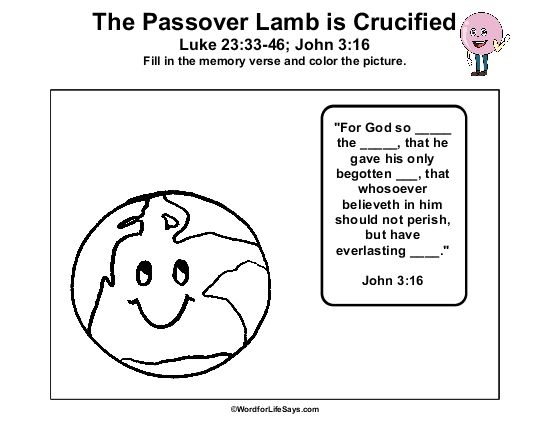
Activity Sheet:  The Passover Lamb is Crucified Activity Sheet


Word Search:  The Passover Lamb is Crucified Word Search  Answers: The Passover Lamb is Crucified Word Search Answers

Crossword:  The Passover Lamb is Crucified Crossword  Answers: The Passover Lamb is Crucified Crossword Answers

Word Scramble:  The Passover Lamb is Crucified Word Scramble  Answers: The Passover Lamb is Crucified Word Scramble Answers 

Copyright © Word For Life Says.com (Sharing any posts or lessons can only be done through the share buttons provided on this site from the original posts, lessons, and articles only. You can reblog from the original posts only using the reblog button provided, or share using the share buttons provided from these social media platforms: Facebook, Twitter, or Pinterest, etc., and they must be shared from the original posts only. All other repostings are prohibited. Posts and other items of interest found on this site MAY NOT BE COPIED AND PASTED, downloaded, uploaded, etc to another website or entity not listed (physical or electronic).  See COPYRIGHT PAGE for more details.

Sunday School Lesson – “The First Passover” Exodus 12:1-14

Above picture provided by Pixabay


VERSE DISCOVERY: Exodus 12:1-14 (KJV, Public Domain)

How fast are we to remember where God delivered us from, our personal journey to salvation? This lesson marks an exciting time of deliverance for God’s people, the children of Israel. From their bondage, He would crush the head of the enemy that oppressed them and deliver them with His mighty arm. In the process, God establishes a holy day, a feast for the people to remember and celebrate this special time of deliverance. Passover was to be forever a national time of remembrance and celebration for God’s people, and before they would step one foot out of Egypt, God already instituted it.

 Instituting This Holy Day

Exodus 12:1-2 “And the Lord spake unto Moses and Aaron in the land of Egypt saying, This month shall be unto you the beginning of months: it shall be the first month of the year to you.”

God’s purpose in Moses returning to Egypt was to be the leader who would initiate and conduct His plan of deliverance for His people (Exodus 3:1-10).  God heard the cries of His people, He remembered His covenant with their forefathers, and set the plan in motion for their release from bondage (Exodus 2:23-25; 3:11-22).

All events leading up to the Exodus were done except for one major, final event. Pharaoh has resisted Moses’ warnings repeatedly, and in doing so, he has resisted God Himself.  All warnings to let His people go have fallen on spiritually deaf ears and hardened hearts.  God has issued plague after plague; everything from turning water to blood, to lice and frogs overtaking the land and the people, to darkness so deep it could be felt, and so on.  God’s power has been manifested, and the Egyptians saw enough of it that it should have compelled them to repent of their evil ways before God and release His people.

Alas, it was not to be so. One more plague was forthcoming.  This was to be the worst of all.  This would not only liberate God’s people, but it would humble the Egyptians under the mighty hand of God.

So sure was God that this would be the last straw for the Egyptians that He had to now get these lifetime slaves in a state of readiness with a mindset to be a people who will be free. In doing so, the first thing He announces, speaking to “Moses and Aaron” (Moses’ older brother who has been used as a mouthpiece of Moses and God), “This month shall be unto you the beginning of months” (see also Exodus 13:4).

Their lives were about to take a dramatic change for the good. The day of their freedom was now going to be a mark of remembrance and celebration for the Israelites.  This would be the “beginning,” the starting point of their new journey in life according to God’s plan.

Note: Do you know, my friend, that God has a plan for your life too (see Psalm 138:8 and Philippians 1:6)?   The Bible has so many verses that give us this assurance.  But God’s plan for your deliverance will only and always have a starting point with making Jesus Christ your Savior (John 3:16; 14:6).  If you have not done so already, I urge you to do it today.

God’s Word says, “For I know the thoughts that I think toward you, saith the Lord, thoughts of peace, and not of evil, to give you an expected end,” (Jeremiah 29:11).  But, before anyone can reach an “expected end” they must have a starting point, and that starting point for God’s people would begin with the instituting of this holy day, a day set apart to remember where God brought them from.

Instructions for This Holy Day

Exodus 12:3-4 “Speak ye unto all the congregation of Israel, saying, In the tenth day of this month they shall take to them every man a lamb, according to the house of their fathers, a lamb for an house: And if the household be too little for the lamb, let him and his neighbor next unto his house take it according to the number of the souls; every man according to his eating shall make your count for the lamb.”

“Speak unto the congregation of Israel.” As the mouthpiece of God and His chosen leader for this mission, Moses was instructed to relay God’s mandates to His people.  Moses would hear from God, and God would teach Moses what needed to be done.  In return, Moses would teach and show the people God’s expectations and how to follow His instructions for this holy day.

“In the tenth day of the month they shall take to them every man a lamb, according to the house of their fathers.” Every Israelite, every man, every house was to participate in this feast that God was instituting. There is a revelation in the fact that God wanted ALL His people covered.  God wanted ALL His people celebrating on the same page.

This is where unity comes to play a key role in their national deliverance. Jesus teaches His disciples in the New Testament that, “If a house be divided against itself, that house cannot stand,” (Mark 3:25).  God wanted all His people free, standing, and marching victoriously out of the land of Egypt.  For that to occur they ALL had to be covered.

“And if the household be too little for the lamb, let him and his neighbor next unto his house take it.” We are so used to doing our grocery shopping the modern way. I go to the store, and I get exactly what my family needs for a particular recipe (ex. 1 ½ lbs. of ground beef for meatloaf, 3 lbs. of chicken if I am in a fried chicken mood, and so on).  During Moses’ day, the measurements were not so exact for meat.  To slaughter a whole animal for only 4-6 people would be extremely wasteful.  So, in these instructions, a community effort of sharing their resources comes into play.  If an animal was much too large for one family, rather than let it go to waste, they were to share it with their “neighbor.”

Exodus 12:5-7 “Your lamb shall be without blemish, a male of the first year: ye shall take it out from the sheep, or from the goats: And ye shall keep it up until the fourteenth day of the same month: and the whole assembly of the congregation of Israel shall kill it in the evening. And they shall take of the blood, and strike it on the two side posts and on the upper door post of the houses, wherein they shall eat it.”

“Your lamb shall be without blemish.” “blemish” is a flaw.  It means it is not in its most perfect state.  There is something wrong with it.  This kind of animal may be okay for a regular Sunday dinner or a weekday supper, but this day was going to be a holy day with great spiritual significance attached to it, and there could be nothing wrong with the “lamb.”

Another reason there could be no “blemish” is that not only was this “lamb” part of the celebration meal, but this little guy was also a symbol of sacrifice.  His “blood” would be used to cover the people, so to speak, on that fateful night to come: “And they shall take of the blood, and strike it on the two side posts and on the upper door post of the houses, wherein they shall eat it.”

What a beautiful picture of salvation represented here. 1 Peter 1:19 shows Jesus “as of a lamb without blemish and without spot,” whose precious blood bought us and covered us.

Exodus 12:8-11 “And they shall eat the flesh in that night, roast with fire, and unleavened bread; and with bitter herbs they shall eat it. Eat not of it raw, nor sodden at all with water, but roast with fire; his head with his legs, and with the purtenance thereof. And ye shall let nothing of it remain until the morning; and that which remaineth of it until the morning ye shall burn with fire. And thus shall ye eat it; with your loins girded, your shoes on your feet, and your staff in your hand; and ye shall eat it in haste: it is the LORD’S passover.”

Not only had God given extremely specific details in the choosing of the lamb, but he also gave very clear instructions on how it was to be prepared, cooked, and eaten.

They were to “eat the flesh in that night.” Everything was to be kept in the purest, freshest state possible.  God left no room for contamination or impurities to enter this sacrifice.  It had to be cooked: “roast with fire,” and then eaten immediately.

“Eat not of it raw, nor sodden at all with water, but roast with fire.” This is the second time He emphasized that it be “roast with fire.” Any other way of preparing or eating it would be a violation of the way God prescribed for this special sacrificial meal and therefore it would be rendered unacceptable (read Malachi 1:7-8, 12-14 for the chastisement of using unacceptable sacrifices).

God further instructed that everything be kept intact: “his head with his legs, and with the purtenance thereof.”

In keeping everything in the purest state possible, they were also instructed to “let nothing of it remain until the morning; and that which remaineth of it until the morning ye shall burn with fire.” There were to be no leftovers.  No lamb sandwiches for the road the next day.  Remember, this is not wastefulness, rather this lamb, as opposed to others for normal dinners, was a lamb of sacrifice and deliverance.  He was a special lamb, for a special night, with a special purpose.  Therefore, anything remaining they had to “burn.”

And they were to “eat it in haste.” God was going to do something amazing in that land that He had never done before, and He already knew how it would turn out.  He already knew that His people would be free on this night.  The people had to prepare themselves in faith as God was instructing them as if they too were, anticipating their own freedom.  They had to eat with “loins girded, your shoes on your feet, and your staff in your hand.” They were to eat in readiness to move no matter what time it would occur.

I rode past a firehouse once, and they had their doors opened for all to see. There on the floor, I could see, positioned by the trucks, were their boots and gear just like you see on tv.  When the alarm sounds, they run to the truck, step in the boots, pull the gear up, and go.  They are always in a state of readiness to move, if necessary, day or night.  This is similar to the idea of God instructing the people to eat with “loins girded, your shoes on your feet, and your staff in your hand.”

They were to be ready because their deliverance was surely coming!

Exodus 12:12 “For I will pass through the land of Egypt this night, and will smite all the firstborn in the land of Egypt, both man and beast; and against all the gods of Egypt I will execute judgment: I am the LORD.”

“For I will pass through the land . . . this night.”  God was passing through with a purpose. On “this night” those of ancient Egypt will be humbled once and for all, and God’s people will gain their long-awaited deliverance.  There is a “firstborn” in every family, in every house, and in every field.  This meant there would not be a home that would not experience the horror that would be unleashed on “this night.” No Egyptian would be able to turn a blind eye any longer.  They will feel the affliction for their own selves.  They all will taste the wrath of the Lord on “this night.”

And every false idea about the supremacy of any false gods would be killed along with the firstborn. God will “execute judgment” and show, once and for all, that He is the only God.  “For the LORD your God is God of gods and Lord of lords, a great God, a mighty, and a terrible…” (Deuteronomy 10:17).  For He says, “I am the LORD.” And, after this night, all arguments against His deity will be put to rest (see also Numbers 33:4).

Exodus 12:13 “And the blood shall be to you for a token upon the houses where ye are: and when I see the blood, I will pass over you, and the plague shall not be upon you to destroy you, when I smite the land of Egypt.”

“When I see the blood, I will pass over you, and the plague shall not be upon you.” Had they have not followed God’s instructions in the way God prescribed, surely then, they too would have tasted the fate of the Egyptians that night. God only promised to “pass over” them when He saw the unblemished “blood” of the lamb on the doorposts.  When He saw that they obeyed His instructions in readiness, then they would experience true deliverance.

That is a lesson for many to take for themselves today.  Jesus, Himself spoke, “I am the way, the truth, and the life: no man cometh unto the Father, but by me” (John 14:6).  There are not numerous ways to experience the freedom and deliverance of true salvation.  Jesus is the only way.  He is not one path to follow in the choice of multiple paths, but He said, “no man cometh unto the Father, but by me.”  The book of Acts supports this great truth by letting us know that “Neither is there salvation in any other: for there is none other name under heaven given among men, whereby we must be saved” (4:12).

To be truly delivered must be done God’s way, in obedience to what He says.  We cannot save ourselves.  It cannot be according to our own plan or what we feel is the right way.  Here, God told them the right way and the only way they would be able to walk out in freedom – the only way they would experience this great Passover, and that was through the blood of the lamb on the doorpost.

Remembering This Holy Day

Exodus 12:14 “And this day shall be unto you for a memorial; and ye shall keep it a feast to the LORD throughout your generations; ye shall keep it a feast by an ordinance for ever.”

“This day shall be unto you for a memorial.” This “feast to the LORD,” this day was to be commemorated “throughout your generations.” Passover was not about God’s people; it was about what God did for His people.  It was a “feast to the LORD.”

The story and celebration of how God delivered them and brought them out of Egyptian bondage were to be passed down always like a treasured family heirloom. So much so God institutes it as law “by an ordinance for ever.” When Jesus Christ died for all mankind, He became our Passover lamb.  “For even Christ our Passover is sacrificed for us,” is what 1 Corinthians 5:7 tells us.

We all have a starting point of when and where God saved us and brought us out of our own bondage to sin. Our job is not to forget what He has done for us either; rather, we are to remember with great appreciation and reverence our day of deliverance.

PDF Full Printable Sunday School Lesson Pack (With easy to read instructions following the P.E.A.R.L. format on how to conduct each lesson with areas for adding personal notes and other ideas available.): Sunday School Lesson – The First Passover

Suggested Activities:

Opening Lesson Idea:

Bring to class different decorations from different holidays and display them around the room. As your students come in, they may be somewhat confused about all the decorations.

Have fun with it and ask them, Aren’t you ready to celebrate!  At the same time, point to the different decorations and comment that it is time to celebrate that particular holiday.  Your class will no doubt correct you.

Ask, So, what are your favorite holidays to celebrate and why?

Say, Did you know the word holiday used to mean holy day?  A holy day is a special day set apart and observed for a special reason.  In today’s lesson, we are going to learn about a special holy day of remembrance God institutes for His people, the children of Israel.  You may not be that familiar with this day.  It may not have been on your list of favorite holidays to celebrate, but this day was especially important to God and His people.

Note: if your students did put Easter on their list of favorites you can link that with today’s lesson.  Today’s lesson talks about the first Passover celebration.  But did you know Jesus plays a key role in the Passover too?

Let’s learn a little more about Passover and tell me if you can pick up on the areas where you see Jesus come in. (For young children, you can make this a game.  Using party favors that you blow or something similar, every time the lesson comes to a part where Jesus is mentioned, they can blow their party favors in celebration.)

Adult Journal Page – Adult Journal Page – The First Passover

Kid’s Journal Page – Kid’s Journal Page – The First Passover

Blank Journal Pages – Blank Adult and Kid’s Journal Pages

Word Search: The First Passover Word Search  Answers: The First Passover Word Search Answers

Crossword: The First Passover Crossword  Answers: The First Passover Crossword Answers

Word Scramble: The First Passover Word Scramble  Answers: The First Passover Word Scramble Answers

Draw the Scene: The First Passover Draw the Scene

Memory Verse: The First Passover Memory Verse

How Many Words: The First Passover How Many Words

Passover Lamb Activity Sheet: The First Passover Activity Sheet

Sunday School Lesson – “The Beginning of Jesus’ Miracles” John 2:1-12

The image above is copyrighted by and provided by Sweet Publishing / FreeBibleimages.org

VERSE DISCOVERY: John 2:1-12 (KJV, Public Domain)

As romance filled the air and the town rejoiced in the jubilant affair, the birthing of miracles was about to take place.

Brides and grooms have many different ideas and wishes for their special day. Some people like nighttime candle-lit themes, while others like weddings outside at the beach. For some, the ceremony is short and sweet. For others, like the Jews in Jesus’ day, it could be a weeklong celebratory event involving everyone they knew.

No matter the weddings you have seen or even dreamed of, this wedding in Cana, on that day, was set apart from the rest as an absolute original, never to be repeated again. It became more than the wedding of the century. It became one whose story has been told time and time again. 

What marked this wedding as a worthy-to-be-passed-down story had nothing to do with design, theme, or the expense of the affair. But, because the extraordinary happened during this seemingly ordinary event, this wedding is remembered forever in history.

Take it to Jesus

John 2:1-4 “And the third day there was a marriage in Cana of Galilee; and the mother of Jesus was there: And both Jesus was called, and his disciples, to the marriage.  And when they wanted wine, the mother of Jesus saith unto him, They have no wine.  Jesus saith unto her, Woman, what have I to do with thee? mine hour is not yet come.”

At this wedding, “the mother of Jesus was there” in attendance already, supposed by some that she was personally involved in the celebration. It could be that she was a relative or a close friend of the family who had members that were to be married that day. Jesus also was “called, and his disciples, to the marriage” giving even more reason to believe that Mary and Jesus had close ties with these newlyweds. As the festivities got underway, at some point, Mary and supposedly the hosts of the affair realized there was a shortage of an essential staple present at these events, the “wine.”

This family in this remote village (where purchasing more wine in abundance, at a moment’s notice, was probably not an option) would know no small embarrassment at the lack of wine during such an auspicious occasion. This could be viewed as a huge social blunder and a reason for scorn and derision for the family involved. Not to mention the possibility of the bridegroom and his bride being mocked on what was supposed to be the happiest day of their life.

They are the ones who were to be celebrated that day, yet because of this misstep in failing to carefully plan for the event and the number of people in attendance, they would be ridiculed, to say the least. Such an error in a culture known for these elaborate feasts and gatherings (weddings during that time could last up to a week), where hospitality was key, would not soon be forgotten. They had social obligations and expectations from those in attendance that needed to be filled.

Mary, whom we are already supposing to have close ties to the family with the dilemma, does what any good Christian should do when facing a crisis: she took the problem to Jesus.

She approached Him and said, what seems to be in a pretty straightforward fashion, “They have no wine.” Can one image her wringing her hands as she realizes the scorn this family could face when the blunder becomes known? Then, could it be that the worry lines that started to stretch across her face began to disappear as she laid eyes on her son, the Son of God, who held all the answers she needed?

Why else did she seek out Jesus? She knew He could do something to remedy the situation. There is an old saying that “familiarity breeds contempt,” meaning those closest to you do not respect you as much as others would because they know too much about you. But, in this case, it is because Mary knew emphatically the realness of who Jesus is and His true identity, that she had no qualms about seeking His help in the time of this desperate situation.

Jesus respectfully replied to His mother’s query for help, saying, “Woman, what have it to do with thee? mine hour is not yet come,” (vs. 4). There is a right time and season for all things. Isn’t that what the book of Ecclesiastes tells us (see Ecc. 3)? Therefore, would not He who was present before time began and will be present when time on this earth comes to an end have a good handle on when it is the right time for Him to act or not?

Jesus has always had a keen idea on His “hour” (compare Matthew 26:18, 45 and John 12:23). What He was asked to do and what He was about to do would usher in a no turning back moment, propelling Him full speed ahead into His earthly ministry toward that end result found on Calvary’s hill. Everything had to be done precisely and according to His “hour.” This would be a visually identifying moment for Him that would begin to reveal, publicly, His true identity not only to His mother but to the world in wait for the Messiah to appear.

Do What He Says

John 2:5-8 “His mother saith unto the servants, Whatsoever he saith unto you, do it.  And there were set there six waterpots of stone, after the manner of the purifying of the Jews, containing two or three firkins apiece.  Jesus saith unto them, Fill the waterpots with water. And they filled them up to the brim.  And he saith unto them, Draw out now, and bear unto the governor of the feast. And they bare it.”

His mother was not put off or dismayed at His response. In fact, she acted confidently in faith that He would offer some solution to the problem at hand. Turning to the servants who were present with her, she simply stated, “Whatsoever he saith unto you, do it” (vs. 5).

Did she overstep herself? I don’t believe so. I believe if she had, Jesus would have simply chosen not to perform the miracle at all. In fact, I think she acted with the boldness of all she knew Him to be.

From time to time, throughout His life growing up, she must have pondered the time when she received the news from the angel Gabriel of the Child she would give birth to. Back when he initially spoke to her, informing her that He “shall be great, and shall be called the Son of the Highest” (Luke 1:32). Back when he spoke, “that holy thing which shall be born of thee shall be called the Son of God” (Luke 1:35), her mind must have traveled from time to time. It may be possible that thoughts such as these have carried her through some difficult days and gave her pause to remember that He, her Son, being the “Son of God,” was everything that God was and is.

Social obligations and expectations aside, she knew in her heart that He could fix the problem at hand because of who He was and confidently told those in service to follow His orders. With that, we are supposing she went on about the business of helping out with the wedding, leaving everything in the hands of Jesus.

If you will allow me to interject here for a moment, didn’t Mary do exactly what the Word encourages saints to do with every problem: take it to Jesus and leave it there? Are we not told in Psalm 55:22 and 1 Peter 5:7 to “cast” our burdens and cares on the Lord? Give Him what is troubling us because He cares about the problems we face? Mary became a great, real-life illustration of how to do just that.

Now, back to our lesson.

Jesus answered her request. Noticing the “six waterpots of stone” at hand for ceremonial “purifying of the Jews,” Jesus instructed the servants to “Fill the waterpots with water.”

Each of these vessels held about 20-30 gallons of fluid, depending on the size and shape of the vessel. They were there for the purpose of ritual washings. Here, they may have been made available for guest to wash their hands before eating. Possibly water from these vessels would be poured out and used for some guests who may have had their feet washed upon entering the house, as we see explained in other Bible stories (ex. Jesus washing the disciples feet at the Last Supper).

No matter the reason they were there, now they would become vessels for the Master’s use. Jesus was going to employ these ordinary containers to hold and pour out a miracle for people to enjoy.

The first step toward that miracle is to do exactly as Mary said. To reiterate, she said, “Whatsoever he saith unto you, do it.” The servants who would carry out the details of this miracle had to obey the voice of Jesus. No obedience = no miracle. (Side note: This almost became a hindrance in Naaman receiving his healing from leprosy when he initially refused to do as instructed until one of his own men pushed the idea that he should follow and obey the voice of the prophet – see 2 Kings 5 for full story).

Obedience enjoined with faith equals miracles. On many occasions of performing miracles, Jesus just did what needed to be done and healed, delivered, or set free. At the same time, on other occasions, His instructions being followed was pivotal in receiving said miracle (see John 9:7). Therefore, “they filled them up to the brim,” (vs. 7). The servants carried out Jesus’ commands leaving no room at the top. Jesus said fill them up and fill them up they did.

Jesus then instructed them to “Draw out now, and bear unto the governor of the feast.” We do not know if the servants could visibly, at this point, still see water in the pots or if they saw wine. The “governor of the feast” was the man in charge of all that was taking place during the celebration. Were the servants actually being asked to serve the governor water to drink from a cleansing pot? They may have wondered.

Experience the Results

John 2:9-12 “When the ruler of the feast had tasted the water that was made wine, and knew not whence it was: (but the servants which drew the water knew;) the governor of the feast called the bridegroom, And saith unto him, Every man at the beginning doth set forth good wine; and when men have well drunk, then that which is worse: but thou hast kept the good wine until now.  This beginning of miracles did Jesus in Cana of Galilee, and manifested forth his glory; and his disciples believed on him.  After this he went down to Capernaum, he, and his mother, and his brethren, and his disciples: and they continued there not many days.”

I personally believe that there still appeared to be water in the pots to the servant, and this too was a step of faith in obedience. The reason I believe this is because verse 9 tells us, “but the servants which drew the water knew,” indicating that it was still water when they took it out of the vessels and gave it to the governor. They, and the governor, were astonished at the results (even though the governor did not previously know where the wine came from – vs. 9).

Pulling the “bridegroom” aside, the governor exclaimed, “Every man at the beginning doth set forth good wine; and when men have well drunk, then that which is worse: but thou hast kept the good wine until now,” (vs. 10). The governor was under the impression that the bridegroom had kept the best for last. But this wasn’t the case at all. The bridegroom and his party ran out of supplies to keep the celebration in full operation. They were finished and set up to be a social embarrassment.

Jesus stepped in to rescue and remedied the situation in what is noted as the “beginning of miracles” He did in “Cana of Galilee.” Jesus did not save the best for last. He totally transformed the ordinary into the extraordinary, making water become the best wine anyone had ever tasted. This, my friends, is a bonafide miracle. He supernaturally made what wasn’t into what was before them now.

The real end result was not to get the best tasting wine possible. Rather, when those disciples who were with Him saw what He did, it encouraged and strengthened their faith in Him, and they “believed on him” all the more.

In what seems to be a minor miracle (I think not) to some, compared to others that would shortly follow, really was something terrific that “manifested forth his glory” to those around Him. Jesus was not a mere man trying to gain a crowd to follow Him. These men witnessed His power in action for the first time, and it was astounding. No one who was not approved by God, no one who was not God in the flesh could alter the structure of something as simple as water, and create it to be something totally different as wine.

We must keep in mind that what was given to the governor was not water that tasted like wine; rather, it was real, and official wine. Normally, this comes about through the grapevines with fruit that has been harvested and pressed and aged for a time. But when Jesus gets ahold of simple H2O, He created it to be something it wasn’t or didn’t have the structure to be. That’s a miracle!

No wonder their faith was encouraged by what they saw. This was one of the purposes for the miracles that Jesus did. They validated Him to the world seeking a Savior. Later in John 10:38, Jesus says, “Though ye believe not me, believe the works: that ye may know, and believe, that the Father is in me, and I in him.”

Only the Son of God can do such things as these, and that’s a cause for belief in Him, all by itself.

After the wedding celebration, Jesus “went down to Capernaum, he, and his mother, and his brethren, and his disciples: and they continued there not many days,” (vs. 12). From this point on, Jesus became fully engulfed in His earthly ministry.

“Capernaum,” at this time, was a respite before heading to Jerusalem for the Passover celebration (see John 2:13).

It was there at Jerusalem where Jesus became displeased and angry over what was going on in His Father’s house and flipped the tables of the merchants (see John 2:16). The disciples that were with Him at this time were clued in even more to His true identity by what they witnessed (see John 2:17), and even more miracles were performed that attested to the fact of who He really was (see John 2:23).

“Capernaum” later would serve as a major place of activity during His earthly ministry, including more miracles. It was there where the centurion asked for help for his servant, and Jesus sent healing his way (see Matthew 8:5-13). It was there, where Peter was instructed to look in the mouth of a fish for money to pay tribute (see Matthew 17:24-27).

What started with wine would eventually end with His blood flowing from Calvary’s cross. The truest of all miracles performed by the Lord who washed our black sins whiter than snow through His red blood offered as a Lamb sacrificed in our place.

Amazing!

PDF Full Printable Sunday School Lesson Pack (With easy to read instructions following the P.E.A.R.L. format on how to conduct each lesson with areas for adding personal notes and other ideas available.): Sunday School Lesson – The Beginning of Jesus’ Miracles

Suggested Activities:

Believe or Don’t Believe game opener. Do an internet search of extreme or what would seem to be unbelievable facts.  Have ideas that are real and some that are false.  These ideas can be from multiple sources such as unusual or weird stories (within reason), different weather events, historical facts or clothing, natural phenomenon, and so forth. Things that may seem outrageous but are hard to tell if it’s true or not.

Make paddles to use for this game. It can be something as simple as paper plates attached to large craft sticks, or you can use the paddle printable found below.  Have enough to give each student or team two paddles each.  On one paddle, have the word Believe written on it, and on the other paddle write the words Don’t Believe.

On a chart, chalkboard, or whiteboard write the name of your students (or teams if you have a larger class) to keep score.  Start presenting the ideas you found from your internet search.  Ask your students on the count of three to show, using their paddles, if they believe or don’t believe the statement you just made.  The student or team who has the most correct answers at the end of the game wins.

Lead into the lesson:  When discussing the miracles of Jesus that are recorded in the Word of God, we must believe that they are one hundred percent true.  Many who came to Jesus for their special needs to be met knew that He could do something to remedy their situation.  Today, we hold on to the truth of those wonderful miracles He performed, and we let them encourage our own faith walk.

Believe Don’t Believe Paddles: Printables found here.  Printing on cardstock is best or glue paddles to construction paper for stability before attaching to craft sticks.

Adult Journal Page: Adult Journal Page – The Beginning of Jesus’ Miracles

Kid’s Journal Page: Kid’s Journal Page – The Beginning of Jesus’ Miracles

Blank Journal Page: These pages, one designed for adults and one for children, can be used to bring out, remember, or write a particular part of the lesson you wish for you and/or your class to focus on.  Click>>Blank Adult and Kid’s Journal Pages to access the journal pages.

Draw the Scene: The Beginning of Jesus’ Miracles Draw the Scene

Memory Verse: The Beginning of Jesus’ Miracles Memory Verse

Word Search: The Beginning of Jesus’ Miracles Word Search  Answers: The Beginning of Jesus’ Miracles Word Search Answers

Crossword: The Beginning of Jesus’ Miracles Crossword  Answers: The Beginning of Jesus’ Miracles Crossword Answers

Word Scramble: The Beginning of Jesus’ Miracles Word Scramble  Answers: The Beginning of Jesus’ Miracles Word Scramble Answers


Sunday School Lesson – “Jesus Blesses the Children” Mark 10:13-16

VERSE DISCOVERY: Mark 10:13-16 (KJV, Public Domain)

There is a familiar scene that plays out in many families between dad, mom, and the little ones.  It is the one where the father, playing with his children, tosses them into the air and catches them on a band of giggles coming from the child while the mother stands on the sidelines holding her breath.

The father with a sure grip and a steady hand has no qualms playing this innocent game.  The child, often young, just thinks it is absolutely hilarious to go for this free ride.  The child never worries about being caught.  The child never worries about being hurt.  The child only sees daddy.  Daddy loves me, daddy cares for me, I trust daddy and daddy will never let me fall.  Therefore, I will enjoy playing with daddy.

From the time that children are born, they have an innate capacity to trust.  They are literally at the whim of their caretakers and can do nothing for themselves.  Their dependency is constantly on others to feed, care for, and love them in their most vulnerable state.  In their innocence, they do not judge by anything outwardly but, only by the love they receive inwardly.

Children are a gift from the Lord (Psalm 127:3).  Children are our future.  These little ones will be the next carriers of God’s Word.  They will be the conduits through which generations after them will find their way to the Lord and His salvation.  At the same time, children can teach us so many things and one of the things they teach us is how to have faith.

Faith gets over-complicated in the adult way of thinking while children just simply receive, remain dependent, trust, and believe.  And that is all God asks from all His children, no matter what their age is.

 Parents Desire

Mark 10:13 “And they brought young children to him, that he should touch them: and his disciples rebuked those that brought them.”

Teachings on the kingdom of God and examples of what true faith looks like were never far from Jesus’ vocabulary.  He took many times and opportunities to open the understanding of all who would listen and heed what God looks for in a true follower of His.

In this lesson, He gives us an undeniable example of both as parents in the crowd “brought young children to him.”  The desires of the parents in question are to have Jesus “touch” their children thereby blessing them. This was not an uncommon practice in this ancient culture.

The truth is parents always want what is best for their children.  If they find a good thing, naturally they would want their children exposed to it as much as possible.  Many modern-day parents spend an enormous amount of money each year to give their children the best clothes, education, housing… the best start in life, if and as they are each able to do.

The parents in today’s lesson saw Jesus teaching and healing and showing compassion to many people, many times over.  He was (and still is) the best thing they could give to their children.  Why would they not want their child exposed to Him?  Why would they not seek a “touch” from Jesus for their little ones if they could?

A child’s faith often starts with their parents (or guardian), and in the home.  It’s where God gave the command of responsibility to Moses for the parents to “teach them diligently unto thy children, and shalt talk of them when thou sittest in thine house…” (Deuteronomy 6:7; see also Deut. 11:19).  There are many variables that go into raising a child.  Parents really must take into consideration and calculate what their children are exposed to on a daily basis and whether or not it is beneficial to their physical and spiritual wellbeing.  The guidelines given to Moses to pass down through the generations was to ensure that the most impressionable of society receive the proper exposure to the things of God; to what would benefit their children the most.  This would also ensure the longevity of the faith amongst the community as a whole.

Those in today’s lesson wanted to expose their children to Jesus.  They wanted Him to touch their little ones with a blessing.  They brought their children near to where Jesus was, giving them the opportunity to hear of His teaching and wisdom on life and the kingdom of God.  The Bible encourages us to, “Train up a child in the way he should go: and when he is old, he will not depart from it,” (Proverbs 22:6).  This stands as a strong lesson that if we want our children to be exposed to Jesus, then we, as parents, must take that responsibility and not depend on others to do it for us.  When it comes to our children’s faith there can be no complacent parenting.

“And his disciples rebuked those that brought them.”  The disciples didn’t have the same vision for the children as the parents did.  The Bible does not exactly state why their rebuke was so strong (although many speculate).  But they did prohibit the parents from bringing the children nearer to where Jesus was and made no attempts to hide their displeasure at the intrusion.

Did they think the children were unworthy of the Master’s time and consideration?  Maybe they believed Jesus was just too busy and important to deal with the likes of these.  Who knows?  Perhaps it would have been prudent for them to ask Jesus first instead of thinking to act on His behalf.  The fact of the matter is they stood in between Jesus and the children.  Something Jesus highly disapproved of.

Everyone MATTERs TO JESUS

Mark 10:14 “But when Jesus saw it, he was much displeased, and said unto them, Suffer the little children to come unto me, and forbid them not: for of such is the kingdom of God.”

Jesus intervened.  Jesus has never turned away a desiring soul.  He has never told a mom or dad no who sought physical or spiritual healing for their child.  And He was not going to turn down or turn away those who desired a special spiritual blessing or touch for their children now.

One of the most precious things I love about our Lord is His ability to see value in everybody.  Those whom society thinks are the lesser, non-important, are magnificent in the eyes of our God.  The Bible teaches us, “But even the very hairs of your head are all numbered. Fear not therefore: ye are of more value than many sparrows,” (Luke 12:7).

To Him, it does not matter where you live, what your social status in life is, or anything else like that.  It does not matter if you are aged with wisdom or new and in the innocence of your years.  He that knows the days then, the days now, and the days to come and sees beyond all of that, straight down to the very soul He loves.  With that, He invites or allows (“suffer” as this lesson puts it) them to come unto Him.

Previously I wrote in another lesson, “The feet of faith walk forward believing God is, “and that he is a rewarder of them that diligently seek him,” (Hebrews 11:6).  Faith in its highest form removes all worldly shackles and just rests in the truth that if it is His will, there is nothing that can hinder God from performing a miracle in one’s life.  Ethnicity, background, and prestige all fall away in the eyes of our Savior whose only view is that of an opened heart filled with belief,” (Word for Life Says/The Centurion’s Great Faith).  All are welcomed before Him: man, woman, and child.  Many are quick to write off young people, but our youths’ matter to Jesus, too!  Everyone matters to Him!

“Forbid them not,” Jesus commanded.  Do not prevent people, no matter who they are, from drawing nearer to Christ.  The constraints that society then and now may put on some people are not recognized by God.

Youths especially come packed with potential.  For example, Samuel was dedicated to God as an incredibly young child (1 Sam. 1:21-28) and became a righteous judge of God’s people.  Josiah, became king at the tender age of 8 (2 Chr. 34:1), and “in the eighth year of his reign, while he was yet young, he began to seek after the God of David his father: and in the twelfth year he began to purge Judah and Jerusalem from the high places, and the groves, and the carved images, and the molten images,” (2 Chr. 34:3) and eventually went on to make great reformations for God’s people in turning them back to true worship (2 Chr. 34-35) which all started while he was still young.  Timothy learned from his grandmother and mother about true faith and helped the apostle Paul during his missionary journeys and in the establishing of new churches (2 Tim. 1:5).  And, let us not forget our Lord Jesus Christ who was found at the age of 12 in the temple with the “doctors”, amazing all who saw Him and heard “his understanding and answers,” (Luke 2:41-52).   It is far better that potential is tapped in young people for the glory of God than for the things of this world.

I am sure the disciples thought they were doing their best in providing protection and care for their Master.  Yet, Jesus has always had an open-door policy when it comes to people.  People matter to our Savior, even the littlest people – the kiddos.  Jesus always had a heart that burned for drawing people near and exposing to them the kingdom of God.  He loves people.  He loves children.  And He loves you, too!

“For of such is the kingdom of God.”  God’s kingdom is made of those who trust Him with total abandon and are dependent without inhibitions; that have faith and just believe as through the eyes of an innocent child.  Too many adults are hindered in their faith due to life experiences.  But children just accept and believe and love and trust.  They are prime examples of how His sheep come to the Shepherd and humbly follow His lead.

Faith as a Child

Mark 10:15 “Verily I say unto you, Whosoever shall not receive the kingdom of God as a little child, he shall not enter therein.”

Continuing His line of teaching on the kingdom of God, Jesus reiterates the one who wishes to enter in must “receive” it “as a little child.”  Those who choose not, forfeit their right to “enter therein.”

Why? Because the same characteristics that made that celebrated faith like a child acceptable in heaven are not found in those who refuse to receive it.  In fact, the exact opposite is usually what is present.  Instead of trusting, one may see self-sufficiency, and instead of a heart surrendered in faith, one may see it being lifted in pride.  Of course, one does not have to go far in realizing these are things God opposes.  They are not found in His children, the accessors of that heavenly kingdom, therefore to them who refuse to receive it as a child, access is denied.

The promise of heaven awaits any and all who will humble themselves as these children do and put on those same traits.  Walking in a lifestyle that opposes the fruit of the Spirit which is often found in these little ones is to oppose the working of the Spirit in that life.  Flesh wins and carnality overtakes that individual prohibiting them an opened door into the heavenly realm.

Do not be like the children of Israel.  God led them through the wilderness, and they fell short of the promise that lay ahead of them.  Losing out on the spiritual blessings of entering heaven would be far worse with more significant eternal consequences than that of an earthly Promised Land.  Therefore, it is prudent that one takes on this faith, which He describes as being like a child in their trust and willingness to receive, that they may enter in.

Blessed by Jesus

Mark 10:16 “And he took them up in his arms, put his hands upon them, and blessed them.”

After His lesson on the benefits of having the same faith as these little ones that were brought before Him, Jesus granted the parent’s request and “blessed them.” 

Look at Jesus’ actions closely. He did not just speak a word over them as He could have.  He did not send one of the disciples to relay the blessings.  No.  He got personally involved with each child there in showing them the compassion of the Savior.  He lifted “them up in his arms, put his hands upon them, and blessed them.”  I get the impression that He possibly took the time to lay hands on each child individually as any good father or spiritual leader would and speak a word of encouragement over each one of them (just my thoughts).

Remember our introduction: “The child never worries about being caught.  The child never worries about being hurt.  The child only sees daddy.  Daddy loves me, daddy cares for me, I trust daddy and daddy will never let me fall.  Therefore, I will enjoy playing with daddy.”  Jesus is calling for all of us to turn to Him with that same kind of innocent and trusting faith found in children.  Your heavenly Daddy loves you!  Turn to Him.

PDF Full Printable Sunday School Lesson Pack (With easy to read instructions following the P.E.A.R.L. format on how to conduct each lesson with areas for adding personal notes): Sunday School Lesson – Jesus Blesses the Children

Suggested Activities:

Lesson Opener:  If you tried to put a picture to the word faith, what would that picture look like? What would it show? (As you present the questions in the following paragraph to open the lesson, have pictures ready that depict the scenes being spoken of.)

Would we see one authoritatively speaking with power to the multitudes (show picture)?  Would we see miracles and signs being performed (show picture)?  Or would you see the face of an innocent child (show picture)?

When Jesus taught about what those who enter the kingdom of God and what they would be compared to, in this lesson, He likened them to the picture of an innocent child.

While all the others are very real signs of things being done by those who profess and walk in the faith – what it all boils down to is if one wants to enter His heavenly kingdom, they must, in faith, receive it as a child.

Adult Journal Page: Adult Journal Page – Jesus Blesses the Children

Kid’s Journal Page: Kid’s Journal Page – Jesus Blesses the Children

Blank Journal Pages: These pages, one designed for adults and one for children, can be used to bring out, remember, or write a particular part of the lesson you wish for you and/or your class to focus on.  Click>>Blank Adult and Kid’s Journal Pages to access the journal pages.

Paper Bag Puppet Craft:  Younger students can also put together a paper bag puppet depicting themselves and, on the back, attach the phrase from the printable available on site which states, “Jesus Thinks I’m Special, Too!”  Click here for the printable PDF.


Draw the Scene: Jesus Blesses the Children Draw the Scene

Memory Verse: Jesus Blesses the Children Memory Verse

Word Search: Jesus Blesses the Children Word Search  Answers: Jesus Blesses the Children Word Search Answers

Crossword: Jesus Blesses the Children Crossword  Answers: Jesus Blesses the Children Crossword Answers

Word Scramble: Jesus Blesses the Children Word Scramble  Answers: Jesus Blesses the Children Word Scramble Answers

Copyright © Word For Life Says.com (Sharing any posts or lessons can only be done through the share buttons provided on this site from the original posts, lessons, and articles only. You can reblog from the original posts only using the reblog button provided, or share using the share buttons provided from these social media platforms: Facebook, Twitter, or Pinterest, etc., and they must be shared from the original posts only. All other repostings are prohibited. Posts and other items of interest found on this site MAY NOT BE COPIED AND PASTED, downloaded, uploaded, etc to another website or entity not listed (physical or electronic).  See COPYRIGHT PAGE for more details.

Sunday School Lesson – “Count it All Joy!” James 1:1-12

VERSE DISCOVERY: James 1:1-12 (KJV, Public Domain)

What do you do when life doesn’t seem to want to play fair?  When all the boxes don’t check off in all the right places and everything seems out of whack – what do you do?

For some, remaining optimistic during trials is harder than others.  Firstly, every trial that every individual person deals with is not the same.  Some things that may be troubling to one, but in reality, is only a minor inconvenience and annoyance, to others, they may be battling tooth and nail to keep their head above the water of the adversity they are facing.

Then, we have each person’s natural dispositions on how they specifically handle tumultuous events.  Where one sees the dark clouds others can readily point out the silver lining.

For those whom James was addressing in his letter, he knew they were being hounded by real troubles and not just a matter of inconvenience.  He knew of the hardships and oppression they were experiencing.  Yet, through it all, he wanted these believers to focus on the positive fruit all the things they were experiencing in their life could produce.

Let Patience Have Her Perfect Work

James 1:1-4 “James, a servant of God and of the Lord Jesus Christ, to the twelve tribes which are scattered abroad, greeting.  My brethren, count it all joy when ye fall into divers temptations; Knowing this, that the trying of your faith worketh patience.  But let patience have her perfect work, that ye may be perfect and entire, wanting nothing.”

This “James”, who addresses himself as “a servant of God and of the Lord Jesus Christ” is supposed by many to be the actual brother of our Lord Jesus Christ.  While Jesus was going about fulfilling His earthly ministry, his brothers were not part of those who supported that ministry (see John 7:3-5).  As a matter of fact, it is supposed that it wasn’t until after he had seen the risen Lord for himself, that James, the natural, half-brother of Jesus Christ, believed and became a follower and a leader in the early church (1 Corinthians 15:7; Acts 1:14).

Which is why he is writing this letter “to the twelve tribes which are scattered abroad.”  As a leader in the early church (Galatians 2:9; Acts 15:13-22), his care for members of the body of Christ is evident in the time and care he takes to write to them about their personal growth in the Lord, the discipline of the faith, conducting personal behaviors pleasing to the Lord, and yes, remaining hopeful in the midst of it all.

In this section of Scripture, James didn’t downplay the suffering some were experiencing.  Rather, he encouraged them to remain focused on what truly matters.  Therefore, he begins this letter by admonishing then to “count it all joy when ye fall into divers temptations.”

“Count it all joy” – when you really think about that statement, it’s naturally a very difficult thing to do.  It’s very similar to the Apostle Paul’s teaching to which he says, “In every thing give thanks…” (1 Thessalonians 5:18).

Those words “all” and “every thing” can encompass a great many circumstances.  Circumstances that wouldn’t need encouragement to remain joyful and thankful if they weren’t adverse.  Nobody needs to be encouraged to be happy when they are already happy.  It’s when things become hard and unbearable that leaders such as James try to cheer them on to see that silver lining in a dark cloud.

James goes on to say, “Count it all joy when ye fall into divers temptations,” or, various trials.  You know what, I have given birth to four different children and each labor experience was different.  Some were scary, some were painful, some were eventful, while others were uneventful.  No two were alike.  Each one was different.  During one, I thought I was going to lose that baby, and during one, my own health was compromised.

But life is like that.  The degrees and variables surrounding each hardship are unique to that particular time, place, situation, and person.  They all don’t come packed in the same neat packaging, for if they did, we could really prepare our actions and reactions to each case.  Trials come looking and feeling many ways and sometimes it’s hard getting a grip on it all and adjusting one’s mindset to see the positive.

But James didn’t focus on the many things people see, feel, and experience now.  He focused on the many things it would produce.

First, he said, “Knowing this, that the trying of your faith worketh patience.”  If you have ever exercised with resistance bands, you know how difficult it can be.  You are using your own body’s strength, be it little or big, to purposely add pressure and pull to an already hard work out.

The “trying of our faith” is working for us, for our good, even though it seems to be opposing us.  That which is hard to deal with is actually teaching us in a way that an easy path, with no resistance, ever could.  It is producing in us virtues and spiritual fruit (Romans 5:3-6) that really will have no way of growing in us if it were not for the adverse circumstances we become occasionally planted in.

Here, in James’ teaching, he is showing them the flip side of what they are feeling.  He’s showing them that what they are going through, those things that feel like they are wearing their faith down, is actually producing “patience” in them.  This patience is all about endurance.  One will never know how to go through hardships and stand if they have never been given the opportunity to exercise that faith and endure.

We read about Bible characters and their stories, and we think, oh, put me in the lion’s den, or let me at Goliath, or some other situation alike, and I know what to do because the Bible tells us what they did.  When reading the lives in these stories, we must not become desensitized to the power and faith it took for an individual to keep remaining true to their faith despite a death threat or to face a monster of a man on the battlefield.  Until we have our own Nebuchadnezzar to stand before with the resolve to refuse to bow and worship a false image, no matter how hot the situation was getting, we will never know what it’s like to endure trials such as these that build our faith unless we go through it for ourselves.

“But let patience have her perfect work.”  If you want to grow and produce things conducive to strong faith, then let that same patience work it out in you.  Every Christian should strive for mature, tested, and tried fruit of these spiritual disciplines to be produced in their life.

Every day we should want to do better and to be better, but a lot of that will never come to be unless we work at letting “patience have her perfect work.”  Then, will we grow, being “perfect and entire, wanting nothing” in the development of our Christian character, now being ripe fruit, fit for the Master’s use.

Ask in Faith and Don’t Waver

James 1:5-8 “If any of you lack wisdom, let him ask of God, that giveth to all men liberally, and upbraideth not; and it shall be given him.  But let him ask in faith, nothing wavering. For he that wavereth is like a wave of the sea driven with the wind and tossed.  For let not that man think that he shall receive any thing of the Lord.  A double minded man is unstable in all his ways.”

“Faith” is a key factor in this opening of James’ letter.  In the trying and in the producing, faith comes to the forefront of a must-have list.

“Wisdom” is needed in so many areas of life.  Proper wisdom is needed all the more when facing opposition.  Wisdom is one of the best tools one should have in their arsenal when navigating or combatting trying times.

Previously I wrote,

“Strength and weapons are carnal devices that depend on fleshly know-how and might.  Often these are the first resources that man runs to in times of difficulty and adversity.  Wisdom is dependent upon God.  ‘The fear of the LORD is the beginning of knowledge; Fools despise wisdom and instruction,’ Proverbs 1:7.

Would it not be more prudent in the days of trials to follow the path of wisdom whose Author is God?” (Wisdom is Better/Word for Life Says).

James said, “If any of you lack wisdom, let him ask of God.”  It is very possible to be in the midst of contentions and not know what to do or how to respond.  God has opened Himself up to us to receive what we need to succeed in this Christian journey.  The Apostle Peter, one of Jesus’ original disciples, wrote, “According as his divine power hath given unto us all things that pertain unto life and godliness…” (2 Peter 1:3; emphasis mine) and that includes wisdom.  God gives it to the one who asks, but when he or she asks, it must be done in “faith.”

Faith supports faith.  The one here, who is in a trial and dealing with contentions because of their faith, are to ask in faith, of the Father, for the proper wisdom of how to continue forward in their faith while going through.

Steadfast, believing faith is necessary for every aspect of our Christian walk.  To “waver” in that is to sway in that belief and in the one who is the Author of that belief.

James gives the picture of this one being “like a wave of the sea driven with the wind and tossed.”  I love the ocean.  I love the beach.  When vacationing, it’s one of my favorite places to visit.  One of the things I most enjoy while there is standing on the shoreline and watching the waves come in and go out.  The ebb and flow of the waters are always moving, never still, and never steady.

While beautiful to look at in nature, in our Christian character that’s not what we’re looking for.  We want to be rooted and grounded in what we believe and whom we believe – that He is able to answer our prayers and give us the wisdom we need.  To shun that, through not asking in faith, is to shun the benefits one would have received otherwise.

James warns, “For let not that man think that he shall receive any thing of the Lord.”  Too many are living the faith they profess to have without living in complete faith and assurance in the “Lord.”  It may be possible for people to live in compliance with regulations of the faith and have the spirit of faith missing.

This one has a divided mindset.  James considers them to be a “double minded man” who is “unstable in all his ways.”  If he or she can’t get off the fence here, before the very foundation of their faith, when praying and asking of God, other areas of life are guaranteed to be constantly shifting and fluctuating as well, being blown about in uncertainty.

But for the one, who in complete faith, is asking God for wisdom, God will give it “liberally” and “it shall be given him.”  Wow!  What a promise!

Endure, There is an Eternal Reward

James 1:9-12 “Let the brother of low degree rejoice in that he is exalted: But the rich, in that he is made low: because as the flower of the grass he shall pass away.  For the sun is no sooner risen with a burning heat, but it withereth the grass, and the flower thereof falleth, and the grace of the fashion of it perisheth: so also shall the rich man fade away in his ways.  Blessed is the man that endureth temptation: for when he is tried, he shall receive the crown of life, which the Lord hath promised to them that love him.”

Rich or poor, it doesn’t matter.  Everyone will experience trials.  And, everyone can be taught valuable lessons through those trials.  All social classes and backgrounds can find joy during times of adversity.

How is that?

James explains it like this.  For the poor, or him of “low degree,” such a one can “rejoice in that he is exalted.”  This one’s “right now status” does not determine their joy in life.

It is easy to see the ones without… without as much as others, without as many financial resources, without proper education, and anything else this world stores up as markers for success and happiness.

This one may think he is justified in being sullen, withdrawn, and living a pity-party lifestyle that no one wants to attend.  Contrarily, James points out the opposite.  Regardless of what he has or didn’t have; no matter how others view his lowliness, or even how he views himself, James declares that joy and rejoicing should still be found in his heart because of the God whom he has placed his trust in, and not his haves and have nots.

In this, too, he can “rejoice.”  When it’s all said and done, when he parts from this world, it is God who will “exalt” him to the things he has never seen with human eyes or even imagined (compare 1 Corinthians 2:9).  He may not have as much as another, but in his trials and temptations, he can still count it all joy!

When Jesus was teaching the Beatitudes, at the end of all those “blessed are” statements that would point out circumstances in which one wouldn’t normally find joy in, Jesus speaks these words: “Rejoice, and be exceedingly glad: for great is your reward in heaven,” (Matthew 5:12).  His comments were spoken in relation to being persecuted, something James’ readers are all too familiar with, yet, what He points out is that even in that hardship, Jesus Himself said, “Rejoice!”

And, He wasn’t teaching anything contrary to what He Himself was not willing to do.  Hebrews 12:2 tells us, “…who for the joy that was set before him endured the cross, despising the shame…”

As those who are linked to Him in faith, James said every believer can count it all joy no matter their privileged or underprivileged status and life.

And the “rich” are to remember, in humility, that though they may have a lot right now, their days are moving just as fast as anyone else’s in this lifespan each of us has been allotted.  Life is a vapor, here today, gone tomorrow (James 4:14).

“As the flower of the grass he shall pass away.”  Riches cannot increase his time or secure him a better end.  He, too, must depend on the same salvation, the same saving grace, as one who may be without and lacking.  The businesses, the homes, the money – nothing he has accumulated in this life will account for anything in eternity.  Outside of Christ, low or high, rich or poor, we are all nothing.

So, when this one faces trials and temptations, he too can count it all joy for he is made keenly aware that his days and life here are very brief.  That awareness brings him “low”; it centers and focuses him on what matters the most.

Both types of trials and temptations are a gift for they both, whether for the rich or poor, should keep us before the Lord in humility and dependence.  Not a one has a reason to glory in his own flesh or circumstances.  Before God, it’s the heart of the man that matters the most.  Not what he has or doesn’t have.

James adds, “Blessed is the man that endureth temptation.”  Counting it all joy is not because we have avoided temptations and trials from ever happening to us.  Counting it all joy for the blessedness that is ours for enduring the times of testing they brought.

Even Jesus was tried, tested, and tempted.  Hebrews reminds us again, “For we have not an high priest which cannot be touched with the feeling of our infirmities; but was in all points tempted like as we are, yet without sin,” (Hebrews 4:15).

Endure!

Let patience have her perfect work!  Because in the end, when the trials and trying times are all over with, that one that was “tried” and endured with faith intact through it – that one “shall receive the crown of life.”

Now, that’s real success.  That’s the real goal.  That’s the real reason to be happy when troubles just won’t seem to let up.

At one point or another, and many times in between, we are all going to be touched by the finger of adversity.  But, as the Word of God declares, “But he that shall endure unto the end, the same shall be saved,” (Matthew 24:13).

Don’t lose your joy!  There is a “crown of life” waiting for you with your name on it.  We are going through and enduring because there is a prize laid up for us at the end of this race (1 Corinthians 9:24-25).

Your running is not in vain.  Your joy is not in vain.  The “Lord” has “promised” this wonderful gift “to them that love him.”

it is spoken.  It is written.  It is ours if we remain in our holy joy and keep pushing for it and not giving up.

The opposite of the joy we are called to have is words like misery, sadness, and the like.  When one keeps swimming in the pools of these waters, they will soon feel overcome by the displeasure found there, let go of their grip, and drown.

Life may not be perfect but maintaining your spiritual joy will keep you buoyant in the murkiest of waters.

So, count it all joy!

PDF Printable Sunday School Lesson Pack (With easy to read instructions following the P.E.A.R.L. format on how to conduct each lesson with areas for adding personal notes): Sunday School Lesson – Count it All Joy

Suggested Activities:

Lesson Lead In/Happy or Sad Activity: Print out one happy face and one sad face (you can just do one set for the teacher or multiple sets so that each student can have their own). Attach the faces to craft sticks. Prepare a list of things that might make one happy or sad (finding money, losing a tooth, receiving an unexpected gift, losing a puppy, etc.). Ask the class, using the faces, to show how each thing listed would make them feel, and why? Then ask, Is it possible to feel joy even in sad times? (Give them space to answer.)

Use this as a lead in to the lesson. Say, James wrote to people during a very hard time in life and one of the things he did was encouraged them to count it all joy. This concept is difficult for some adults to grasp, let alone children. Let them know a Christian’s joy is never based on the goodness of their circumstances. Rather, their joy is based on the goodness of God, who will give us the wisdom we need to make it through hard times.

Frown Upside Down Craft: Make your own frowning face that can be turned upside down to make a smiling face. If you don’t know how to do this, search the internet for great examples. Use this as a supplement to the lesson Count it All Joy.

Adult Journal Page: Adult Journal Page – Count it All Joy

Kid’s Journal Page: Kid’s Journal Page – Count it All Joy

Blank Journal Pages: Blank Adult and Kid’s Journal Pages (These pages are great to use with the other journaling exercise provided in the PEARL lesson packet or to use to bring out any other area of the lesson you choose to focus on.  Enjoy!)

Draw the Scene: Count it All Joy Draw the Scene

Word Search: Count it All Joy Word Search  Answers: Count it All Joy Word Search Answers

Crossword: Count it All Joy Crossword  Answers: Count it All Joy Crossword Answers

Word Scramble: Count it All Joy Word Scramble  Answers: Count it All Joy Word Scramble Answers 

Copyright © Word For Life Says.com (Sharing any posts or lessons can only be done through the share buttons provided on this site from the original posts, lessons, and articles only. You can reblog from the original posts only using the reblog button provided, or share using the share buttons provided from these social media platforms: Facebook, Twitter, or Pinterest, etc., and they must be shared from the original posts only. All other repostings are prohibited. Posts and other items of interest found on this site may not be copied and pasted, downloaded, uploaded, etc to another website or entity not listed (physical or electronic). See COPYRIGHT PAGE for more details.

Sunday School Lesson Series: “Christmas”

“And she shall bring forth a son, and thou shalt call his name JESUS: for he shall save his people from their sins.” – Matthew 1:21

“For unto us a child is born, unto us a son is given: and the government shall be upon his shoulder: and his name shall be called Wonderful, Counsellor, The mighty God, The everlasting Father, The Prince of Peace.” – Isaiah 9:6

“For unto you is born this day in the city of David a Saviour, which is Christ the Lord.” – Luke 2:11

“For God so loved the world, that he gave his only begotten Son, that whosoever believeth in him should not perish, but have everlasting life.” – John 3:16

“Thanks be unto God for his unspeakable gift.” – 2 Corinthians 9:15

Christmastime really is the most wonderful time of the year, but not for the reasons most profess it.  Caught up in commercialism and materialism, many are so focused on the giving of gifts that they forget or take their focus off the greatest gift given: Jesus Christ our Savior.  He is the reason we celebrate.  He is the reason for the season.

The verses above remind us of all the wonderful things God has secured for us through the coming of His Son into this world.  As we draw deeper into this blessed season, may our hearts be enlightened more with the truth behind the reason we celebrate: JESUS.  It’s all about Him.

In light of that, I have put together a Christmas Series of Sunday School Lessons to help us and students draw nearer to Him and to learn and appreciate more the realness of this wonderful time.  Each of these lessons is designed to be used as individual lessons, or as seen here,  they can be grouped together to be used as a series.    Below you will find four links to the lessons offered.

As always, while I provide resources and activities for lessons and lesson development, I encourage my readers to do their own personal studies as well.

To access the lessons, simply click on the links below.

“An Angel Foretells of John’s Birth” – Luke 1:8-20

Before Gabriel spoke to Mary, he appeared to another person in relation to the future Messiah.  He came to a man by the name of Zacharias and foretold of the child he would father.  This child would grow to be a messenger before the Lord and would be he of whom it was prophesied as the one who would be characterized as, “The voice of one crying in the wilderness, Prepare ye the way of the Lord, make his paths straight,” (Mark 1:3).

“Gabriel Foretells of Jesus’ Birth” – Luke 1:26-38

These little details that surround the greatest story ever told can get lost in the bustle of the celebration.  But, if we take the time to sit and listen as Mary did with the angel, we too can find assurance in the plans that God has for us in our lives.

“Mary’s Song” – Luke 1:39-56

Let your soul magnify God with Mary! God is worthy to be praised! Not just in those marvelous times when He is working miracles out for you and me, but praise Him as Mary did, for His holiness. Praise Him for being the great God that He is!

“Jesus’ Birth” – Luke 2:8-20

If nothing else will move the soul, the birth of our Savior ought to give us all a reason to reflect on the goodness of the Lord and praise Him as the shepherds did on that Holy Night.

May these lessons bless you and help you to fully appreciate and celebrate our Savior, Jesus Christ, the Lord, and all that He has done for each of us.  Blessings and peace to you all!

Sunday School Lesson – “Gabriel Foretells of Jesus’ Birth” Luke 1:26-38

VERSE DISCOVERY: Luke 1:26-38 (KJV, Public Domain)

One moment in time that would change history forever; affecting not only the life of one individual but for all mankind that ever was and that will ever be born upon the face of the earth.

Mary, the young Jewish woman from Nazareth, surely knew of the prophecy that was taught to her people down through the generations: “Behold, a virgin shall conceive, and bear a son, and shall call his name Immanuel,” (Is. 7:14).  But, never could she have imagined that she would be that one; that she would be that virgin spoken of so many years ago, (see Mt. 1:21-23).

As we enter into the celebration of the Christmas season let us not become so familiar with the story that we pass it by without a second glance.  Rather, as the angel Gabriel introduces to Mary the great feat that God is about to do in her life, let us reintroduce ourselves to His great power and plan to bring salvation to all men

Lesson Summary

Luke 1:26 “And in the sixth month the angel Gabriel was sent from God unto a city of Galilee, named Nazareth,”

In the verses leading up to our lesson a dramatic event unfolded.  Zacharias’ lot was drawn “to burn incense” in the temple of the Lord, (Luke 1:9).  Whilst there, “Gabriel,” the same angel in today’s lesson, informs Zacharias that he shall have a son that he “shall be great in the sight of the Lord,” (Luke 1:15).  Zacharias, though working in the temple of the Lord, doubted what God could do in his life.  This caused him to be stricken “dumb, and not able to speak, until the days that these things shall be performed,” (Luke 1:20).

His wife Elisabeth conceived as was told by the angel Gabriel and “hid herself five months,” (Luke 1:24).  Today’s lesson picks up “in the sixth month” where we see the same Gabriel who spoke to Zacharias in the temple now appearing to Mary in “Nazareth.”

Bethlehem is the song on our lips when celebrating the Christmas season.  It is, after all, the place of our Lord’s birth.  It is the place where Christ enters the world as any other babe would.  Over seven hundred years have gone by since the prophecy of Micah announced the promise that the Savior of the world would come from this place (Micah 5:2,3).

But before Bethlehem, there was Nazareth.  A place nobody paid much attention to.  A little village despised and rejected as not being worth consideration.

To this obscure place, the angel Gabriel was sent to announce to a young woman there her participating role in the coming of the Saviour into this world.

“Can there any good thing come out of Nazareth?” one asked (John 1:46a).  Another responded, “Come and see,” (John 1:46b).

Nazareth would no longer be a little-known or forgotten town.  Since the Saviour penetrated its borders and was hailed from this place, it would be on the lips of many throughout history (Mt. 21:11; Mk. 16:6; Lk. 18:37; 24:19; Jn. 19:19; Ac. 4:10; 22:8).

Luke 1:27 “To a virgin espoused to a man whose name was Joseph, of the house of David; and the virgin’s name was Mary.”

Mary was “espoused” or as we like to call it in modern terms “engaged” to a man by the name of “Joseph.”  Unlike modern times, to be engaged then carried far more weight of commitment then it does today.  Those “espoused” were considered husband and wife without partaking in the intimate affairs of the relationship at this time.  That would come a year later when she would go to be with him as a wife in every sense of the word.  At this point in their relationship, only a divorce could break off their engagement.

Luke 1:28-29 “And the angel came in unto her, and said, Hail, thou that art highly favoured, the Lord is with thee: blessed art thou among women.  And when she saw him, she was troubled at his saying, and cast in her mind what manner of salutation this should be.”

“The angel came in unto her, and said, Hail.”  In most depictions of this encounter, one gets the sense that this encounter took place outdoors.  But here it states that when the angel Gabriel greeted Mary, he “came in unto her,” giving us the impression that Mary was indoors during this holy encounter.

He spoke, “Thou art highly favoured.”  Now, to be real I think in our day we hear so much preaching on the word favor that we have missed the real significance of the word.  Too many people associate favor with the plethora of prosperity messages.  In the Bible, “favour” is associated with “grace,” and grace is, after all, God’s unmerited favor.

It’s something that is not earned or deserved.  But God, when he looked upon Mary saw something special in her to choose her to be the one to partake in this life-changing, world-changing, history-changing mission.  In God’s eyes, she was “highly favoured.”  I like the fact that the Bible does not go into greater detail of why God chose Mary outside of being “highly favoured,” lest we think of it as a list of criteria to try to emulate to gain favor when this is all done through grace.

“The Lord is with thee.”  How many times in her life would she need to reflect back on that promise?  When the news got out about her pregnancy; when all the gossips and tongue lashers had their way, how many times would she need to reach back to this promise that God is with her?  What about when uncertainty in the turbulent times of the day where people would seek to threaten the life of her child?  Or, even moving beyond this story to the scene of Jesus’ death, how often would she remind herself of those words of blessed assurance?  Is this not one of the greatest promises associated with the birth of the Messiah?  He is “Emmanuel, which being interpreted is, God with us,” (Matthew 1:23).

“Blessed art thou among women.”  No woman on the face of this earth would ever, and I do mean ever, experience what Mary did.  Not only in being chosen for this mission of God but also in every aspect of life this journey would take her through from His conception to death.  In that, she is “blessed.”  Women have conceived since the time of Eve, but none has ever been a virgin overshadowed by the Holy Ghost.  Women have carried children in their womb, but none else has ever or will ever carry the Son of God.  She is “blessed.”

“She was troubled at his saying… what manner of salutation this should be.”  One of my favorite verses in the Bible is a humbling verse and it asks, “What is man, that thou art mindful of him? and the son of man, that thou visited him?” (Psalm 8:4).

This could be imagination on my part, but I believe one of the reasons behind Mary being “troubled at his saying” and her questioning of “what manner of salutation this should be” is rooted in the same spirit of humility that Psalms 8:4 expresses.  “What is man?” – “Who am I?” must have been running through her head that an angel of God would greet her so.

There would also be a healthy dose of godly fear intermingled with her personal response.  After all, it isn’t every day that God dispatches a messenger from heaven to speak face to face with a person.  This was truly an awe-inspiring event.  Anytime an angel appeared to speak directly to an individual it was often “troubling” to the receiver (compare to Luke 1:12).

Luke 1:30-33 “And the angel said unto her, Fear not, Mary; for thou hast found favour with God.  And, behold, thou shalt conceive in thy womb, and bring forth a son, and shalt call his name JESUS.  He shall be great, and shall be called the Son of the Highest: and the Lord God shall give unto him the throne of his father David: and he shall reign over the house of Jacob for ever; and of his kingdom there shall be no end.”

“Fear not, Mary: for thou hast found favour with God.”  Gabriel spoke words meant to calm the fright she was experiencing on the inside.  “Fear not” is one of my favorite sets of words in the Bible.  It is spoken over and over again on many occasions to many different people; approximately 365 times, one for every day of the year.  My favorite is found in Isaiah 41:10 where these words of assurance are found saying, “Fear thou not; for I am with thee: be not dismayed; for I am thy God: I will strengthen thee; yea, I will help thee; yea, I will uphold thee with the right hand of my righteousness.”  “Fear not” pleads with mankind and is pleading with Mary to trust God wholeheartedly.

Gabriel then reiterated that Mary “hast found favour with God.”  With the task she is about to receive she would need this double dose of reassurance of God’s favor over her life.

“Thou shalt conceive in thy womb, and bring forth a son, and shalt call his name JESUS.”  “Shalt” means that it is going to happen.  God has a plan for her that begins and ends with “JESUS.”  She, in the very near future, would carry a child in her “womb.”  Though her year of being espoused is not yet up and the final marriage preparations have not been done, she is told she will “bring forth a son and shalt call his name JESUS.”  When the angel spoke to Joseph in Matthew 1:21, he confirmed the name of this special child would be “JESUS.”  That name, with the meaning of salvation, is where many would find life eternal (see John 20:31).

“He shall be great, and shall be called the Son of the Highest.”  He would be no ordinary child by any means of the word.  Jesus will later say of Himself, “I am from above: ye are of this world; I am not of this world,” (Jn. 8:23).  He knew His origin was different than any other man that had been born on the earth.  Here, Gabriel tells Mary her son will be from the “Highest,” (see also John 3:31).

“And the Lord shall give unto him the throne of his father David.”  For centuries the hopes of the Jewish people’s awaited Messiah sprang from the promise that God made to His servant David when He said, “And thine house and thy kingdom shall be established for ever before thee: thy throne shall be established for ever,” (2 Samuel 7:16, see also 1 Chronicles 17:14).

David desired to build God a physical house, but God desired to build off his legacy a spiritual house that will never fail.  The son that Mary would carry in her womb would hold the keys to that spiritual house.  He would be the one to occupy the “throne” forever.

“He shall reign… and of his kingdom there shall be no end.”  Earthly kings would come and go down through the course of time.  Some would be good kings, and some would be evil.  For some they would do what was right in the eyes of God while others would rule as polar opposites.  One thing they all had and still have in common is no matter who they are, and no matter the motivation, the location, or the rule – sooner or later their reign will end.  Either by death, usurping of the throne, or by some other kingdom-shifting event they would eventually lose their right to rule.

The child that Mary would carry would always “reign.”  Even when it looked like death may have won for a short space of time – He was just revving up to rule forever.

Luke 1:34 “Then said Mary unto the angel, How shall this be, seeing I know not a man?”

When all was said and done and her stomach would begin to grow with child, most people would never believe Mary’s statement: “I know not a man.”  People judge by what they see with their natural eyes.  But, for Mary her statement would forever stand as truth in the eyes of all who believe that this virgin would conceive the Son of God.

Mary knew the means in which one would normally conceive a child.  She also knew that though she was espoused, she has remained untouched in this manner.  The Bible confirms that “before they came together, she was found with child of the Holy Ghost,” (Matthew 1:18).  Her questioning was more of a “How in the world will this happen?” statement rather than of doubt.  She knew her pure state.  How was God going to accomplish such a thing in her?  Her body would produce a miracle – but, how?

Luke 1:35 “And the angel answered and said unto her, The Holy Ghost shall come upon thee, and the power of the Highest shall overshadow thee: therefore also that holy thing which shall be born of thee shall be called the Son of God.”

“The Holy Ghost shall come upon thee, and the power of the Highest shall overshadow thee… shall be called the Son of God.”  Gabriel answered Mary’s question.  In His own way, a way that only God Himself can explain or understand, “The Holy Ghost” will come upon her and “the power of the Highest shall overshadow” her.  Though the Holy Ghost had previously and temporarily empowered people to do something for God, here He was playing a key role in the incarnation of Christ in whom “dwelleth all the fulness of the Godhead bodily,” (Col. 2:9).  John 1 recognized Jesus as the only begotten Son of God, (VSS. 14, 18).

Luke 1:36-37 “And, behold, thy cousin Elisabeth, she hath also conceived a son in her old age: and this is the sixth month with her, who was called barren.  For with God nothing shall be impossible.”

“Elisabeth, she hath also conceived a son in her old age.”  The angel encouraged Mary with this sweet reminder of the grace of God at work, there was a miracle in the womb of her cousin.  How many times had God blessed a barren womb in the Bible?  Elisabeth’s son would fulfill a prophecy of his own (see Isaiah 40:3) and would forever be remembered for his greatness in going before the Lord.  Even Jesus spoke of John and said, “For I say unto you, Among those that are born of women there is not a greater prophet than John the Baptist,” (Luke 7:28).

“For with God nothing shall be impossible.”  Oh, how often have we quoted this and yet underestimate His power at work in it?  God, the Creator of all heaven and earth, was still fashioning things into existence in a miraculous way.  “Nothing” is outside of the scope of the power of God!  There isn’t “no-thing” that He can’t do!  “God hath spoken once; twice have I heard this; that power belongeth unto God,” (Psalm 62:11).  Revelation 19:1 declares, “Alleluia; Salvation, and glory, and honour, and power, unto thee Lord our God.”  With God, it will happen!

Luke 1:38 “And Mary said, Behold the handmaid of the Lord; be it unto me according to thy word.  And the angel departed from her.”

Mission accomplished.  The angel delivered his message and departed after she accepted the mission at hand.  Let us not downplay Mary’s acceptance of this calling.  The situation could have ended her life.  The situation would bring shame and ridicule to her and her family.  It is hard to accept some of the things that God asks of His people.  At one point in His own ministry, Jesus’ teachings would invoke this response: “This is an hard saying; who can hear it?” (John 6:60) questioned some who followed Him.

For Mary, the task she was accepting was in fact very hard, but she acquiesced to the hand of God and His will over her life.  Jesus later would accept the harder calling of God, and said, “O my Father, if this cup may not pass away from me, except I drink it, thy will be done,” (Matthew 26:42).  Following God’s way will not always be easy, but it will always be right.

These little details that surround the greatest story ever told can get lost in the bustle of the celebration.  But, if we take the time to sit and listen as Mary did with the angel, we too can find assurance in the plans that God has for us in our lives.

PDF Printable Sunday School Lesson Pack (With easy to read instructions following the P.E.A.R.L. format on how to conduct each lesson with areas for adding personal notes): Sunday School Lesson – Gabriel Foretells of Jesus’ Birth

Suggested Activities:

Adult Journal Page: Adult Journal Page – Gabriel Foretells of Jesus’ Birth

Kid’s Journal Page: Kid’s Journal Page – Gabriel Foretells of Jesus’ Birth

Draw the Scene: Gabriel Foretells of Jesus’ Birth Draw the Scene

Craft Idea:  Bouncing off the idea expressed in the Draw the Scene section, for a simple Craft Idea students can cut out different pictures of an angel, a woman, and other items out of old magazines, books, or even different coloring books in an almost collage format to recreate the scene of Gabriel speaking to Mary as in today’s lesson.

Memory Verse: Gabriel Foretells of Jesus’ Birth Memory Verse

Word Scramble: Gabriel Foretells of Jesus’ Birth Word Scramble  Answers: Gabriel Foretells of Jesus’ Birth Word Scramble Answers

Word Search: Gabriel Foretells of Jesus’ Birth Word Search  Answers: Gabriel Foretells of Jesus’ Birth Word Search Answers

Crossword: Gabriel Foretells of Jesus’ Birth Crossword  Answers: Gabriel Foretells of Jesus’ Birth Crossword Answers

Sunday School Lesson – “An Angel Foretells of John’s Birth” Luke 1:8-20

VERSE DISCOVERY: Luke 1:8-20 (KJV, Public Domain)

Before Gabriel spoke to Mary, he appeared to another person in relation to the future Messiah.  He came to a man by the name of Zacharias and foretold of the child he would father.  This child would grow to be a messenger before the Lord and would be he of whom it was prophesied as the one who would be characterized as, “The voice of one crying in the wilderness, Prepare ye the way of the Lord, make his paths straight,” (Mark 1:3). 

Imagine for a moment, the president, king, or any head of a country, coming to an area to visit.  Before their arrival, another would have been sent ahead to announce and make the proper preparations before they get there.  Such as it was in ancient times when kings came into town.  And, so is the ministry of John the Baptist, the child whom Gabriel speaks of in today’s lesson as a promise to Zacharias, when the King of all kings makes His arrival on this earth.

Zacharias’ Duty

Luke 1:8-10 “And it came to pass, that while he executed the priest’s office before God in the order of his course, According to the custom of the priest’s office, his lot was to burn incense when he went into the temple of the Lord.  And the whole multitude of the people were praying without at the time of incense.”

Righteous before God.  Walking in the commandments.  Blameless.  These are some of the noteworthy characteristics of Zacharias and Elisabeth his wife (see Luke 1:5-6).

Although he was a faithful priest in the eyes of the Lord and his wife modeled the same holy qualities, they had no child.  Being well-advanced in years, their time for this possibility seemed to be over until God steps in and shakes up their way of thinking and reorders their life with a great and precious promise.

The number of priests available to serve in those days was very large.  But 1 Chronicles 24:1-19 had a plan in place to bring order and divide the priests into what it calls “divisions”.  There were 24 in all and from these divisions, the duties that were to be performed in the temple were selected by “lot.”  Using the term “lot” it describes the system of selection that depended on God to choose who will do what and when they will do it by the drawing or casting of lots.

On this particular day, Zacharias had the privilege to experience the opportunity to serve before the Lord.  “According to the custom of the priest’s office” (see 2 Chronicles 8:14), as the lots were cast for the duty of burning incense (see 1 Chronicles 23:13; 2 Chronicles 29:11), Zacharias’s name was chosen to perform this job “in the temple of the Lord.”

This was a highly desired position and considered a great honor.  Before the morning sacrifice and after the evening sacrifice was offered, the chosen priest would burn incense before the altar symbolizing the prayers of the people who were positioned outside of the temple (“praying without”), during this time.

An Angel Encounter

Luke 1:11-14 “And there appeared unto him an angel of the Lord standing on the right side of the altar of incense.  And when Zacharias saw him, he was troubled, and fear fell upon him.  But the angel said unto him, Fear not, Zacharias: for thy prayer is heard; and thy wife Elisabeth shall bear thee a son, and thou shalt call his name John.  And thou shalt have joy and gladness; and many shall rejoice at his birth.”

Above all else, we believe God to be sovereign.  We believe Him to be in charge of time and circumstance.  And, although Zacharias is considered old at this time, we believe God held his name in remembrance to appear on the scene and receive the promise of he who would be chosen and work to prepare the way of Christ at this chosen time in history.

While reverently going about his duties which, as already noted, had to be performed twice a day (see Exodus 30:7-8), “there appeared unto him an angel of the Lord.”  Imagine, if you will, being in that holy atmosphere where one might not hear anything but the burning of coals and the shuffling of his own feet; an atmosphere where everything is sacred and yet, God chose you to come before Him in the temple to perform this holy calling.

With the aromas of spices filling the air, off to the right side of the altar, beyond the ascending fragrant cloud, Zacharias sees “an angel of the Lord.”  Some depictions of this encounter may have Zacharias just hearing the angel, but the Bible says he “saw him.”

And when he “saw him, he was troubled, and fear fell upon him.”  Throughout the Bible, any time an angel appeared directly to an individual it was often unsettling and troubling to the individual (see 1 Chronicles 21:30; Matthew 28:2-4).  God does not do anything frivolously, especially regarding having a heavenly host appear to mankind.  This was an occasion to take seriously.  Not knowing at that time, the exact reason for the visit, “fear fell upon him.”

“But the angel said unto him, Fear not, Zacharias.”  Zacharias’s reaction wasn’t necessary, and the angel sought to ease the millions of horrific thoughts that may be running through his mind.  God’s dispatched angel came with a message of promise, not of peril; therefore, he spoke, “Fear not;” the same comforting words he will give to Mary in Luke 1:30.

“For thy prayer is heard.”  Zacharias was a righteous man and he was a praying man and according to God’s holy word, “The eyes of the LORD are upon the righteous, and his ears are open unto their cry, “(Psalm 34:15; see also 1 Peter 3:12).  Knowing the heartbreak and shame of being childless; I don’t know how many years Zacharias prayed, but in His perfect, pre-ordained time, God let him know He “heard.”

In a previous article titled Know That God Hears, I wrote: “Our deepest heart’s desires do not fall on deaf ears.  God is not playing cat and mouse with us.  He wants us to seek Him that He may be found: “Seek ye the LORD while he may be found, call ye upon him while he is near,” (Isaiah 55:6).  Then, He can respond!” (Word For Life Says)

And, respond He did.  The angel told Zacharias of what would be.  He said, “Thy wife Elisabeth shall bear thee a son, and thou shalt call his name John.”  A woman, who like her husband is “well-stricken in years,” (Luke 1:7) will finally, not only have a child and know the joy of motherhood, but she will “bear thee a son.”

Just think, after all those years of let downs.  After feelings of disgrace have surely washed over them and it seemed all hope is gone – God favored them.  They would know what it is like; they will experience their very own fulfilled promise in the form of a son named “John.”

His birth would not only bring “joy and gladness” to the parents whose hearts longed to hear a babe crying in their home, and to hold and coddle their own flesh and blood – but, “many shall rejoice at his birth.”

As time goes by and Elisabeth does give birth, we see in Luke 1:58, “her neighbours and her cousins heard how the Lord had shewed great mercy upon her; and they rejoiced with her,” (emphasis mine).  I believe the angel’s words were meant to have a much farther reach of impact in the lives of the people who will respond to his call of repentance, and eventually be led to Christ.

John’s Foretold Character

 Luke 1:15 “For he shall be great in the sight of the Lord, and shall drink neither wine nor strong drink; and he shall be filled with the Holy Ghost, even from his mother’s womb.”

“Before I formed thee in the belly I knew thee; and before thou camest forth out of the womb I sanctified thee, and I ordained thee a prophet unto the nations” (Jeremiah 1:5) is what God told the prophet Jeremiah about his calling on his life.  But here in this lesson, we see that not only from the womb can one’s purpose and calling be laid out, but even before conception, John was ordained into this role God had planned for him.  Nothing is hidden or a surprise to God.  He knows our days “when as yet there was none of them” (Psalm 139:16).

“For he shall be great in the sight of the Lord.”  When Jesus came on the scene, during His years of ministry, He testified of John and said, “For I say unto you, Among those that are born of women there is not a greater prophet than John the Baptist,” (Luke 7:28; see also Matthew 11:11).  Jesus’ ministry obviously is superior in depth and importance than that of John the Baptist’s (read John 1:29-34 for John’s own testimony of the Lamb of God’s ministry; He [Jesus] that is preferred before him [John the Baptist]).

Nevertheless, because of his position and unique ministry as the one who would prepare the way before the Savior, John the Baptist stands out and is extraordinary among the name of the prophets.  From the time of the womb, he would bear witness of the Christ (see Luke 1:41; John 1:15, 29-34).

“And he shall drink neither wine nor strong drink.”  This is reminiscent of the instructions we see given to Samson’s parents when an angel appeared to them.  The withholding of oneself from “strong drink” as well as other strict requirements, was in keeping with what is known as a Nazarite vow (compare Judges 13:4-5).  This devoted life would be a sign of the holy and set apart nature of the individual; that God was doing something special in his life.

“And he shall be filled with the Holy Ghost, even from his mother’s womb.”  John the Baptist would be heavenly empowered and enabled from the womb to fulfill the role as that prophesied voice and that holy messenger, heralding to all who would listen, before the arrival of the Savior (compare Isaiah 40:3).  Anything done for God must be Spirit-powered.  Many today try to operate in their own power but fall short of producing godly fruit for the Kingdom.  John’s life and mission would be infused with “Holy Ghost” power!

John’s Foretold Ministry

Luke 1:16-17 “And many of the children of Israel shall he turn to the Lord their God.  And he shall go before him in the spirit and power of Elias, to turn the hearts of the fathers to the children, and the disobedient to the wisdom of the just; to make ready a people prepared for the Lord.”

“Many of the children of Israel shall he turn to the Lord their God.”  When John the Baptist came into his ministry, he is seen “preaching in the wilderness of Judaea, And saying, Repent ye: for the kingdom of heaven is at hand,” (Matthew 3:1-2).  People from all over the area came: “Jerusalem, and all Judaea, and all the region round about Jordan, And were baptized of him in Jordan, confessing their sins,” (Matthew 3:5-6).  He was working to turn hearts back “to the Lord their God.”  He was winning souls to the Kingdom, fulfilling this prophecy over his life.

John’s style of clothing (camel’s hair garments) and eating choices (locusts and wild honey) did not detract from the impact he made on those who came out to see and hear him.  The love for people, the Kingdom, and the ingrained ministry in him compelled him to reach out and help those who were seeking “the Lord their God.”

“And he shall go before him in the spirit and power of Elias.”  In the Old Testament, it was prophesied, “Behold, I will send my messenger, and he shall prepare the way before me…” (Malachi 3:1).  When we study the New Testament, particularly the sayings of Jesus on the subject, we see that John was, in fact, he that came “in the spirit and power of Elias [Elijah],” (read Matthew 17:11-13 for further clarification).

“To turn the hearts of the fathers to the children.”  In correlation with this prophecy of John the Baptist being compared to Elijah, here too we see another O.T. promise being fulfilled through his life and ministry.  With almost exact wording, Malachi 4:5-6 talks about Elijah coming again with a focus on restoring familial relationships.  The very fabric that makes up the strength of the home is relationships; those connections would have “hearts” renewed in love and peace for one another again.

Some may see it in a different way, but regardless of how one views it, his ministry softens “hearts” that will be ready to receive the healing that Christ will offer.

When John the Baptist does arrive on the scene to do the work of the Lord, the people would have been 400 years without hearing the voice of a true prophet of God.  The above quotation from Malachi 4:5-6 was among the last words spoken by a prophet in the Old Testament.

“And the disobedient to the wisdom of the just; to make ready a people prepared for the Lord.”  The ministry of John the Baptist would change hearts and minds from unjust behavior to “just” behaviors; leading people to look for the greater gift of salvation which is found in Jesus Christ.  As such, he was making “ready a people prepared.”  John the Baptist can be seen as the opening act, while Jesus Christ, without a doubt, is the main event.

Zacharias’ Doubt

Luke 1:18-20 “And Zacharias said unto the angel, Whereby shall I know this? for I am an old man, and my wife well stricken in years.  And the angel answering said unto him, I am Gabriel, that stand in the presence of God; and am sent to speak unto thee, and to shew thee these glad tidings.  And, behold, thou shalt be dumb, and not able to speak, until the day that these things shall be performed, because thou believest not my words, which shall be fulfilled in their season.”

“Whereby shall I know this? for I am an old man, and my wife well stricken in years.”  Surprised at the announcement.  Overwhelmed at the possibility.  Over-thinking the proposed miracle.  All this and more led Zacharias down a path of doubt.

Here, Zacharias’s prayer was heard, and God sent a messenger to declare he’s getting what he prayed for.  But the faith that caused him to ask in prayer was missing at the declaration of the miracle.  Rather than respond with rejoicing, he responded with questioning.

What happened?

He looked with human eyes at human conditions and made up his mind for God, that it just wasn’t possible.  Let us be reminded of this great biblical truth: “But without faith it is impossible to please him: for he that cometh to God must believe that he is, and that he is a rewarder of them that diligently seek him,” (Hebrews 11:6; emphasis mine).

Zacharias was a “diligent” seeker of the Lord (as noted earlier in this lesson).  God was ready to reward him, but he just couldn’t see with his natural eyes the miracle ahead.  Therefore, he asks, “Whereby shall I know this?”

What God speaks always comes to pass, so the angel, who is revealed as the same “Gabriel” who speaks with Mary – his response below is just.

“I am Gabriel, that stand in the presence of God; and am sent to speak unto thee, and to shew thee these glad tidings.”  Coming as a holy messenger of God, what “Gabriel” brought was good news!  As if it isn’t awesome enough to see an angel, period – this one brought a promise with him.  Most would think this is convincing enough, but for Zacharias, he met the miracle with misgivings about his situation and wanted something more: “Whereby shall I know this?”

Thus, the angel Gabriel said, “Thou shalt be dumb, and not able to speak, until the day that these things shall be performed.”  If we fast forward to the birth of John, particularly the eighth day when it was time for him to be circumcised according to custom, which would also be the same time when he officially gets his name, we see Zacharias wrote the babe’s name “John” on a tablet.  And when he did so, “his mouth was opened immediately, and his tongue loosed, and he spake, and praised God,” (Luke 1:59-64).  Until that day he was “not able to speak” according to Gabriel’s words because he “believest not.”

Remember, what God promises, He is able to perform (Romans 4:21).  Believe Him for it all.

PDF Printable Sunday School Lesson Pack (With easy to read instructions following the P.E.A.R.L. format on how to conduct each lesson with areas for adding personal notes): Sunday School Lesson – An Angel Foretells of John’s Birth

Suggested Activities:

Adult Journal Page: Adult Journal Page – An Angel Foretells of John’s Birth

Kid’s Journal Page: Kid’s Journal Page – An Angel Foretells of John’s Birth

Memory Verse: An Angel Foretells of John’s Birth Memory Verse

How Many Words: An Angel Foretells of John’s Birth How Many Words

Draw the Scene: An Angel Foretells of John’s Birth Draw the Scene

Word Search: An Angel Foretells of John’s Birth Word Search  Answers: An Angel Foretells of John’s Birth Word Search Answers

Crossword: An Angel Foretells of John’s Birth Crossword  Answers: An Angel Foretells of John’s Birth Crossword Answers

Word Scramble: An Angel Foretells of John’s Birth Word Scramble  Answers: An Angel Foretells of John’s Birth Word Scramble Answers