

Here we go again. At the rear end of my backyard stands a wide, tall, bush-like tree extending forward eleven feet, and who knows how many feet wide along the back fence.
Moving into this house, it was one of the drawing factors because it offered complete privacy from the neighbors behind.
But, when a game of playing with any type of ball or frisbee takes place, that flying object will almost always end up lost in the massiveness of this so-called bush tree. Then, it is up to me to try to climb under, or in, or around this massive monster to retrieve the lost object.
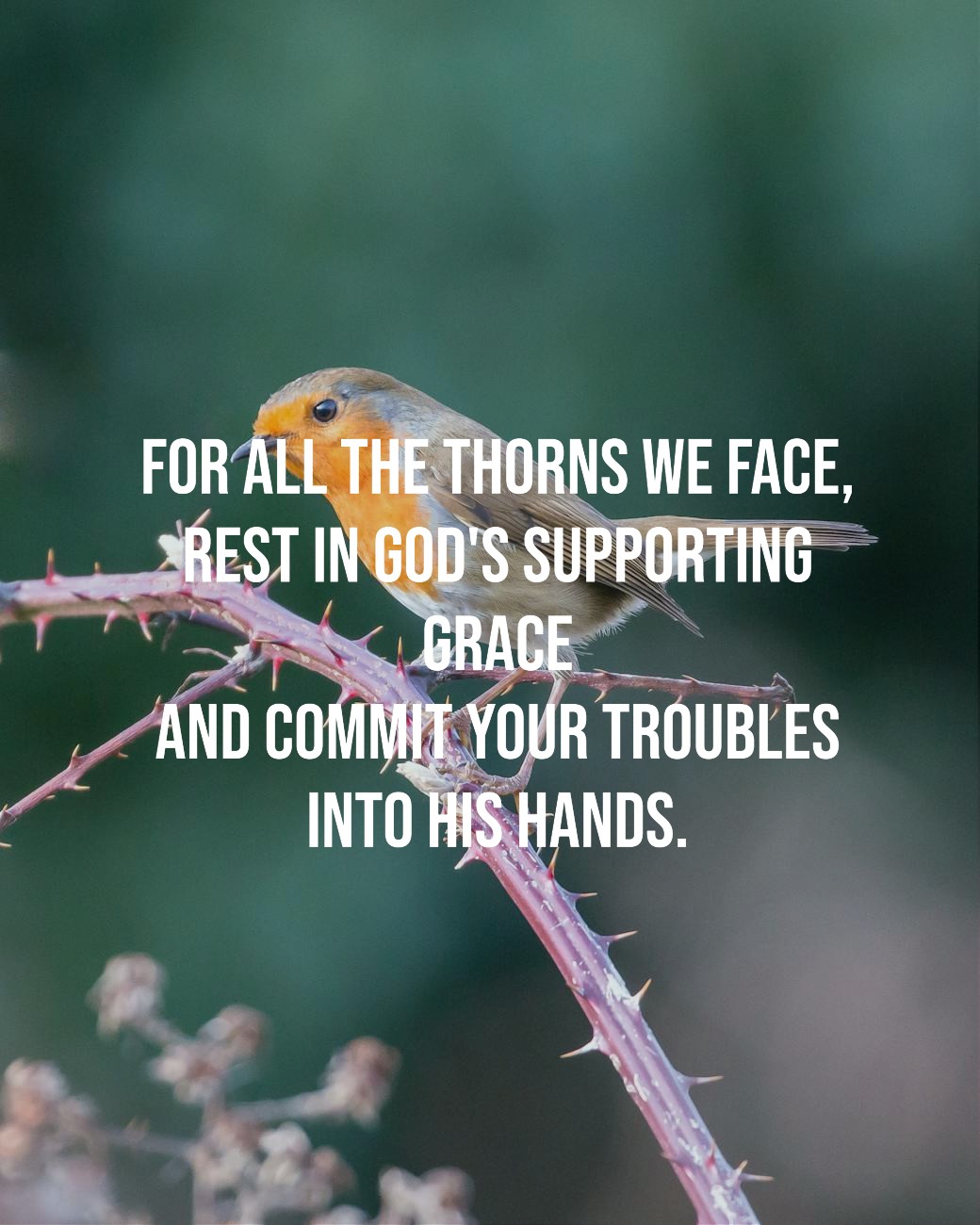
It is not as difficult as it sounds (unless you are afraid of bugs and other critters), except the yard behind me has an over-energetic raspberry patch whose branches have wiggled their way through our massive monster, making navigating it harder due to its thorny reach.
Thorns hurt. If you have ever grabbed a branch filled with thorns, or a rose, you know what I mean. If you have accidentally brushed against one of these protruding antagonists, you can feel my pain of having to try to navigate this area and come out unscathed.
But the truth is, my friend, we will not go through this world unscathed. There are going to be things that hurt us. There is suffering we may encounter or thorny places we may have to navigate as we travel this road called life.
Jesus said, “In the world ye shall have tribulation…” (John 16:33), yet when afflictions come, we forget these words and those of Peter who said, “Beloved, think it not strange concerning the fiery trial which is to try you, as though some strange thing happened unto you,” (1 Peter 4:12).
Why? Because when it hits us personally, it feels different. It hits too close to home, and we want to shut the doors on them, yet these hard times, these thorny places, seem to find you anyway.
Knowing that it is all a part of our existence and living on this earth does not make it easier. But maybe we can learn from others how they navigated their thorny places.
IN THE BEGINNING
Please know, that when God perfectly created this world, our life was intended to be a garden of peace. We were never supposed to have to deal with thorny places. But because of sin, because of the curse, Adam was told, “Cursed is the ground for thy sake; in sorrow shalt thou eat of it all the days of thy life; Thorns also and thistles shall it bring forth to thee…” (Genesis 3:17b-18a).
Where there was no sorrow, now sorrow exists. Where there were no thorny places, now they have come forth making what we have to do here harder than God ever intended.
PAUL’S THORN
The Apostle Paul knew personally about thorns.
Paul’s resume is doubtless impressive. In addition to having authored two-thirds of the New Testament – his missionary journeys, works, and miracles allowed him to not only see things but also inthe supernatural workings of the Lord in his life.
Through it all, he could have boasted (Philippians 3:4-6), yet he stated in Philippians 3:8, “I count all things but loss for the excellency of the knowledge of Christ Jesus my Lord… and do count them but dung, that I may win Christ.”
After rehearsing the measure of suffering he had endured for the ministry (2 Corinthians 11:22-29), he stated, “If I must needs glory, I will glory in the things which concern mine infirmities,” (2 Corinthians 11:30).
Although he experienced “visions and revelations of the Lord” (2 Co. 12:1), some where he was “caught up to the third heaven” (2 Co. 12:2), “into paradise, and heard unspeakable words, which is not lawful for a man to utter” (2 Co. 12:4), he knew it would be a foolish thing to boast (2 Co. 12:5,6).
As if to draw a line in the sand, Paul was given “a thorn in the flesh” to prevent any measure of self-exaltation that would cross the lines of humility and usefulness where he stood.
Jesus taught in parables regarding thorns that would encumber and choke one’s progress in the word of God “through cares and riches and pleasures of this life” preventing them from coming to a place of fruitfulness (Luke 8:14).
It would seem as though, for Paul’s spiritual benefit, a thorn was used to keep him in a place of fruitfulness rather than from it.
THE THORNS OF JESUS
Thorns are not easy for anybody to bear with. Through the humiliation and suffering of our Lord Jesus Christ, before His crucifixion, as if to add insult to injury, He was given thorns that would tear into His literal flesh: “And they clothed him with purple, and platted a crown of thorns, and put it about his head,” (Mark 15:17).
His thorns were not to keep Him from being exalted, for God would ensure His name is exalted above every name (Philippians 2:9-11). Anything revolving around the crucifixion and the cross, including the thorns, was to identify with and for the man (humans) He came to save, and to be obedient to the will of God, although being equal with God, Himself (Philippians 2:6-8).
Hebrews confirms that Jesus felt and experienced the fullness of humanity (yet without sin) while maintaining His full deity (Hebrews 4:15). That includes the sufferings that came with it all, and the thorns as well.
When trying to move through the difficulties of life, how do we do it? It is always easier to tell one about what they’re going through and what they should do, but the hows of knowing a way to move through these prickly patches is a whole other story.
Thankfully, the Bible and the lives of how these two thorn-bearers handled the inflictions upon them can help.
LEAN ON GOD’S SPIRITUAL SUPPORT SYSTEM
The same God who has been with you is the same God whose grace sustains you.
From Paul, we learn a lot about this. Although he prayed, as many would, for the thorn to be removed, God’s answer was for His best plan to be carried out in Paul’s life. And to do that, as uncomfortable and burdensome Paul may view it the thorn must remain.
Even though the thorn was to remain, God gave Paul an answer we can all glean comfort from when we are dealing with our own protruding antagonists: “My grace is sufficient for thee: for my strength is made perfect in weakness…” (2 Corinthians 12:9a)
We will never have all the answers to the ins and outs and the behind-the-scenes going on in our lives. But we have God, the only true living God, who supplies us with sufficient grace through it all.
God gave him the spiritual support he needed to go through these troubles in the form of grace. He didn’t answer the prayer in the way that Paul prayed for it, but he was guaranteed that in all that he was encountering, God had a heavenly supply that would keep him in his most useful state.
So often we pray to be useful for God’s kingdom, and yet, the way it comes out may not be at all like we imagined. But just because we didn’t imagine it this way, doesn’t mean God can’t use it. Because He can, my friend. He can.
God told Paul, “For my strength is made perfect in weakness.” When we think we don’t have much to give. When we compare our journey to this and that and feel like we come up short, we may be in the exact spot where God can manifest His strength the most.
If we think we have all the answers, as long as we can find sufficiency in ourselves and in our own strength, it is easy to lean on that. It is not until we know that without Him, I would fail. Not until we see and rely on God as our all-in-all, can He get the most out of us.
Therefore, Paul’s response was most appropriate: “Most gladly therefore will I rather glory in my infirmities, that the power of Christ may rest upon me. Therefore I take pleasure in infirmities, in reproaches, in necessities, in persecutions, in distresses for Christ’s sake: for when I am weak, then am I strong,” 2 Corinthians 12:9b-10).
Paul doesn’t celebrate or take pleasure in pain, rather he settles himself in them because of the useful state it allows him to remain in before God. It’s as if to say regardless of where this leads or what I must endure, I’m choosing to continue in this ministry and leave the outcome to God.
COMMIT IT INTO THE HANDS OF GOD
And for Christ, as He hung on the cross with the crown of thorns upon His head, and saw the angry stares of the people, with their jeering and angry words hurled at Him, He committed the whole process of the cross into the hands of God.
He refused to relieve Himself from it. He refused to back down. He persevered through the pain.
When they entered Gethsemane to arrest Him, He could have escaped. Before they laid one stripe upon His back, He could have called down blindness upon His prosecutors as the angels did at the door of Lot (Genesis 19:10-14). Before one nail inserted itself into the flesh that would die for all humankind, He could have stopped it but that would not have been in the will of God.
So, regardless of the cost, the pain, and the persecution, Jesus committed it all to God’s hand and submitted to His holy will: “Nevertheless not my will, but thine, be done” (Luke 22:42). That included the whole package deal of the cross, including every single thorn God wanted Him to feel and wear.
And through His submission came our salvation.
When we release it all into God’s hands, we know it is in a place where it won’t fail from His purpose. God can do perfectly in one moment what we struggle and strive for our entire lives to accomplish.
The pain of thorny places may make us feel like our world is spinning out of control. But anything committed into the hands of God will come out the way He orders it, even if it doesn’t look or feel like we think it should.
We all deal with thorns, but it doesn’t mean we are in a place of disfavor. It could very well be that we are in a place of maximum usefulness. Where we see weakness, God may see His strength overcoming it. Where we see thorns, it may be a place where God wants to perform a great work in you.
Text Free Photo by Radovan Zierik on Pexels.com

 Word For Life Says...