Staying Open to the Sound of the Savior | 4 Steps to Implement Today

Open communication is one of the keys to a healthy relationship. What many of us forget is that communication is a two-way street between the one who is speaking and the one who is listening. Or, supposed to be listening…

Years ago, I was in a conversation with someone.  Admittedly, I unintentionally tuned out at one point during our talking.  I wasn’t trying to be rude, nor was there a lack of interest in the conversation.  It was just one of those moments, probably due to exhaustion of the day, where I momentarily glazed over and responded to what I heard without really knowing what was being said.

Imagine my embarrassment when my friend turned to me and said, “You didn’t hear what I just said, did you?”

I had to admit that I had not and apologized to her for my lack of proper attention.

But I must ask, how attentive are we when Jesus is speaking?  Have we familiarized ourselves so much with Him, with His Word, that we have become almost complacent and desensitized upon hearing it?  Like a teenager rolling their eyes over a mother’s request to clean their room again?

As His people, His sheep, we above all others should be very interested in the words of our Lord.  Mary was, and she planted herself at His holy feet in anticipation of what He would say next (Luke 10:39).

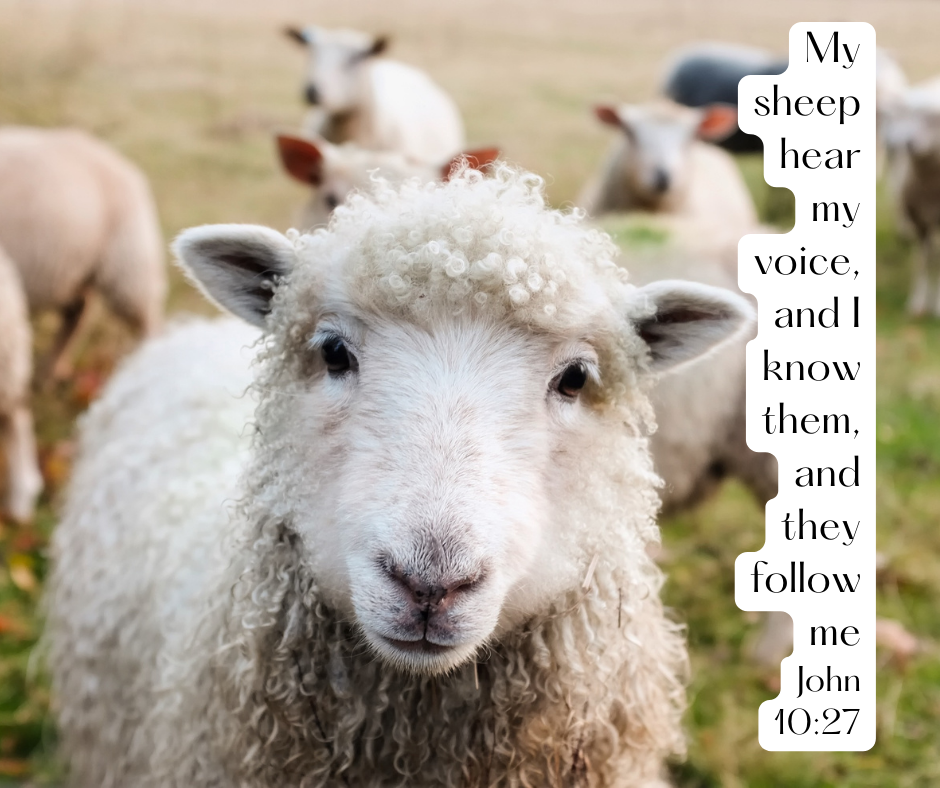
Jesus said, “My sheep hear my voice . . .” (John 10:27).  They know Him and are known of Him.  They are tuned into His heart and the words that flow from there. 

Others around may not believe.  Naysayers and the world may not be interested in hearing what He says.  But when His voice speaks, our ears and our hearts need to be receptive to His truths.

In our age, people have made themselves susceptible and open to many things, doctrines, and voices.  But our relationship and closeness to the Lord should want more.  More than what others seek.  And more than a quick fix or a drive-thru Sunday sermon.

The intimacy we have in knowing Him and being known by Him should keep the ears of our hearts in ready anticipation of Him speaking.  Stay open, my friend, to the sound of the Savior.  Stay receptive to His voice, because what He says is always in line with the Father (John 12:49-50).  When He opens His mouth, it is never frivolous but always with the purpose of teaching, exhorting, healing, delivering, and so much more.  When His voice is heard, it is to guide us, as our Good Shepherd, through our days, our decisions, and our destiny in Him. 

So, how do we get better at staying open to the sound of the Savior?  Here are a few steps you can begin to implement today.

  1. Prioritize what you allow in the hearing of your space throughout the day.  Everything you hear is not good for you.  As much as depends on you, you can choose to filter what you willingly listen to.  Not only are we encouraged in Philippians 4:8 about what to think on, but God’s Word in general stands as the ultimate filter to the noise that tries to enter our space daily.  We do not have to entertain contrary speech. Tune in to what is truly important and tune out what is not.
  2. Give opportunity and make room for His speaking.  Position yourself with the opportunity in mind that I want to hear from Him.  Whether through His Word, sermons, or other means, we are welcoming His voice in the environment of our daily living.  In our hurried world that is cluttered with all kinds of noise, it is our responsibility to make sure that we have quiet time to do just what Mary did, and that was to just sit at His feet and listen.
  3. Hear not only with your ears or through the words you read on the page but hear with your heart.  Many can hear but do not perceive.  Many heard Jesus speak audibly in the crowds but the words He spoke were never ingested into their very being, causing Him to say, “Who hath ears to hear, let him hear” (Matthew 13:9).  Like in the parable of the Sower, the soil of their hearts, the place that nurtures the seed/word, must be good ground and receptive (Matthew 13:3-23).  Jesus speaks for challenge and for change, but none of it will do any good if the listener is not willing to take it in and recognize it for the truth that it is.  
  4. Steward His words well.  When you hear, what do you do next?  When it is taken in, see how this applies to you now or in your present circumstance.  What is the takeaway?  What can you do with what you have heard?  Jesus never speaks with the intention of His words being placed on the shelf like a forgotten piece of beautiful artwork.  It is to be used, applied and lived out in one’s life.  He said, “Therefore whosoever heareth these sayings of mine, and doeth them, I will liken him unto a wise man, which built his house upon a rock” (Matthew 7:24).   

Friends, what Jesus speaks is for the instructing and building of our lives.  He said, “The words that I speak unto you, they are spirit, and they are life” (John 6:63).  Stay open to His voice, receive what He says, and follow Him. The voice of the Shepherd is calling out to you today.

More articles of interest to help you on your journey to better hear from the Savior:

“A Good Steward”

“And unto one he gave five talents, to another two, and to another one; to every man according to his several ability…” Matthew 25:15

So often when one speaks of the idea of stewardship the mind automatically travels down the road to finances. The overall idea of finances and stewardship has been linked together for ages, even since the Bible times – and that’s a correct assessment. I want us to look beyond the management of “talents,” looking rather to talents. Huh!

Well, we have the Bible definition to deal with and then we have our English definition. Talents in the Bible refer to 3,000 shekels of silver while one’s talent in the English refers to that special something that God had planted on the inside of each of us. That skill or ability that comes so naturally, it just flows from one’s being. I think the idea of stewardship or being a manager can nicely encompass those God-given delectables on the inside of each of us.

I really think it is something special that God created these two words, though spelled the same, yet have different meanings, and then, gave a management directive over both of them. Paul charged Timothy and said, “Neglect not the gift that is in thee,” (1 Timothy 4:14). Paul knew that God had bestowed something amazing on the inside of this young man, yet, if it were going to prosper and flourish in him, he would have to pay careful attention to guard it.

Ask any gardener about the care that they take of their land once the seed has been planted. There are many steps to ensure growth. Just as with Adam in the Garden of Eden, God has planted the seed but has given each of us the charge to nurture it. That’s what stewardship is all about. Being careful to manage the thing/gift that God has put me in charge of.

Do you know how much the world needs the unique stuff that God has placed inside you? There can be a million preachers. There can be a million teachers. There can be a million givers. There can be a million ushers, janitors, authors, or whatever! There can be a million of anything that can be fathomed, but nobody can do it like YOU!

You are special. You are unique. Stop hiding your talents, your skills, that special something that God put in you. Stop burying it (Matthew 25:18). Rather do as Paul instructed Timothy and pay careful attention to it. Do what you have to do to cause that seed that God planted in you to grow to the point that it is flourishing on the outside of you. Then, the whole body of Christ can profit from that great gift in you.

“As every man hath received the gift, even so minister the same
one to another, as good stewards of the manifold grace of God,”
1 Peter 4:10.


A Matthew 6:30 Promise | Words to Live By

Caring for someone is not a trivial thing. The importance of one’s love for you can be felt in what they do for you and by the words and the way they speak over you. The Father’s care for us can be experienced by both. In our daily lives, we see His love manifested in myriad ways. And in His Word, we read what He thinks of us and how important we are to Him. In Matthew 6:30, Jesus confirms this by telling us, “Wherefore, if God so clothe the grass of the field, which to day is, and to morrow is cast into the oven, shall he not much more clothe you, O ye of little faith?” You cannot begin to understand how important you are to God, just trust that you are. And the daily things that concern us are not a worry in the heart of the Father. “He’s got you!” Those words are not just another casual phrase to be tossed about. They are words of promise you can stand upon in faith today!

Then and Now | Christ is the Mediator of the New Covenant

Although I am not the greatest at it, I really do try not to waste.  I am a saver.  Sometimes to my own detriment.  Admittedly, I hold on to things probably much longer than I should.  At times, the truth of it will show up in clutter, confusion, and mess.  There are times when we must be willing to let go of the old to make space for and welcome the new.

There are various reasons we cling to the things of our past.  Some are sentimental or have historical value to us.  Some reasons can revolve around more.  But whatever the reason, one thing I am slowly learning is, that if it is not serving a purpose in the day and time I am currently living in, I must categorize its usefulness and see if it is something I am going to choose to actively hang on to or if I need to trash, donate, or keep (but have it stored somewhere out of my everyday space). 

Old things have their place.  Whether it was in things that served us for a time or in experiences we lived through, but to mature and find greater peace in the space of your life right now, they must be kept in their proper place and that place may not look like what it used to look like or serve the way we were used to being served by it.

Spiritually speaking, we see the truth of this from the Hebrew writer when he was explaining the differences between the old and the new covenants.  There was a future designed for the people of God that some could not yet fathom, therefore they desired to hold on to the old way of connecting and relating to God. 

But what Galatians 3:23-25 teaches us is, “Before faith came, we were kept under the law, shut up unto the faith which should afterwards be revealed.  Wherefore the law was our schoolmaster to bring us unto Christ, that we might be justified by faith.  But after that faith is come, we are no longer under a schoolmaster.”  The law was only a tutor for a time, showing our need for a Savior, showing us how to live in anticipation of what Christ would wholly fulfill in His person through His death, burial, and resurrection.

With that being revealed and accomplished, what now has come, and how one’s relationship with God would transpire from here on out, would be much different, but better.  For what was coming was no longer going to deal with the letter of the law, but the relationship we would have with our heavenly Father would be from the position of a transformed heart (Jeremiah 31:31-34; Hebrews 8:10).  This heart transformation would be spawned from the finished work of Jesus Christ, on the cross.

In Hebrews 12:18-21, the writer teaches from the history of their previous experience, explaining, “For ye are not come unto the mount that might be touched, and that burned with fire, nor unto blackness, and darkness, and tempest, And the sound of a trumpet, and the voice of words; which voice they that heard intreated that the word should not be spoken to them any more: (For they could not endure that which was commanded, And if so much as a beast touch the mountain, it shall be stoned, or thrust through with a dart: And so terrible was the sight, that Moses said, I exceedingly fear and quake:)”.

This was a “that was then” moment.  Thinking back, he recalls through their history that it was two months after God delivered the children of Israel, He brought them to Mount Sinai.  Upon their arrival, they were given very specific commands to follow because life and death depended upon it.  During the time of His visitation, if any attempted to look at God or break through the boundaries that were set up to protect the perimeter of the mount, that individual would be killed.  Even if a beast of any sort were to touch the mount where the manifested presence of God would make Himself known, it too was to be killed.  No exceptions.

The thunder and lightning, along with the sound of the trumpet that blasted to signal their approach to the mount, and the blackness and the voice of words, all made the event very terrifying for the people.  Their request was that Moses would be the intermediary between God and man; that Moses would hear the instructions that were coming from the mouth of God and relay them to the people.  The awesomeness of God’s manifested presence on that mountain was just too much to bear. 

At one point, even Moses himself, a man who would meet with God up close and personal, “face to face, as a man speaketh unto his friends” (Exodus 33:11), was described at this event as saying, “I exceedingly fear and quake” (Hebrews 12:21).  God’s power that showed forth on that mount was terrifying to behold for sure.

Moses and the representation of the Mosaic Law had its time and there were currently still teachers of it in operation (Acts 15:21), but let’s talk about the now of the new.

In this “now moment,” God has a new covenant, a new mount experience, with a new intermediary in place.  It is not based on the event portrayed at Mount Sinai.  He wasn’t looking for ordinances written on stone as the old covenant was, but a spiritual difference in the heart of mankind that would lead one to heaven through the new covenant established through Jesus Christ.

In Hebrews 12:22-24 he further explains, “But ye are come unto mount Sion, and unto the city of the living God, the heavenly Jerusalem, and to an innumerable company of angels, To the general assembly and church of the firstborn, which are written in heaven, and to God the Judge of all, and to the spirits of just men made perfect, And to Jesus the mediator of the new covenant, and to the blood of sprinkling, that speaketh better things than that of Abel.”

This is now where our access to God lies, in the faith, hope, and grace afforded to us through the new covenant, through the blood of Jesus Christ, which is spiritual.  Not in the old system or order of doing things that were contingent on coming to God through the outward conformity of the law which is physical.  Now our access through Jesus Christ brings us to the place where God is in heaven.

He, Jesus, is the mediator of the new covenant (see also Revelation 14:1). And if heaven is your goal, then Jesus is the way there.  While on earth Jesus spoke, “I am the way, the truth, and the life: no man cometh unto the Father, but by me,” (John 14:6).  The only way to get to where God is, is through the door of Jesus Christ Himself; through accepting Him as Savior (John 10:9).  There is no other way around it.  The old way is obsolete and no longer in effect.  Mount Sinai stood to symbolize the old covenant while Mount Sion stood to symbolize the new.  Jesus is the way to the new.

When Jesus died on the cross, He not only became the Author of the new covenant, but He became the mediatorthe go-between of God and man.  He stood in the gap that we would have fallen into that leads to eternal death.  But through His death, through Him as the new covenant and mediator of our faith, we cross over the gap that sin caused and follow Him to eternal life.  He is the way, “For through him we both have access by one Spirit unto the Father,” (Ephesians 2:18; see also Romans 5:2).  Jesus is the bridge that leads us to our heavenly home.

Jesus is our only hope that draws us near to the Father.  Fear of the quaking, thunderous mountain is not there.  But a welcoming receptivity of new life and reconciliation that only love in its truest form can bring is now what we get to experience. That past mount, we could not go to and touch, but today, because of what now is established through Jesus, we have a Savior who has come and touched us.  The beauty of His nearness is extraordinary, and the experience of what He has done is like no other.  The new has overtaken the old.  While the old was good for its time and place, the new is better.  The culmination of everything we need to spiritually succeed can be found in Christ Jesus alone, with no added additions.  

Heal

Scabs were a fascination for me in my youth. I had a bad habit where right when the healing would be almost complete, I would pick at the scab and pick at it again until it reopened, prohibiting it from properly healing in a timely fashion.

In life, we can find ourselves doing the same thing with the hurts of all nature. And as easy as it is to pick, we can choose to leave it alone and let God do what He does best.

Allow for healing. What bitterness is so precious that we fight to hold on to it? What hurt must we keep rehearsing in our mind that we won’t let go of it? Allowing these to take up precious space in our hearts will not make room for His healing to take place when we can let it go and trust God with the outcome. Continually nursing all the wrongs prohibits the growth of all that is good.

We choose what we strengthen: bitterness and hurt or good and healing. We have the choice to bring into greater focus the things that will help us overcome those tumultuous thoughts or keep us bound in them. “Finally, brethren, whatsoever things are true, whatsoever things are honest, whatsoever things are just, whatsoever things are pure, whatsoever things are lovely, whatsoever things are of good report; if there be any virtue, and if there be any praise, think on these things” (Philippians 4:8).

Where your mind and your thinking lead, the heart will follow. Follow those beautiful things that lead to healing. Why let that which is corrupt ruin your day, your week, your life?

No one can understand like you what your heart is feeling (Proverbs 14:10). No one can discredit the hurt one has experienced. At the same time, no one but you can refuse to sit in the pity party, celebrating the misery.

Allow for healing. Bring all the heaviness of heart, all those things that speak against wholeness and recovery, all the hurt to Jesus, who promises that in Him, we will find rest for our souls (Matthew 11:29; read Matthew 11:28-30).

Why suffer as one who has no help? Jesus is your help for healing, and He is waiting to lead you into complete restoration. He is the cure for whatever you are holding onto, and He is the cure for whatever you are going through.

Focus your heart on what is good, and don’t leave Jesus out of the healing process. There is not an infirmity He hasn’t faced and experienced (Hebrews 4:15).

He knows how much it hurts, but He also knows how to bring about wholeness. “Let us therefore come boldly unto the throne of grace, that we may obtain mercy, and find grace to help in time of need” (Hebrews 4:16). Come, that you may be healed.

Letting go of bitterness and hurt – sometimes it is easier said than done. But when we do, we allow for God’s healing to come and saturate our souls.

Our Bold Stance

Our posture is not a hung-down posture of giving in or giving up. We stand upright knowing who we are and Whose we are. Our posture is that of winners. As children of the Most High, we have a promise that will not be destroyed and we will not be defeated. We are always victors through Christ Jesus our Lord (1 Corinthians 15:57). The Bible declares, “We are troubled on every side, yet not distressed; we are perplexed, but not in despair; Persecuted, but not forsaken; cast down, but not destroyed” (2 Corinthians 4:8-9).

As a Christian, you are victorious! You stand boldly knowing that regardless of what your current situation may tell you, God’s holy Word says that you are an overcomer (1 John 4:4).

More winning promises:

“The Lord is on my side; I will not fear: what can man do unto me?” Psalm 118:6

“What shall we then say to these things? If God be for us, who can be against us?” Romans 8:31

“Nay, in all these things we are more than conquerors through him that loved us.” Romans 8:37

“For I am persuaded, that neither death, nor life, nor angels, nor principalities, nor powers, nor things present, nor things to come, Nor height, nor depth, nor any other creature, shall be able to separate us from the love of God, which is in Christ Jesus our Lord.” Romans 8:38-39

“For whatsoever is born of God overcometh the world: and this is the victory that overcometh the world, even our faith.” 1 John 5:4

It’s in You!

When God puts a gift, a seed of talent in you, whether you feel particularly inspired or not, the gift in you demands to be heard, noticed, and shared with the world.

It’s just like that.  In each of us there dwell the possibilities that He knows you can do something with it.

We are good ground and from it we want to bear much fruit. The world needs what grows from the soil of you.

Contrastingly Beautiful | Appreciating the Differences of Spiritual Gifts

“But the manifestation of the Spirit is given to every man to profit withal.” 1 Corinthians 12:7

There is a beautiful thing in the body of Christ called diversity. And yes, when we hear that word typically our minds are drawn to the notion of race, ethnicity, background, and the like. Believe me, those things DO make the body of Christ uniquely beautiful, and we will see the full culmination of that when we get to heaven.

But to help usher people toward that goal of reaching those heavenly doors, and to teach, assist, and encourage the saints along the way, variety in the form of spiritual gifts are very vital.

Working together in unison with His Spirit and one another for Kingdom purposes means that one does not have to shoulder the weight of every gift upon oneself. Rather, as doctors are in areas of specific studies, there are special areas endowed with special abilities from high. The beauty is, as a community of believers we have all the gifts of His Spirit in operation to benefit the body as a whole, lacking nothing, regardless of who is the one carrying the gift.

Spiritual gifts are never to be the source of contention and division. Every gift, regardless of the name or manifestation you attach to it, comes from the same Spirit, the same Lord, the same God (1 Corinthians 12:4-6).

It’s not about who gets to do what, or who is recognized for this and that, or whose gift seems to be “greatest.” It is all about what are we doing with what God gave us? How are we pooling our resources to help people and to help further increase His Kingdom?

First Peter 4:10, 11 instructs us, saying, “As every man hath received the gift, even so minister the same one to another, as good stewards of the manifold grace of God. If any man speak, let him speak as the oracles of God; if any man minister, let him do it as of the ability which God giveth: that God in all things may be glorified through Jesus Christ, to whom be praise and dominion for ever and ever. Amen.”

This means all gifts given are with the purpose that we “minister” or serve one another with the end result “that God in all things may be glorified.”

This is a concept Paul had to explain to the Corinthian church, who allowed divisiveness to enter over the topic of spiritual giftings. Paul explained to the church the different varieties of gifts, the value of all gifts given, and their intended purpose, which was for the benefit of all (read 1 Corinthians 12:1-11).

In 1 Corinthians 12:7, he wrote, “But the manifestation of the Spirit is given to every man to profit withal”, reiterating the way the Spirit manifests or reveals His working through individuals by their gifting is to “profit withal.” The advancement of God’s business, and the church as a whole, should benefit from what He has blessed inside each of us.

We are a part of His plan to make a difference in the lives of others. Each of us has something special within us that is never meant to be buried, hidden, or kept for ourselves. One should not want to go through life without the world benefiting from that spiritual treasure inside you. Take the bold approach and unearth it. Put it out there for all to partake in.

And whatever you do, don’t use it as some sort of measuring rod to compare with others. We have different gifts for a reason. Where I am strong, I can do my part to help minister to those around me.

Where I am weak, I cannot not only lean upon another, but I can help send others who have needs to be fulfilled in that direction to get the specific help they need.

Doing this makes us good stewards of the gifts. This is beautiful, because hand in hand, and heart with heart, like Nehemiah and the people building the wall, we are all working in unison together on our individual part to build up and finish the work (Nehemiah 3-4).

You, my friend, are gifted, and your gift is needed in this work. Let us not fight or become discouraged over the gifts but let us build together using them.

In the Good and the Bad

“In the day of prosperity be joyful, but in the day of adversity consider: God also hath set the one over against the other, to the end that man should find nothing after him.” Ecclesiastes 7:14

Let’s talk about bad days because we all have them.  Bad days are like clouds that block out the sun.  When they move in, they overshadow the beauty around them.  If they hang around long enough, the dreariness accompanying them can settle in your surroundings, obscuring your view, and warping your perspective.

People tend to shift their perspectives based on experience.  Experience can be subjective due to knowledge and/or feelings.  In all, it is easy for one to think or feel a certain way regardless of what the actual fact says.

Here’s what is true for the Christian, if the Bible says something, then that’s a fact.  With that as our springboard, let’s unpack Ecclesiastes 7:14 to gain a better understanding of whatever kind of day, the season of life, or challenges you may be facing.

In the day of prosperity be joyful, but in the day of adversity consider.”  Know this, we will have both good days and bad days.  Yet, we are always surprised when our good days are interrupted by the bad.  Part of that comes with the shock and awe of the adverse moment.  And it’s not as if we are totally divorcing ourselves from all the feelings we feel when facing difficulties, but we are also to realize that this is a part of life.  Peter writes, “Beloved, think it not strange concerning the fiery trial which is to try you, as though some strange thing happened unto you” (1 Peter 4:12).  Some days, hard stuff will happen, if for no other reason than we are living.  We are alive.  In that, our experiences in the ups and downs of life may vary from day to day.

Ecclesiastes tells how to handle those variances: in the good days, when everything is fine and prosperous, going your way – rejoice.  Be “joyful!”  Be thankful for those moments.  Live with an appreciative heart in gratitude for them.

And in the bad, when things don’t look so rosy – those days you want to hide from the world, he says to “consider.”  There are fewer things in life that will slow you down and give you a long pause to reflect, like adversity.  It provides a place to mull over some things and to deeply think about this life and the many facets it brings.

The word consider is used in a specific way in this verse that I will deal with in more depth when we get to the next section.  But to know for a fact that both experiences of good days and bad days are just a part of our human living, can be almost liberating.  In that, it allows us to prepare our hearts and our responses in how we want to act for either/or during those times, even if we sometimes do it imperfectly. 

“God also hath set the one over against the other.”  God is sovereign over any and all days.  One of the things we like to say is that a situation may have taken us by surprise, but it sure didn’t take God by surprise.  And that’s so true!  I can write a book on the verses of Him ordering the days, and times, and seasons – oh wait, they already did that.  It’s called the Bible, and in it, we see from the first page to the last, God’s sovereign hand moving.  In the middle, there are a lot of lives, with a lot of stories – some good, and some not so good.  But our God, who Ecclesiastes 7:14 assures us regarding these differences of days, “hath set the one over against the other.”

Our God, who is the Creator of the world, is the Creator of our days.  And even when the days don’t look right or feel right to us, we have this promise: “And we know that all things work together for good to them that love God, to them who are the called according to his purpose” (Romans 8:28). 

Did you see what I saw in that verse?  Even if it doesn’t appear good to us, God is able to make something good out of that experience.  It doesn’t say that everything that happens to us is good, but whatever happens, God can use it for good.

“To the end that man should find nothing after him.”  You never know what’s ahead, so strive to thrive in all seasons and days you experience.  Life is a gift, and while we may not like some of the things and days we face, and we may wish they were all full of joy and celebrating, we can remain in hope in our God who has never failed.

The children of Israel experienced many days of a time of prolonged captivity under the rule of their enemy when they thought it would never get better.  Because of what they were experiencing, some struggled with the picture of their future God provided through the prophet Jeremiah when he said, “For I know the thoughts that I think toward you, saith the Lord, thoughts of peace, and not of evil, to give you an expected end” (Jeremiah 29:11). 

My friends, when the days are good, we claim to see the hand of the Lord moving in all kinds of ways in our lives.  But when approached by the bad, we fail to realize He’s still there, and no matter what we are facing, good or bad, our reliance, dependence, and hope are securely anchored in God alone and in what He can do and has done for us – not in ourselves, our present circumstances, or experiences. 

And while we may struggle to see the end, our trust is to always be in the God who knows the end.

Daily

“Give us this day our daily bread.” Matthew 6:11

The soul must recognize, and the heart acknowledge, there is not a day that goes by when we don’t need the holy provisions that come from on high. The hope, joy, and peace of heaven – every good, and every perfect gift from above – all of it we need daily to feed this spiritual life (James 1:17).

You, O God, are the one true source of all. To look anywhere else to nourish our souls for these times would be a futile pursuit. It is in You that we find the freedom we so long for. It is before You, we lay our cares, our thoughts, our burdens at Your holy feet.

Whatever we place there may feel like a lot to us, but it is never too much for You. So, daily You invite us to come, ask, seek, knock, and believe in faith (Matthew 7:7-8).

Today, and every day, we know that we need You. You, who were the manna in the wilderness, are the daily, living bread we need for this life right now (John 6:47-51). As a man starved in appetite, let us look to You for our heavenly sustenance (Matthew 5:6). You are the hope we lean upon, daily.

Friend, go to Him, daily.