“And seeth two angels in white sitting, the one at the head, and the other at the feet, where the body of Jesus had lain.” John 20:12
The morning after the high Sabbath had come. Certain women, of whom Mary Magdelene was one, approached the tomb of their beloved Savior, intent on properly honoring Him with the spices they brought for His body.
Upon arrival at the tomb, the object of their desire for coming was not there. The body of Jesus, whom they wanted to pay homage to, was gone.
They felt the earthquake, they saw the angel that sat upon the stone that had been rolled from the door of the tomb, and they heard his words: “And the angel answered and said unto the women, Fear not ye: for I know that ye seek Jesus, which was crucified. He is not here: for he is risen, as he said. Come, see the place where the Lord lay,” (Matthew 28:5, 6).
The women were entrusted to share the news with Jesus’ disciples, but one had come back.
Mary, whose encounter with Jesus freed her life of demonic oppression (Mark 16:9), needed to take a deeper look into the tomb, and what she saw may have reminded her of God’s presence and work among His people: “But Mary stood without at the sepulchre weeping: and as she wept, she stooped down, and looked into the sepulchre, And seeth two angels in white sitting, the one at the head, and the other at the feet, where the body of Jesus had lain,” (John 20:11, 12).
Not being a high priest, or any priest for that matter, and never seeing it for herself, but hearing stories of what it may have been like, I wonder if she pondered this question in her heart, “Is this what the mercy seat was like?”
The Mercy Seat in the Old Testament
The book of Exodus describes the meticulous instructions and care to follow on the building of everything regarding the Tabernacle as prescribed by God, including the mercy seat: “And thou shalt make a mercy seat of pure gold: two cubits and a half shall be the length thereof, and a cubit and a half the breadth thereof. And thou shalt make two cherubims of gold, of beaten work shalt thou make them, in the two ends of the mercy seat. And make one cherub on the one end, and the other cherub on the other end: even of the mercy seat shall ye make the cherubims on the two ends thereof,” (Exodus 25:17-19).
This is the sacred place of which God said, “And there I will meet with thee, and I will commune with thee from above the mercy seat, from between the two cherubims which are upon the ark of the testimony…” (Exodus 25:22).
This is the place of atonement, where the high priest would enter with the blood of animals once a year for the sins of the people.
The Mercy Seat in the New Testament
But when Jesus died on the cross, that protocol had been done away with. The old covenant had been replaced by the new: “Jesus, when he had cried again with a loud voice, yielded up the ghost. And, behold, the veil of the temple was rent in twain from the top to the bottom…” (Matthew 27:50, 51).
The way that only one man could enter once a year (Hebrews 9:6) had now been opened for all who would believe: “But Christ being come an high priest of good things to come, by a greater and more perfect tabernacle, not made with hands, that is to say, not of this building; Neither by the blood of goats and calves, but by his own blood he entered in once into the holy place, having obtained eternal redemption for us,” (Hebrews 9:11, 12).
Whether or not what she saw reminded her of that ancient ark, what she saw was the sure sign that the price had been paid once and for all. Not only for her sins but for the sins of the world (John 3:16) if they would only believe: “For Christ is not entered into the holy places made with hands, which are the figures of the true; but into heaven itself, now to appear in the presence of God for us… but now once in the end of the world hath he appeared to put away sin by the sacrifice of himself,” (Hebrews 9:24, 26b).
What Jesus’ Fulfillment Means to Us
Mercy, by definition, is God not giving us what we deserve. We deserved the penalties. We deserved the price that was extracted through His holy sacrifice. When He laid down His life, He did so for us, not Himself.
Now, all hindrances are removed. All excuses, as they say, are nailed to the cross. Believers far and near have no reason, like Mary, to draw near in complete faith: “Having therefore, brethren, boldness to enter into the holiest by the blood of Jesus, By a new and living way, which he hath consecrated for us, through the veil, that is to say, his flesh; And having an high priest over the house of God; Let us draw near with a true heart in full assurance of faith, having our hearts sprinkled from an evil conscience, and our bodies washed with pure water. Let us hold fast the profession of our faith without wavering; (for he is faithful that promised;),” (Hebrews 10:19-23).
Paul, in his second letter to the Corinthian church, called God, “The Father of mercies” (2 Corinthians 1:3), and rightly so. Just a glimpse into any of our lives would reveal how much His love and long-suffering nature have held, blessed, kept, provided, and more, despite our undeserving state.
And still today, mercy is available as we are invited not to draw near to the tomb, but to the throne: “Let us therefore come boldly unto the throne of grace, that we may obtain mercy, and find grace to help in time of need,” (Hebrews 4:16).
Once the way was not as easily accessible, but now we are beckoned to come. And not just come, but “come boldly.” Jesus paid the price for our mercy. The “new and living way” has been opened.
While the old mercy seat is gone, Jesus Christ has more than satisfied the atoning cost of the new covenant, establishing now, that through Him, is where we find the grace and mercy we need.
Friend, come boldly to Jesus Christ if you need mercy.
“And his mercy is on them that fear him from generation to generation.” Luke 1:50
“But ye are a chosen generation, a royal priesthood, an holy nation, a peculiar people; that ye should shew forth the praises of him who hath called you out of darkness into his marvellous light; Which in time past were not a people, but are now the people of God: which had not obtained mercy, but now have obtained mercy.” 1 Peter 2:9-10
“Behold… be it unto me according to thy word,” (Luke 1:38) are the words Mary spoke when she willingly accepted God’s plan for her life. She said yes to a future unknown. She got into agreement with God and allowed His mission to become her mission, and her life was changed forever.
I believe that God wants to move mightily in many lives, but many are not willing to say yes. It’s not because they don’t want God to do a fantastic thing in them and through them, but when they preview all the ideas that could happen, the balance of all the what-ifs seems too much to bear. Yet, it is most often in those extremely unbearable moments where God works the most wonderful of wonderfuls.
Yes, comes with sacrifice. Yes, refutes the idea of the impossible. Yes says, “I don’t know where this journey is leading me, but Lord, I accept the challenge. I choose Your cause and I choose this day to order my life according to that cause.”
Mary’s yes could’ve ended in her death. Surely there must’ve been shame and ridicule hurled at her. Never once, not even when her eldest Son, Jesus Christ, hung on the cross to redeem man, did we ever hear of her recoiling from that original yes. There had to have been troubling times and days of confusion – yet, her yes remained yes, and to Him, she surrendered all.
Yes, it can be glorious and lead one on the wildest journey they could ever experience. But, yes can also be the hardest and most selfless decisive act one can take on. Nevertheless, God’s invitation has gone out to many. How will you respond today? Will you recoil in fear, or through faith, say, “All aboard!” I choose to ride with God through this journey by saying yes today!
Winners and success stories, how often do we study their lives, habits, and choices to open a window to the possibility of implementing something in our lives that will benefit us.
Unfortunately, as the case usually goes, many examples come from a different direction or perspective in which we view life or in the course we want to take. Therefore, we will glean our lesson from the trusted source of God’s Word.
With that, we will look closely at the old familiar story of David versus Goliath. At the beginning of this story, the prospective winner has already been determined in the minds of those on both sides who attended that battle, and David is not their choice for a victor.
When Goliath was viewed, the world saw in him what they considered to be the ideal champion. They took into consideration his height, strength, weapons, and experience at war (1 Samuel 17:4-7, 33) and made what they thought was an accurate determination.
But across the Elah Valley, there was one whose stature and outward appearance weren’t as impressive, at least not to those who had drawn up for the standoff. He was considered meddlesome and nosy by even his brother (v. 28), too small and inexperienced for the fight.
What they did not consider was the unflinching faith David possessed on the inside. What they could not see about David was what marked him as a true champion for that time, and ages to come.
David possessed an uncommon confidence. (Vv. 23-32)
What do I mean by uncommon confidence? It really is as simple as it sounds. David’s character produced in him the ability to believe, to have an assurance that could not be matched by those around him. It is what caused him to stand out as someone uniquely special among the thousands gathered.
Taking the scene in perspective, daily the Israelites were challenged in their own faith through the tool named Goliath. As warriors dotted the landscape, when this massive man appeared, the men of Israel disappeared.
Physically they believed that they were no match to compete and win against this giant.
David, on the other hand, cared not for the man’s size or boast. His disdain for him was voiced when he said, “Who is this uncircumcised Philistine, that he should defy the armies of the living God?” (v. 26).
There was no flinching or fear in his actions or voice. He was 100% ready to confront this enemy and be done with him and his army: “And David said to Saul, Let no man’s heart fail because of him; thy servant will go and fight with this Philistine” (v. 32).
It takes an uncommon, extraordinary faith to see something or someone so big and choose to not focus on it.
David saw the same thing those around him saw, but he chose to process what he saw through a different filter: faith.
As the rest cowered in fear, David stepped up and offered to do what no one else, not even the king, was willing to do.
Foolhardy youth? No.
The seed of faith planted in him grew greater than any fear this foe hoped to instill. David knew who he belonged to, and he knew who he served.
Uncommon confidence bypasses the scene before one’s eyes and focuses on Who is really in charge.
David refuses the voice of doubt. (Vv. 33-37)
It is always your choice what you will allow in your hearing and your heart.
Doubt will speak if you give it a voice. Open the door just a little, and it will consume the whole room.
When David stated his declaration to fight the giant, the very next words he heard were, “Thou art not able…” (v. 33).
Talk about letting the air out of the balloon. But words such as these people hear all the time. Even if they don’t present themselves in the same wording, the idea arises to discourage and draw one’s attention to the can’t’s of life: you can’t do this because…, you are not able due to …
These “can’t” phrases can rob you of the hope to push past what you see, and if David had allowed, Saul’s words would have done just that and prohibited his progress against this enemy.
But David refused. Instead of words of improbability and fear, he leaned on his experience with God, which he already had (vv. 34-37).
David had been delivered by God through unbelievable situations before when encountering a bear and a lion. Both animals, I dare say, would even put Goliath to flight had he come upon them.
Ferocious as they were, they, nor Goliath, can outmatch God. David knew that God was the one who delivered him before, and He believed with his whole heart that He would do it again.
David refuses to fight like others fought. (Vv. 38-46)
Experience is a great teacher and there are things we can learn from the wisdom of others who have fought the battles of this life before us.
But Saul was at a standstill in his faith. Not only did he lack it in the progression toward Goliath, but also in the way he expected David to fight.
He wanted David to wear something that wasn’t designed for him.
David wasn’t built like Saul – not in body or belief. So, he couldn’t fight like Saul would fight.
God has blessed each of us with our own unique style and gifts to carry forth in faith. God knows each one individually and has blessed each one with individuality.
The way He chooses to work in or through another should not cause us to neglect what He has placed in us.
This is a strong part of the faith lesson.
David could have shrunk back in comparison because he did not fit Saul’s design, but he didn’t. He worked what God gave him, how God gave it to him.
Comparing our abilities against the line of another’s calling will not only diminish your faith, but it can bring you to a total standstill as it did Saul.
Devoid of armor not fit for him, David, with stones in his hand, pronounced with faith to the Philistine: “Thou comest to me with a sword, and with a spear, and with a shield: but I come to thee in the name of the Lord of hosts, the God of the armies of Israel, whom thou hast defied” (v. 45).
When David stepped on that battlefield, the real weapon he stepped up with was not found in his hand, but in his heart. It was a faith that Saul and the rest of Israel’s army lacked in their arsenal.
That’s why we can’t compare; it’s always the part of the fight that we cannot see that matters the most: the inside part.
David’s faith takes a stand and believes in God’s deliverance. (Vv. 46-48).
Jesus once spoke in rebuke to the Pharisees, saying, “Out of the abundance of the heart the mouth speaketh” (Matthew 12:34), and Proverbs instructs, “Keep thy heart with all diligence; for out of it are the issues of life” (4:23).
Those in the camp of the Israelites, their hearts were cowered in fear. But David’s heart brought him face to face with Goliath.
Unflinchingly, he took a stand, but he didn’t take a stand on his own merit. He took his stand based on what he believed in his heart about God: He is faithful.
David said, “This day will the Lord deliver thee into mine hand; and I will smite thee, and take thine head from thee; and I will give the carcases of the host of the Philistines this day unto the fowls of the air, and to the wild beasts of the earth; that all the earth may know that there is a God in Israel. And all this assembly shall know that the Lord saveth not with sword and spear: for the battle is the Lord’s, and he will give you into our hands” (Vv. 46-47).
In David’s heart, he knew this was not about him or what he could bring to the fight. “The battle is the LORD’s!”
Our hearts are considered to be the very center of our being. And in that center, David made sure God was the center.
In his life and in his fight, not himself, his circumstances, wants or desires were brought to the forefront. No, but the Lord God Almighty was his focal point.
Are we moving forward with hesitant steps because God is not the center of our progress?
True faith will always be a heart issue. With that, he moved forth in complete confidence: “David hastened, and ran toward the army to meet the Philistine” (v. 48).
Where others hesitated, David quickened his steps – again, with no backing down. His heart would not accept decrease, but it seemed at every avenue he traveled in his life, his heart of faith grew more and more because he sought to put God in the center more and more.
David used his personal gifting. (Vv. 49-50)
Earlier we discussed David refusing armor that was not fit for him. Here, we focus on what is.
David had a unique way that he would face his giant, and it was going to be by using something small and seemingly insignificant.
Many struggle with their individual giftings. Compared to others, it may not seem big enough, influential enough, or polished enough. “If I could just _______, I would be able to _______” (you fill in the blank).
Every believer is gifted by God. But every believer may be gifted differently. When David stepped out with his little stones, I wondered what the onlookers thought.
To him, it didn’t matter. What mattered was being himself before God. This was his design. This was his gift. This is what he knew how to do well.
In a world surrounded by trends and social media, it takes bravery to be yourself. You will never succeed at being anyone but you.
Use what God gave you in faith, no matter how small it appears, and leave the results to Him.
Faith wins. (v. 51)
Little David slew the big giant. Not because he was smarter or stronger, but because every step he took in the process was a step of faith.
When any questioning arose or doubt was uttered, David continued forth in faith. He never gave the space of his heart permission to think about or adhere to anything else.
Some of our favorite faith verses remind us that: “Now faith is the substance of things hoped for, the evidence of things not seen” (Hebrews 11:1), and “Without faith it is impossible to please him: for he that cometh to God must believe that he is, and that he is a rewarder of them that diligently seek him” (Hebrews 11:6).
Together, these tell us what faith is and what faith does: it goes on and believes God regardless of what is seen or not seen. And that’s what David did. He didn’t have faith, which was just talked about. His faith moved him into action to do something despite how the circumstances appeared.
Father God is in the business of stretching our faith. Bringing us to places or before situations we may view as strange, unimaginable tasks to conquer. He has something He wants to fulfill on the other side of that stretching moment but we, like David, must commit to the follow through in faith.
Faith is the access key to everything God wants to do in our lives.
Is your faith being stirred for more today? What are some hindrances to growing your personal faith?
Walking in faith and choosing to follow God by faith will carry you further than your own plans ever will.
But don’t be surprised if the victory you are anticipating comes in a way that you least expect it. Often God’s view of how something is or is to be will look much different than our own.
Nevertheless, David felt prompted to move on God’s behalf because of his sold-out relationship with God. He approached Goliath with an all-in attitude.
Retreating was never an option in his book. And even though David would go on to face other challenges (such as being on the run from King Saul), he still had space in his heart and repertoire to pen the words that would encourage himself and many hearts through fearsome trials, saying, “The Lord is my light and my salvation; whom shall I fear? the Lord is the strength of my life; of whom shall I be afraid?” (Psalm 27:1).
That is faith language at its best. But remember, David backed his talk up with action. He lived a life operating with an all-in faith and you can, too.
Please Note: Ads below or referenced on this site are prefabricated and mass-produced (of which I currently have no control over) and DO NOT necessarily represent the views and/or beliefs of this site and its admin.
As I write these articles and begin the editing process, it will sometimes require me to go through old photos to post with the article. Often, I come across times of family events, vacations, and the like and in my mind, I am allowed to momentarily relive and remember those precious moments.
Today is a good day for reflection. It may be Monday and the beginning of the week, or it may be a Wednesday, a Friday, or a Sunday, but if we just take a moment to think about God’s goodness and where He has brought us from, oh, the impact that would have for this day! The remembrance of His holy protection and love that has carried us this far could ignite a fire of passion inside us to do more, to be more, and to come up to where He wants us more.
The status quo goes into these given days’ business as usual. We can enter with a refreshed spirit and a new mindset because we remember, and our past has already testified that God has been there for us. So far, we have survived everything we have been through, and it is because of His power, His grace, and His mercy that has been directing and covering us. No, the path hasn’t always been easy. But we are here today because of the love of God at work in our lives and the belief that He has so much more in store for us.
Remembering and reflecting on the old days would reassure our hearts and souls that no matter what I am facing today, God is still faithful. Looking back reminds us, that He didn’t bring us this far to leave us. Recalling His goodness tells us, that if He did it once, He’ll do it again. The mindset is our God is able, He has before, and He will again be there for us through it all.
Today has just started, but because of the God in our lives, we can already see a victorious end. This day might be brand new, but it’s not new to Him. He has our days numbered. We are in His thoughts. He knows all about us, and it is in Him we rest and believe for so much more. The journey of our soul will keep pushing ahead because we believe God has held us thus far, and He will hold us through today as well.
“But the Lord is faithful, who shall stablish you, and keep you from evil.” 2 Thessalonians 3:3
“Oh that I were as in months past, as in the days when God preserved me;” Job 29:2
Have you ever experienced these same thoughts that Job expressed? Have difficult times ever made you look back to times when you felt everything in your world was right? When adversity strikes and we deal with things we do not understand, I am sure many of us like Job take our mind’s eye to those past days when trouble wasn’t knocking on our door.
The difficulty of the days he was presently in caused Job to look at those previous times as times of favor, saying, that’s when “God preserved me”. But now, his expressions tell a different story of what his feelings are feeling. His troubles caused him to think that just because he was going through adversity, God was not as presently with him as before.
Little did Job know, and many times we need to be reminded, that just as God was with us in the good times, so too is He with us in the troubling times. It may look different than we are used to seeing it, and it may feel different, but just because we don’t understand and may question it, it doesn’t negate the fact that God is presently near, watching, and keeping His people.
Jesus taught, “Are not five sparrows sold for two copper coins? And not one of them is forgotten before God. But the very hairs of your head are all numbered. Do not fear therefore; you are of more value than many sparrows” (Luke 12:6-7).
A bird sold is not forgotten before God, and neither was Job, and neither are you. Our value before God is so precious and more than we could ever imagine. The clouds that come during those dark days may try to hide that fact, but the truth of God’s Word is a fact, that no matter how we feel or how hard it may seem, God is still there for us. Even if you are dealing with hurtful situations and even if you feel like you have been wronged, God’s loving eyes see and His precious hands are working behind the scenes, holding you, loving on you, and valuing you when others may not.
Difficult times are difficult because they are not easy. During these times, see Him with eyes of faith. See that He is still with you and that you have not been left in this alone (Hebrews 13:5). Take your cares, your disappointments, your hurts, and your discouragements to God in prayer. He is there listening. And trust me, He does care.
Just because it hurts it does not mean He’s not feeling what you are feeling (Hebrews 4:15). And just because we can’t figure out all this stuff, God knows the end from the beginning (Isaiah 46:10), and we must trust Him with it, and with all the times in between.
God is here for you today, God is here. Regardless of what you feel or are going through, you are not forgotten.
“Can a woman forget her sucking child, that she should not have compassion on the son of her womb? yea, they may forget, yet will I not forget thee.” Isaiah 49:15
Now, if you grew up like me watching Saturday morning cartoons (which were the best) with a bowl of cereal in hand, you have probably spent your fair share of time being entertained by a certain coyote and a particular bird who were always trying to outwit one another. One of the humorous things about the show was the fake scientific or Latin names given to these characters that expressed some funny trait about who they were or what they were doing. Thus, in parodic form was the title of this article born of the humorous need to make it sound really scientific.
One day, I was walking with my husband and something was really bothering me I had dealt with during the day and I couldn’t wait for an opportunity to unload what occurred. It was like I was trying to play double-dutch jump rope, looking for the right time when I could jump in and unleash my complaint.
Walking side by side with him to go into our church that evening, while right on the tip of my tongue, ready to come out, my complaint was interrupted. We ran into another church member and what she said to my husband escaped me, but my husband’s response didn’t. He said, “I won’t complain.” And he wasn’t saying it in a lackadaisical church manner, for he put emphasis on his point by refusing to acknowledge the reason for the complaint. Obviously, I was floored. Here I am holding something that’s just itching to get out and I experienced a case of “complaintus interruptus.”
And sometimes, that’s not a bad thing.
Often in life, we do deal with things and we look to unload the weight of it onto others. Sometimes we feel that if we can just talk about it with someone, that act alone can help us to feel better. And in most cases, that’s true as long as we are seeking to do it constructively, and not just to do it for the sake of wanting to complain.
There is a big difference. Out and out complaining is negative and tells those around us that I am just not happy about a situation and I want to gripe about it. It’s not seeking resolution, it’s just seeking to show discontent, tear down, and spew out unnecessary drama. Whereas, constructively telling someone of your concerns and upsets, not to unleash or accuse, but to seek counsel that will help you deal with the situation, is a positive move in the right direction to wrangle in the feeling of upset and misunderstandings one may be facing.
We find cases of both in the Bible to teach us the do’s and do not’s of what goes on in these situations. First, we have the gripers, or murmurers, as the Bible calls them. Those, who for the mere sake of wanting to expose their displeasure, pop the cork off their mouth and let the unhappiness flow. We can find these types of characters throughout the Bible, particularly in those whom God delivered from Egypt. Yet, they constantly found something to complain about and it seemed they were never quite happy with what God was doing (see Exodus 14:11 and 16:2-3; Numbers 14:27 for some examples).
For these types of people, God was greatly displeased (Numbers 11:1; 21:5-7). After only three days of their journey (compare Exodus 15:22-23) they expressed to God their discontent about their wandering situation even though it was these same people who cried out to God for deliverance because of their taskmasters. It was hard for these people to overcome testing because their complaining spirit always seemed to win out over their emotions, thwarting their focus and devotion from God and His deliverance.
Then, we have those like King David who, in Psalms prayed, “I cried unto the LORD with my voice; with my voice unto the LORD did I make my supplication. I poured out my complaint before him; I shewed before him my trouble,” (Psalm 142:1-2). He comes before God humbly, with a prayerful spirit, seeking help and consolation, not to grumble or show his displeasure about his situation. Simply put, he was going through trouble and he took that supplication and situation to the Lord in prayer.
The Bible invites us to give our worries, upsets, and problems to God by saying, “Casting all your care upon him; for he careth for you,” (1 Peter 5:7; see also Psalm 55:22). This is a constructive and positive way of dealing with the hurts and disappointments of life. We take it to the Lord in prayer and we leave it there. We express to Him, reverently, how we feel, how we are hurting and upset, and we let Him take the wheel, and we leave it alone. It is a matter of trusting God with our problems, and not demanding something from Him through our murmuring.
God loves those who sincerely seek Him in prayer but He doesn’t like complaining. Sometimes we need to check ourselves and put a hand up to stop the words flowing before what we think we need to say comes out of our mouths. Perhaps we need a case of complaintus interruptus to corral wayward thoughts and words.
Some Verses to Ponder:
Philippians 2:14 – “Do all things without murmurings and disputings.”
Ephesians 4:29 – “Let no corrupt communication proceed out of your mouth, but that which is good to the use of edifying, that it may minister grace unto the hearers.”
Lamentations 3:39 – “Wherefore doth a living man complain . . .”
1 Corinthians 10:10 – “Neither murmur ye, as some of them also murmured, and were destroyed of the destroyer.”
Psalms 39:1 – “I said, I will take heed to my ways, that I sin not with my tongue: I will keep my mouth with a bridle, while the wicked is before me.”
Philippians 4:11 – “Not that I speak in respect of want: for I have learned, in whatsoever state I am, therewith to be content.”
Hebrews 13:5 – “Let your conversation be without covetousness; and be content with such things as ye have: for he hath said, I will never leave thee, nor forsake thee.”
How often have we gone through a mental checklist to compare ourselves with others or even the lives we see represented in the pages of Scripture? “If I were more like so-and-so, then I would be able to do _________ like they did.”
While our living can be inspired positively by others and we can learn mighty lessons through their stories, in the end their story and your story is written with God’s purpose for that particular life in mind. While Daniel is noted for his wisdom, his obedience, and altogether good character, when it came time to do what no one in history was able to do, tell another’s dream and give the interpretation, Daniel readily made it known that, “But as for me, this secret is not revealed to me for any wisdom that I have more than any living, but for their sakes that shall make known the interpretation to the king, and that thou mightest know the thoughts of thy heart,” Daniel 2:30, emphasis added.
While all these good character traits put Daniel in a better position to be used by God in this fashion, Daniel, himself, recognized that it was not because of anything he had done, nor did he count himself more special than anyone else. He saw himself as the present vessel of that time that God chose to use for His divine purposes.
I feel like a lot of modern-day Christians are designing their own purposes for their lives and expecting God to put His stamp of approval on it. But when we read the lives represented in the Bible, that just was not the case. Peoples lives were often “interrrupted” by the call of God on their lives. Gideon was threshing wheat. Peter and the boys were out fishing. Samson’s mother was minding her business when an angelic being appeared to her. David was tending sheep. And Mary and Joseph’s plan for a normal betrothal period definitely did not go as they had planned. Even regarding the priesthood we see that, “No man taketh this honour unto himself, but he that is called of God, as was Aaron,” Hebrews 5:4, emphasis added.
Individual’s callings are just that, callings. Certain people have certain appointments on their lives that may not look or operate as others do. Lives are meant to inspire us but we may not be able to completely replicate their story and experience exactly in our own lives. That was their story. We appreciate that we witnessed it or that it was recorded in history for us to glean God-truths from to help us build our faith.
But when Jesus states, “Without me ye can do nothing,” John 15:5, that’s exactly what He means. True wisdom recognizes this truth and lives daily before Him, measuring their course in this world by His Word. From that, as a potter with his vessel, we are molded, shaped, and used as the Master sees fit according to His holy purposes.
Live right. Yes.
Follow the Word. Yes.
Obey His calling. Yes.
Keep your character in check. Yes.
Walk in faith. Yes, and more.
But don’t get discouraged if your story looks different than another’s. As long as your living is pleasing in the eyes of God, that’s all that matters. And you can celebrate who you are, as the apostle Paul did himself in recognizing this truth: “By the grace of God I am what I am…” 1 Corinthians 15:10.
Who knows how your “right now” story is inspiring others. Daniel or other Bible characters probably couldn’t fathom us still being inspired by their stories thousands of years later. But, here we are.
You may not be interpreting dreams, healing the sick, or some other phenomenal feat – but I just want to encourage you to keep living for God. His purpose for you may look different than others but that does not take away from the fact that you are still here with a divine assignment on your life.
I may never walk on water, bring down Goliath with a stone, sleep in comfort on a pillow of lions, or take a stroll through fiery flames without being touched, but that doesn’t mean my life and your life isn’t touching someone else. Our daily, mundane, routine, unexciting, and unpopular living is not in vain. For if I only inspire one of my grandbabies (although I desire all) to follow the Lord, is this not a great treasure reaped from an “ordinary” life?
God can use your life right where you are at! Just live for Him. That is all Daniel ever wanted to do. He wasn’t seeking glory for himself or popularity. He simply recognized he was a vessel and it had nothing to do with him being better than any other in any sense of the word. God used him where he was at and God can use you, too.
“The Lord will perfect that which concerneth me: thy mercy, O Lord, endureth for ever: forsake not the works of thine own hands.” – Psalm 138:8
“There are many devices in a man’s heart; nevertheless the counsel of the Lord, that shall stand.” – Proverbs 19:21
“Fear God, and keep his commandments: for this is the whole duty of man.” – Ecclesiastes 12:13
“And that ye study to be quiet, and to do your own business, and to work with your own hands, as we commanded you; That ye may walk honestly toward them that are without, and that ye may have lack of nothing.” – 1 Thessalonians 4:11, 12
Please Note: Ads below or referenced on this site are prefabricated and mass-produced (of which I currently have no control over) and DO NOT necessarily represent the views and/or beliefs of this site and its admin.
Open communication is one of the keys to a healthy relationship. What many of us forget is that communication is a two-way street between the one who is speaking and the one who is listening. Or, supposed to be listening…
Years ago, I was in a conversation with someone. Admittedly, I unintentionally tuned out at one point during our talking. I wasn’t trying to be rude, nor was there a lack of interest in the conversation. It was just one of those moments, probably due to exhaustion of the day, where I momentarily glazed over and responded to what I heard without really knowing what was being said.
Imagine my embarrassment when my friend turned to me and said, “You didn’t hear what I just said, did you?”
I had to admit that I had not and apologized to her for my lack of proper attention.
But I must ask, how attentive are we when Jesus is speaking? Have we familiarized ourselves so much with Him, with His Word, that we have become almost complacent and desensitized upon hearing it? Like a teenager rolling their eyes over a mother’s request to clean their room again?
As His people, His sheep, we above all others should be very interested in the words of our Lord. Mary was, and she planted herself at His holy feet in anticipation of what He would say next (Luke 10:39).
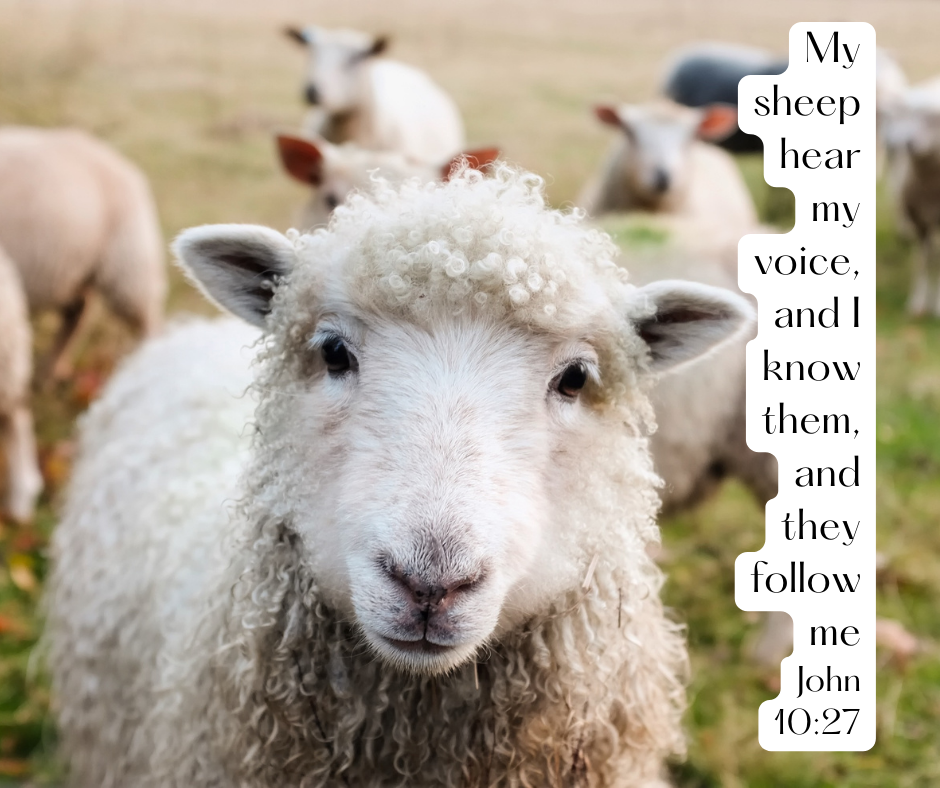
Jesus said, “My sheep hear my voice . . .” (John 10:27). They know Him and are known of Him. They are tuned into His heart and the words that flow from there.
Others around may not believe. Naysayers and the world may not be interested in hearing what He says. But when His voice speaks, our ears and our hearts need to be receptive to His truths.
In our age, people have made themselves susceptible and open to many things, doctrines, and voices. But our relationship and closeness to the Lord should want more. More than what others seek. And more than a quick fix or a drive-thru Sunday sermon.
The intimacy we have in knowing Him and being known by Him should keep the ears of our hearts in ready anticipation of Him speaking. Stay open, my friend, to the sound of the Savior. Stay receptive to His voice, because what He says is always in line with the Father (John 12:49-50). When He opens His mouth, it is never frivolous but always with the purpose of teaching, exhorting, healing, delivering, and so much more. When His voice is heard, it is to guide us, as our Good Shepherd, through our days, our decisions, and our destiny in Him.
So, how do we get better at staying open to the sound of the Savior? Here are a few steps you can begin to implement today.
Prioritize what you allow in the hearing of your space throughout the day. Everything you hear is not good for you. As much as depends on you, you can choose to filter what you willingly listen to. Not only are we encouraged in Philippians 4:8 about what to think on, but God’s Word in general stands as the ultimate filter to the noise that tries to enter our space daily. We do not have to entertain contrary speech. Tune in to what is truly important and tune out what is not.
Give opportunity and make room for His speaking. Position yourself with the opportunity in mind that I want to hear from Him. Whether through His Word, sermons, or other means, we are welcoming His voice in the environment of our daily living. In our hurried world that is cluttered with all kinds of noise, it is our responsibility to make sure that we have quiet time to do just what Mary did, and that was to just sit at His feet and listen.
Hear not only with your ears or through the words you read on the page but hear with your heart. Many can hear but do not perceive. Many heard Jesus speak audibly in the crowds but the words He spoke were never ingested into their very being, causing Him to say, “Who hath ears to hear, let him hear” (Matthew 13:9). Like in the parable of the Sower, the soil of their hearts, the place that nurtures the seed/word, must be good ground and receptive (Matthew 13:3-23). Jesus speaks for challenge and for change, but none of it will do any good if the listener is not willing to take it in and recognize it for the truth that it is.
Steward His words well. When you hear, what do you do next? When it is taken in, see how this applies to you now or in your present circumstance. What is the takeaway? What can you do with what you have heard? Jesus never speaks with the intention of His words being placed on the shelf like a forgotten piece of beautiful artwork. It is to be used, applied and lived out in one’s life. He said, “Therefore whosoever heareth these sayings of mine, and doeth them, I will liken him unto a wise man, which built his house upon a rock” (Matthew 7:24).
Friends, what Jesus speaks is for the instructing and building of our lives. He said, “The words that I speak unto you, they are spirit, and they are life” (John 6:63). Stay open to His voice, receive what He says, and follow Him. The voice of the Shepherd is calling out to you today.
More articles of interest to help you on your journey to better hear from the Savior:
“But your eyes have seen all the great acts of the Lord which he did.” Deuteronomy 11:7
How would life look for us, or how much more would our faith be fed if we were intentional about remembering “the great acts of the LORD?” We don’t need to see the seas part, the ground opened to swallow, or mighty plagues – but surely, there are moments in our lives when we know that it was nothing but God. There are miracles, blessings, the moving of His holy hand, and His Holy Spirit that could be nothing short of His intervention for us.
As Moses recaps God’s commandments in Deuteronomy for the wilderness wanderers, he also wants them to remember personally what their eyes have seen, the things they have experienced during this time with God.
Days gone by supply us with a life full of the stories of His deliverance, His patience, and His constant and consistent work in our lives. Sometimes too numerous to tell, but when we think back, our eyes of faith behold them and we see that it is nothing we have done, nor can we take the credit. We see a God who has done more to love us, so this is where our trust should lie. This is where we should look in hope also for the days coming ahead.
If you look back into your bygone moments, what can you see? Can you see His hand showing up unexpectedly in a moment of grace? Can you see where His mercy touched what was once believed to be untouchable? Can you see where His promises came alive more vividly when you thought it was all over?
There are big things and there are small things – events and seasons that grow our appreciation all the more for the wonderful God we serve.
It takes nothing more than for us to simply appreciate that our eyes have awakened to a new day, and our lungs are breathing what He provides, to see God’s wonderful acts at work in our lives even right now.
His presence and concern for us are marked by the care He invests in us. Every prayer is heard. Every prayer responded. The feelings of His love wrapped around us – yes, He is there.
Even in times of tears and upset, His comforting presence saturates the atmosphere with His reassuring peace.
Throughout your life your eyes have seen many things and many things have been your experiences. Some may have been wonderful and good. Some may not have been. But if you pick through all you have witnessed, your testimony would call to mind: “I have seen the great acts of the Lord in my life.” In that, God’s faithfulness and neverending love for you shines through, holding you in faith through the days when it’s hard to see anything positive.
Take a walk down memory lane today and see those moments where He has faithfully made a way. Pray for God to show you Him in that walking and may your faith be increased as you take in the great acts of the Lord, for wherever He is, it is always great.
“I will remember the works of the Lord: surely I will remember thy wonders of old.” Psalm 77:11
Please Note: Ads below or referenced on this site are prefabricated and mass-produced (of which I currently have no control over) and DO NOT necessarily represent the views and/or beliefs of this site and its admin.
I recently attended an event where the fathers of our organization were looked to, recognized, appreciated, and honored for their contributions to the faith and the church body. In an age, where sadly, there seems to be an absence of good, godly role models, I am reminded, currently speaking, that we are never without wholesome examples to pattern our lives and walks of faith after.
In the Bible, the children of Israel did not always have current, good representatives to follow. King Hezekiah, for example, had the wicked King Ahaz as his biological father. But as Hezekiah grew and came to reigning as king at the age of twenty-five, he didn’t follow in his birth father’s footsteps. Through him, a great reformation took place in the land because his heart was stirred to do more and for that, he looked to better examples. 2 Kings 18:3 says, “And he did that which was right in the sight of the Lord, according to all that David his father did.”
Hezekiah reached beyond the experience of those around him and those who raised him to find a good life to pattern his ways after. And yes, David, like all humans, had his moments of weakness and frailty, but in the end, was still dubbed a man after God’s own heart (1 Samuel 13:14; Acts 13:22). David’s heart was directed toward God and this is what Hezekiah wanted for himself and for the people.
He recited to the people the evil their fathers have done (2 Chronicles 29:6-9; 30:6-9) and pled with them to return to the God of Abraham, Isaac, and Israel – the same God who the faithful fathers followed and not the practicing of current affairs or political influences.
Even if one is devoid of what we would call a good example in their present life and circumstances, we have what the Bible calls a great cloud of witnesses (Hebrews 12:) whose lives we can look to as a holy example to follow after. And of course, Jesus Christ is the litmus test that everyone should judge their steps by and seek to represent in their own lives and order their steps after (Hebrews 12:2).
“For even hereunto were ye called: because Christ also suffered for us, leaving us an example, that ye should follow his steps.” 1 Peter 2:21
“Brethren, be followers together of me, and mark them which walk so as ye have us for an ensample.” Philippians 3:17



















 Word For Life Says...