Christian inspirational cross picture for redemption and deliverance, Isaiah 43:1

Redeemed.

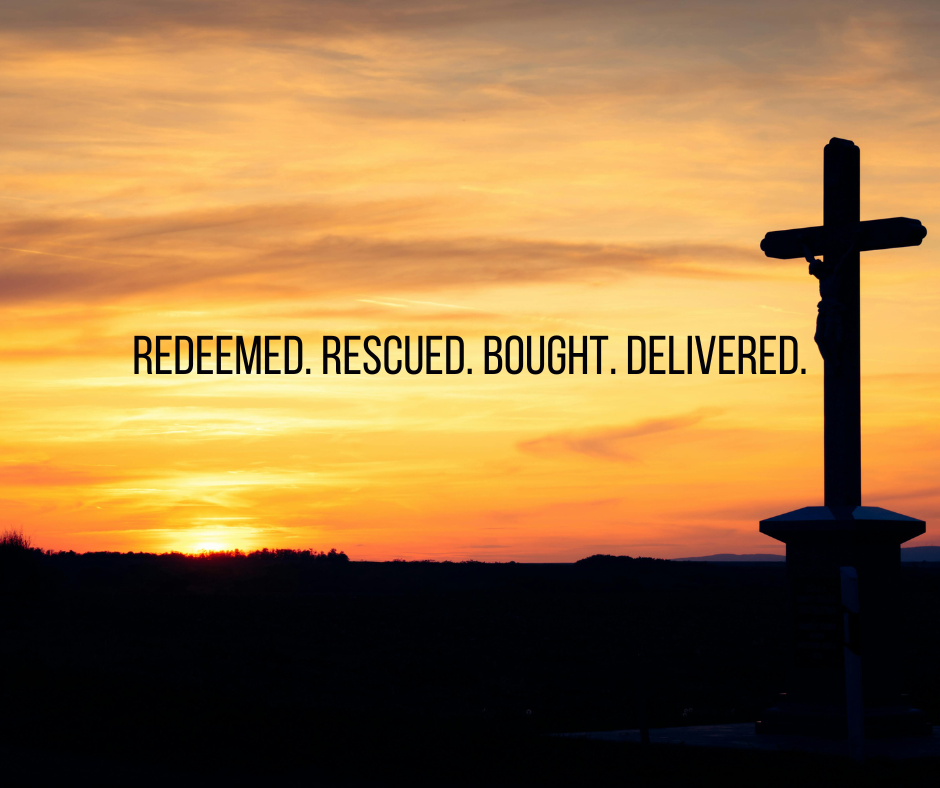
Redeemed. Rescued. Bought. Delivered.

All these words speak beautifully of the testimony of what I was brought out of. For if the conditions were optimal, then there would be no need for the rescue. If I was good where I was, there would be no need for a recovery.

History has repeatedly proven that there is a vast void one experiences in the life that is lived outside of this holy renewal. There is an intense longing that says, I need saving. And saving, He did.

Crushed and broken, Jesus gave His life for mine. The sacrificial atoning exchange took place. Not for me to question or be in doubt, but to walk bravely in the paths He has ordained for me. Not to fear, but with confidence, He instilled in me the strength to stand toe to toe with what is before me, declaring, I can, because He did.

In His redemption, I can experience a life that I would have never imagined. Not one centered around the benefits of the gains this world offers. But it is because of the blessing of newness of life He presents to me.

Those words, “being redeemed,” speak to me and comfort me, telling me of His surrender and offering of Himself. He paid for what I could not.

Image by Tumisu from Pixabay

It was my life that needed the change. Still, He arranged it so that I would be the one to reap the benefits of the seed of Himself sown (John 12:24). That I might be a part of the fruit of that vine (John 15:5), attached to Him, nourished by the flow of life therein, and brought up that I might live eternally with my Savior.

Only His atoning work makes this possible. When He reclaimed my life with the giving of His, the longing has been satisfied, and the rescue has been eternally made. My path before I encountered such grace and mercy was dismal at best. But when He died for me and invited me to take of Him, my soul said, yes. And now I have been captured by this gift of love.

Take in, dear friend, all that He offers you. Take in His love. Take in His being. Take in His gift of deliverance, for it is an incredible feeling when He declares such a loving action fulfilled in your life. And you will never be the same again.

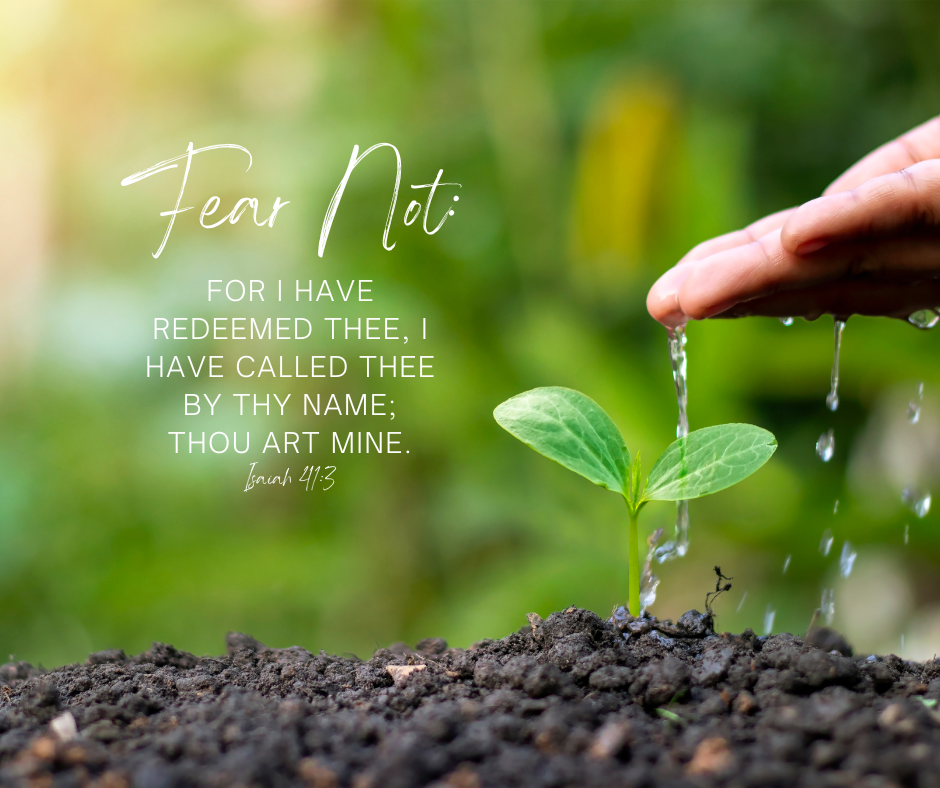
“…Fear not: for I have redeemed thee, I have called thee by thy name; thou art mine” (Isaiah 43:1).

Sometimes a knight in shining armor just won’t do. You need the most powerful of the land, the King; Almighty God, to come to the rescue. Nobody can help you like He can. Nobody can love you like He can. Nobody can save you like He can. We need the King! Turn to the King – He’s waiting for you!

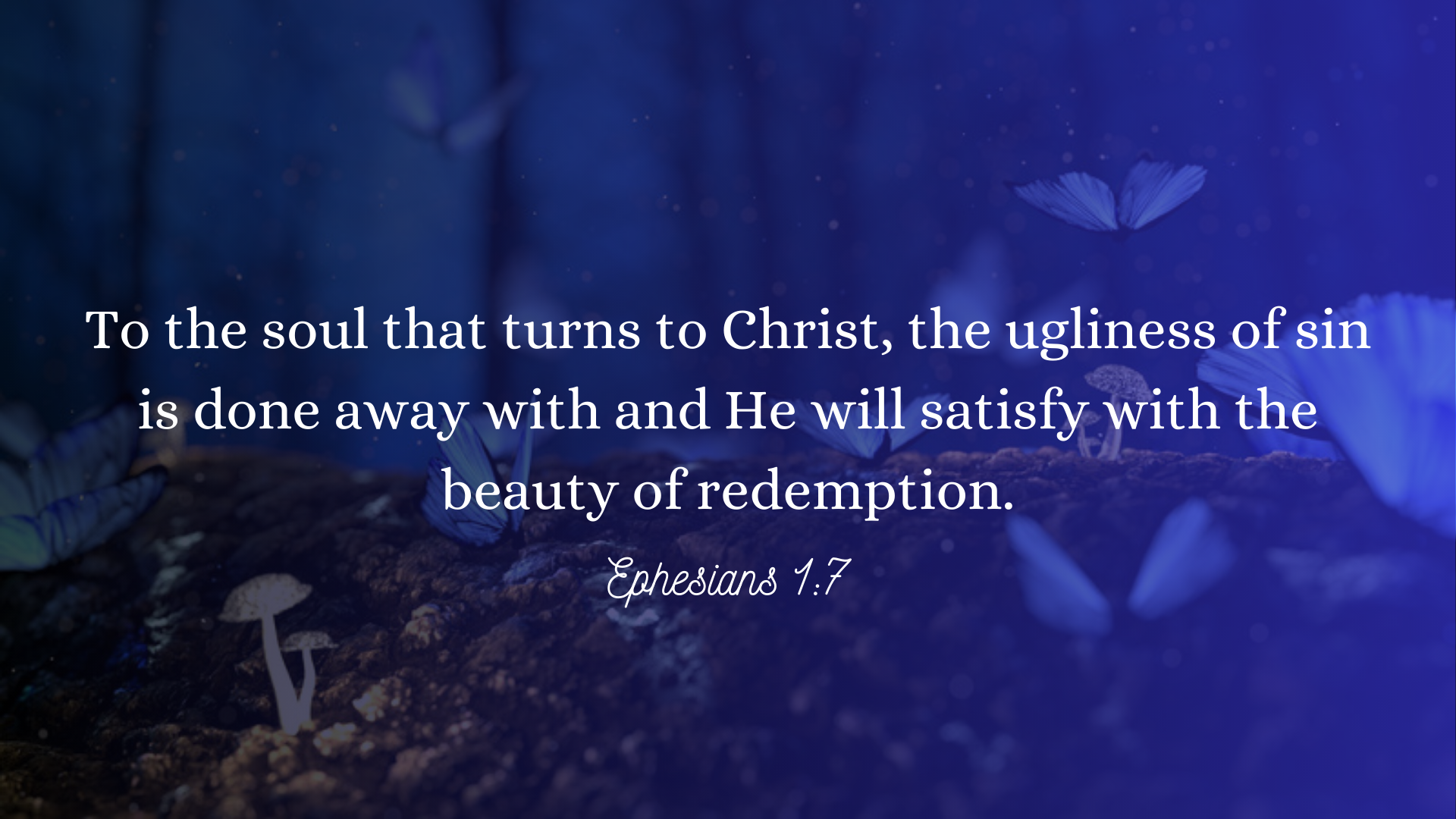
Corrie Ten Boom reminds us, “There is no pit so deep, that God’s love is not deeper still.”  To the soul that turns to Christ, the ugliness of sin is done away with and He will satisfy with the beauty of redemption.

Oh, what a day that will be! The chains and the shackles of this world will be permanently loosed and true freedom will come once and for all. God’s people will rise to reign in victory because the Redeemer has come!

Even if things don’t look like their turning in your favor.
Even if today doesn’t look better than yesterday.
God, your Redeemer is alive and in charge. No matter what it looks like right now, believe HIM through it all!

Navigating Thorny Places

Here we go again.  At the rear end of my backyard stands a wide, tall, bush-like tree extending forward eleven feet, and who knows how many feet wide along the back fence.

Moving into this house, it was one of the drawing factors because it offered complete privacy from the neighbors behind.

But, when a game of playing with any type of ball or frisbee takes place, that flying object will almost always end up lost in the massiveness of this so-called bush tree.  Then, it is up to me to try to climb under, or in, or around this massive monster to retrieve the lost object.

It is not as difficult as it sounds (unless you are afraid of bugs and other critters), except the yard behind me has an over-energetic raspberry patch whose branches have wiggled their way through our massive monster, making navigating it harder due to its thorny reach.

Thorns hurt.  If you have ever grabbed a branch filled with thorns, or a rose, you know what I mean.  If you have accidentally brushed against one of these protruding antagonists, you can feel my pain of having to try to navigate this area and come out unscathed.

But the truth is, my friend, we will not go through this world unscathed.  There are going to be things that hurt us.  There is suffering we may encounter or thorny places we may have to navigate as we travel this road called life.

Jesus said, “In the world ye shall have tribulation…” (John 16:33), yet when afflictions come, we forget these words and those of Peter who said, “Beloved, think it not strange concerning the fiery trial which is to try you, as though some strange thing happened unto you,” (1 Peter 4:12).

Why?  Because when it hits us personally, it feels different.  It hits too close to home, and we want to shut the doors on them, yet these hard times, these thorny places, seem to find you anyway.

Knowing that it is all a part of our existence and living on this earth does not make it easier.  But maybe we can learn from others how they navigated their thorny places.

IN THE BEGINNING

Please know, that when God perfectly created this world, our life was intended to be a garden of peace.  We were never supposed to have to deal with thorny places.  But because of sin, because of the curse, Adam was told, “Cursed is the ground for thy sake; in sorrow shalt thou eat of it all the days of thy life; Thorns also and thistles shall it bring forth to thee…” (Genesis 3:17b-18a).

Where there was no sorrow, now sorrow exists.  Where there were no thorny places, now they have come forth making what we have to do here harder than God ever intended.

PAUL’S THORN

The Apostle Paul knew personally about thorns.

Paul’s resume is doubtless impressive. In addition to having authored two-thirds of the New Testament – his missionary journeys, works, and miracles allowed him to not only see things but also inthe supernatural workings of the Lord in his life.

Through it all, he could have boasted (Philippians 3:4-6), yet he stated in Philippians 3:8, “I count all things but loss for the excellency of the knowledge of Christ Jesus my Lord… and do count them but dung, that I may win Christ.”

After rehearsing the measure of suffering he had endured for the ministry (2 Corinthians 11:22-29), he stated, “If I must needs glory, I will glory in the things which concern mine infirmities,” (2 Corinthians 11:30).

Although he experienced “visions and revelations of the Lord” (2 Co. 12:1), some where he was “caught up to the third heaven” (2 Co. 12:2), “into paradise, and heard unspeakable words, which is not lawful for a man to utter” (2 Co. 12:4), he knew it would be a foolish thing to boast (2 Co. 12:5,6).

As if to draw a line in the sand, Paul was given “a thorn in the flesh” to prevent any measure of self-exaltation that would cross the lines of humility and usefulness where he stood. 

Jesus taught in parables regarding thorns that would encumber and choke one’s progress in the word of God “through cares and riches and pleasures of this life” preventing them from coming to a place of fruitfulness (Luke 8:14).

It would seem as though, for Paul’s spiritual benefit, a thorn was used to keep him in a place of fruitfulness rather than from it.

THE THORNS OF JESUS

Thorns are not easy for anybody to bear with.  Through the humiliation and suffering of our Lord Jesus Christ, before His crucifixion, as if to add insult to injury, He was given thorns that would tear into His literal flesh: “And they clothed him with purple, and platted a crown of thorns, and put it about his head,” (Mark 15:17).

His thorns were not to keep Him from being exalted, for God would ensure His name is exalted above every name (Philippians 2:9-11).  Anything revolving around the crucifixion and the cross, including the thorns, was to identify with and for the man (humans) He came to save, and to be obedient to the will of God, although being equal with God, Himself (Philippians 2:6-8). 

Hebrews confirms that Jesus felt and experienced the fullness of humanity (yet without sin) while maintaining His full deity (Hebrews 4:15).  That includes the sufferings that came with it all, and the thorns as well.

When trying to move through the difficulties of life, how do we do it?  It is always easier to tell one about what they’re going through and what they should do, but the hows of knowing a way to move through these prickly patches is a whole other story.

Thankfully, the Bible and the lives of how these two thorn-bearers handled the inflictions upon them can help.

LEAN ON GOD’S SPIRITUAL SUPPORT SYSTEM

The same God who has been with you is the same God whose grace sustains you.

From Paul, we learn a lot about this.  Although he prayed, as many would, for the thorn to be removed, God’s answer was for His best plan to be carried out in Paul’s life.  And to do that, as uncomfortable and burdensome Paul may view it the thorn must remain.

Even though the thorn was to remain, God gave Paul an answer we can all glean comfort from when we are dealing with our own protruding antagonists: “My grace is sufficient for thee: for my strength is made perfect in weakness…” (2 Corinthians 12:9a)

We will never have all the answers to the ins and outs and the behind-the-scenes going on in our lives.  But we have God, the only true living God, who supplies us with sufficient grace through it all.

God gave him the spiritual support he needed to go through these troubles in the form of grace.  He didn’t answer the prayer in the way that Paul prayed for it, but he was guaranteed that in all that he was encountering, God had a heavenly supply that would keep him in his most useful state.

So often we pray to be useful for God’s kingdom, and yet, the way it comes out may not be at all like we imagined.  But just because we didn’t imagine it this way, doesn’t mean God can’t use it.  Because He can, my friend.  He can.

God told Paul, “For my strength is made perfect in weakness.”  When we think we don’t have much to give.  When we compare our journey to this and that and feel like we come up short, we may be in the exact spot where God can manifest His strength the most.

If we think we have all the answers, as long as we can find sufficiency in ourselves and in our own strength, it is easy to lean on that.  It is not until we know that without Him, I would fail.  Not until we see and rely on God as our all-in-all, can He get the most out of us.

Therefore, Paul’s response was most appropriate: “Most gladly therefore will I rather glory in my infirmities, that the power of Christ may rest upon me.  Therefore I take pleasure in infirmities, in reproaches, in necessities, in persecutions, in distresses for Christ’s sake: for when I am weak, then am I strong,” 2 Corinthians 12:9b-10).

Paul doesn’t celebrate or take pleasure in pain, rather he settles himself in them because of the useful state it allows him to remain in before God.  It’s as if to say regardless of where this leads or what I must endure, I’m choosing to continue in this ministry and leave the outcome to God.

COMMIT IT INTO THE HANDS OF GOD

And for Christ, as He hung on the cross with the crown of thorns upon His head, and saw the angry stares of the people, with their jeering and angry words hurled at Him, He committed the whole process of the cross into the hands of God.

He refused to relieve Himself from it.  He refused to back down.  He persevered through the pain.

When they entered Gethsemane to arrest Him, He could have escaped.  Before they laid one stripe upon His back, He could have called down blindness upon His prosecutors as the angels did at the door of Lot (Genesis 19:10-14).  Before one nail inserted itself into the flesh that would die for all humankind, He could have stopped it but that would not have been in the will of God.

So, regardless of the cost, the pain, and the persecution, Jesus committed it all to God’s hand and submitted to His holy will: “Nevertheless not my will, but thine, be done” (Luke 22:42).  That included the whole package deal of the cross, including every single thorn God wanted Him to feel and wear.

And through His submission came our salvation.

When we release it all into God’s hands, we know it is in a place where it won’t fail from His purpose.  God can do perfectly in one moment what we struggle and strive for our entire lives to accomplish.

The pain of thorny places may make us feel like our world is spinning out of control.  But anything committed into the hands of God will come out the way He orders it, even if it doesn’t look or feel like we think it should.

We all deal with thorns, but it doesn’t mean we are in a place of disfavor.  It could very well be that we are in a place of maximum usefulness.  Where we see weakness, God may see His strength overcoming it.  Where we see thorns, it may be a place where God wants to perform a great work in you.

Text Free Photo by Radovan Zierik on Pexels.com

The Mercy Seat

“And seeth two angels in white sitting, the one at the head, and the other at the feet, where the body of Jesus had lain.” John 20:12

The morning after the high Sabbath had come.  Certain women, of whom Mary Magdelene was one, approached the tomb of their beloved Savior, intent on properly honoring Him with the spices they brought for His body.

Upon arrival at the tomb, the object of their desire for coming was not there.  The body of Jesus, whom they wanted to pay homage to, was gone.

They felt the earthquake, they saw the angel that sat upon the stone that had been rolled from the door of the tomb, and they heard his words: “And the angel answered and said unto the women, Fear not ye: for I know that ye seek Jesus, which was crucified. He is not here: for he is risen, as he said. Come, see the place where the Lord lay,” (Matthew 28:5, 6).

The women were entrusted to share the news with Jesus’ disciples, but one had come back.

Mary, whose encounter with Jesus freed her life of demonic oppression (Mark 16:9), needed to take a deeper look into the tomb, and what she saw may have reminded her of God’s presence and work among His people: “But Mary stood without at the sepulchre weeping: and as she wept, she stooped down, and looked into the sepulchre, And seeth two angels in white sitting, the one at the head, and the other at the feet, where the body of Jesus had lain,” (John 20:11, 12). 

Not being a high priest, or any priest for that matter, and never seeing it for herself, but hearing stories of what it may have been like, I wonder if she pondered this question in her heart, “Is this what the mercy seat was like?”

The Mercy Seat in the Old Testament

The book of Exodus describes the meticulous instructions and care to follow on the building of everything regarding the Tabernacle as prescribed by God, including the mercy seat: “And thou shalt make a mercy seat of pure gold: two cubits and a half shall be the length thereof, and a cubit and a half the breadth thereof.  And thou shalt make two cherubims of gold, of beaten work shalt thou make them, in the two ends of the mercy seat.  And make one cherub on the one end, and the other cherub on the other end: even of the mercy seat shall ye make the cherubims on the two ends thereof,” (Exodus 25:17-19).

This is the sacred place of which God said, “And there I will meet with thee, and I will commune with thee from above the mercy seat, from between the two cherubims which are upon the ark of the testimony…” (Exodus 25:22). 

This is the place of atonement, where the high priest would enter with the blood of animals once a year for the sins of the people.

The Mercy Seat in the New Testament

But when Jesus died on the cross, that protocol had been done away with.  The old covenant had been replaced by the new: “Jesus, when he had cried again with a loud voice, yielded up the ghost.  And, behold, the veil of the temple was rent in twain from the top to the bottom…” (Matthew 27:50, 51).

The way that only one man could enter once a year (Hebrews 9:6) had now been opened for all who would believe: “But Christ being come an high priest of good things to come, by a greater and more perfect tabernacle, not made with hands, that is to say, not of this building; Neither by the blood of goats and calves, but by his own blood he entered in once into the holy place, having obtained eternal redemption for us,” (Hebrews 9:11, 12). 

Whether or not what she saw reminded her of that ancient ark, what she saw was the sure sign that the price had been paid once and for all.  Not only for her sins but for the sins of the world (John 3:16) if they would only believe: “For Christ is not entered into the holy places made with hands, which are the figures of the true; but into heaven itself, now to appear in the presence of God for us… but now once in the end of the world hath he appeared to put away sin by the sacrifice of himself,” (Hebrews 9:24, 26b). 

What Jesus’ Fulfillment Means to Us

Mercy, by definition, is God not giving us what we deserve.  We deserved the penalties.  We deserved the price that was extracted through His holy sacrifice.  When He laid down His life, He did so for us, not Himself.

Now, all hindrances are removed.  All excuses, as they say, are nailed to the cross.  Believers far and near have no reason, like Mary, to draw near in complete faith: “Having therefore, brethren, boldness to enter into the holiest by the blood of Jesus, By a new and living way, which he hath consecrated for us, through the veil, that is to say, his flesh; And having an high priest over the house of God; Let us draw near with a true heart in full assurance of faith, having our hearts sprinkled from an evil conscience, and our bodies washed with pure water. Let us hold fast the profession of our faith without wavering; (for he is faithful that promised;),” (Hebrews 10:19-23). 

Paul, in his second letter to the Corinthian church, called God, “The Father of mercies” (2 Corinthians 1:3), and rightly so.  Just a glimpse into any of our lives would reveal how much His love and long-suffering nature have held, blessed, kept, provided, and more, despite our undeserving state.

And still today, mercy is available as we are invited not to draw near to the tomb, but to the throne: “Let us therefore come boldly unto the throne of grace, that we may obtain mercy, and find grace to help in time of need,” (Hebrews 4:16). 

Once the way was not as easily accessible, but now we are beckoned to come.  And not just come, but “come boldly.”  Jesus paid the price for our mercy.  The “new and living way” has been opened.

While the old mercy seat is gone, Jesus Christ has more than satisfied the atoning cost of the new covenant, establishing now, that through Him, is where we find the grace and mercy we need.

Friend, come boldly to Jesus Christ if you need mercy.

“And his mercy is on them that fear him from generation to generation.” Luke 1:50

“But ye are a chosen generation, a royal priesthood, an holy nation, a peculiar people; that ye should shew forth the praises of him who hath called you out of darkness into his marvellous light; Which in time past were not a people, but are now the people of God: which had not obtained mercy, but now have obtained mercy.” 1 Peter 2:9-10

Text Free Image by Arnie Bragg from Pixabay

“Even when…”

I don’t know about you, but I find a certain beauty in “perfection” (and I use that word loosely). What I mean is that when things are where they belong or are functioning as they were designed to, it gives me a sense of satisfaction, a sense of fulfillment when all of the chips fall into their proper place.

But what about when they don’t? When plans don’t go off without a hitch or when a properly cleaned space, that once shone with order becomes an undone mess? How does that make us feel about that job, project, person, or place?

When things are “perfect,” altogether, and nice, without any mess, madness, or flaws, we tend to value those times, moments, and things a little more. But when it comes to people who are less than perfect (hint: that’s all of us), God showed us just how much He values us, and despite our imperfections, He chose to love us perfectly. When we were in our mess of worldly pursuits and fleshly desires, God saw the deepest need of our hearts and souls for a Savior who would heal, reconcile, and deliver people, and He provided the remedy for that need through our Lord Jesus Christ.

There are a lot of things we can do for ourselves, but one thing that is solidly taught in the Bible is that we CANNOT save ourselves. We not only do not have the power, but we don’t possess the capacity for the wisdom, love, understanding, eternity, and everything in between that it takes to not only come up with this plan of salvation but to fully execute it thoroughly, without flaw or failure, from the beginning of time to the very end.

Thankfully, it was God who took the initiative to not only come up with the plan but to implement it fully by His grace to save our souls. And the beauty of the story is, that He didn’t wait for us to get our act together to do it. His love wanted the plan because His love wanted the people. With that, Ephesians tells us, “But God, who is rich in mercy, for his great love wherewith he loved us, Even when we were dead in sins, hath quickened us together with Christ, (by grace ye are saved;)” (2:4,5; emphasis added). 

God had compassion for struggling humanity and refused to leave them tangled in the way of sin without a way out, without a plan for deliverance.  His love would not and could not settle with the very idea of it.  So, when we were at our worst, God was working out His best for us.  Romans 5:8 tells us, “But God commendeth his love toward us, in that, while we were yet sinners, Christ died for us.”

He didn’t wait for us to clean ourselves up and get perfect to put His plan of love in motion.  That is a sheer impossibility regardless. Further proof of that truth comes from 1 John 4:19 which says, “We love him, because he first loved us.” 

With that, we are told, “Even when we were dead in sins…”  Even when we were torn up from the floor up…  Even when our lives contradicted everything He wanted for us…  Even when we were going nowhere fast…  Even when we were enjoying living lives ensconced by the dark…  God stepped in with His plan of salvation and “commendeth his love toward us, in that, while we were yet sinners, Christ died for us.”

Ephesians continues to tell us, that God “hath quickened us together with Christ.”  As our Savior was raised from the dead, God in His saving love raised those who believe to a restored life, a brand new life made possible through Jesus Christ.  God’s rich mercy became our lifesaver tossed out in the sea of sin where we were drowning, to bring us to the shores of His redeeming love.  No, we didn’t deserve it, nor could we earn it on our own merit.  God simply put this plan to save mankind from himself and the enemy of our soul into action because He loved us.  Love was His only motivation.  Love steered Him to take the course of action that put His only begotten Son on the cross in our place.  Love and only love was His reason for everything!

Thus, as believers, we readily recognize this is nothing short of a God-sized miracle worked out in our lives.  For it is “by grace ye are saved.”  It doesn’t matter who you are or what your situation, position, circumstance, or status is in life, the only way one can enter into a renewed relationship with God is through the grace and forgiveness offered through the shed blood of Jesus Christ.  You cannot earn your way into it.  You cannot work your way into it. You can’t bargain your way there, either.  Only by going through the doors of the plan of His grace can you be saved.

What would happen if today God sat down and took account of all the wrongs we have done?  What would it be like if we stood before Him unable to pay what we owe?  Guess What?  We were there!  We could never pay for it. Jesus knew the predicament that humanity was in.  He knew that man could never get himself out of the debt of sin, so through Him, we obtained freedom from the old life we lived through grace, mercy, and compassion as people who do not deserve it but He loved into it.

We could not fathom how many times our accounts would have gone unpaid had it not been for the blood of Christ. But thank God, He acted in love to save us!  Not just us – but everyone who comes to Him in faith regardless of their background.  It is all a work of grace.  It is all done as the ultimate act of love, even when we didn’t perfectly deserve any of it.

When Jesus encountered the young rich ruler who thought he checked off the list of do’s and don’ts perfectly, the Bible said, “Jesus beholding him loved him…” and then disclosed what the young man needed to do before he walked away sad (Mark 10:21). 

God loves us and as any parent who wants the best for their child, He gave us His best even when…

But His best will only work if you and I will do what we need to do and accept it, accept Jesus.

Today can be your biggest turnaround. Today can be your day of freedom. Today, you can turn your even when into a now, and be saved.

A Matthew 6:30 Promise | Words to Live By

Caring for someone is not a trivial thing. The importance of one’s love for you can be felt in what they do for you and by the words and the way they speak over you. The Father’s care for us can be experienced by both. In our daily lives, we see His love manifested in myriad ways. And in His Word, we read what He thinks of us and how important we are to Him. In Matthew 6:30, Jesus confirms this by telling us, “Wherefore, if God so clothe the grass of the field, which to day is, and to morrow is cast into the oven, shall he not much more clothe you, O ye of little faith?” You cannot begin to understand how important you are to God, just trust that you are. And the daily things that concern us are not a worry in the heart of the Father. “He’s got you!” Those words are not just another casual phrase to be tossed about. They are words of promise you can stand upon in faith today!

A Truth You Must Know

Perfection.  Innocent.  Pure and undefiled is how the world stood.  It was beautifully unmarked and untainted from heaven’s sky to the dirt on the ground.

Then came sin with all the diseases that follow its wrong course.  There was now pain and sorrow, hurtfulness and despair.  Perfection has been injured.  What was beautiful has received a scar.  The world was fallen – utterly torn apart (Gen. 3; Rom. 5:12).

Torn apart from its innocence.  Pure no more. 

Torn apart from its Maker.  What would happen now?

Would He turn away and erase it all?  Could the shattered love that spoke of its good still see hope in the end?

He did. 

God didn’t leave the fallen world without an answer to its depravity.  He refused to forget His love for the ones He made.  He made a choice and had a plan to redeem what was broken.  In Jesus Christ, He had the cure: “Who gave himself for our sins, that he might deliver us from this present evil world, according to the will of God and our Father” (Gal. 1:4).

We can look around and measure the world by the wickedness we see.  Or we can look at how much grace was bestowed on you and me. 

In the world, we were far from perfect or right.  In the world, we too groped like people in the night.  But His plan shone a light to help us see that this is not the end of the story for us or humanity (Jn. 3:16).

Friend, if you have fallen, may your eyes upon Him turn.  He has not forgotten you.  God is waiting for your return.  There is salvation ready in His redemptive plan.  Something that could never be earned by any woman or man.  But because His love for us is so real, His only begotten Son became our everlasting seal:

“For it pleased the Father that in him should all fulness dwell;

And, having made peace through the blood of his cross, by him to reconcile all things unto himself; by him, I say, whether they be things in earth, or things in heaven.

And you, that were sometime alienated and enemies in your mind by wicked works, yet now hath he reconciled

In the body of his flesh through death, to present you holy and unblameable and unreproveable in his sight:

If ye continue in the faith grounded and settled, and be not moved away from the hope of the gospel . . .” (Col. 1:19-23)

When we believe, we are redeemed, covered by the ransom’s cost which His holy and undefiled blood has bought (1 Pet. 1:18-19).  That is the truth you must grasp today.  The question is, will you accept the Gift that saves (2 Cor. 9:15; Jn. 3:16)?

“For God so loved the world, that he gave his only begotten Son, that whosoever believeth in him should not perish, but have everlasting life.” John 3:16

“Jesus saith unto him, I am the way, the truth, and the life: no man cometh unto the Father, but by me.” John 14:6

“For all have sinned, and come short of the glory of God.” Romans 3:23

“But God commendeth his love toward us, in that, while we were yet sinners, Christ died for us.” Romans 5:8

“For the wages of sin is death; but the gift of God is eternal life through Jesus Christ our Lord.” Romans 6:23

“Then Peter said unto them, Repent, and be baptized every one of you in the name of Jesus Christ for the remission of sins, and ye shall receive the gift of the Holy Ghost.” Acts 2:38

“Neither is there salvation in any other: for there is none other name under heaven given among men, whereby we must be saved.” Acts 4:12

Jesus said, “I am come that they might have life, and that they might have it more abundantly.” John 10:10

Image by Suanpa from Pixabay

Copyright © Word For Life Says.com articles/lessons/worksheets may not be copied or redistributed without the express written permission of WordforLifeSays.com.  Please see the COPYRIGHT PAGE for more details.  Blessings to you.

Please Note: Ads below or referenced on this site are prefabricated and mass-produced (of which I currently have no control over) and DO NOT necessarily represent the views and/or beliefs of this site and its admin.


Sunday School Lesson – “The Love of God” 1 John 4:7-19


VERSE DISCOVERY: 1 John 4:7-19 (KJV, Public Domain)

Love is a subject very near and dear to my heart.  It is probably one of my most written about topics to express.  And, we find out from today’s lesson that love is the essence of who God is.  We will learn deeply how our love is an identifying factor in proving us to be of Him and it shows the depth of all He feels for us.

In fact, the whole of our human story has been entirely of God’s love for us.  From our beginning in Genesis to the ending of the story to come, God’s love for humanity has been at the forefront of His relational chase of us.  If you have followed me and my writing for any amount of time you have probably come across a time or two an article I have written titled, Know Real Love.  In that I write:

“God loves you! Throughout the pages of the Bible, the overflow of all He feels for us is pronounced over and over again. He has plenty of evidence to mark the extremes of His love for us . . .  in Deuteronomy 23:5, He is noted as reversing a curse because He loves His people. But His ultimate show of love came when He initiated His plan to reverse the curse of sin once and for all. The plan was successful, but it didn’t come without a price. His love for us cost the life of His Son, John 3:16. All that was done so that one day we might experience the joy of what it really means to be loved; such a tender embrace wrapped around us that can’t be felt anywhere else.” (Word for Life Says/Know Real Love).

Because He loves us so, may we extend that same love to one another, is the pleading of this lesson.  We are His real-life examples to a lost world.  We are the only Bible that some people may read in their entire lifetime.  Let the story they see in you and I be one of love.

Think of it, in a world filled with hatefulness, selfishness, and condemnation, I personally believe we can never tire of hearing of the love of God.  And, as Christians we constantly need to be on our toes; to be retaught over and over again the importance that we show that same love God gave to us to one another.

The ugliness of this world’s characteristics DOES NOT have to infect us.  We can shine brighter above it all knowing that we are loved in a special way by Him.  With that knowledge, we too can return what we have received of Him to others.

When we truly know how much God loves us, we can love others better.

God is Love

1 John 4:7-10 “Beloved, let us love one another: for love is of God; and every one that loveth is born of God, and knoweth God.  He that loveth not knoweth not God; for God is love.  In this was manifested the love of God toward us, because that God sent his only begotten Son into the world, that we mighty live through him.  Herein is love, not that we loved God, but that he loved us, and sent his Son to be the propitiation for our sins.”

God doesn’t birth ugliness (nasty characteristics and ungodly traits).  If one is born of God, then as His spiritual children that one should possess the character and nature of their heavenly Father (just as natural children inherit some of the nature and traits of their parents).

False teachers and naysayers will always try to usurp what God wants to do in the life of the Christian and how they ought to live.  In his letter, false teachers are an enemy that John had to deal with and because of them, he had re-educate the people on what God says is true and encourage people to live and follow that truth which revolves, here in this lesson, around love.

As a matter of fact, John opens chapter 4 with this warning: “Beloved, believe not every spirit, but try the spirits whether they are of God: because many false prophets are gone out into the world,” (1 John 4:1).  After that he gives a summation of the contrast between the Christian and the world; “Ye are of God, little children . . .” (1 John 4:4), and “They are of the world. . .” (1 John 4:5).  Immediately following this comparison of who is in truth and who is in error, 1 John 4:6 begins to admonish the saints how we ought to live.  How the love of God is to be manifest in our culture.

Christians are to operate in a love culture for this is what we have learned from our heavenly Father.  For John to keep pushing this key point means there must have been a serious disturbance and dissension going on in the church that made it necessary for this subject’s continual address.  I wonder how many disturbances in our modern-day churches are due to a lack of this godly love culture being produced within its walls.

With that, John writes, “Beloved, let us love one another: for love is of God.”  God loves us – Yes!  Love comes from God – Yes!  Now, the responsibility to share that love falls on the shoulders of the believers; of the body of Christ, the Church.  As Christians, God has lavished on us the best of His love through our Lord Jesus Christ (as well as being offered to the whole world if they will accept Him).  Therefore, as Christians, our relationship with one another should express that same spirit of love because what comes out of us gives testimony to what’s inside of us (see Jesus’ teaching in Matthew 15:16-20).

For a Christian to claim he is of God means that individual should express the same attributes that are characteristic of the God they say they represent.  To be without those attributes is to be without proof of who you say are and whose you say you are.  The things that come out of our life tell more about the real us than any words of the mouth.

In taking up the responsibility to love one another we are daring to stretch out beyond our personal comfort zones to the benefit of another soul in need.  We are putting our faith in action through the course of loving others.  We are pushing past the popular feelings of emotions and commanding of ourselves and our lives to give unto others what we have received from God.  We are personally making it our goal to imitate the Father’s love toward us.

Romans 12:10 tells us, “Be kindly affectioned one to another with brotherly love; in honour preferring one another.”  As brothers and sisters in Christ, we are all of the same holy family.  We share spiritual kindred and as such we should be devoted to one another in well-being and care expressed through a loving relationship as a family should.  Our love for one another is to be marked by fervency (see 1 Peter 1:22) which means we should have an on-fire, zealous love for one another in Christ.

Love is of God; love is from God and He has demonstrated His love toward humanity when He sent his Son into the world, that we might live through him, (see also John 3:16 and Romans 5:8 which we will see later in this lesson as well).  The sacrifice of Christ proved to us (manifested; made clear) and the world how much God loves us and now we are to make that same love evident to all through our daily living and sacrifice.

God is love (vss. 8, 16), something I hinted on earlier.  The word is can be compared to words such as be or exist.  God doesn’t just love.  God doesn’t just have love.  God isn’t just in love with us.  Loving is not just a part of Him.  God is love.  It’s what His entirety is.  Thus, whoever claims to be in an intimate relationship with God and knows God should readily and willingly demonstrate the same character He is.  In contrast to that, he that loveth not knoweth not God; for God is love.

This love relationship we get to experience didn’t start in or with us.  God has been the chaser of mankind since his creation.  Love begins and ends with God as the bookends that hold everything together.

To prove His love, He provided a means for mankind to be redeemed from the rift of sin that has torn apart his relationship with God.  He sent his Son to be the propitiation for our sins.   The fact of the matter is sin destroys.  And, there is no way around atoning (offering of propitiation) for that sin and restoring humanity’s relationship with God outside of shed blood.  Hebrews remind us, “Without shedding of blood is no remission,” (Hebrews 9:22).

With that being said, Christ became that shed blood sacrifice, sent by God, which permanently atoned for our sins.  The Bible tells us, “For Christ is not entered into the holy places made with hands, which are the figures of the true; but into heaven itself, now to appear in the presence of God for us: Nor yet that he should offer himself often, as the high priest entereth into the holy place every year with blood of others; For then must he often have suffered since the foundation of the world: but now once in the end of the world hath he appeared to put away sin by the sacrifice of himself,” (Hebrews 9:24-26), where He not only covered our sins but, took them away forever.

Now, that’s love!  That’s what God’s love looks like!  Therefore, our response should be to love like God loves.

Love Like God Loves

1 John 4:11-13 “Beloved, if God so loved us, we ought also to love one another.  No man hath seen God at any time. If we love one another, God dwelleth in us, and his love is perfected in us.  Hereby know we that we dwell in him, and he in us, because he hath given us of his Spirit.”

Since God showed us the kind of love that would give up His only begotten Son, the command is, we ought to also love one another.  Whatever little meager anything we think we may lose or give up in extending love can never be compared to what God already gave.

Love is the key that opens the door to the reality in showing that we love Him.  God will not dwell in an environment of hate and selfishness.  If those are present, God is not.  If we, as His children, are showing His characteristics of love, then we know that we dwell in him, and he in us.  Love or lack of it is the marker that shows one’s stance in his/her relationship with God.  Anytime the individual or church is not operating in love, they are not operating in God and He is not in the midst.

There is a personal responsibility that John is pointing to for each individual believer to follow.  Approximately 10x’s John uses the word we throughout this lesson alone, not including the rest of his book where there are many, many more instances and identifying words which incorporate and reference the whole body of Christ with the use of words like “us” and “our.”

“We” identifies us.  We” states what we believe.  We,” tells our mission.  “We” also have His Spirit living on the inside of us and as such should operate the way His Spirit operates; in love.

Every true, born-again Christian, must possess the indwelling of His Spirit.  The effective and powerful Christian life cannot be lived out without His Spirit.  His leading and guiding on the inside is the separating factor between us and the world.  The world caters to the things of the flesh while the Spirit hones in on the things of heaven; the things of God.  Therefore, he hath given us of his Spirit and His Spirit should lead every Christian down the path of showing the same love He has shown to us.

1 John 4:14 “And we have seen and do testify that the Father sent the Son to be the Saviour of the world.”

Here, we see the word “we” again.  In this usage of the word, John is speaking from his personal experience with Jesus.  John was not doing a retelling of a story passed down; rather, he was attesting to the real-life knowledge of the ministry he witnessed following Jesus Christ personally for those 3 ½ years.  This is a ministry that he has seen with his own eyes and now lives to tell about it or testify to others.

And, what does he testify?  “The Father sent the Son to be the Saviour of the world!”  How incredibly AWESOME is that!  He knows and witnessed His workings while here on earth that Jesus Christ was no less than the Son who has come to save!  He is the love of God in action!

Jesus Himself told Nicodemus, “For God sent not his Son into the world to condemn the world; but that the world through him might be saved,” (John 3:17). This is nothing short of the ultimate act of love.  This, throughout every facet of His ministry, John gave witness to, testified of and wrote as a record in the books that bear his name.

1 John 4:15 “Whosoever shall confess that Jesus is the Son of God, God dwelleth in him, and he in God.”

Earlier in this same book John wrote, “Whosoever denieth the Son, the same hath not the Father: he that acknowledgeth the Son hath the Father,” (1 John 2:23).  This goes back to his combatting the false teachers and their teachings.  He stated very bluntly in the verse prior to this: “Who is a liar but he that denieth that Jesus is the Christ? He is antichrist, that denieth the Father and the Son,” (1 John 2:22).

Not only are they a “liar,” but have been identified with the “antichrist.”  That’s a heavy dose of truth.  Christians have to be on guard where they are getting their information from and where they are allowing it to lead them.  But he that shall confess that Jesus is the Son of God, God dwelleth in him, and he in God.

The false teachings are out there.  We are to make sure we are following the way of truth in love.

1 John 4:16-19 “And we have known and believed the love that God hath to us. God is love; and he that dwelleth in love dwelleth in God, and God in him.  Herein is our love made perfect, that we may have boldness in the day of judgment: because as he is, so are we in this world.  There is no fear in love; but perfect love casteth out fear: because fear hath torment. He that feareth is not made perfect in love.  We love him, because he first loved us.”

Here, the love issue is unwrapped and exposed for us to understand.  What do we understand?

  1. We know and believed the love that God hath to us. – Before one can dish it out to another, they must believe the love that God has for them. God loves you! We are more than familiar with the John 3:16 statement of love, but what about the Romans 5:8 statement of love: “But God commendeth his love toward us, in that, while we were yet sinners, Christ died for us.” While we were yet in our mess – God loved us so much to send His Son to the cross for us. That’s powerful love!
  2. God is love. – Again, as already has been stated in our lesson, God cannot be separated from the character of who He is.  Love is not what God does, it’s who He is. Now, everything that the world identifies as love does not mean that God is in that.  If it is in opposition to His Word, He ain’t there.  Point blank.  Plain and simple.
  3. He that dwelleth in love dwelleth in God, and God in him. – God’s love was a demonstrative type of love; one He put on display through action, particularly in the sacrificing of His Son. In John 15:13 Jesus said, “Greater love hath no man than this, that a man lay down his life for his friends.” He who possesses the same marks of love He did, has the same “God in him.” He that lives in the life of love lives in God.
  4. Perfect love – We can experience His perfect love.  When the day of judgment comes we can stand with no fear in us because we have already been covered by His love. Therefore, we fear no sense of judgment or separation.  Romans 8:38-39 reminds us, “For I am persuaded, that neither death, nor life, nor angels, nor principalities, no powers, nor things present, nor things to come, Nor height, nor depth, nor any other creature, shall be able to separate us from the love of God, which is in Christ Jesus our Lord.” There is no fear in His perfect love.  Perfect love casteth out fear, therefore if any remain in fear he is not in love and needs to reevaluate their relationship with God. “For ye have not received the spirit of bondage again to fear; but ye have received the Spirit of adoption, whereby we cry, Abba, Father,” (Romans 8:15; see also 2 Timothy 1:7).
  5. We love him, because he first loved us. – Make no mistake about it; humans cannot take credit for this. As already stated before, love originates with God.  “God loves you!”  You, my friends, are so very much and incredibly loved by the King of all kings and the Lord of all lords.  There is so much that we face daily that tries to speak contrary to the blessedness we have in Him.  But, my God loves you with an undying love.  His heart is tied to His people.  His people need only to rest in the promises of His mercy, grace, power, and authority that make their hearts soar on the wings of the hope we have in Him all because He chose to love us first despite our sins and flaws.

And, when we truly grasp the understanding of the love of God for us, then can we learn to love others better.

PDF Printable Sunday School Lesson Pack (With easy to read instructions following the P.E.A.R.L. format on how to conduct each lesson with areas for adding personal notes for teaching): Sunday School Lesson – The Love of God

Object Lesson Ideas:

“How Much Are We Worth?”

“He Loves Me… He Loves Me Not”

“God’s Love Letter”

Craft Heart: Create a simple heart craft that expresses God’s love for them. Simply fold a piece of construction paper in half and cut into the shape of a half heart.  When the students open the heart fully, they can write in the middle “God is Love” and decorate their heart by making designs, or adding stickers, glitter, or other embellishments to it.

Kid’s Journal Page: Kid’s Journal Page – The Love of God

Adult Journal Page: Adult Journal Page – The Love of God

Memory Verse: The Love of God Memory Verse
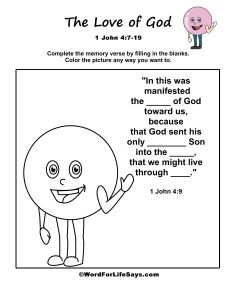
Draw the Scene: The Love of God Draw the Scene

Word Search: The Love of God Word Search  Answers: The Love of God Word Search Answers

Crossword: The Love of God Crossword  Answers: The Love of God Crossword Answers

Word Scramble: The Love of God Word Scramble  Answers: The Love of God Word Scramble Answers

Additional Activities/Resources/Links:

“Love Bible Printables” (Yes, printables!  Originally for Valentines Day but goes very nicely with today’s lesson.  Enjoy!)

“Bible Lessons, Crafts and Activities about Love” (Several to choose from that can be nicely incorporated in this week’s lesson.  Enjoy!)

“Love One Another” (How does making “friendship stickers” sound?  This and another activity can be found on this link.  What a creative way to show love!  Enjoy!)

“Love One Another” (A creative classroom project which involves a big red heart and students’ self-portraits.  Very nice!  Enjoy!)

“Heart Crafts” (Several for Valentine’s Day that can be used creatively for our lesson.  Enjoy!)

“As I Have Loved You” (Children’s Bible lesson and activities with printable sheets and group activities that include a “Sucker Relay,” “Bubble Popping,” and more.  Enjoy!)

“Teaching Kids How to Love God and Love Others” (Sunday School Lesson Help)

“Love Bible Verses for Children” (Easy printable activity for kids.  Enjoy!)

“Love One Another Printable Mobile” (AWESOMENESS!  ENJOY!)

“Love Crafts” (Many unique love crafts to choose from that can be adapted to today’s lesson.  Click to check it out.  Enjoy!)

“Three Bible Stories that Teach About Love”