

Sunday School Lesson – “The Christian Race” Hebrews 12:1-13


Photo: Pixabay

VERSE DISCOVERY: Hebrews 12:1-13 (KJV, Public Domain)

On your marks.  Get set.  Go!  Once you have accepted Jesus Christ into your life as your personal Savior you have officially entered the Christian race.  The prize is before you and the contests are around you, and the only way to make it to the finish line is by focusing on He who paved the way before you.  The struggles may seem hard at times, but Jesus promised, “He that shall endure unto the end, the same shall be saved,” (Matthew 24:13).

Endurance is the key and although troubles seem to catch us off guard, we are reminded that we are not the only ones suffering; we are not alone in our pursuit to live like Christ and yet face adversity.  Others have gone before us, including our Lord.  Let their testimony encourage the weary and faint of heart to press on through the contentions of this life that we may gain the crown of life in the next.

Our Focus

Hebrews 12:1-4 “Wherefore seeing we also are compassed about with so great a cloud of witnesses, let us lay aside every weight, and the sin which doth so easily beset us, and let us run with patience the race that is set before us, Looking unto Jesus the author and finisher of our faith; who for the joy that was set before him endured the cross, despising the shame, and is set down at the right hand of the throne of God. For consider him that endured such contradiction of sinners against himself, lest ye be wearied and faint in your minds.  Ye have not yet resisted unto blood, striving against sin.”

In the chapter prior to this, we have some of the greatest sources of encouragement recorded not only in God’s Word but in the world.  We have, as the people of God, dubbed it the Hall of Fame of Faith; and, rightfully so.  In that chapter, we see a concentrated version of God’s mighty acts performed through and for those who followed hard after Him in faith.  Their stories are amazing, and their examples are a testimony of how to do life while still holding on to the promises of God; how to make it to the end even when some personally didn’t see the fulfillment of said promises.

These people who have gone before us can testify that the road wasn’t always easy.  They can tell their story of how they tried to do the work of God and people acted adversely toward them and did not respond the way they had hoped, or the trials they faced on the way to their particular promise were heavy at times.  They can let the cat out of the bag about how they were mistreated, used and abused because their desire was to fulfill the call of God on their lives.  They are a “great cloud of witnesses” that can testify and say, “I’ve been there and done that.  Just hold on to God’s unchanging hand and He will see you through.”

“Let us lay aside every weight, and the sin which doth so easily beset us.”  Most Olympians and accomplished runners in any race strive to enter the competition with as little baggage as possible.  Clothing is kept to a minimum, as much as decency will allow.  Preparations for physical strength and the shedding of unwanted weight that can prove to be a hindrance were made before one foot touches the starters block.

Why?  To give the athlete the best possible chance of winning.

Jesus wants us to make it to the end of our race.  He wants us to come in victorious as the winners He knows we are in Him.  That can’t happen if we allow people, and stuff, and sin bog us down.  The feet that were meant to run like they had wings attached rather sink as if stones were wrapped around their ankles.  Therefore, the author of Hebrews commands us to “lay aside” everything that wants to hold us back; everything that stands as an obstacle to our spiritual success; everything that works against our salvation preventing us from experiencing the fullness of joy we have in Christ Jesus.

Those in this world compete for trophies, but our competition in our Christian race is for a prize this world can’t offer.  We must do as Paul instructed and, “press toward the mark for the prize of the high calling of God in Christ Jesus.” (Philippians 3:14).  We can’t do that carrying the extra “weight” of worries and “sin” of this world.

“Let us run with patience the race that is set before us.”  Notice the word “us” written here.  That word is inclusive and tells us that we all have our own race to run that is “set before us.”  The track I am on may not look like yours, but we’re still in this together, each running the course that’s ahead of them.  The things I fight with may not be the same for you, but we are altogether battling against things that try to stop our progression in Christ.

This was especially true for the original readers of this letter who were suffering through times of persecution and hardship.  I can imagine some lying awake at night or hiding out in some undisclosed location wondering about the promises of God through the murkiness of the pain they were experiencing.  I don’t care what anybody tells you, nobody likes to experience troubles, but the soul that can hold on will see the light at the end of the tunnel.  It may not shine as you supposed it would, but it will be there nonetheless as a testimony to the glory of God working in your life as well.

But, to continue this course, in spite of it all, requires “patience;” endurance.  Going back to the picture of an athlete preparing for the competition, they stretch their bodies past normal limits in order to condition it for the race.  They add on extra time and additional boundaries to push past in order to get their endurance and stamina up so that they can power through the most difficult times.  They mold, shape, and work their bodies to be fit for the fight.

Here, the writer is giving us the same advice in the spiritual.  We must purposely trust God and push past some stuff we see now to build up our faith and give us the strength to make it to the end.  We will never be able to power through the competitions of this life if we don’t allow our faith muscles to be conditioned for the battle.

“Looking unto Jesus the author and finisher of our faith; who for the joy that was set before him endured the cross.”  Jesus, once again, stands as our perfect example of not only how to run the race but how to endure during the process, and one thing I wrote about in a previous article was His “Focus Shift” (I encourage you to read the entire article).  Jesus, while going through the worse thing He could ever possibly endure, didn’t dwell on His current situation or even the enemies at hand, He was more concerned about the welfare of others; He gained a heavenly perspective for souls and salvation that we can only hope to emulate as we look to Him.

Through the trials and tribulations we may face in our own race, we are told to gain a new perspective as well; we are told to shift our focus from ourselves and look to Jesus.  In His life and His obedience, He has gone the road before us to show us how to live and walk in accordance with the Father’s will and never give up.

He is the “author and finisher of our faith.”  He is the originator and completer of our faith.  He is our soul’s pioneer, if you will (a word you often hear referenced when discussing this topic).  He went before us into uncharted territory to gain heavenly ground for each one of us.  Jesus Christ has secured everything we need under the faith umbrella to live this life the way God is calling us to live.

 “Who for the joy that was set before him endured the cross.”  The cross and the process of dying on the cross were ugly.  But, the results that would come from the cross were beautiful and brought joy to the heart of our Savior.  One of my favorite articles written is titled “Reap Rejoicing.”  In that I wrote:

“No one could ever put into words the pain of what it felt like to hang on that cross and bear the sins of the world.  But, as He hung there, with blood pouring down, He was in the gathering process.  That’s why He couldn’t come down because even as He was nailed and left to die, He with great sorrow and tears, was working at gathering that would eventually lead to rejoicing.

What a clear head and frame of mind our Lord kept through it all.  Most of us would have went into survival mode under such duress, thinking of self.  Jesus went to survival mode, too.  Not for Himself rather, “To seek and to save that which was lost,” (Luke 19:10, KJV).”

Therefore, He “endured” the course before Him with “joy” for souls like us and becomes our prime example of how to follow the path of faith.  As the “author and finisher of our faith;” the beginning and end – He showed us how to run our race.

“Despising the shame, and is set down at the right hand of the throne of God.”  The cross was just not about pain, but it was about “shame.”  Jesus hung on the cross naked – shame!  Jesus took on the curse of sin for humanity – shame!  Jesus was abused, beaten, and tossed about as nobody worth considering; just another criminal – shame!  Yet, He took any and all shame that would seek to bind us.  He didn’t give in to the pull to turn tail and run.  He took it all on Himself and completed fully the work of the cross and is “set down at the right hand of the throne of God.”  He finished His race and gained His reward and lives forever to show us how to do it.

“Consider him!”  He “endured!”  He was wrongfully accused and wrongfully abused due to the “contradiction of sinners against himself.”  Jesus spoke rightly when He said, “He that is not with me is against me…” (Matthew 12:30), and at the time of the cross His body bore the marks of their opposition and hatred toward Him – yet, He still refused to give up.  Even when the taunting tongues said, “He saved others; himself he cannot save. If he be the King of Israel, let him now come down from the cross, and we will believe him,” (Matthew 27:42); He held on and endured the cross until He gave up the ghost and ascended on high.

“Lest ye be wearied and faint in your minds.”  Why are we continually told to look to Jesus, to fix our spiritual gaze upon Him and consider all that He went through?  Because His legacy becomes a testament to how one should run this Christian race.  His story becomes a well of strength from which we can draw encouragement from.  His experience becomes the energy that we need to motivate us to press on despite all the adversity that tries to mount attacks against us; that try to move us from our faith.  “But they that wait upon the LORD,” the Bible tells us, “shall renew their strength; they shall mount up with wings as eagles; they shall run, and not be weary; and they shall walk, and not faint,” (Isaiah 40:31).  Consider Jesus that you yourselves to don’t faint in the process of running the race.

When we discussed the previous chapter, the Hall of Fame of faith, in that we see Moses’ character in taking a stand against sin: “Choosing rather to suffer affliction with the people of God, than to enjoy the pleasures of sin for a season,” (Hebrews 11:25).  Standing for one’s faith usually brings about persecution and affliction such as what the readers of this letter were facing.  How far are they willing to go in order to stand for their faith?  There are many in the body of Christ who have borne the harsh ravages of persecution on their own bodies, and even their lives.  There are many who gave all to follow Jesus.  The encouragement is for these readers to stir up their minds, gain strength from the stories of those devoted lives, keep pushing forth, and don’t give up!

Our Discipline

Hebrews 12:5-11 “And ye have forgotten the exhortation which speaketh unto you as unto children, My son, despise not thou the chastening of the Lord, nor faint when thou art rebuked of him: For whom the Lord loveth he chasteneth, and scourgeth every son whom he receiveth.  If ye endure chastening, God dealeth with you as with sons; for what son is he whom the father chasteneth not?  But if ye be without chastisement, whereof all are partakers, then are ye bastards, and not sons.  Furthermore we have had fathers of our flesh which corrected us, and we gave them reverence: shall we not much rather be in subjection unto the Father of spirits, and live?  For they verily for a few days chastened us after their own pleasure; but he for our profit, that we might be partakers of his holiness.  Now no chastening for the present seemeth to be joyous, but grievous: nevertheless afterward it yieldeth the peaceable fruit of righteousness unto them which are exercised thereby.”

“Despise not thou the chastening of the Lord, nor faint when thou art rebuked of him… if ye endure chastening, God dealeth with you as with sons.”  “Chastening” or discipline is part of what we must go through in order to grow and mature in Christ as need be.  There will be times of suffering as we continue to walk our path to go higher in Him.  There will be times when the road traveled will seem like we’re fighting an uphill battle.  There will be times of pain and hardships, but as Romans reminds us, “And we know that all things work together for good to them that love God, to them who are the called according to his purpose,” (Romans 8:28).

Keep in mind, how we view something as working out for good and how God views it could look very different.  Something that may bring us sadness now, God may see a better benefit down the road for our good.  When God looks into the meat of our lives, He’s looking beyond the here and now and the tool that is often used is discipline.

Discipline is rarely seen as being pleasant.  Whether it refers to the bringing of one’s body under subjection for the benefit of exercising and preparing for a race; or, if it is for correction to set one’s course on a right path – hardship in this life is rarely a welcomed companion.

But we are told not to “despise” it as we are reminded that Jesus, the author of our faith, didn’t mount Calvary’s cross by bypassing suffering (see also Proverbs 3:11 and Job 5:17).  He faced it head-on as the Son of God who would redeem mankind from their sins.  Now, we are referred to as sons and daughters of God, and as such should we not take it all in stride when the Father’s molding of our lives involves things we would rather not endure?  Yet, endure we must for one will never reach the finish line of any competition by dropping out.  It’s pushing through despite the pain and the struggle that allows us to reach our eternal reward in victory.

For when God chastens, His only motivation is “love.”  Proverbs 3:12 verifies this by telling us, “For whom the LORD loveth he correcteth; even as a father the son in whom he delighteth.”  Parents don’t want to see their children hurting or sad over a situation no more than God does.  But there are some things that parents can’t allow their children to pursue because, in the end, it will be to their ruin.

God wants us where He is.  He “scourgeth even son whom he receiveth.”  He is our ultimate prize at the end of this race, but we will never get there if we allow the cumbrances of this world to deviate us off that path.  God steps in and corrects the steps we take that we may gain the richer rewards of heaven rather than settle for the less than this world has to offer.  He beckons us to follow the discipline and not to give up.  Allow it to mold you and work for your good to bring about a better end.

Did He not say in Jeremiah, “For I know the thoughts that I think toward you, saith the LORD, thoughts of peace, and not of evil, to give you an expected end?” (29:11). Those words of promise were spoken as the people endured the discipline of captivity.  God always, always, always has the greater good of His people in mind despite what it currently looks like.  Therefore, run the race and “endure hardness, as a good soldier of Jesus Christ,” (2 Timothy 2:3).  Subject yourselves “unto the Father of spirits, and live!”  His correction in our lives is for our good!

He does it for “our profit, that we might be partakers of his holiness.”  Anything we face in this world cannot compare to the joy that we have in Him and the glory that lay ahead eternally.  One can only be a participator of that joy and glory if they are “partakers of his holiness.”  “But as he which hath called you is holy, so be ye holy in all manner of conversation; because it is written, Be ye holy; for I am holy,” (1 Peter 1:15-16).

God wants holiness in our lives and in our worship.  I love a message that pronounces blessings just as much as the next person, but without holiness, it means absolutely nothing in His sight.  We need to come back to the central theme of holiness because the LORD requires nothing less.  It is for our profit and if discipline is what it takes to get us there, then God will have His way because you and I are treasured that much that He wants you to be where He is.

No, it’s not “joyous” at the time of receiving said correction and discipline, but “afterward it yieldeth the peaceable fruit of righteousness unto them which are exercised thereby.”  There have been times when correction was probably necessary for our own lives, growing up or as an adult.  And no, we don’t like it but, we can thank God for where the correction keeps us from.  The paths of sin and wrong choices that could have kept us walking a road that yielded anything but “righteousness.”  It could have kept us bound in sin.

Children don’t usually rejoice due to correction and discipline.  When parents send a correction in the way of a child it is to prepare them for life up ahead.  When God sends discipline for each of us, we become like trees fit (trained, “exercised thereby”) due to pruning to prepare us to yield “fruit” that will carry over into eternity.

Our Race

Hebrews 12:12-13 “Wherefore lift up the hands which hang down, and the feeble knees; And make straight paths for your feet, lest that which is lame be turned out of the way; but let it rather be healed.”

Be encouraged through it all!  Get in there and run this Christian race!  Don’t let defeat win.  Don’t let the hardships knock you out of place, robbing you of the goal at the end.  If you feel down, get back up, strengthen yourself, and keep on running that your soul may be “healed.”  Jesus is waiting at the finish line.

We can be so easily swayed this way and that with the moving of our circumstances and our emotions and just plain old life itself.  But Jesus, “the author and finisher of our faith;” our perfect example, never let anything sway Him from the righteous path.  He never let anything drag Him off course from where God wanted Him to be.  As a matter of fact, He repeatedly let us know “For I came down from heaven, not to do mine own will, but the will of him that sent me,” (John 6:38).  And yes, He suffered through it all, but suffering didn’t win, and discouragement didn’t stand a chance against the will of God planted so deeply in Him, ergo He ran His race unhindered.

The writer of Hebrews is teaching his readers and us the same valuable life lesson.  Everything will not always seem to work in our favor (despite the barrage of popular messages that tell otherwise), but “make straight paths for your feet;” look past the obstacles that try to obstruct your view from the finish line and stay wholly focused on Him who is our spiritual forerunner.  Follow His lead who endured already and “ponder the path of thy feet, and let all thy ways be established,” (Proverbs 4:26).

Remember, others are watching your race so run that they too may be encouraged to keep going and not be “turned out of the way.”  May they press on to receive healing for their souls as well.

Sometimes the things we deal with get hard.  Trials and tribulations are nothing to sneeze at, but we must make the decision to respond the way Jesus did and to not let it frustrate us from everything that God has for us and want us to do.  If you keep your eyes firmly fixed on Jesus, you can make it to the end of your Christian race.

PDF Printable Sunday School Lesson Pack (With easy to read instructions following the P.E.A.R.L. format on how to conduct each lesson with areas for adding personal notes): Sunday School Lesson – The Christian Faith 

Suggested Activities:

Object Lesson: “Run the Race Object Lesson”

Video Links: 

“Running the Race Youtube Video/Skit Guys”

“Derek Redmond Inspiration Video/Never Give Up”

Adult Journal Page: The Christian Race
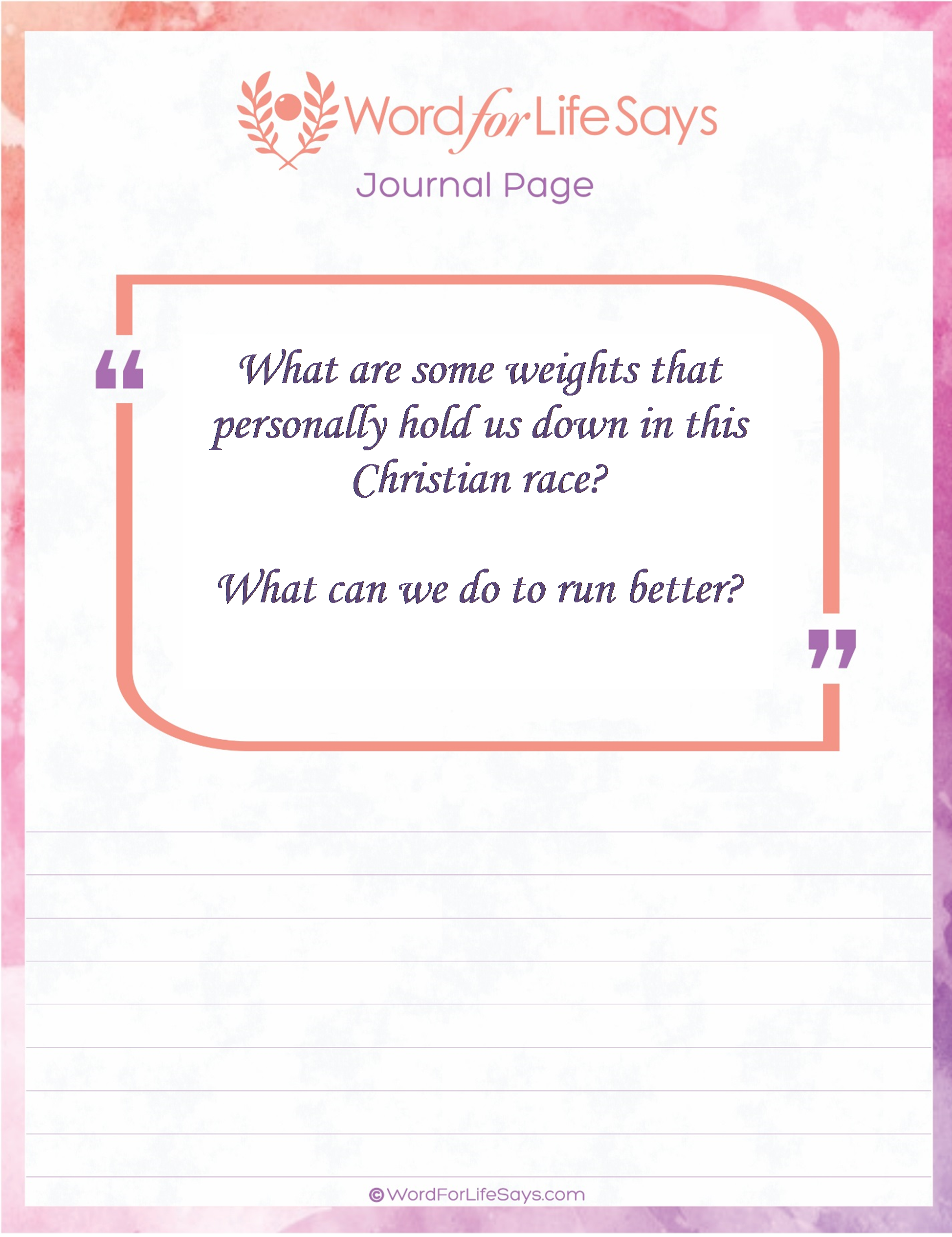
Kid’s Journal Page: The Christian Race

Blank Journal Pages (to cover what points you prefer to bring out):  Blank Adult and Kid’s Journal Pages

Draw the Scene: The Christian Race Draw the Scene

How Many Words: The Christian Race How Many Words

Memory Verse: The Christian Race Memory Verse


Word Search: The Christian Race Word Search  Answers: The Christian Race Word Search Answers

Crossword: The Christian Race Crossword  Answers: The Christian Race Crossword Answers

Word Scramble: The Christian Race Word Scramble  Answers: The Christian Race Word Scramble Answers

“Perseverance” (opening Marshmallow Toss activity)

“What the Olympics can teach us about Christianity”

“Pressing for the Prize” 


Sunday School Lesson – “A Sheep or a Goat?” Matthew 25:31-46

Photo: Pixabay/Zahaoha

VERSE DISCOVERY: Matthew 25:31-46 (KJV, Public Domain)

Much of our culture is self-seeking and gives evidence to a heart that is far from the heart of God.  And, as time goes by it seems to infect more and more like a disease that won’t be snuffed out.  But snuff it is what God is asking for as we raise for ourselves flags of surrender to be waved in service for Him toward others.  That we give up of us and pour out all for Him; that we show the world a thing or two about true love; true appreciation to a Savior who poured out all for us.

The Bible tells us, “In all things shewing thyself a pattern of good works…” (Titus 2:7).  It’s time for a new pattern to be laid.  The foundation of self must dissipate, and new groundwork needs to be found on who He is the head of our life and all that He has already done.  It’s time to show the world a different lifestyle.

The Bible assures us, “That they do good, that they be rich in good works, ready to distribute, willing to communicate; laying up in store for themselves a good foundation against the time to come, that they may lay hold on eternal life,” (1 Timothy 6:18-19).  In that, we see that our service toward one another matters and what we do or do not do for others on behalf of our Lord  – the impact of it can even show up in our eternal reward or eternal punishment.

In this lesson, Jesus teaches the difference between the two.  He shows His disciples the difference of being classified as a sheep or a goat.

 When the Son of Man Comes

Matthew 25:31-33 “When the Son of man shall come in his glory, and all the holy angels with him, then shall he sit upon the throne of his glory: And before him shall be gathered all nations: and he shall separate them one from another, as a shepherd divideth his sheep from the goats: And he shall set the sheep on his right hand, but the goats on the left

Today’s lesson is known to be a part of The Olivet Discourse which begins at Matthew 24:1. Throughout this “discourse,” Jesus is telling or prophesying of times to come.  He even foretold of the destruction of the temple which would occur in A.D. 70 (see Matthew 24:1-2).

I absolutely love how this portion of the discourse begins with the word “when.”  Not “if,” but “when.”  And the “when” that is being referenced is the second coming of Jesus Christ.

Jesus is coming back!  Point blank.  And, one’s eternity is measured by how they lived on earth.

A large part of biblical preaching and teaching is focusing on and preparing people for the return of Christ that they might reign with Him when He comes.

When some look down through the pages of history, they don’t see the chain of events that ushered in the plan of salvation for mankind.  They believe or don’t believe based off what they see with their natural eyes and their short-sighted minds and/or ideas. They don’t see the promise of the good to come that God has already laid up for our futures. They don’t see the fulfilling prophecies that brought God’s kingdom closer to man.  When they look down through history all they see is a normal course of events.  They don’t see this beautiful, epic love story where God tries to woo mankind back to Himself.

But, rest assured, there is a future after this and Jesus says “when” the time comes, this is what’s going to happen.  The events that He speaks of are truths that are still unfolding.  We haven’t seen it all yet, but it’s coming.

The Bible reassures us, “For the Lord is not slack concerning his promise, as some men count slackness,” (2 Peter 3:9a).  We are also told, “For the vision is yet for an appointed time, but at the end it shall speak, and not lie: though it tarry, wait for it; because it will surely come, it will not tarry,” (Habakkuk 2:3).

Know this, every word of God, for good or bad, for happy or sad, for those who believe or for those who don’t believe, will come to pass!  For right now He is withholding His hand of judgment so that as many people as possible can be saved.  For us and everyone out there, there is hope for salvation.  God’s waiting won’t add to the demise of people as in the.  Rather, His “longsuffering” is because He is “not willing that any should perish, but that all should come to repentance,” (2 Peter 3:9b).  Will all come and accept a relationship with God through Jesus Christ?  No.  But God loves mankind so much that He wants to get as many people as possible out of the waters of sin that seek to drown them for all eternity.

And, although He has held off, eventually, judgment will come.  2 Peter 3:10 says, “But the day of the Lord will come as a thief in the night…”

Here, in this lesson, we see we have a King, and the King is coming back.  A time of judgment takes place; a division from those who believe and those who don’t believe; from those who are considered righteous and those who are called cursed: the sheep and the goats, if you will.

“When” this takes place, our lesson tells us “the Son of man shall come in his glory, and all the holy angels with him, then shall he sit upon the throne of his glory.”  Daniel paints a very similar picture to the one Jesus is describing.  He writes, “I saw in the night visions, and, behold, one like the Son of man came with the clouds of heaven, and came to the Ancient of days, and they brought him near before him.  And there was given him dominion, and glory, and a kingdom, that all people, nations, and languages, should serve him: his dominion is an everlasting dominion, which shall not pass away, and his kingdom that which shall not be destroyed,” (Daniel 7:13-14).    

Here, we see Jesus obtained His dominion and declaring His reign in these verses and was found sitting “upon the throne of his glory.”  Have you ever read a story when a king rides up in battle with his armies, obtains the victory and sits down on the throne declaring his rule?  This is the picture that comes to my mind when I read this verse.  Jesus, the King of all kings, comes with His entourage of angels; His armies of heavenly hosts and sits in His place of honor where He will rule and reign forever into eternity.

He is that prophesied “righteous Branch, and a King shall reign and prosper, and shall execute judgment and justice in the earth,” (Jeremiah 23:5; emphasis mine); and here it can be said, “Let the judging commence.”

“Before him shall be gathered all nations: and he shall separate them one from another, as a shepherd divideth his sheep from the goats.”  When He does return, as already stated, a judgment will commence, and this judgment should be taken seriously for in it those living for Christ will be blessed and those who are not shall be condemned.

Here, He is gathering “all nations,” meaning no one on the face of this earth will be exempt from this judgment.  Everyone will be examined, and everyone will be separated “as a shepherd divideth his sheep from the goats” according to how He classifies them.  Psalm 4:3 lets us know, “That the LORD hath set apart him that is godly for himself…”

We see here, those who are classified as being “sheep” are placed “on his right hand.”  Repeatedly in the Bible, we see the phrase “at the right hand” is used.  For example, in the Old Testament, God said, “Fear not… I will uphold thee with the right hand of my righteousness,” (Isaiah 41:10; emphasis mine).  And, in the New Testament Hebrews 12:2 says, “Looking unto Jesus the author and the finisher of our faith; who for the joy that was set before him endured the cross, despising the shame, and is set down at the right hand of the throne of God,” (emphasis mine).

The “right hand” is a special place.  It gives the idea that those on the right are in a more honored and favored position than others.

The opposite occurred for those who are considered “goats” for they were placed “on the left.”  In the following verses, we will really see the impact of what being in those opposite positions means.

To the Sheep He Says…

Matthew 25:34-40 “Then shall the King say unto them on his right hand, Come, ye blessed of my Father, inherit the kingdom prepared for you from the foundation of the world: For I was an hungred, and ye gave me meat: I was thirsty, and ye gave me drink: I was a stranger, and ye took me in: Naked, and ye clothed me: I was sick, and ye visited me: I was in prison, and ye came unto me. Then shall the righteous answer him, saying, Lord, when saw we thee an hungred, and fed thee? or thirsty, and gave thee drink? When saw we thee a stranger, and took thee in? or naked, and clothed thee? Or when saw we thee sick, or in prison, and came unto thee? And the King shall answer and say unto them, Verily I say unto you, Inasmuch as ye have done it unto one of the least of these my brethren, ye have done it unto me.”

First, the “King” addresses those “on his right hand.”  With that, He calls them, “Blessed of my Father” and pronounces that they will “inherit the kingdom prepared for you from the foundation of the world.”

In John 14:3 Jesus stated before His death, “And if I go and prepare a place for you, I will come again, and receive you unto myself; that where I am, there ye may be also.”  Here, we see the “King” has come back as promised and is now speaking directly to those have become inheritors of that prepared kingdom; to those that He is receiving to Himself.

Their service gave proof/evidence of the faith they claimed they possessed causing them to think outside of the box of their own little world into that of others who have needs.  But let us remember, we are not saved by our works, but our works prove to whom we belong.  “Even so faith, if it hath not works, is dead, being alone,” (James 2:17; read vss. 14-18).

Jesus gave the reason they were in their favored position: on a human level, they acted as He would in their care and concern for the “brethren.”  To do this means their faith was put into action, and that manifested itself through service, despite the cost to their personal being.

In another portion of Scripture Jesus said, “He that loveth his life shall lose it; and he that hateth his life in this world shall keep it unto life eternal.  If any man serve me, let him follow me; and where I am, there shall also my servant be: if any man serve me, him will my Father honour,” (John 12: 25-26; emphasis mine).  Here, we see them receiving that honor as the “blessed of my Father.”

Basically, payday has come, if you want to call it that.  Just as in a natural job, so it is in the spirit.  Those who work good works will be rewarded.  That’s why Hebrews 13:16 tells us, “But to do good and to communicate forget not: for with such sacrifices God is well pleased.”  God is pleased when we offer our lives in service and the doing of good works.  Colossians 3:23-24 supports this by telling us, “And whatsoever ye do, do it heartily, as to the Lord, and not unto men; Knowing that of the Lord ye shall receive the reward of the inheritance: for ye serve the Lord Christ” (emphasis mine).  There is a reward at the end of the services we offer on behalf of the Lord.

The “sheep” know what it is to put their faith into action and make a difference in the world around them.  Faith is not silent.  Faith is full of action.  Faith is alive.  Faith is shared through works to testify of its genuineness and sincerity.  Faith does more than move mountains; if it is lived out in the lives of the men and women of God, it can move hearts toward salvation!

When one is living a life of faith people should be able to look at their life, their actions, as signs of accreditation that we belong to God.  They should be able to tell by how we operate and carry ourselves through our display of service, that we live what we talk.

James, in his book, wrote, “If a brother or sister be naked, and destitute of daily food, And one of you say unto them, Depart in peace, be ye warmed and filled; notwithstanding ye give them not those things which are needful to the body; what doth it profit?” (James 2:15-16).

James saw the emptiness in just words alone.  Speaking “peace” without lifting a finger to physically help satisfy the present need, to him it was not true faith.  True faith believes and then allows that belief to be put to work.  True faith has heavenly aspirations that work out to show good on earth.  So, he asked, “What doth it profit” without it?  What is each of us doing now that is benefiting his fellow man and the kingdom of heaven?

Words without supplying to the physical, emotional or spiritual comfort of another in distress are what these two verses speak of.  But, all too often, how many times have we heard or spoken of what should be done to help others without putting in some work to help society move toward that goal?

Jesus gave props to those who stepped in to help others.  James mentioned two issues that Jesus also stated: naked and food, giving further verification of the call to help one another in need.

Jesus said to those who helped the “hungred… thirsty… stranger… naked… sick… prisoner,” it was as if they were helping Him.  Their care for their fellow man matters in the eyes of heaven.  They supplied for and filled needs wherever it showed up and were blessed because of it.

The “sheep” didn’t understand when they ever saw Jesus in the needs described and gave aide to Him.  But, “the King shall answer and say unto them, Verily I say unto you, Inasmuch as ye have done it unto one of the least of these my brethren, ye have done it unto me.” 

Treat people like you would treat Jesus.  Wow!

Again, let us remember, we are not saved by works: “For by grace are ye saved through faith; and that not of yourselves: it is a gift of God: Not of works, lest any man should boast,” (Ephesians 2:8-9).  Rather, works give proof to the living faith on the inside: “Even so faith, if it hath not works, is dead, being alone,” (James 2:17).

To the Goats He Says…

Matthew 25:41-46 “Then shall he say also unto them on the left hand, Depart from me, ye cursed, into everlasting fire, prepared for the devil and his angels: For I was an hungred, and ye gave me no meat: I was thirsty, and ye gave me no drink: I was a stranger, and ye took me not in: naked, and ye clothed me not: sick, and in prison, and ye visited me not. Then shall they also answer him, saying, Lord, when saw we thee an hungred, or athirst, or a stranger, or naked, or sick, or in prison, and did not minister unto thee? Then shall he answer them, saying, Verily I say unto you, Inasmuch as ye did it not to one of the least of these, ye did it not to me. And these shall go away into everlasting punishment: but the righteous into life eternal.”

Now it’s time to turn our attention to those on the “left;” “the goats.”  These are spoken to and receive the opposite of the sheep because what they did, or in this case, did not do, was the opposite.

Instead of a reward of inheritance of a prepared kingdom, they were condemned to “everlasting punishment;” a place of “everlasting fire, prepared for the devil and his angels.”   Instead of being called “blessed” and “righteous,” they were marked as being “cursed.”

Jesus presented the same scenarios to the left residents that He did to those on the right and in each instance the words “no” or “not” stands out.  They were given the same chances and opportunities to help and make a difference, but they refused.  This is contrary to kingdom living.  That’s not who Jesus is or what He’s all about.  Them that want to be where He is should be as He is.

Does this remind us of somebody?  Remember the story of Lazarus and the rich man (Luke 16:19-31).  Both the “goats” and the “rich man” had the opportunity to help but were not moved with compassion to do so.  Both received the same end.  Here, we already stated above what the goats received.  In the case of the rich man the Bible tells us, “In hell he lift up his eyes, being in torments…” (Luke 16:23).

To reiterate the blessings of those who choose to selflessly serve others, Jesus affirms that the righteous will go “into life eternal.”  Awesome!

How one treats and serves people, or not, has an everlasting impact, for reward or punishment.

PDF Printable Sunday School Lesson Pack (With easy to read instructions following the P.E.A.R.L. format on how to conduct each lesson with areas for adding personal notes): Sunday School Lesson – A Sheep or a Goat

Suggested  Activities:

Draw the Scene: A Sheep or a Goat Draw the Scene

Activity Sheet: A Sheep or a Goat Activity Sheet

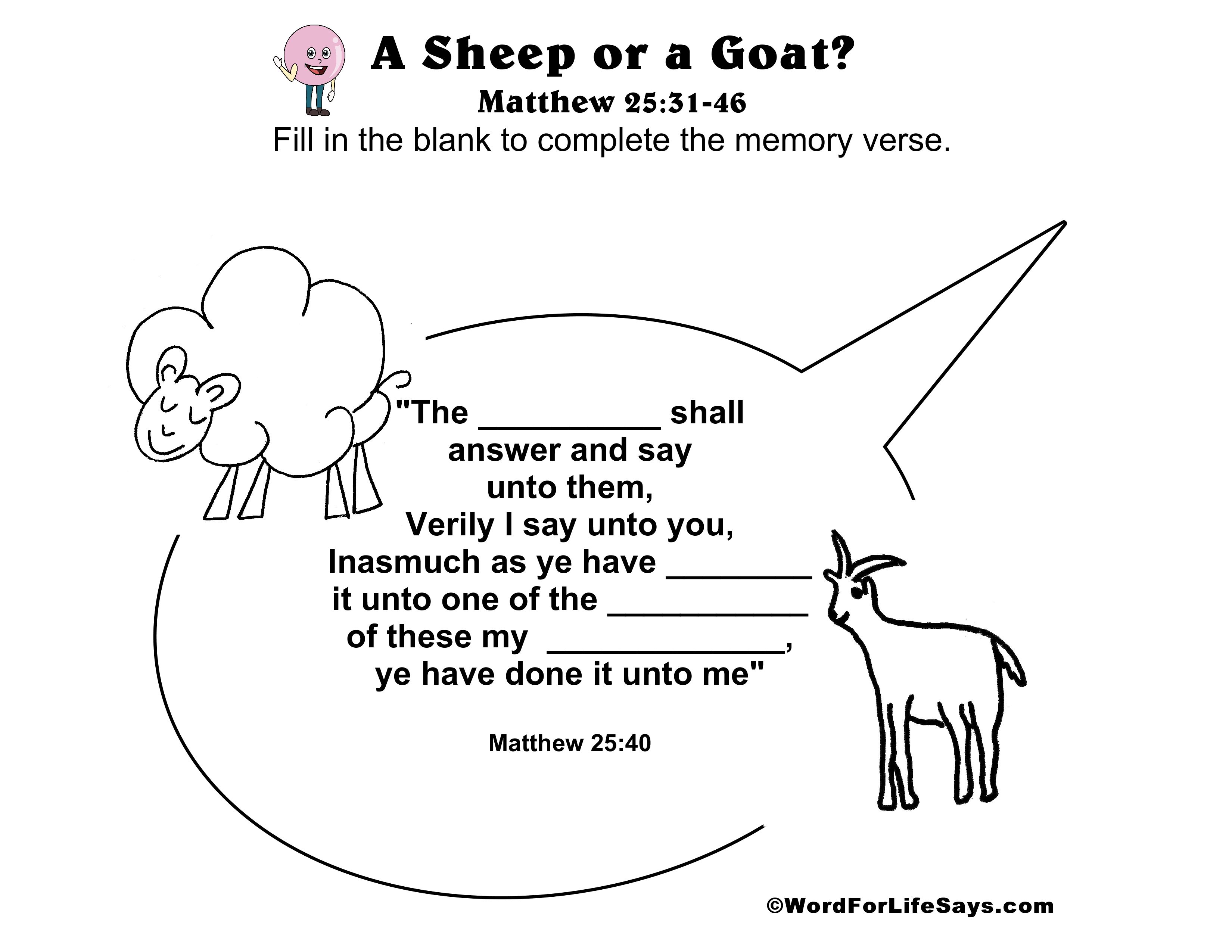
Memory Verse: A Sheep or a Goat Memory Verse

Kid’s Journal Page: Kid’s Journal Page – A Sheep or a Goat

Adult Journal Page: Adult Journal Page – A Sheep or a Goat

Word Search: A Sheep or a Goat Word Search  Answers: A Sheep or a Goat Word Search Answers

Crossword: A Sheep or a Goat Crossword  Answers: A Sheep or a Goat Crossword Answers

Word Scramble: A Sheep or a Goat Word Scramble  Answers: A Sheep or a Goat Word Scramble Answers

“Unto the Least of These” (Many activities including some for group participation and coloring page for younger students.  Enjoy!)

“The Sheep and Goats Coloring Page” (Older students)

“The Parable of the Sheep (and the Goats)” (Games, activities and even self-portraits with a twist.  A lovely idea.  Enjoy!)

“Sheep or Goats?” (Activities, group ideas, and more.  Enjoy!)

“Game: Sheep and Goats”

“Parable of the Sheep and the Goats Coloring Page”

“Retelling the Story of the Sheep and Goat with Felt” (What an interesting way to tell this popular story for little ones to understand and enjoy.)

“Sheep Storytime” (Here is a cute, little adorable, stand alone sheep that your students can make to accompany this week’s lesson.  Enjoy!)

“How to Draw a Goat” (Though we really want to focus on being sheep, your older students may enjoy to learn how to draw a goat, step by step.  This could be a great reminder of what not to be.  Enjoy!)

“I Can Follow Jesus by Helping Others Coloring Sheet”

“The Spiritual Discipline of Serving”


Sunday School Lesson – “Jesus’ Birth” Luke 2:8-20

VERSE DISCOVERY: Luke 2:8-20 (KJV, Public Domain)

Is there any time of the year that’s more special or rings with more sentiments than Christmas?  It stands out as iconic since the days of our youth.  It’s a time of year that’s separated from the rest.  Despite one’s belief, there is always a different feeling in the atmosphere during this time of the year.  People seem to be kinder and more patient with one another.  Many feel charitable and look at his fellow man with a more compassionate heart during this season.  This time of the year; this moment of celebration affects all.

Many are very familiar with the backdrop of this lesson.   Caesar Augustus had issued a decree for all the world to be taxed (Luke 2:1).  From there, families were to report to the place of their lineage to be accounted for.  Lineage played a key role in so many aspects of the Bible.  Even when it came time to “tax,” people had to line up and file in at the place of their birth or where their family hailed from.  One’s bloodline, one’s tribe were factors in their inheritance, land rights and so on.  These are matters that those who seek to tax would be greatly interested in.

Augustus thought in and of himself that he was responsible for sending families back to their “own city;” back to the place where their ancestors were from. When, in actuality, God was using him to line up everything according to His holy prophecies that were spoken through the years.  This is why, though to our eye’s times may seem troubling and hard to understand, yet we never know what God is doing behind the scenes.  The people may not understand the need to be forced into travel to undergo taxing, but God was lining them up for their greatest deliverance yet!

Joseph and Mary were not exempt and were forced, despite being far along in her pregnancy, to travel the approximately 90-mile journey from Nazareth to Bethlehem to participate in the taxing process.

While she was there it became time for her to deliver her firstborn child.  Luke 2:6-7 states, “And so it was, that, while they were there, the days were accomplished that she should be delivered.  And she brought forth her firstborn son, and wrapped him in swaddling clothes, and laid him in a manger; because there was no room for them in the inn.”

It is here we pick up in today’s lesson where the role of the shepherds came into play.  They show us the birth of our Savior, the Lord Jesus Christ, is not just a passing event.  Rather, it is a reason to stop and celebrate God and give Him all the glory that is due to His holy name.

Angelic Announcement to the Shepherds

Luke 2:8-9 “And there were in the same country shepherds abiding in the field, keeping watch over their flock by night.  And, lo, the angel of the Lord came upon them, and the glory of the Lord shone round about them: and they were sore afraid.”

“Shepherds” were considered some of the lowest of people during the Bible era.  Men who spent their time with animals roaming the fields to find pasture for their flocks.  Yet, on this night they were the first chosen to hear of this good news.  They were elevated above kings to receive the birth announcement of the King of kings.

Can you imagine being in that field on that night then suddenly light shining from what seems to nowhere appear with a glorious siting of “the angel of the Lord?”  In an era of no electricity, with only the light from the fire they sat around (if they were lucky enough to have one), an illumination of greater proportion appeared and made them “sore afraid.”  I think it’s safe to say, if it were me, I would have been just as “afraid” as they were.  It’s not an everyday occurrence to see the power of the Lord manifested in the siting of one of His “angels.” Who knows why he was here.  “Angels” have been long known as messengers from the Lord and here this one appears with the greatest revelation of all time; one that the “shepherds” are privileged to hear first.

Luke 2:10-12 “And the angel said unto them, Fear not: for, behold, I bring you good tidings of great joy which shall be to all people.  For unto you is born this day in the city of David a Saviour, which is Christ the Lord.  And this shall be a sign unto you; Ye shall find the babe wrapped in swaddling clothes, lying in a manger.”

In an effort to alleviate any trepidation the shepherds were feeling with encountering God’s angel, he spoke to them words that were meant to bring comfort and assurance.  He said, “Fear not” (a greeting that is meant to calm).

The appearance of these heavenly messengers can be a little much to take in.  When the one angel sat upon the stone that was rolled away from Jesus’ tomb the Bible tells us, “His countenance was like lightning, and his raiment white as snow: And for fear of him the keepers did shake, and became as dead men,” (Matthew 28:3-4).  One would need a certain measure of comfort in the presence of these awesome creatures.

“Behold, I bring you good tidings of great joy which shall be to all people.”  Here, the lowliest of the low; the shepherds that others despise and reject as not being noteworthy, receive the good news that “shall be to all people;” themselves included.

“For unto you is born this day in the city of David a Saviour, which is Christ the Lord.”  The message is, that long-awaited day has finally arrived!  The Jews felt the oppression of enemies for years.  They have listened to the prophecies passed down from generation to generation that spoke, “For unto us a child is born, unto us a son is given: and the government shall be upon his shoulder: and his name shall be called Wonderful, Counsellor, The mighty God, The everlasting Father, The Prince of Peace,” (Is. 9:6).  He that was spoken of has arrived in this lowly place, to a lowly people, to save them and be their Messiah.

The news could not get any better than this.  I imagine eyes misting over and a lonely tear streaking down the weather-worn cheek of these men to whom the angel spoke.  Oh, the joy of it all on that holy night!

“And this shall be a sign unto you; Ye shall find the babe wrapped in swaddling clothes, lying in a manger.”  So that no misrepresentation and no doubt can reside in the mind of these shepherds, the angel described in great detail who and what they should expect to find.  Just as our introduction described is how they would find this blessed “babe” when they came upon Him.  Surely, with the scene matching up with the description given upon their arrival to see the “babe” they would absolutely know that He is their “Saviour.”

Luke 2:13-14 “And suddenly there was with the angel a multitude of the heavenly host praising God, and saying, Glory to God in the highest, and on earth peace, good will toward men.”

As if the appearance of one angel with an awesome message wasn’t enough to seal the deal of belief with these shepherds, “a multitude of the heavenly host” appeared.  It was as if heaven could not hold back its rejoicing over the birth of the Savior.  Heaven peaked through into the earthly realm and these shepherds got to see them “get their praise on” as we would call it today.

They were saying, “Glory to God in the highest!”  I don’t think the words do the moment justice.  Yes, they were ascribing “glory to God” but I believe there was a tingling in the atmosphere that can’t be replicated with words.  I believe there was a charge of elation mixed with the power of God’s presence radiating through these “heavenly host” that can’t be described.  A time and place like no other that only these lowly shepherds got to witness on this holy night.  Awesome!

“And on earth peace.”  Sin has destroyed humanity’s “peace” with God.  The beloved creature that He formed and placed in the Garden of Eden; that He loved and treasured as His own, was now corrupt and subject to perish without holy intervention.  Romans 5:12 tells us, “Wherefore, as by one man sin entered into the world, and death by sin; and so death passed upon all men, for that all have sinned.”  Because of that, “peace” and reconciliation needed to be restored.

Romans 5:18 encourages us and says, “Therefore as by the offence of one judgment came upon all men to condemnation; even so by the righteousness of one the free gift came upon all men unto justification of life.”  “Gifts” are major for most this time of the year.  But, on this holy night, God gave the best “free gift” that would annihilate the effects of sin that destroyed the “peace” He intended for His creation.  Now, the “heavenly host” are rejoicing because they know the significance of this birth for all of humanity and the “earth.”  Through the “free gift” of His Son, God is showing the ultimate “good will toward men.”

Hasting to See the Babe

Luke 2:15-17 “And it came to pass, as the angels were gone away from them into heaven, the shepherds said one to another, Let us now go even unto Bethlehem, and see this thing which is come to pass, which the Lord hath made known unto us.  And they came with haste, and found Mary, and Joseph, and the babe lying in a manger.  And when they had seen it, they made known abroad the saying which was told them concerning this child.”

“Let us now go even unto Bethlehem, and see this thing which is come to pass.”  After the angels disappeared, the shepherds wasted no time in making up their mind to see “this thing which is come to pass.”  “Come to pass” means it has already happened.  They were speaking in terms of belief.  They hadn’t seen the “babe” as of yet, but through the words and rejoicing of the angels they believed that “which the Lord hath made known.”

What an awesome revelation both literally and nonliterally!  God showed up and showed out and sent His message, the birth announcement of His Son, to a field whose occupants seemed to the rest of the world counted unworthy.  With their newfound knowledge, they wasted no time in seeing with their own eyes that which was revealed to them so much so that the Bible tells us “they came with haste.”  Excitement propelled them forward and they “found Mary, and Joseph, and the babe” just as it was spoken to them.

“And when they had seen it, they made known abroad the saying which was told them concerning this child.”  They may have been the lowliest in the eyes of society.  They may have been counted out of many cliques and circles, but these dirt covered, smelled like the field and animals’ men became the first evangelist of the Lord Jesus Christ.  God had revealed something awesome to them.  Then, they saw the manifestation of it with their own eyes.  Their hearts were then burdened to make it “known abroad,” the same revelation that they received “concerning this child.”

Mary’s Pondering Heart

Luke 2:18-20 “And all they that heard it wondered at those things which were told them by the shepherds.  But Mary kept all these things, and pondered them in her heart.  And the shepherds returned, glorifying and praising God for all the things that they had heard and seen, as it was told unto them.”

“All they that heard it wondered at those things which were told them by the shepherds.”  The reaction of the people that heard the message of the shepherds was reactions of “wonder.”  They were simply amazed and in awe over the shepherds and the message they carried.  I believe that this type of “wonder” didn’t have any questioning to it.  Rather, they were just completely taken aback over the news and the excitement of the shepherds.

How a message is delivered also bears an impact on how the message is received by the hearers and judging by the enthusiasm of these lowly shepherds on that night, many had to be filled with total astonishment.  If the news could be believed, then the greatest miracle to ever be imposed on mankind has finally taken place; an extraordinary event like no other.  No wonder the shepherds couldn’t help but tell and express all they witnessed on this night.  The people had to see and feel that this news was a remarkable and outstanding experience.

“But Mary kept all these things, and pondered them in her heart.”  A mother’s heart works differently toward her child.  She’s the one to whom the angel showed up out of the blue one day and delivered the message that she would carry the Son of God in her own womb.  She’s the one who dealt with being ostracized and mistreated by those who thought the worse of her.  She’s the one that bore the babe in her womb for nine months dealing with all that comes with it.  She’s the one who lay up in a stable, if you will, and pushed forth this new, special life into the world.  Now, these shepherds show up and declare the glorious.  They show up and pay special attention and respect to her Son.  She holds in all in her “heart” and mind.

Surely, during this time her mind had to travel back to the day Gabriel approached her and told her, “The Holy Ghost shall come upon thee, and the power of the Highest shall overshadow thee: therefore also that holy thing which shall be born of thee shall be called the Son of God,” (Luke 1:35).  Thinking back to then and comparing the scene unfolding before her now must have given her pause to stop and consider all that has transpired (compare Luke 2:51).

What must have been going through her mind at the time, one can only imagine.  But, there in her “heart,” she held it all.  The moments; the memories; the miracle that she has been a part of – there in her “heart,” the wonder of it all rests.

“And the shepherds returned, glorifying and praising God for all the things that they had heard and seen, as it was told unto them.”  The “shepherds,” who were previously known for their care of the flocks, were now known for their praise.  When a miracle occurs on this level one can’t help but let a praise flow from their innermost being.  It should be a natural occurrence that when God blesses you to see a manifestation of His promise come to pass, praise should issue forth like an unstoppable river flow.

They “heard and seen” some amazing things on this night.  Things that many will never ever get to experience; things we can only read about and have faith in – they were eyewitnesses to it all!  They, with their own eyes and ears, physically saw our Lord Jesus Christ as a babe lying in a manger.  How AWESOME is that?!  The revelation given to them of the angel assured them that this was no ordinary babe.  The King of all heaven and earth lay before them.  They can’t keep that praise in!  They glorify God!  God is worthy!

They didn’t “return” the same way they left.  What they witnessed was too extraordinary to go back to life as usual.  They now had a praise that would not stop; one that had to be expressed to the fullest that God get the glory He deserves over this magnificent event.  Hallelujah!!!

PDF Printable Sunday School Lesson Pack (With easy to read instructions following the P.E.A.R.L. format on how to conduct each lesson with areas for adding personal notes): Sunday School Lesson – Jesus’ Birth

Suggested Activities:

Adult Journal Page: Adult Journal Page – My favorite part of the Christmas Story

Kid’s Journal Page: Kids Journal Page – My favorite part of the Christmas story

Draw the Scene: Jesus’ Birth Draw the Scene

Wordsearch: Jesus’ Birth Wordsearch  Answers: Jesus’ Birth Wordsearch Answers

Crossword: Jesus’ Birth Crossword  Answers: Jesus’ Birth Crossword Answers

Memory Verse: Jesus’ Birth Memory Verse

Baby Jesus Best Gift Craft: BABY JESUS GIFT CRAFT_2 (This craft will remind students of God’s best gift He gave us in Jesus Christ.  Enjoy!) – Use this PDF link for accurate printing. Simply print out, color, and cut.  Cut construction paper in half.  Glue tab for gift box and attach.  Next, glue baby Jesus under the gift box and close.  Last, attach the “God’s Best Gift!” label with glue.  And, there you have it.  When students open the “gift box” they can view God’s best gift: Jesus Christ. 


Sunday School Lesson – “Mary’s Song” Luke 1:39-56

VERSE DISCOVERY: Luke 1:39-56 (KJV, Public Domain)

The news that Mary received that she would be the carrier of God’s plan of salvation was phenomenal, to say the least.  One could even say that it all may have been a bit overwhelming.   After all, this would be the actual Son of God in her body and the angel Gabriel told her some pretty awesome stuff concerning Him.  Upon hearing it all and taking it in – she accepted the calling of God on her life and yielded, literally, her body as a sacrifice.

Still, one can imagine questions rolling around in her mind.  If our minds get blown away at the little special stuff God does for us here and there, I can’t help but think Mary may have been a little taken aback by the whole scene before her and the future that lay ahead.

Despite it all, Luke 1:38 tells us she acquiesced to the hand and plan of God, saying, “Behold the handmaid of the Lord; be it unto me according to thy word.”

Not once did she ever ask for a sign but as the scene of today’s lesson unfolds God gives her one.  Miraculously and mysteriously God peels back what people could not have known except by divine revelation and confirms not only the promise to her but His plan of salvation for the world.

 Elisabeth’s Confirming Praise

Luke 1:39-40 “And Mary arose in those days, and went into the hill country with haste, into a city of Juda; And entered into the house of Zacharias, and saluted Elisabeth.”

These verses pick up immediately after the angel Gabriel departed from speaking with Mary God’s plans and promise for her life and the life of the Child she was to carry.

But, before his departure, he encouraged Mary, noting, “For with God nothing shall be impossible,” (Luke 1:37) after telling Mary, “Behold, thy cousin Elisabeth, she hath also conceived a son in her old age: and this is the sixth month with her, who was called barren,” (Luke 1:36).  I can only imagine after all that was said and done, she remembered these blessed words and “arose in those days, and went into the hill country with haste, into a city of Juda.” 

Perhaps it was one of those “I just have to see Elisabeth” moments after all she heard.  Regardless of the reason, we do know that it was with “haste” that she was compelled to go.  Immediately, without hesitation, she wanted to be where Elisabeth was.  God was doing an unexpected thing in her life and she possibly wanted to connect with the other name Gabriel gave her concerning this great miracle.

So long ago, on a hill far away, Mary went.  It almost reads like a fairy tale, but the story herein is very true and worthy to be learned and appreciated for the intricacies of details God weaves through their lives and the history of our salvation, as well as to bring about His promise for mankind.

“And entered into the house of Zacharias, and saluted Elisabeth.”  Upon arriving at her destination at the house where Elisabeth dwelt with her now mute husband, Zacharias, Mary entered and greeted her according to custom.

Luke 1:41-45 “And it came to pass, that, when Elisabeth heard the salutation of Mary, the babe leaped in her womb; and Elisabeth was filled with the Holy Ghost: And she spake out with a loud voice, and said, Blessed art thou among women, and blessed is the fruit of thy womb.  And whence is this to me, that the mother of my Lord should come to me?  For, lo, as soon as the voice of thy salutation sounded in mine ears, the babe leaped in my womb for joy.  And blessed is she that believed: for there shall be a performance of those things which were told her from the Lord.”

The words of Mary’s greeting aren’t recorded, but the response by Elisabeth and what happens after is: “When Elisabeth heard the salutation of Mary, the babe leaped in her womb.”  When Mary’s greeting reached the ears of her cousin, God phenomenally made His way known during what seemed to be a very normal and customary interaction between two people.

Something moved in Elisabeth at the hearing of the voice of Mary; and not just the baby inside of her (Although as noted in the lesson he “leaped” and reacted to hearing her voice as well.  See note below).  Mary’s voice connected with her innermost being by the moving of God’s Spirit, hence we see her at this very time being “filled with the Holy Ghost.” 

Please Note: Babies in a womb have an amazing connection to their own mother’s voice and maybe even dads.  But rarely will they react as energetically to a voice they have never heard.  This makes the baby’s reaction all the more powerful and a reason to take note.  The baby, later known as John the Baptist, was filled with the Holy Ghost at this time fulfilling a promise as well (see Luke 1:15).  God used an unborn child to spiritually testify of the work He was doing.  Awesome!

Can I give you something to try to associate this feeling with?  Imagine someone knocking on your door one day to give you the best news possible.  Maybe you are one of those famous sweepstakes winners and all your financial needs will be forever taken care of.  Or, perhaps someone announced that you are a long-lost relative of someone who has left you an extraordinary inheritance.  Maybe that knock brings a lost love home again for which the joy felt cannot be measured in dollars and cents.  Any of these events would have us in joyful tears and simply awestruck at what is happening.  I can imagine the same (although many, many times more),  “I can’t believe it!” joy was felt by Elisabeth at the sound of sweet Mary’s voice.

Mary and Elisabeth were no longer just cousins of the flesh but they were sisters in the Spirit because God was working mightily through both.

Continuing to be moved by the Spirit of God, Elisabeth’s voice rang out in exuberant praise, declaring, “Blessed art thou among women, and blessed is the fruit of thy womb.”  When Gabriel appeared to Mary, he too used words like “highly favoured” and called her “blessed” (Luke 1:28).  Her life would become extraordinarily different from women everywhere and in every era.  There wasn’t then, and would never be, another woman like her in the entire world or the world’s history who was called to do what she did.  She was “blessed.”  And Elisabeth’s declaration: “blessed is the fruit of thy womb,” (even though Mary was nowhere near showing at this time to give the outward appearance of pregnancy) means that she [Elisabeth] was speaking directly about the miracle that God has performed in her [Mary’s] life.

In an age where instant notifications, emails, text messaging, social media, and the like didn’t exist, as quickly as these events unfolded there appears to be no prior knowledge of Mary’s pregnant condition before the infilling of the Holy Ghost.  God revealed this to Elisabeth and Elisabeth sang out in praise declaring how special she [Mary] is because of the babe [the fruit of the womb] inside of her.

Still awestruck at the greatness of all transpiring before her, Elisabeth continues, saying, “Whence is this to me, that the mother of my Lord should come to me?”  Immediately, without any questioning of detail or such, she knew that Mary was the “mother of my Lord.”  What a declaration for Mary to hear!  Very shortly, when word got out about her pregnancy, she would hear, I’m sure what I assume to be a myriad of hateful and hurtful remarks.  But for now, I can imagine Mary letting Elisabeth’s words wrap around her as a warm hug confirming what God is doing in her life.

Elisabeth continues to tell Mary about the reaction of her own baby at the hearing of her voice: “Lo, as soon as the voice of thy salutation sounded in mine ears, the babe leaped in my womb for joy.”  Inspired by the Spirit of God, Elisabeth not only felt the baby physically leap but inwardly she knew the reason was for “joy.”  The forerunner of Christ was already getting happy and testifying to the greatness that was to come through Him.

Ringing out these Holy Ghost-inspired words, Elisabeth continues to say, “Blessed is she that believes.”  That’s a powerful statement.  It not only testifies to Mary’s confident acceptance of what God was doing through her but it also shows how much faith must play a key role in anything God calls anyone to do.  Hebrews 11:1 reminds us, “Now faith is the substance of things hoped for, the evidence of things not seen.”  One’s faith is important for without it we are told it is impossible to please God (see Hebrews 11:6).  As scary as this situation was for Mary, she got on board with God’s plan without knowing everything that would unfold in her future.

Because of that, “there shall be a performance of those things which were told her from the Lord.”  Mary accepted in faith, and Elisabeth declared that God was moving on her behalf.  God has never failed to follow through with His promises.  He speaks them.  Here it is confirmed.  And, it shall come to pass.  Other areas of the Bible remind us of this great truth, saying, “For I am the LORD: I will speak, and the word that I shall speak shall come to pass…” (Ezekiel 12:25; see also Psalm 111:7).

In response, Mary’s soul joins in with rejoicing!

Mary’s Song of Rejoicing

Luke 1:46-47 “And Mary said, My soul doth magnify the Lord, And my spirit hath rejoiced in God my Saviour.”

“My soul doth magnify the Lord.”  What God revealed to her through Gabriel and confirmed through Elisabeth is nothing short of AWESOME!  It goes beyond the concept of human thinking and understanding and takes you to a realm of the way He thinks and operates.  It beckons one to step out into the unknown with a life and a heart of complete trust.

How else is Mary to respond except to say, “My soul doth magnify the Lord?”  God was about a great work (as He always is).  For centuries they have longed for the promise of the Messiah to be fulfilled.  Generations have laid up their hopes in store for this great day.  Mary’s soul can’t help but praise God.  She knew before anyone else that God was ready to do a great kingdom shift.  She is rejoicing because the time is finally at hand for the long-awaited promise to come to pass and she is to be personally involved.

Thus, she was moved to “magnify the Lord.”  We use the word “magnify” to mean “to enlarge.”  We can’t make God bigger than He already is.  1 Kings 8:27 declares, “The heaven of heavens cannot contain thee.”  But we can exalt and praise Him – we can lift His name up at the joy of what He is doing in the lives of His people.  We can make our praise of Him grow and grow until it affects the lives of those around us.  Through our worship, we can’t help but enlarge His territory and gain spiritual ground in the lives of those who witness what God is doing in us.

When was the last time you can honestly say, “My soul doth magnify the Lord?”  When was the last time you felt a shift in your spirit to move into the realm of praise over the greatness of God in your life?  Mary was at her cousin’s house when she rang out with this hymn, rejoicing.  You can feel the Spirit of God move you to worship anywhere!  You don’t have to wait until Sunday morning service!  Let your soul “magnify” Him now!  That’s why she continued, and said, “My spirit hath rejoiced in God my Saviour.”

“God my Saviour.”  This is all about Him and what He is doing.  Man cannot save himself.  Man does not have the means to secure permanent deliverance from sin for himself.  Try as he might, it just won’t work.

But, God…

Her people were under the tyranny of Herod and whoever else decided to put their hands in the pot of affliction over them.  Worse than that, despite laws and sacrifices, the tyranny of sin still permeated the world and had mankind shackled in its bonds.

But, God…

Mary can “rejoice!”  There is hope for her.  There is hope for her people.  There is hope for the world.  “God my Saviour” is ready to let loose His plan of deliverance once and for all!  Titus 3:4-5a says, “But after that the kindness and love of God our Saviour toward man appeared, Not by works of righteousness which we have done, but according to his mercy he saved us…” Rejoice!  “God my Saviour” had and has a plan to “save us!”

Luke 1:48-50 “For he hath regarded the low estate of his handmaiden: for, behold, from henceforth all generations shall call me blessed.  For he that is mighty hath done to me great things; and holy is his name.  And his mercy is on them that fear him from generation to generation.”

“For he hath regarded the low estate of his handmaiden.”  Who are you to those who see you every day?  Are you known as mom or dad, sister or brother?  Are you just that church member who sits at the end of pew five from the front?  Or, are you just that neighbor down the street?  Who are you to those at work or to those who see you drop off the kids at school?  How do people identify you?  Are you just a passing thought to most or do people “regard” you?  Do people take notice of you and your life?

Mary, when she woke up that morning before Gabriel spoke to her, she just saw herself as Mary; nothing more, nothing less.  She was just one in a group of young women who lived in her town of Nazareth.  Yet, the whole time God “regarded” her.  God had His eyes on her for something bigger and better in life and she didn’t even know it.  “He hath regarded the low estate of his handmaiden.”  In a spirit of humility, she may have viewed herself as nobody and her humble surroundings would suggest it as well, but she was somebody God paid attention to.

“From henceforth all generations shall call me blessed.”  God is big on remembering those who submit in obedience to His will and allow themselves to be used by Him.  “He is a rewarder of them that diligently seek him,” (Heb. 11:6).  Jesus told His disciples one day after Mary (not the Mary from today’s lesson) anoints Him with the oil from the alabaster box, “Wheresoever this gospel shall be preached throughout the whole world, this also that she hath done shall be spoken of for a memorial of her” (Mat. 26:13).  People are going to remember her.

With the Mary of today’s lesson, the one that would bear the Son of God, people are going to do more than just remember her, they “shall call me blessed.”  She will forever be linked to the greatest miracle God has ever done and considered “blessed” to be a part of it.

“For he that is mighty hath done to me great things; and holy is his name.”  How often has God moved in the life of one to bless and bring about “great things” to only have them take credit for it or attribute it to another?  Mary didn’t do that.  She recognized that God is the “mighty” One and that He was the One performing these “great things” in her life.  1 Samuel reminds us, “For them that honour me I will honour,” (2:30).  She honored God and attributed glory to His name for His mighty hand in her life.

“Holy is his name.”  Mary is rolling out this beautiful hymn of what God is doing, and in the middle, she takes as we call it today, a praise break!  At least, this is how I viewed it.  God has overwhelmed her, in a good way, and she can’t help but stop and declare, “Holy is his name!”

God is unique in who He is and in how He does things.  After God delivered the children of Israel from Pharaoh and his chariots at the Red Sea, Moses and the children of Israel sang a song, Exodus 15:1.  In that song, they also recognized the holiness of God.  They sang, “Who is like unto thee, O LORD, among the gods? who is like thee, glorious in holiness, fearful in praises, doing wonders?” (15:11).  This is the same heart of song that Mary rejoices with in today’s lesson when she pronounces “Holy is his name!”  Psalm 99:3 declares, “Let them praise thy great and terrible name; for it is holy.”

When God moves in your life; when He does the impossible, if at no other time, one should especially recognize His holiness, power, and uniqueness through it all and praise Him for it!

“And his mercy is on them that fear him from generation to generation.”  I have a lot of favorite psalms but by far one of my top favorites is Psalm 118.  This is one I cling to and often go back to for times when I need encouragement.  It starts by giving a brief history of the goodness of God in the life of His people because “his mercy endureth forever.”  Then, this beautiful psalm moves to an even more beautiful declaration of God’s promises for those who place their trust in Him.  There is not a verse in this Psalm that I don’t like.  It even ends with another, “For his mercy endureth for ever,” (Ps. 118:29).

Mary recognized God’s hand of mercy over “them that fear him from generation to generation.”  Psalm 103:17 also states, “But the mercy of the LORD is from everlasting to everlasting upon them that fear him, and his righteousness unto children’s children.”  Both verses express the unending mercy of God.

God promised David through Nathan the prophet, speaking of his descendants, saying, “I will be his father, and he shall be my son.  If he commit iniquity, I will chasten him with the rod of men, and with the stripes of the children of men: But my mercy shall not depart away from him, as I took it from Saul, whom I put away before thee,” (2 Sam. 7:14-15).

Mary saw God’s promise to David and that His mercy was still at work to “them that fear him.”  Proverbs 1:7 says, “The fear of the LORD is the beginning of knowledge,” (see also Pro. 9:10-11).  Time did not erase the promises of God.  Though they have waited, and at times the wait may have made it seem the Messiah wasn’t coming, God’s mercy was working it out from “generation to generation.”

Luke 1:51-53 “He hath shewed strength with his arm; he hath scattered the proud in the imagination of their hearts.  He hath put down the mighty from their seats, and exalted them of low degree.  He hath filled the hungry with good things; and the rich he hath sent empty away.”

“He hath shewed strength with his arm.”  When God has a plan, He shows up in the full strength of His power to accomplish it.  God is omnipotent.  There is nothing that He can’t do.  There is none who can subdue or usurp His power.  That’s why we are encouraged to, “Seek the LORD and his strength, seek his face continually,” (1 Chron. 16:11) because God’s strength is unmatched in power and authority.

In His strength, He “scattered the proud in the imagination of their hearts… he put down the mighty from their seats… the rich he hath sent empty away.”  He made them broke, busted, and disgusted!  Those that should have had no lack; those that should have been top of their game; God humbled them and removed them.  Why?  Because they lived in relying on their own power and ability.  They lived a life of pride; a life in opposition to God.  Therefore, “God resisteth the proud, but giveth grace unto the humble.” (James 4:6).

God flips the script, and He “exalted them of low degree” and “He hath filled the hungry with good things…”   God lifts up and blesses the lowly of this world such as His people Israel.  “Though the LORD be high, yet hath he respect unto the lowly,” (Ps. 138:6).  It was the lowly, the unassuming, and the unexpected course that God would use to usher in the reign of the Messiah.  From the choosing of a young woman from Nazareth to His lowly birth and being “laid… in a manager,” (Lk. 2:7); all was done without pomp and circumstance to bring forth the Savior of the world.

Luke 1:54-55 “He hath holpen his servant Israel, in remembrance of his mercy; As he spake to our fathers, to Abraham, and to his seed for ever.”

“He hath holpen his servant Israel.”  God has been a constant source for His people “Israel.”  They were a people of promise.  They were a people who would be an example to other nations (Deut. 4:6-8).  They were a people through whom we would be blessed also: “And the scripture, foreseeing that God would justify the heathen through faith, preached before the gospel unto Abraham, saying, In thee shall all nations be blessed,” (Gal. 3:8, see also Luke 1:55 (today’s lesson); Gen. 12:3).  He remembered “his mercy” despite their failings and short-comings.  God has helped Israel and stood by Israel’s side so they can become the people they were called to be.

Luke 1:56 “And Mary abode with her about three months, and returned to her own house.”

Mary, we are assuming, stayed with Elisabeth until the time came for her to give birth to baby John.  Gabriel came to her in the sixth month (Luke 1:26), and here we are told she “abode with her about three months” which would equal the normal time for pregnancy to be completed.  Then, she “returned to her own house.”  After which, verse 57 (not in today’s lesson), tells us of the birth of John.

PDF Printable Sunday School Lesson Pack (With easy to read instructions following the P.E.A.R.L. format on how to conduct each lesson with areas for adding personal notes): Sunday School Lesson – Mary’s Song

Suggested Activities:

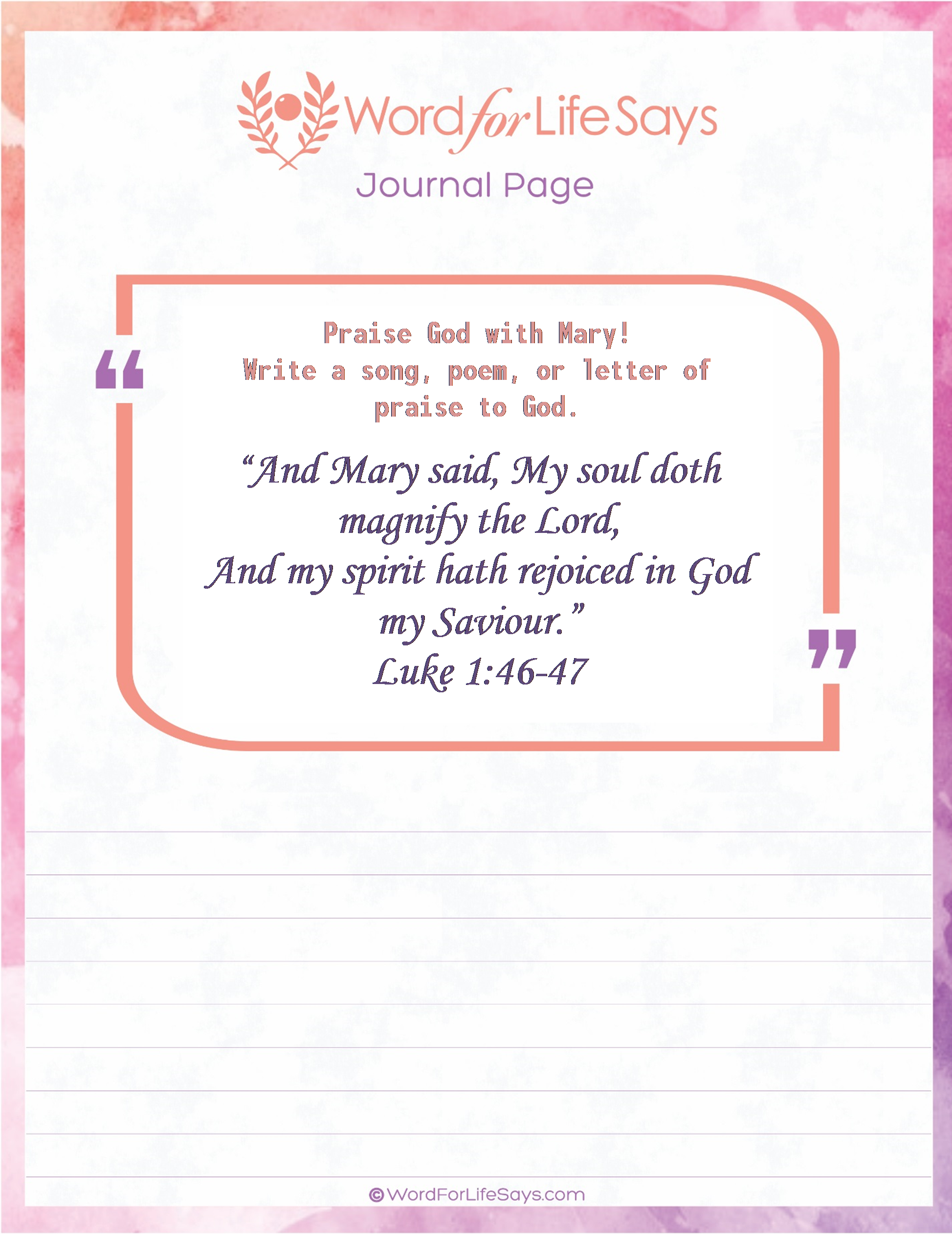
Adult Journal Page: Adult Journal Page – Mary’s Song

Kid’s Journal Page: Kid’s Journal Page – Mary’s Song

Blank Journal Pages to fill in for your own ideas: 2 journal pages

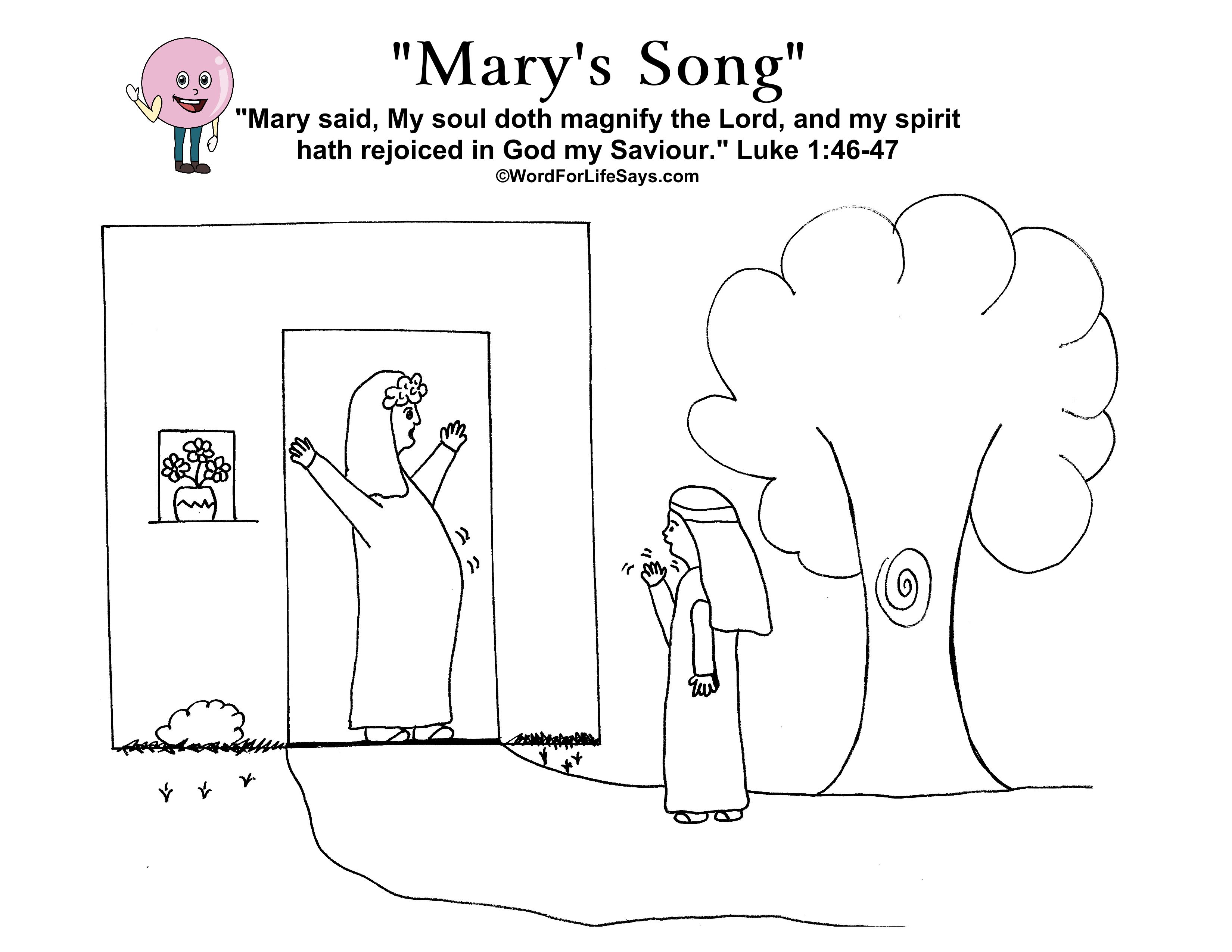
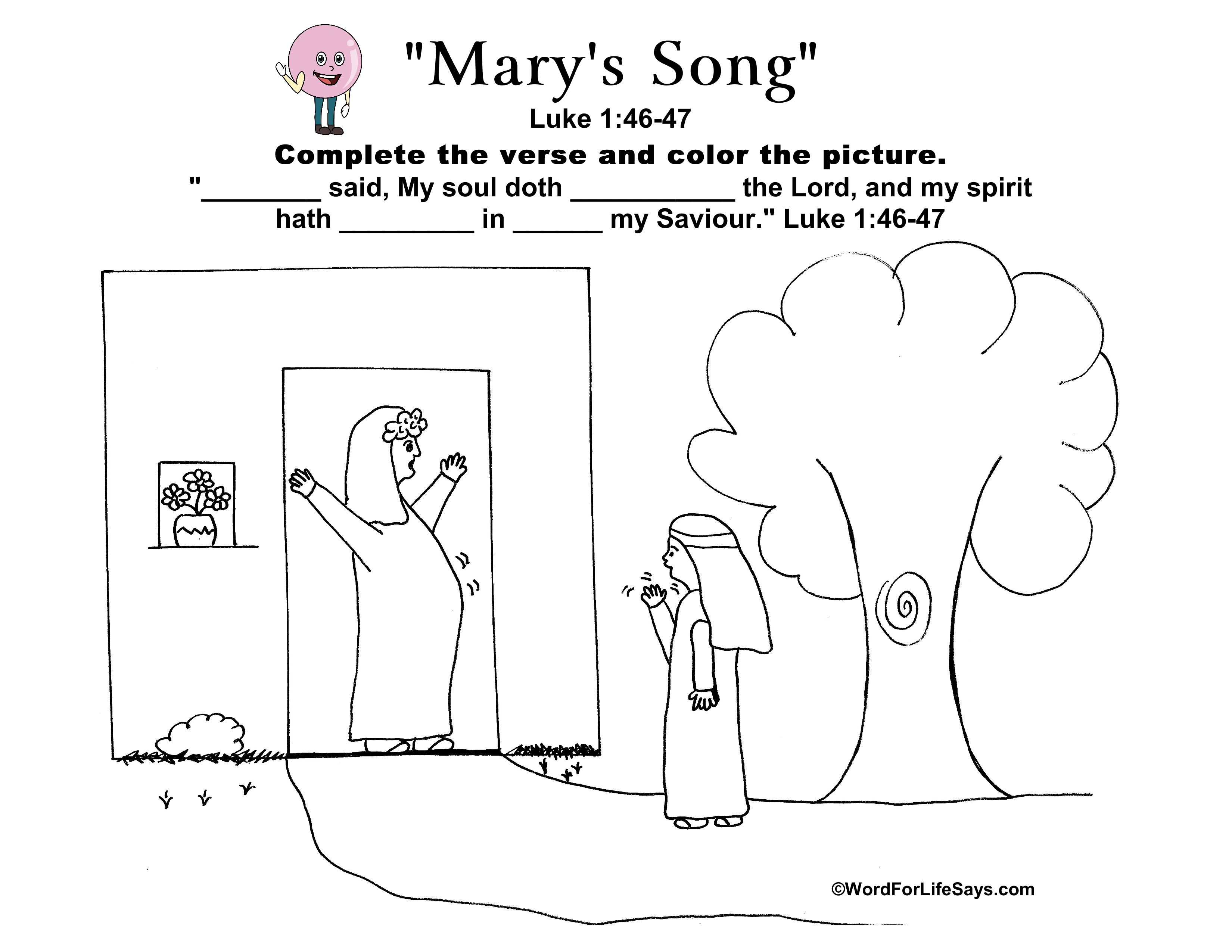
Coloring Page: Mary’s Song Coloring Page

Memory Verse: Mary’s Song Memory Verse

Word Search: Mary’s Song Word Search  Answers: Mary’s Song Word Search Answers

Crossword: Mary’s Song Crossword  Answers: Mary’s Song Crossword Answers

Word Scramble: Mary’s Song Word Scramble  Answers: Mary’s Song Word Scramble Answers

“My soul doth magnify the Lord.” Using a magnifying glass, allow students to look at small things in a new way. What details can they see they have seen before? Mary used her heart and her voice to magnify God. God was doing a new thing, and it was something to get excited about.

Craft Idea: This time of the year we are doing a lot of singing right along with Mary.  We are magnifying God in the Christmas songs that we sing.  What better way to Magnify God than to sing of the birth of His Son.  Children can put together their own personal songbooks filled with the blessed melodies of the season.  A great addition to that would be to put together candle crafts that they may hold while singing to the glory of God.  The ideas are limitless in helping our students worship during this Christmas season.